Monrovia and Pasadena, written for buyers, for Google, and for the AI assistants people now ask first. Here's what went into them, where everything lives, and the three little things we still need from you.
Each guide is a hub. Every blog post is a spoke that goes deeper on one part of a guide and links straight back to it. Every post then goes out on social. Everything points home to Jennifer's site, and the two guides point at each other where buyers compare cities.
Everything, connectedBoth guides, 12 months of posts and social
WebsiteGuide (the hub)Guide sectionBlog postExtra postSocial channel
Drag the dots. Hover one to light up everything it connects to; click a guide or section to jump there. “Up to 3 a month” adds the extra posts that are already planned and ready to swap in (5 for Monrovia, 8 for Pasadena).
What went into it
Not a one-prompt article.
165review notes, questions and tasks, every one answered and logged
52editorial rules the guides now follow, from plain words to fair housing
177links to official sources, checked one by one
0stock photos. Every painting, map and chart is original
4narrated videos and audio summaries, with transcripts and captions
2printable pre-offer checklists with Jennifer's name on them
The full story (who checked what, when, and every change) is in each city's Provenance record.
Speaking the language
What the little tags mean.
On each guide, flip on Expertise X-ray and numbered notes appear in the margin. Each one is tagged with what it helps.
SEO Search engine optimization: showing up in Google's regular results.
AEO (ChatGPT, Claude) Answer engine optimization: being the answer AI assistants like ChatGPT and Claude give, and Google's AI Overviews.
GEO (AI citations) Generative engine optimization: getting cited as a source inside AI-written answers from ChatGPT, Claude, Perplexity and Google AI Overviews.
Local SEO (Google Maps) Showing up in the map results when someone searches for an agent near them.
Schema Labels for search engines: a block of code at the bottom of the page that says what each part is (a question, an answer, an author, a video). It doesn't change what readers see.
E-E-A-T Experience, Expertise, Authority and Trust: how Google's reviewers judge whether to believe a page.
HTML5 Custom visuals built from live web text, not pictures: search engines can read every word.
Local expertise Rules and facts specific to one city that generic real estate sites skip. They show the page was written by someone who works there.
Jennifer's SEO class list
Your SEO checklist, mapped
Every item from Jennifer’s SEO class list, and where it’s handled. Turn on Expertise X-ray on either guide to see each feature called out.
On this pageStructured data (labels for search engines): author, article, FAQ, video, audio, breadcrumbs, neighborhoodsReady-to-paste code for each guide. It identifies Jennifer as a licensed agent and reuses her site’s existing author record if there is one, so search engines see one Jennifer.
At launchReview of the site-wide schema and service-area coverageWe check the live author and brokerage records and add the service areas.
On this pageSemantic HTML and descriptive headingsOne H1, a logical H2/H3 tree, real lists and tables, and graphics built in HTML5.
At launchHomepage H1 and heading structureReviewed site-wide after launch.
On this pagePlain-language labelsHeadings name what buyers recognize: schools, commute, fire zones.
On this pageName, service areas and ZIP codes in crawlable copyCity names, ZIP codes and Jennifer’s name appear as text, not images.
On this pageInternal linksJump links from the neighborhood graphic, cross-links between the two guides, and a link to the specializations page.
Built inMobile speed and Core Web VitalsWebP images, lazy loading, set image sizes, no JavaScript in the graphics. Tested again after launch.
At launchCanonical URLs and redirectsEvery changed path mapped and checked.
At launchXML sitemap and Search ConsoleSubmitted and verified in Jennifer’s own Search Console property.
At launchrobots.txt and indexing settingsPreview noindex removed at go-live and verified.
Needs JenniferConsistent NAP (name, address, phone)We’ll use the exact approved format everywhere.
Needs JenniferAd pixels (Meta, LinkedIn, Google)Added once she shares the tag IDs.
On this pageImage alt text and file namesEvery image is described, and file names are descriptive.
On this pageAEO (ChatGPT, Claude): answer-first quick answer, FAQ, glossary, Speakable markupWritten so ChatGPT, Claude, Google’s AI Overviews and voice assistants can quote it directly.
On this pageGEO (AI citations): cited sources, dated statistics, methodology, firsthand quotesQuotes need Jennifer’s answers to the pre-written questions.
Needs JenniferLocal SEO (Google Maps): consistent name, address and phone, service-area placesMatches her Google Business Profile once she confirms the exact listing.
Needs JenniferE-E-A-T: byline, bio, credentialsConfirm DRE number, years of experience and certifications.
On this pageFair housing compliancePlaces are described by homes and features, never by people.
On this pageFreshness“Last updated” date, live listings and market stats, and a quarterly fact review.
Where to look
Three tabs per city. That's it.
01
Guide
The page as buyers will see it. Flip on Expertise X-ray to see what each piece does for Google and AI search.
Three things only Jennifer (and her site) can add.
1
Her quotes
22 short questions are waiting in the guides (9 Monrovia, 13 Pasadena). One relaxed 30-minute call covers all of them, and doubles as video clips for social.
2
Listings
13 live listing spots are placed and ready. They fill in once her IDX feed is connected, filtered to each city's real boundaries.
3
Market stats
8 live market modules switch on with the data feed and keep themselves current, dated and sourced.
Plus a quick fact check: 19 items in Monrovia and 21 in Pasadena are tagged for Jennifer to confirm. Each one says exactly what to check and with whom.
The next 12 months
The guides go live. Then they keep growing.
Two posts a month per city, November through October, timed to when buyers actually search: tax bills, school enrollment, insurance renewals, the Rose Parade. Each post links into the guide, each guide section links back out, and every post gets a share card, a clip and a Google Business Profile post.
Prepared by Virtual Results for Jennifer Perich, REALTOR®, HomeSmart Evergreen Realty · Preview only. Not yet published.
Preview built for review. On Jennifer's site, each module appears in her own page design, without the numbered notes. Turn on Expertise X-ray to see what each part does. Copying is turned off on this preview.
Site preview · Monrovia
Buying a Home in Monrovia, CA: Neighborhoods, Schools & Commute
Searchbuying a home in monrovia ca
By Jennifer Perich, REALTOR®, HomeSmart Evergreen Realty, DRE #01331183 · Last updated [Month Year]
What you read
By Jennifer Perich, REALTOR®, HomeSmart Evergreen Realty, DRE #01331183 · Last updated [Month Year]
The byline you read, and the same facts labeled for search engines: who wrote it, her license, her brokerage and the last-updated date.
Image Original hand-painted illustration, animated. Alt text (read by search engines and screen readers): "Illustration of Old Town Monrovia, CA storefronts at dusk with the San Gabriel Mountains behind"
Quick answer: What should you know before buying a home in Monrovia?
Buying a home in Monrovia, CA usually means choosing among four very different settings:
A hillside home with mountain views in the Gold Hills area
A Craftsman or Spanish Revival home in the North Monrovia foothills
A walkable bungalow, condo, or small income property near Old Town's Myrtle Avenue
A mid-century ranch in South Monrovia near the Metro A Line station
Single-family homes in Monrovia typically sell from about $750,000 to more than $2 million, and as of [Month] 2026 the citywide median is around $1 million to $1.1 million.
Before you commit, check five things:
Whether the address is in the city or in unincorporated LA County
Which school district serves it
The fire hazard zone and how much insurance will cost
The home's historic status
Its permit history, and whether any ADU (accessory dwelling unit, a backyard or attached second home) was permitted
Listen: Monrovia buyer guide in 2 minutes (AI-narrated summary)Read the transcript
This is a short audio summary of the Monrovia, California home buyer's guide from Jennifer Perich, REALTOR with HomeSmart Evergreen Realty. It's AI-narrated, and the full guide has the details and sources.
Monrovia sits at the foot of the San Gabriel Mountains, about eight miles east of Pasadena. It has a walkable Old Town on Myrtle Avenue, a Metro A Line station, and trails that start minutes from home. Single-family homes typically sell from about seven hundred fifty thousand dollars to more than two million.
Think of the city in four bands, from the mountains down to the train. Gold Hills, in the northern foothills, has larger custom homes and views. North Monrovia has Craftsman, Spanish Revival and Victorian homes, many of them historic landmarks. The Old Town area mixes bungalows, condos and small income properties. And South Monrovia, below the 210, has mid-century ranch homes on flatter lots near Station Square.
Before you write an offer, check five things. First, whether the address is really in the City of Monrovia. Mayflower Village and South Monrovia Island are unincorporated county areas with Monrovia addresses. Second, the school district for that exact address. Most homes are in Monrovia Unified, but some are in Duarte or El Monte districts, and Santa Fe Middle School merges into Clifton starting this school year. Third, the fire hazard zone. The 2025 state maps added about fifteen hundred Monrovia properties to the Very High zone. Fourth, insurance. Get real quotes during your inspection period. And fifth, historic status and permit history, because landmark rules and unpermitted work are the costliest surprises.
Commuting is easy. Trains run about every eight minutes at peak, and it's roughly fifteen to twenty minutes to Old Pasadena and about forty to Union Station.
There's no city transfer tax, and you should plan for property taxes of roughly one point one to one point two five percent of the price, plus a supplemental bill after closing.
For the full guide, live listings and Jennifer's local advice, visit her website.
What you read
Quick answer: What should you know before buying a home in Monrovia? Buying a home in Monrovia, CA usually means…
This code sits in its own block at the bottom of the page. It doesn’t change what you see; it tells search engines what each part is.
Monrovia market snapshot Monrovia (city): median sale price, median $/sq ft, days on market, sale-to-list ratio, active listings
As of [month, year] · Updated automatically · Sources: CRMLS, ATTOM, NAR, realtor.com
Median priceLive
$ / sq ftLive
Days on marketLive
Sale-to-listLive
Market statistics on this page come from third-party data sources, which may include CRMLS, ATTOM, the National Association of REALTORS® and realtor.com. Data is deemed reliable but not guaranteed and is current as of the date shown.
Monrovia at a glance
County
Los Angeles County
ZIP codes
91016. Some 91016 and 91006 addresses are in unincorporated LA County (Mayflower Village, South Monrovia Island)
Population
About 39,100 (CA Department of Finance, January 2026)
Founded / incorporated
Founded 1886; incorporated 1887, the fourth-oldest city in LA County
Size
About 13.7 square miles
Distance
About 8 miles east of Pasadena; about 20 miles northeast of downtown LA
Main public school district
Monrovia Unified School District (MUSD)
Rail
Monrovia Station, Metro A Line (Long Beach ↔︎ Pomona)
Freeways
I-210; I-605 begins just to the east
City transfer tax
None. Only the LA County documentary transfer tax ($1.10 per $1,000) applies
Historic landmarks
About 160 designated landmarks and a Mills Act program
Signature weekly event
Friday Night Street Fair on Myrtle Avenue
Figures as of 2026. Sources: California Department of Finance (population), U.S. Census Bureau (land area), City of Monrovia (historic landmarks and Mills Act program).
Monrovia sits at the base of the San Gabriel Mountains in Los Angeles County's San Gabriel Valley. It has a historic downtown, a Metro light rail stop, and canyon trails that start minutes from residential streets.
That mix is the draw, and it's also the challenge. Two homes three miles apart can differ in age, lot size, fire risk, school assignment, and even which government approves your remodel. This guide is written by Monrovia buyer's agent Jennifer Perich, who has walked buyers through each of those differences. This guide covers what buyers should know: how the main neighborhoods compare, which schools serve the city, how commuting works, what types of homes you'll find, and which California-specific issues deserve a close look before you write an offer.
In this guide, you'll learn:
How Gold Hills, the North Monrovia foothills, the Old Town area, and South Monrovia compare
Why a Monrovia mailing address doesn't always mean the City of Monrovia or Monrovia Unified
What changed in Monrovia schools in 2026
How the 2025 fire hazard maps, Zone 0, and California's insurance market affect buyers here
What Monrovia allows for ADUs, SB 9 lot splits, and historic homes
What is it like to live in Monrovia, CA?
Monrovia feels like a small city with a strong sense of place. About 39,000 people live here. That's big enough for a real downtown and small enough that Old Town still works as the community's shared living room. Every Friday night, Myrtle Avenue fills with the street fair and farmers market.
The mountains shape daily life. From much of the city, the San Gabriels fill the northern skyline. In the northern neighborhoods, trailheads into Monrovia Canyon Park and the Hillside Wilderness Preserve are close to home. Summers run hot and dry, as in most of the inland San Gabriel Valley, and that climate makes wildfire planning part of homeownership here.
Monrovia also has a clear historic identity. The town was founded in 1886, when early lots sold on the condition that buyers build homes worth at least $2,000. It incorporated in 1887. Today the city has about 160 designated historic landmarks, and many listings highlight original Craftsman details, Victorian homes, and early Spanish Revival houses. You'll find newer construction too, especially around Station Square, but much of the housing predates World War II or comes from the postwar building boom.
The short version: Monrovia combines a historic, walkable core with foothill living and regional rail access. The tradeoff is real variation from block to block, so neighborhood-level research matters more here than citywide averages.
Monrovia neighborhoods compared: where each type of buyer tends to look
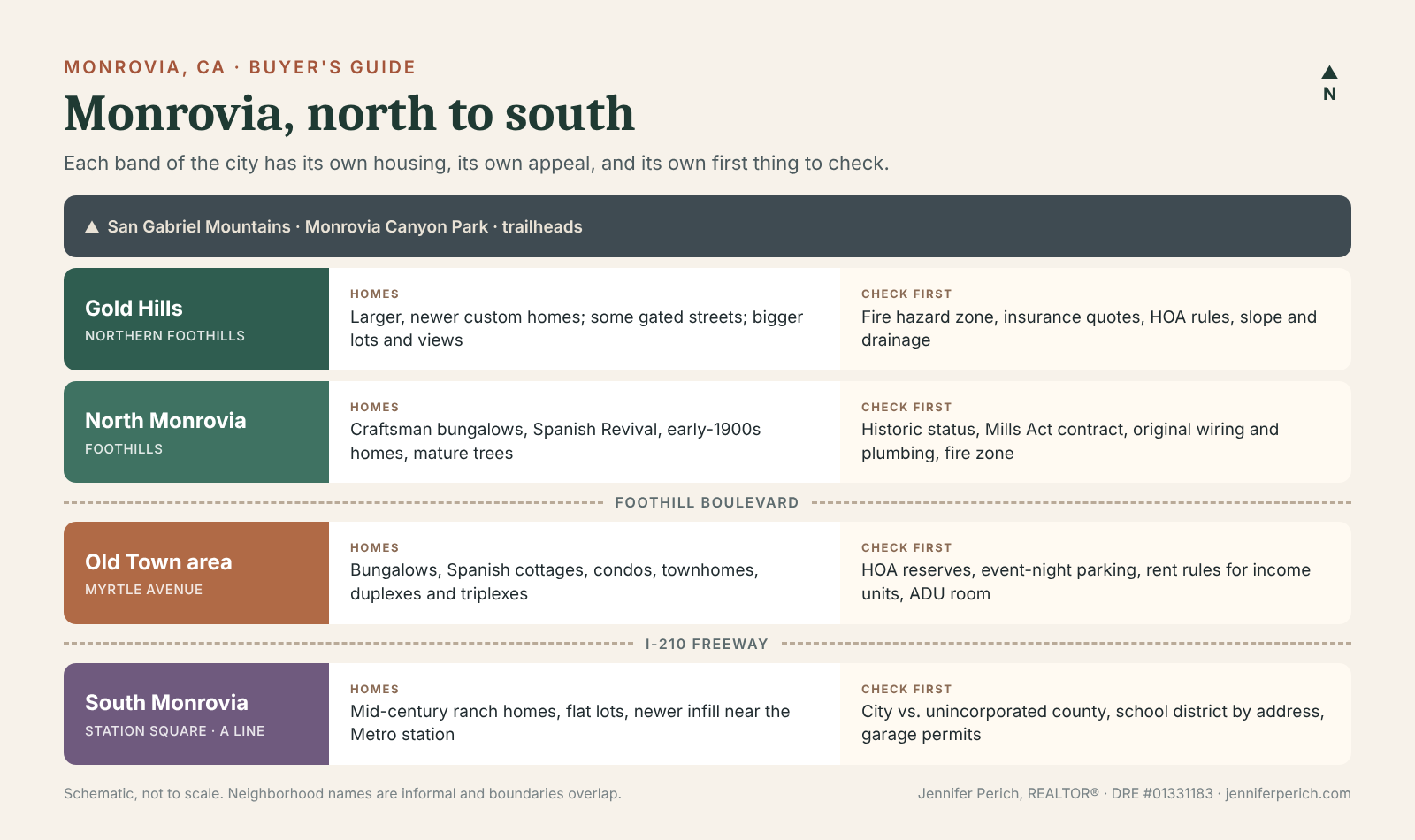
Monrovia doesn't run on official neighborhood boundaries the way some cities do. Real estate portals, residents, and agents use overlapping names. The four areas below cover the main buying zones most people consider. They run roughly north to south, from the mountains to the Metro station.
Every module from here on has a Share button in its top-right corner. Try it: it makes a branded image with Jennifer’s name and a link back to that spot.
Copying is on in this box only, so you can test it. It’s turned off everywhere else on this preview.
Image A picture of the graphic
Try to select a neighborhood name. You can’t, and neither can Google: it only gets the alt text.
Live HTML The same names as live text
Gold Hills North Monrovia foothills Old Town Monrovia South Monrovia and Station Square
Now select a line: it highlights. That’s the same text Google and AI tools read.
Show what search engines read
Monrovia, north to south
• Gold Hills
• North Monrovia foothills
• Old Town Monrovia
• South Monrovia and Station Square
Monrovia, CA · Buyer's Guide
Monrovia, north to south
Each band of the city has its own housing, its own appeal, and its own first thing to check. Tap a name to jump to its section.
▲ San Gabriel Mountains · Monrovia Canyon Park · trailheads
HomesMid-century ranch homes, flat lots, new apartments near the Metro station
Check firstCity vs. unincorporated county, school district by address, garage permits
Schematic, not to scale. Neighborhood names are informal and boundaries overlap. Mayflower Village and South Monrovia Island are unincorporated LA County.
Gold Hills
Gold Hills is a hillside area in Monrovia's northern foothills, around streets like Norumbega Drive and Hidden Valley Road. It's known for larger custom homes, many built from the 1980s through the 2000s. Some streets and estates are gated. VERIFY: Jennifer to confirm Lots tend to be bigger, views broader, and prices often sit at the top of the local range. The Sleepy Hollow trailhead into the Hillside Wilderness Preserve is right in the neighborhood.
Who it tends to suit: Buyers who want space, privacy, views, and newer construction, and who are comfortable with hillside living.
Think twice if: You want low insurance costs, a flat yard, or a short walk to shops. Hillside upkeep (slopes, drainage, retaining walls, brush clearance) is a real recurring cost here, and some streets have HOA rules on what you can change.
Approximate area: The hillside streets in Monrovia's northern foothills around Norumbega Drive and Hidden Valley Road, north of Foothill Boulevard. VERIFY: Jennifer to confirm the streets locals include in Gold Hills
What to check:
Your Fire Hazard Severity Zone status, and real insurance quotes early in escrow
HOA rules, dues, and architectural review requirements, if they apply
Slope, drainage, and the condition of retaining walls
Drive times to the 210 and Old Town during peak hours
Question for Jennifer · her answer replaces this box
What do Gold Hills buyers most often underestimate — insurance, HOA rules, hillside maintenance? Give one real example, with the street or area and roughly what it cost.
Answer shape: (1) the thing buyers underestimate, (2) one real example with a number, (3) what you now tell every Gold Hills buyer to check first.
Live listings Gold Hills / Monrovia foothills north of Foothill Blvd, single-family, $1.5M+
North of Foothill Boulevard, the streets climb toward the mountains. This is where you'll find many of Monrovia's character homes: Craftsman bungalows with river-rock porches, Spanish Revival houses, Victorians, and early 20th-century homes with original built-ins. Mature trees, mountain views, and quiet streets show up often in listings. The Ridgeside, Cloverleaf, and Highland Place trailheads put the Hillside Wilderness Preserve within walking distance of many homes. Canyon Boulevard leads up to Monrovia Canyon Park.
Many of the city's landmarks are here, including homes in the Wildrose Tract historic district. Landmark status can add value and charm. It can also add design review when you want to change windows, add a second story, or build an ADU. Historic and architecturally significant homes are one of Jennifer's specialties.
Who it tends to suit: Buyers who want architectural character, quick trail access, and a residential feel close to Old Town.
Think twice if: You plan big exterior changes, a second story, or a quick ADU. Landmark and Wildrose Tract rules add design review, and original wiring, plumbing and sewer lines often need money soon after closing.
Approximate area: North of Foothill Boulevard, from roughly Canyon Boulevard and the Wildrose Tract east and west along the lower foothill streets. VERIFY: Jennifer to confirm the usual boundaries
What to check:
Whether the home is a designated landmark or sits in the Wildrose Tract district
Whether a Mills Act contract is attached. It can lower property taxes but comes with maintenance obligations, and it transfers to you.
Original systems, including knob-and-tube wiring, galvanized plumbing, clay sewer laterals, and older foundations
Fire hazard mapping, especially closer to the canyon edges. The 2025 maps added roughly 1,500 Monrovia properties, almost all near the mountains, to the Very High zone.
Question for Jennifer · her answer replaces this box
What's it like buying a landmark or Mills Act home in Monrovia? What should a buyer ask before falling in love with one? Name a specific rule or cost that surprised a client.
Answer shape: (1) the one question to ask first, (2) a real example (street or tract, what the rule or cost was), (3) whether it was still worth it.
Old Town centers on Myrtle Avenue, a walkable strip of restaurants, cafés, shops, and a movie theater. Library Park and the Monrovia Public Library anchor the area. The housing nearby mixes small bungalows, Spanish-style cottages, bungalow courts, condos and townhomes, and small multifamily buildings such as duplexes and triplexes.
This is often the most practical way into Monrovia. Condos and smaller homes near Old Town can come in below the city's single-family median. Small income properties also give some buyers an owner-occupant path: living in one unit and renting out the other. New housing is also arriving at the south end of Myrtle, including a large mixed-use project approved in late 2025.
Who it tends to suit: First-time buyers, downsizers, house hackers, and anyone who wants to walk to dinner.
Think twice if: You want quiet Friday nights, easy street parking, or a big yard. Blocks near Myrtle Avenue get the street-fair crowds, and lots are generally smaller.
Approximate area: The blocks around Myrtle Avenue between roughly Foothill Boulevard and the 210 freeway, centered on Library Park. VERIFY: Jennifer to confirm the usual boundaries
What to check:
Friday night noise and parking, especially on the blocks near the street fair
HOA financials and reserve studies for condos and townhomes
Rent levels, lease terms, and state tenant protections (AB 1482) for income properties
Lot size and setbacks if you're hoping to add an ADU
Question for Jennifer · her answer replaces this box
For a first-time buyer, what does a realistic Old Town purchase look like right now — condo, bungalow, or duplex — and what's the usual tradeoff? Give a recent example with an approximate price.
Answer shape: (1) what a realistic first purchase looks like, (2) one recent example with a price range, (3) the tradeoff you warn about.
South of the 210, Monrovia shifts toward mid-century ranch homes, flatter streets, and larger, more uniform lots. This area includes Monrovia Station on the Metro A Line and the Station Square district around it. More than 1,000 new apartments have been built or approved nearby VERIFY: confirm current project status, and the area's 1926 Santa Fe depot is slated for restoration. It also includes the Huntington Drive and Duarte Road commercial corridors.
Who it tends to suit: Buyers who want single-story living, flatter lots, rail access, and often more square footage per dollar than the foothills.
Think twice if: You're sensitive to freeway noise or construction. Homes near the 210 hear it, and the blocks around the station are getting denser, with more cars and ongoing building.
Approximate area: South of the 210 freeway to the city limit, including Station Square around Monrovia Station. VERIFY: Jennifer to confirm the usual boundaries
What to check:
City of Monrovia or unincorporated LA County jurisdiction
School district assignment for the specific address
Freeway proximity and noise for homes near the 210
Permit records for garage conversions and additions, which are common in postwar tracts
Planned changes near the station. A state law, SB 79, is opening the area within half a mile of the station to more housing.
Monrovia addresses that aren't in the City of Monrovia
This is the detail out-of-area buyers miss most often. Two unincorporated Los Angeles County areas carry Monrovia mailing addresses:
Mayflower Village, on Monrovia's southwest edge toward Arcadia. Most of it is served by Monrovia Unified, but the southern part is in the El Monte school districts. VERIFY: spot-check addresses with the districts
South Monrovia Island, south and southeast of the city toward Duarte and Irwindale. The western part is in Monrovia Unified and the eastern part in Duarte Unified. VERIFY: spot-check addresses with the districts
In both areas, planning, permits, and many services come from LA County, not the city. Check the jurisdiction on the LA County Assessor's parcel record before you rely on anything else in this guide.
How Monrovia neighborhoods compare
Area
Typical housing
Main appeal
Key buyer check
Gold Hills
Larger custom homes, 1980s–2000s
Space, views, privacy
Fire zone, insurance, HOA rules
North Monrovia foothills
Craftsman, Spanish Revival, Victorian
Character, trails, mountain views
Landmark rules, older systems, fire zone
Old Town area
Bungalows, condos, small multifamily
Walkability, lower entry prices
HOA health, noise, rental rules
South Monrovia / Station Square
Mid-century ranch homes, new apartments
Rail access, flat lots, single-story
City vs. county, school district
Mayflower Village / South Monrovia Island (unincorporated)
Postwar homes
Monrovia address, often lower prices
County rules, split school districts
The short version: The right Monrovia neighborhood depends on your priorities. Foothill buyers trade higher fire-related costs for views and character. Old Town buyers trade yard size for walkability. South Monrovia buyers should confirm jurisdiction and school district before anything else.
Monrovia schools: what buyers should verify
Most of the city is served by Monrovia Unified School District (MUSD), which enrolls about 4,700 students (2025–26). VERIFY: confirm the enrollment figure on the California Department of Education's DataQuest Its schools include:
Also: Canyon Early Learning Center and Monrovia Community Adult School
Heads up: Santa Fe is no longer a middle school. In February 2026, the MUSD board voted to close Santa Fe Computer Science Magnet as a middle school starting in August 2026, under the district's budget plan, so all MUSD middle school students now attend Clifton Middle School. The district plans to move Canyon Oaks and Mountain Park onto the Santa Fe campus. If a listing still mentions Santa Fe as a middle school, that information is out of date. (Monrovia Now covered the decision, including the board's January vote to delay it.)
Caution: Check the district, not the mailing address. A Monrovia mailing address doesn't guarantee Monrovia Unified. Parts of unincorporated Mayflower Village are in the El Monte school districts, and the eastern part of South Monrovia Island is in Duarte Unified. Attendance areas within MUSD can also change.
☎ Not sure which district an address is in? Call Jennifer at 626-376-8532.
How to verify school assignment:
Ask the district, in writing. Email or call Monrovia Unified's enrollment office with the full property address. Ask: "Which district, and which elementary, middle and high school, serve this address for the coming school year?" Keep the reply.
Cross-check with the tax bill. During escrow, look at the property's most recent LA County secured tax bill. Its "Voted Indebtedness" section lists voter-approved debt such as school bonds. If the school bonds named don't match what you were told, stop and ask the district again.
If you want a specific program (a magnet, a dual-language or arts program, or special-education services), ask the district four things: is it open to every resident or by application or lottery, when is the deadline, is there a waitlist this year, and is transportation provided? Transfer rules are on MUSD's transfers page.
Time it. Do steps 1 and 2 before your inspection contingency ends.
Listings sometimes advertise a school as "highly sought-after." That's marketing language, not verification. Treat it as a prompt to check, not a fact.
Question for Jennifer · her answer replaces this box
What's your warning to buyers who assume a Monrovia address means Monrovia Unified? Tell one real example: where the home was, what the buyer or listing assumed, what checking showed, and what the buyer did.
Answer shape: (1) one-sentence warning, (2) the example in two or three sentences, (3) what you now have every buyer do.
The short version: MUSD serves most of Monrovia, and all of its middle school students now attend Clifton Middle School. Address-level checking is essential, especially in South Monrovia and the unincorporated pockets.
Monrovia commute guide: Metro A Line and the 210
Monrovia's location gives commuters two main options: rail and freeway.
Metro A Line
Monrovia, CA · Buyer's Guide
Commuting from Monrovia on the Metro A Line
Monrovia Station is at 1641 S. Primrose Ave., with about 350 park-and-ride spaces at $3 a day with a TAP card.
Monrovia → Old Pasadena (Memorial Park)
about 15–20 min*
Monrovia → Union Station (downtown LA)
about 40 min*
Train frequency
~8 min peak · 10 min midday
*Estimated travel times; check Metro's trip planner. The line runs Long Beach ↔ Pomona North (since September 2025). Diagram not to scale.
Monrovia Station sits at 1641 S. Primrose Avenue in Station Square, south of the 210 and Old Town. It opened in 2016.
Westbound, the A Line runs through Arcadia and Pasadena to Union Station in downtown LA, then continues south to Long Beach.
Eastbound, since September 2025, it runs through Duarte, Irwindale, Azusa, Glendora, San Dimas, and La Verne to Pomona North.
Practical details:
Frequency: Trains run about every 8 minutes at weekday peak, 10 minutes midday and on weekends, and about 20 minutes late at night.
Parking: The station has about 350 park-and-ride spaces, at $3 a day paid with a TAP card through Metro's parking app, plus EV chargers and bike lockers.
Travel times (estimated): About 15–20 minutes to Old Pasadena and about 40 minutes to Union Station. VERIFY: confirm in Metro's trip planner Confirm current times in Metro's trip planner.
For Pasadena jobs, especially near the Pasadena stations, rail can be a realistic daily option. If you're also weighing Pasadena itself, see our
. Trips to downtown LA take longer but avoid freeway traffic and parking costs.
Interstate 210
The 210 runs east-west through Monrovia, with access near Myrtle Avenue and other major streets. It connects west to Pasadena and to routes into downtown LA, and east toward the Inland Empire. The 605 begins just east of Monrovia and runs south toward the Gateway Cities and Orange County.
Drive times depend heavily on time of day. A trip that takes 20 minutes at midday can easily double at rush hour. Test your actual commute at your actual departure time before you buy.
Local options
Foothill Transit and Metro buses serve Monrovia's main corridors. The city's GoMonrovia program offers discounted Lyft rides within its service area: you pay the first $6, and the program covers up to $15 more, and Monrovia Transit offers dial-a-ride for residents 62 and over and riders with disabilities. Check the city's website for current fares and hours.
When Monrovia is a hard commute
Monrovia works best for jobs along the 210 and the A Line. If you must drive every day at peak hours to the Westside, the South Bay, or Orange County, the trip can take far longer than the miles suggest, and for many buyers it becomes a deal-breaker within months. Before you buy, drive it yourself on a weekday at the time you'd really leave, in both directions.
Commuting from Monrovia? Check these before you buy:
Drive your route at peak hour, in both directions
Time the walk or bike ride from the home to Monrovia Station
Check station parking availability if you plan to park and ride
Question for Jennifer · her answer replaces this box
Where does a Monrovia commute stop making sense? What have clients told you after a month of driving it, and where do the ones who commute happily tend to buy?
Answer shape: (1) the honest limit, (2) one real example, (3) what you tell buyers to test.
The short version: Monrovia works well for Pasadena commuters and gives downtown LA workers a rail alternative, but daily peak-hour drives to the Westside, South Bay or Orange County are hard. Homes in South Monrovia and near Old Town have the easiest station access.
Types of homes in Monrovia and what they cost
Monrovia's homes span about 140 years of building styles. That variety creates opportunity, but it also means condition and history vary widely.
Hillside custom homes: Newer, larger homes in the northern foothills, including Gold Hills
Condos and townhomes: Concentrated near Old Town and along major corridors
New apartments near the station: Mostly rentals, which matter mainly as a sign of where the area is heading
Small multifamily: Duplexes, triplexes, and properties with existing ADUs
Monrovia, CA · Buyer's Guide
Home styles you'll see in Monrovia
Each era brings its own charm and its own inspection checklist.
Image
Victorian & early homes
1880s–1900s · many are city landmarks
Typical areas: North Monrovia, near Old Town
Image
Craftsman bungalow
1905–1930 · porches, river rock, built-ins
Typical areas: North Monrovia, near Old Town
Image
Spanish Revival
1920s–30s · stucco, tile roofs, arches
Typical areas: North of Foothill, Old Town
Image
Mid-century ranch
1945–1965 · single-story, larger lots
Typical areas: South Monrovia
Image
Hillside custom
1980s–2000s · views, larger lots
Typical areas: Gold Hills, foothills
Image
Bungalow court
Cottages around a shared garden
Typical areas: Near Old Town
Original illustrations are representative, not specific homes. Locations are typical, not exclusive.
Price range
As of [Month] 2026, Monrovia's citywide median sale price has been around $1 million to $1.1 million, depending on the data source and the month. Detached single-family homes have mostly sold between about $750,000 and $2 million:
Smaller bungalows and homes needing work sit at the lower end.
Updated foothill homes, large lots, and properties with permitted ADUs reach the upper end.
Condos and senior-community homes can list well below that range.
North of Foothill and south of the 210 often behave like different markets. Ask for a comparative market analysis built from sales on the same side of town, for the same home type and size you're targeting, or talk with a Monrovia real estate agent before you write an offer.
Monrovia market snapshot Monrovia by area if the module supports it (north vs. south of the 210), otherwise city-level: median price, $/sq ft, days on market, months of inventory.
As of [month, year] · Updated automatically · Sources: CRMLS, ATTOM, NAR, realtor.com
Updates automaticallyMonrovia's citywide median has been around $1 million to $1.1 million in 2026, depending on the data source and the month.
Market statistics and listings on this page come from third-party data sources, which may include CRMLS (California Regional Multiple Listing Service), ATTOM, the National Association of REALTORS® and realtor.com. Data is deemed reliable but not guaranteed, may not include every sale, and is current as of the date shown.
Question for Jennifer · her answer replaces this box
What's driving prices in Monrovia right now? How much do an ADU, lot size, a view, or being north of Foothill change what buyers will pay? Use a real comparison if you can, such as two similar homes on either side of Foothill.
Answer shape: (1) the biggest price driver right now, (2) one real comparison with rough numbers, (3) what buyers overpay for.
The short version: Monrovia offers a wide range of home styles and price points. The biggest value drivers tend to be location, lot size, condition, historic status, and whether additional units are permitted.
Local lifestyle: Old Town, canyon trails, and mountain views
Old Town and the Friday Night Street Fair
Old Town's Myrtle Avenue is Monrovia's social center. The Monrovia Friday Night Street Fair runs most Fridays from 5 to 9 p.m. on South Myrtle Avenue in Old Town, weather permitting. It includes a certified farmers market and food vendors, with kids' entertainment on the first Friday of the month. Beyond Fridays, Old Town offers year-round dining, independent shops, and a movie theater within walking distance of many homes. Check the city's event calendar for current details.
Monrovia Canyon Park
At the city's northern edge, Monrovia Canyon Park (1200 N. Canyon Blvd.) has picnic areas, a nature center, and the trail to Monrovia Falls, a roughly 30-foot waterfall that often flows most of the year.
Hike: From the upper lot, it's about 1.6 miles round trip. From the park entrance on the Bill Cull Trail, it's about 3 miles round trip.
Longer option: The Ben Overturff Trail is a strenuous loop of about 7 miles.
Closures: The park closed after the 2020 Bobcat Fire and later storm damage, and reopened in 2025.
Hours and fees: Vehicle access is typically closed on Tuesdays for maintenance. VERIFY: confirm current hours and fees with the city Parking has cost $5 on weekdays and $6 on weekends and holidays since September 15, 2025, and a $65 annual pass is available.
Heads up: Hours, fees, and trail status change, especially during fire season or after storms. Confirm with the city before you go.
Monrovia's Hillside Wilderness Preserve has more than 4.5 miles of trails, open daily from 6 a.m. to 9 p.m., with neighborhood trailheads at Sleepy Hollow (Norumbega Drive), Ridgeside Drive, Cloverleaf Drive, and Highland Place. For many North Monrovia and Gold Hills homes, that means a trail walk from the front door.
Mountain views and outdoor access
Many listings highlight views of the San Gabriel Mountains, and they earn the mention. Homes north of Foothill Boulevard generally have the most dramatic views and the fastest trail access. Keep in mind that the same closeness to the mountains raises wildfire considerations.
Question for Jennifer · her answer replaces this box
What's your perfect Monrovia Saturday — a breakfast spot, a hike, a Friday-night tradition? What would you tell a friend moving here to do first? Name real places.
Answer shape: (1) your Saturday, place by place, (2) the first thing you'd tell a friend to do.
The short version: Monrovia's lifestyle centers on a walkable downtown and close access to the mountains. Old Town convenience and foothill scenery often appeal to different buyers, so decide which matters more to you.
Buyer considerations specific to Southern California
These issues affect nearly every Monrovia purchase. They deserve attention before you make an offer, not after.
Prop 13, Prop 19, and property taxes
Under Proposition 13, your home's assessed value resets to roughly your purchase price when you buy. The base tax rate is 1% of assessed value per year, and annual increases in assessed value are generally capped at 2%. Your actual bill will be higher than 1%, though, because two kinds of charges get added on top:
Voter-approved bonds, such as Monrovia Unified's school bonds, including Measure MM from 2022
Direct assessments, such as lighting, sewer, and county charges
In the first year, many Monrovia buyers end up paying roughly 1.1% to 1.25% of the purchase price per year. VERIFY: Jennifer to check against recent tax bills Check the exact rate and line items on the property's current tax bill.
Expect a supplemental tax bill after closing. It covers the difference between the seller's old assessed value and your purchase price for the rest of the tax year, and many first-time buyers aren't expecting it.
Illustrative example
How a supplemental tax bill is figured in Monrovia
After you buy, LA County bills the difference between the seller's assessed value and your price, for the months left in the July–June tax year.
Find the increase$1,000,000 price − $400,000 seller's assessed value = $600,000
Apply the tax rate$600,000 × about 1.1% ≈ $6,600 a year
Prorate for the months left$6,600 × 9/12 ≈ $4,950
JulAugSepOctNovDecJanFebMarAprMayJun
Closing on October 1 leaves 9 of the 12 months (October–June) in the tax year.
Estimated supplemental bill: about $4,950, separate from your regular yearly bill.
Close between January and May and you'll usually get two supplemental bills: one for the rest of this tax year and one for the next. Illustrative only; your rate and dates will differ. Source: LA County Treasurer and Tax Collector. Guide by Jennifer Perich, HomeSmart Evergreen Realty.
How a supplemental bill is figured (illustrative only): You buy for $1,000,000. The seller's assessed value was $400,000, so the increase is $600,000. At about 1.1%, that's roughly $6,600 a year in extra tax. You close on October 1, with 9 of the 12 months left in the July–June tax year, so your supplemental bill is about $6,600 × 9/12 ≈ $4,950. If you close between January and May, you'll usually get two supplemental bills: one for the rest of the current tax year and one for the next. (Source: LA County property tax FAQ.)
Proposition 19 (2021) lets homeowners who are 55 or older, severely disabled, or victims of a wildfire or natural disaster transfer their existing tax base to a replacement home anywhere in California, up to three times. If the new home costs more, the difference is added to the transferred value. If you're selling a long-held California home to buy in Monrovia, ask a tax professional whether you qualify.
A quick example (illustrative only): On a $1,000,000 purchase, an effective rate of 1.1% to 1.25% works out to roughly $11,000 to $12,500 a year, or about $920 to $1,040 a month, before any Mills Act reduction.
Does Monrovia have a transfer tax or "mansion tax"?
No. Monrovia does not add its own transfer tax, and the City of Los Angeles's Measure ULA "mansion tax" doesn't apply here. The only transfer tax is Los Angeles County's documentary transfer tax of $1.10 per $1,000 of value, which sellers customarily pay.
Wildfire hazard zones
Monrovia, CA · Buyer's Guide
Monrovia's 2025 fire hazard map update
Properties newly added to each Fire Hazard Severity Zone when CAL FIRE updated the local maps in March 2025, almost all near the mountains.
+2,854 properties added to a fire hazard zone in 2025
Very High+1,481
High+619
Moderate+754
What a fire zone can mean for buyers: seller disclosures, brush clearance and defensible space, stricter building standards for new work, the proposed "Zone 0" ember rules (not yet in effect), and higher or harder-to-find insurance. Look up the exact parcel on CAL FIRE's Fire Hazard Severity Zone map.
Source: City of Monrovia and CAL FIRE (2025), as reported by Monrovia Now.
In March 2025, CAL FIRE released updated Fire Hazard Severity Zone maps for areas that cities, rather than the state, are responsible for. The update added about 1,481 Monrovia properties to the Very High zone, 619 to High, and 754 to Moderate, almost all of them near the mountains. Monrovia's City Council took up the maps in June 2025. A home that wasn't in a fire zone a few years ago may be in one now.
Recent history shows why the maps matter. The 2020 Bobcat Fire burned more than 100,000 acres in the San Gabriels, including Monrovia's canyon lands link needed. In January 2025, the Eaton Fire reached Monrovia's western canyon ridge and brought evacuation warnings to foothill neighborhoods link needed. No homes were reported lost in Monrovia.
What a fire zone means for buyers:
Check the current map. Look up the exact parcel on CAL FIRE's Fire Hazard Severity Zone viewer, and read the Natural Hazard Disclosure report.
Know the disclosures. For homes in High or Very High zones, sellers must provide documentation that the property meets defensible-space rules, or sign an agreement that the buyer will get it (Civil Code §1102.19). For homes built before 2010 in those zones, sellers must also give a home-hardening notice, disclose known vulnerabilities such as non-ember-resistant vents or combustible material within five feet of the house, and provide a list of low-cost retrofits (Civil Code §1102.6f).
Plan for brush clearance and building standards. Fire zones bring brush clearance and defensible-space rules, plus stricter wildfire building standards for new work and remodels. Monrovia Fire & Rescue link needed can answer questions about a specific address.
Watch Zone 0, but it isn't law yet. On August 19, 2026, the state Board of Forestry adopted "Zone 0" rules for the first five feet around homes in Very High zones. On September 8, 2026, the package was withdrawn from the state's Office of Administrative Law review, so as of October 2026 the rules are not in effect and no compliance deadline is running. VERIFY: check Zone 0 status at publishing As adopted, they would require ember-resistant materials, prohibit combustible mulch, and bar combustible fences attached to the house, with existing homes given about three to five years to comply. Ask what upgrades the home may need if the rules are refiled.
Can you get homeowners insurance in Monrovia? What the FAIR Plan means
Usually yes, but not always from a regular insurer. In Monrovia's foothill fire zones, some insurers won't write new policies, so some buyers end up on the California FAIR Plan, the state's insurer of last resort. California's homeowners insurance market has been under stress, and it matters most in Monrovia's foothill neighborhoods.
Caution: Get real insurance quotes during your inspection period, not after. If the only offer is the FAIR Plan plus a separate policy, you'll want to know the total cost before you remove contingencies.
The FAIR Plan. Some buyers end up on the California FAIR Plan, the state's insurer of last resort. It covers fire perils only, so you'll also need a separate "difference in conditions" policy for theft, liability, and water damage. The FAIR Plan had about 697,000 policies in force statewide as of June 2026, according to the FAIR Plan's own figures, and average FAIR Plan rates rose about 29% effective October 15, 2026, so individual increases vary.
The state's recovery plan. The Sustainable Insurance Strategy link needed is meant to bring insurers back to higher-risk areas. Several major insurers have committed to writing more policies, but availability still varies a lot by address.
Discounts. Fire-hardening upgrades can help with both insurability and discounts. Ask your insurance broker which upgrades insurers credit, such as ember-resistant vents, a Class A roof, and defensible space.
Question for Jennifer · her answer replaces this box
How has insurance changed the way you write offers in the Monrovia foothills? What do you have buyers do in the first 48 hours of escrow? Tell one real example where an insurance quote changed a deal.
Answer shape: (1) the warning, (2) the example (area, what the quote was, what happened), (3) your 48-hour checklist.
Monrovia has one of the more active preservation programs in the San Gabriel Valley. The city adopted its preservation ordinance in 1995, and it now has about 160 designated landmarks and one historic district, the Wildrose Tract.
What the Mills Act is: a California law that lets cities lower the property taxes on a designated historic home if the owner signs a contract to preserve and maintain it. For a buyer, it can mean a noticeably lower tax bill, but also a contract you inherit, with upkeep obligations and limits on what you can change. The city notes it can't guarantee the reassessment will lower the tax, so ask for the current owner's actual tax bill.
Things buyers should know:
Older homes get extra review. The Historic Preservation Commission reviews proposed demolitions of homes built before 1940, whether or not they're landmarks, and can impose a hold of up to 180 days. Exterior changes to landmarks also go through design review.
The Mills Act can cut property taxes. It's available only for designated landmarks. Owners sign a 10-year, self-renewing contract to preserve and maintain the home in exchange for a lower property tax assessment. An existing contract transfers to the buyer, along with its obligations.
You can landmark a home after buying it. If a home qualifies but isn't designated, you can apply. The process typically takes about six months and requires approval from the commission and the City Council. Landmark status can also bring practical benefits, such as reduced permit fees and some flexibility on parking and setbacks for additions.
Monrovia ADUs and SB 9 lot splits
An ADU (accessory dwelling unit) is a second, smaller home on the same lot: a backyard cottage, a converted garage, or a unit attached to the house. For buyers, a permitted ADU can mean rental income, room for relatives or a home office, and a higher resale value. An unpermitted one can mean the opposite. Monrovia has been one of the more ADU-friendly cities in the area. It approved about 280 ADUs between 2021 and 2025. VERIFY: confirm the ADU count and its source with Monrovia Planning (housing element annual progress report)
The rules: The city adopted an updated ADU ordinance in 2025.
Pre-approved plans: Monrovia launched a pre-approved ADU plan program. Its first plan is "The 16th," a detached one-bedroom unit of about 476 square feet, and more designs are expected. Pre-approved plans can shorten design time and plan review.
SB 9 lot splits and duplexes (a state law allowing lot splits and up to two homes per lot): The state law applies in Monrovia's single-family zones. Under city rules, it does not apply to designated historic properties (landmarks, state or national register properties, and the Wildrose Tract district). Lots in the Very High fire zone are also excluded unless the project includes fire-hazard mitigation. VERIFY: confirm wording with Monrovia Planning That matters for many foothill buyers who are counting on a lot split.
ADU condo sales: As far as we know, Monrovia hasn't opted into the state law (AB 1033) that would let ADUs be sold separately as condos. VERIFY: confirm with Monrovia Planning Confirm with the Planning Division.
Caution: Don't pay for a lot split you can't build. If a home is a landmark, in the Wildrose Tract, or in the Very High fire zone, confirm with Monrovia Planning that SB 9 applies before your offer price assumes it.
Confirm what's allowed on your specific lot with the Planning Division. Lot size, setbacks, fire zone, and historic status all matter.
If the home already has an ADU or a converted garage, verify it was permitted. An unpermitted unit can affect value, insurance, financing, and rental income.
How to check for unpermitted work in Monrovia
Unpermitted work can affect a home's value, financing, insurance and rental income, and the buyer inherits it. Monrovia doesn't require a city presale inspection or records report when a home sells, VERIFY: confirm with the Building Division so buyers need to do this homework themselves:
Pull the permit history. Start with the city's "About My House" page, which links to the online permit records. For older homes, request records through the City Clerk's public records request, and ask about the city's Permit Book, which covers permits from 1911 to 1947.
Compare the official record with the house. Check the LA County Assessor's square footage, bedroom count and number of units against what's actually there.
Brief your inspector. Ask them to flag work that looks newer than its permits, especially garage conversions, enclosed porches, added bathrooms, and ADUs.
Caution: If something isn't permitted, get a contractor's estimate to legalize it, or price it into your offer, before you remove contingencies.
Older homes, sewer lines, and earthquake readiness
Many pre-war Monrovia homes still have original clay sewer laterals. A sewer scope inspection costs relatively little and can head off an expensive surprise. Homes built before about 1980 on raised foundations may benefit from seismic bolting and cripple-wall bracing. California's Earthquake Brace + Bolt program offers grants in eligible ZIP codes during open registration periods.
Does Monrovia have rent control? Rules for buying income property
Monrovia has no local rent control ordinance, but California's statewide rent cap and just-cause law, the Tenant Protection Act (AB 1482), covers many older rentals. It caps yearly rent increases at 5% plus inflation, never more than 10%. Some properties are exempt, including a duplex where the owner lives in the other unit, housing built in the last 15 years, and many single-family homes and condos not owned by a corporation or REIT, as long as the owner gives tenants the required written notice. The duplex exemption doesn't apply when either unit is an ADU. See Civil Code §1947.12. If you're buying a duplex or triplex near Old Town with tenants in place, review current rents, leases, and any past notices before you remove contingencies.
The short version: In Monrovia, the costliest surprises usually come from four places: fire zone and insurance, historic rules on what you can change, unpermitted work, and assumptions about ADUs or lot splits. None of them show up in a listing description, and all of them show up in a permit request, a fire map lookup, or an insurance quote.
What's changing in Monrovia
Schools: Santa Fe closes as a middle school this year. All Monrovia Unified middle school students now attend Clifton Middle School, and Canyon Oaks and Mountain Park are moving to the Santa Fe campus.
Station Square growth: More than a thousand apartments have been built or approved near Monrovia Station, and a state law, SB 79, now allows more housing within half a mile of it. For buyers near the station, that can mean more shops and foot traffic, and also more cars, construction and density. Visit at rush hour before you decide.
Old Town's south end: A mixed-use project at 701 S. Myrtle, approved in December 2025, will add about 200 homes and retail. VERIFY: confirm current status
Fire maps and Zone 0: The 2025 maps will shape insurance, inspections, and upgrades for years. The Zone 0 rules adopted in August 2026 were withdrawn from state review in September and could be refiled.
The A Line extension: Since September 2025, Monrovia has direct rail service east to Pomona, and a further extension toward Claremont and Montclair is planned.
Pre-offer checklist for Monrovia buyers
Monrovia, CA · Buyer's Guide
Before you write an offer in Monrovia
Address-level checks that citywide averages and listing descriptions won't answer for you.
City or county?Mayflower Village and South Monrovia Island are unincorporated LA County. Check the Assessor parcel record.
School district by addressMost homes are Monrovia Unified, but some are Duarte Unified or El Monte. Ask the district, not the listing.
Fire zone + disclosuresCheck the 2025 CAL FIRE map, the NHD report, and the fire-hardening disclosures for High and Very High zones.
Insurance quotes, earlyGet quotes during your inspection period. In the foothills, budget for a possible FAIR Plan + DIC policy.
Historic statusLandmark, Wildrose Tract, Mills Act contract, or built before 1940 (demolition review)?
Permit historyPull records via the city's About My House page and compare to the Assessor's records. Don't count on a city presale inspection.
ADU / SB 9 reality checkPre-approved ADU plans help, but SB 9 is excluded on historic properties and, unless mitigated, in the Very High fire zone.
Sewer scope + foundationPre-war clay laterals and raised foundations are common. Ask about seismic bolting.
Property tax estimatePlan for about 1.1%–1.25% of the price per year, including direct assessments, plus a supplemental bill after closing.
Commute testDrive it at rush hour and time the walk to Monrovia Station (A Line, $3/day parking).
General information, not legal, tax, or insurance advice. Verify with the agency named.
From Jennifer Perich, REALTOR®, HomeSmart Evergreen Realty · DRE #01331183 · 626-376-8532
Transcript: "10 things to check before you buy in Monrovia." 1. City or county? 2. School district by address. 3. Fire zone and disclosures. 4. Insurance quotes, early. 5–9: local items covered in the checklist above. 10. Commute test. "Get the full Monrovia buyer's guide."
What you read
Video tour: buying a home in Monrovia, CA The video, its captions and a readable transcript.
What search engines see
<script type="application/ld+json">
{
  "@type": "VideoObject",
  "name": "Video tour: buying a home in Monrovia, CA",
  "description": "A two-minute narrated tour of the Monrovia, CA home buyer guide: neighborhoods, home styles, fire zones, commute and a pre-offer checklist.",
  "thumbnailUrl": "{{MEDIA_URL:monrovia-hero-premium.jpg}}",
  "uploadDate": "{{PUBLISH_DATE_ISO}}",
  "duration": "PT2M24S"
}
</script>
The labels tell search engines the video’s title, description, thumbnail, length and upload date.
☎ Want help running this checklist on a specific address? Call Jennifer at 626-376-8532.
Monrovia vs. nearby cities
City
Jurisdiction and schools
What buyers tend to like
What to know
Monrovia
Own city; mostly Monrovia Unified
Walkable Old Town, foothill trails, A Line
Fire zones near the mountains; unincorporated pockets
Arcadia
Separate city; Arcadia Unified
Larger and newer homes, Santa Anita, A Line
Generally higher prices
Sierra Madre
Separate city; Pasadena Unified
Small-town village feel, foothills
Limited inventory; fire zones
Duarte
Separate city; Duarte Unified
City of Hope, A Line, often lower prices
Different school district
Pasadena
Separate city; Pasadena Unified
Range of neighborhoods, culture, more A Line stops
Video tour: buying a home in Monrovia, CA (2 min). Captions available.Read the transcript
This is a short audio summary of the Monrovia, California home buyer's guide from Jennifer Perich, REALTOR with HomeSmart Evergreen Realty. It's AI-narrated, and the full guide has the details and sources.
Monrovia sits at the foot of the San Gabriel Mountains, about eight miles east of Pasadena. It has a walkable Old Town on Myrtle Avenue, a Metro A Line station, and trails that start minutes from home. Single-family homes typically sell from about seven hundred fifty thousand dollars to more than two million.
Think of the city in four bands, from the mountains down to the train. Gold Hills, in the northern foothills, has larger custom homes and views. North Monrovia has Craftsman, Spanish Revival and Victorian homes, many of them historic landmarks. The Old Town area mixes bungalows, condos and small income properties. And South Monrovia, below the 210, has mid-century ranch homes on flatter lots near Station Square.
Before you write an offer, check five things. First, whether the address is really in the City of Monrovia. Mayflower Village and South Monrovia Island are unincorporated county areas with Monrovia addresses. Second, the school district for that exact address. Most homes are in Monrovia Unified, but some are in Duarte or El Monte districts, and Santa Fe Middle School merges into Clifton starting this school year. Third, the fire hazard zone. The 2025 state maps added about fifteen hundred Monrovia properties to the Very High zone. Fourth, insurance. Get real quotes during your inspection period. And fifth, historic status and permit history, because landmark rules and unpermitted work are the costliest surprises.
Commuting is easy. Trains run about every eight minutes at peak, and it's roughly fifteen to twenty minutes to Old Pasadena and about forty to Union Station.
There's no city transfer tax, and you should plan for property taxes of roughly one point one to one point two five percent of the price, plus a supplemental bill after closing.
For the full guide, live listings and Jennifer's local advice, visit her website.
Monrovia home buying glossary
Plain-English definitions of terms used in this guide.
AB 1482: California's Tenant Protection Act: a statewide annual rent cap and just-cause eviction rules that cover many older rental units.
ADU / JADU: An accessory dwelling unit (a backyard or attached second home) or a junior ADU (a small unit created within the main house).
California FAIR Plan: The state's insurer of last resort for property owners who can't find regular coverage. It covers fire perils only.
Difference in conditions (DIC) policy: A companion policy that adds the coverage the FAIR Plan leaves out, such as theft, liability and water damage.
Documentary transfer tax: LA County's tax on property sales, $1.10 per $1,000 of value, customarily paid by the seller. Monrovia adds no city transfer tax.
Fire Hazard Severity Zone (FHSZ): CAL FIRE's rating of wildfire hazard for an area: Moderate, High or Very High. Maps were updated in 2025.
GoMonrovia: Monrovia's discounted ride program: riders pay the first $6 of a Lyft ride within the service area, and the program covers up to $15 more.
Mills Act: A program that lowers property taxes on designated historic homes in exchange for a 10-year preservation contract that transfers to new owners.
Natural Hazard Disclosure (NHD) report: A report sellers provide that shows whether a property is in fire, flood, earthquake fault or other mapped hazard zones.
Prop 13: California's 1978 property tax law. Your assessed value resets to roughly your purchase price, the base rate is 1% a year, and annual increases in assessed value are generally capped at 2%.
Prop 19: A 2021 law that lets homeowners who are 55+, severely disabled, or disaster victims move their property tax base to a replacement home in California.
SB 9: A 2021 state law that allows lot splits and up to two homes per lot in many single-family zones, with local exceptions.
Supplemental tax bill: A one-time bill after you buy, covering the gap between the seller's old assessed value and your purchase price for the rest of the tax year.
Unincorporated area: Land in LA County that isn't part of any city. County rules, permits and services apply, even when the mailing address names a nearby city.
Wildrose Tract: Monrovia's designated historic district, where exterior changes go through design review.
Zone 0: Proposed state rules for the first five feet around a home in a Very High zone, requiring ember-resistant materials. Adopted by the Board of Forestry in August 2026, then withdrawn from state review in September 2026, so not yet in effect.
Frequently asked questions about buying a home in Monrovia
What you read
What is the average home price in Monrovia, CA? As of [Month] 2026, Monrovia's citywide median sale price has been around $1 million to $1.1 million, depending on the source and month. Single-family homes typ…
What search engines see
<script type="application/ld+json">
{
  "@type": "FAQPage",
  "mainEntity": [
    {
      "@type": "Question",
      "name": "What is the average home price in Monrovia, CA?",
      "acceptedAnswer": {
        "@type": "Answer",
        "text": "As of [Month] 2026, Monrovia's citywide median sale price has been around $1 million to $1.1 million, depending on the source and month. Single-family homes typically sell between about $750,000 and $2 million. Check the live market stats on this page for current figures."
      }
    },
    "… the other questions, word for word …"
  ]
}
</script>
One question as you read it, and the same words labeled “Question” and “Answer” for search engines.
What is the average home price in Monrovia, CA?
As of [Month] 2026, Monrovia's citywide median sale price has been around $1 million to $1.1 million, depending on the source and month. Single-family homes typically sell between about $750,000 and $2 million. Check the live market stats on this page for current figures.
Is Monrovia, CA a good place to live?
Many buyers choose Monrovia for its walkable Old Town, the Friday Night Street Fair, quick trail access, and a Metro A Line station. Tradeoffs include wildfire and insurance considerations in the foothills and big differences in housing age and condition from block to block.
Which Monrovia neighborhoods have single-story homes or larger lots?
South Monrovia has many single-story mid-century ranch homes on flatter lots near the train. Gold Hills has larger lots and newer custom homes with views. North Monrovia has character homes near trails and Old Town, often on smaller lots. Always confirm the school district for the specific address.
What school district is Monrovia in?
Most of Monrovia is in Monrovia Unified School District. Some homes with Monrovia addresses, in unincorporated Mayflower Village and South Monrovia Island, are served by the El Monte school districts or Duarte Unified. Check the exact address with the district.
Did Santa Fe Middle School in Monrovia close?
Yes, as a middle school. In February 2026, the Monrovia Unified board voted to close Santa Fe Computer Science Magnet as a middle school starting with the 2026–27 school year, so all MUSD middle school students now attend Clifton Middle School. The district plans to use the Santa Fe campus for Canyon Oaks High School and Mountain Park School.
Is Monrovia in a fire zone?
Parts of it are. CAL FIRE's 2025 maps added about 1,481 Monrovia properties to the Very High Fire Hazard Severity Zone, almost all near the mountains. Look up the specific parcel on CAL FIRE's map and review the Natural Hazard Disclosure report.
Can I get homeowners insurance in Monrovia?
Usually yes, but cost and availability depend heavily on the address and fire zone. Some foothill buyers need the California FAIR Plan plus a "difference in conditions" policy. Get quotes during your inspection period, before you remove contingencies.
Does Monrovia have a transfer tax?
No. Monrovia doesn't have its own transfer tax. Only Los Angeles County's documentary transfer tax of $1.10 per $1,000 applies, and sellers customarily pay it. Measure ULA applies only in the City of Los Angeles.
Can I build an ADU in Monrovia?
Generally yes. Monrovia updated its ADU ordinance in 2025 and offers a pre-approved ADU plan program. Rules depend on lot size, setbacks, fire zone, and historic status, so confirm with the Planning Division before you buy.
Does SB 9 apply in Monrovia?
SB 9 lot splits and duplexes are allowed in Monrovia's single-family zones. Under city rules, they don't apply to designated historic properties, or to lots in the Very High fire zone unless the project includes fire-hazard mitigation. Confirm with the Planning Division for a specific lot.
Is Mayflower Village part of Monrovia?
No. Mayflower Village is unincorporated Los Angeles County, even though many homes there have Monrovia or Arcadia mailing addresses. County rules apply, and part of the area is in the El Monte school districts.
How long is the commute from Monrovia to Pasadena or downtown LA?
By Metro A Line, it's roughly 15 to 20 minutes to Old Pasadena and about 40 minutes to Union Station. VERIFY: confirm in Metro's trip planner By car on the 210, Pasadena can be 15 to 20 minutes off-peak and much longer at rush hour. Test your own route at your normal travel time.
Is there parking at the Monrovia Metro station?
Yes. Monrovia Station has about 350 park-and-ride spaces at about $3 a day, paid with a TAP card through Metro's parking app, plus EV chargers and bike lockers.
When is the Monrovia Friday Night Street Fair?
Most Fridays from 5 to 9 p.m. on South Myrtle Avenue in Old Town, weather permitting, with a certified farmers market and food vendors. Check the city's event calendar for current details.
What is the Mills Act in Monrovia?
It's a program that lets owners of designated historic landmarks sign a 10-year, self-renewing preservation contract with the city in exchange for a lower property tax assessment. Existing contracts transfer to new owners.
Thinking about buying in Monrovia?
JP
Jennifer PerichREALTOR® · HomeSmart Evergreen Realty · DRE #01331183[Approved phone] · [Approved office address, as on Google Business Profile]Tell Jennifer your budget, commute and must-haves. She’ll reply with the two or three Monrovia neighborhoods worth touring first.Get my personal Monrovia shortlist
Live listings All Monrovia, newest first, with a link to the full Monrovia search
Jennifer Perich, REALTOR®HomeSmart Evergreen Realty · Pasadena, Monrovia and the San Gabriel ValleySpecialties: historic and architecturally significant homes, probate and trust sales, downsizing, out-of-state owners. [Years of experience and certifications to confirm]
How this guide was researched
Every fact in this guide was checked against primary sources, and each one is linked where it appears. They include the City of Monrovia (planning, building, historic preservation, parks, events and GoMonrovia), Monrovia Unified School District and each school's own site, the California School Dashboard, the California Department of Finance, LA Metro, Foothill Transit, CAL FIRE and the Office of the State Fire Marshal, the Board of Forestry and Fire Protection and the Office of Administrative Law, the California Department of Insurance and the California FAIR Plan, the LA County Assessor, Treasurer and Tax Collector, and Registrar-Recorder, the California Civil Code, the Board of Equalization, the U.S. Census Bureau, the Monrovia Historic Preservation Group, and local reporting from Monrovia Now. The full list of pages used is under Sources below. An independent reviewer then re-checked the claims most likely to change or be misread, such as school assignments, fire zones and insurance, and screened the language for fair housing compliance. Dated figures are labeled with their date. Live market numbers and listings come from third-party data sources, which may include CRMLS, ATTOM, the National Association of REALTORS® and realtor.com, and are dated where they appear. If you spot something that has changed, let us know and we'll update the guide.
This guide is general information for home buyers, not legal, tax, insurance, or financial advice. Rules, rates, and programs change; verify current details with the agency named and with qualified professionals before you act.
Site preview · Pasadena
Buying a Home in Pasadena, CA: Neighborhoods, Schools & Commute
Searchbuying a home in pasadena ca
By Jennifer Perich, REALTOR®, HomeSmart Evergreen Realty, DRE #01331183 · Last updated [Month Year]
What you read
By Jennifer Perich, REALTOR®, HomeSmart Evergreen Realty, DRE #01331183 · Last updated [Month Year]
The byline you read, and the same facts labeled for search engines: who wrote it, her license, her brokerage and the last-updated date.
Image Original hand-painted illustration, animated. Alt text (read by search engines and screen readers): "Illustration of an arched bridge over the Arroyo Seco in Pasadena, CA with the San Gabriel Mountains at sunset"
Quick answer: What should you know before buying a home in Pasadena?
Buying a home in Pasadena, CA usually means choosing among very different settings, each with its own rules:
A Craftsman bungalow in a landmark district such as Bungalow Heaven
A hillside home with views in the San Rafael Hills or Linda Vista
A historic home or estate near Caltech, along South Orange Grove, or in Oak Knoll
A postwar ranch house in Hastings Ranch
A condo or townhome within walking distance of Old Pasadena, Playhouse Village or an A Line station
As of [Month] 2026, Pasadena's citywide median sale price is around $1.1 million to $1.2 million, depending on the data source and the month. VERIFY: confirm against the live market module at publishing Single-family homes commonly run from about $1 million to more than $3 million, and condos more often sell in the $600,000s to $900,000s.
Before you commit, check six things that are specific to Pasadena:
Whether the address is in the City of Pasadena or in unincorporated LA County (East Pasadena, Altadena, Kinneloa Mesa)
Which school district serves it
Its fire hazard zone, and what insurance will actually cost
Whether it sits in a landmark district or carries a Mills Act contract
The status of the city's required presale certificate
Measure H rent rules, if you're buying a rental
Listen: Pasadena buyer guide in 2 minutes (AI-narrated summary)Read the transcript
This is a short audio summary of the Pasadena, California home buyer's guide from Jennifer Perich, REALTOR with HomeSmart Evergreen Realty. It's AI-narrated, and the full guide has the details and sources.
Pasadena is about ten miles northeast of downtown Los Angeles, home to the Rose Bowl, Caltech and some of the most protected historic architecture in Southern California. As of fall 2026, the median sale price was about one point one eight million dollars.
Your main choices are: a Craftsman bungalow in a landmark district like Bungalow Heaven, a hillside home in the San Rafael Hills or Linda Vista, a historic home near Caltech or Oak Knoll, a nineteen-fifties ranch in Hastings Ranch, or a condo near Old Pasadena and Playhouse Village.
Before you write an offer, check six things that are specific to Pasadena. First, whether the address is actually in the city. East Pasadena, Chapman Woods, Kinneloa Mesa and Altadena are unincorporated, and part of East Pasadena is in San Marino Unified. Second, the school district for the exact address. Third, the fire zone and insurance. The 2025 maps put about forty-six hundred Pasadena parcels in the Very High zone, and the Eaton Fire destroyed about a hundred eighty-five structures inside the city, mostly in Upper Hastings Ranch. Fourth, the city's required presale certificate, which can surface unpermitted work. Fifth, landmark district rules and the Mills Act. And sixth, if you're buying a rental, Measure H rent stabilization, which allows a two and a half percent increase for 2026 to 2027 on most units built before 1995.
Six Metro A Line stations serve Pasadena, and Old Pasadena to Union Station takes about twenty-five minutes. There's no city transfer tax.
For the full guide, live listings and Jennifer's local advice, visit her website.
What you read
Quick answer: What should you know before buying a home in Pasadena? Buying a home in Pasadena, CA usually means…
This code sits in its own block at the bottom of the page. It doesn’t change what you see; it tells search engines what each part is.
Pasadena market snapshot Pasadena (city): median sale price, median $/sq ft, days on market, sale-to-list ratio, active listings
As of [month, year] · Updated automatically · Sources: CRMLS, ATTOM, NAR, realtor.com
Median priceLive
$ / sq ftLive
Days on marketLive
Sale-to-listLive
Market statistics on this page come from third-party data sources, which may include CRMLS, ATTOM, the National Association of REALTORS® and realtor.com. Data is deemed reliable but not guaranteed and is current as of the date shown.
Pasadena at a glance
County
Los Angeles County
ZIP codes
91101, 91103, 91104, 91105, 91106, 91107 and 91125 (Caltech). Parts of 91107 are unincorporated East Pasadena, and parts of 91104 are Altadena
Population
About 141,000 (CA Department of Finance, January 2026); about 136,000 by the U.S. Census Bureau's July 2025 estimate
Incorporated
June 19, 1886, as a charter city
Distance
About 10 miles by road northeast of downtown Los Angeles
Main public school district
Pasadena Unified School District (PUSD), which also serves Altadena and Sierra Madre
Rail
Six Metro A Line stations: Fillmore, Del Mar, Memorial Park, Lake, Allen, Sierra Madre Villa
Freeways
I-210, SR-134 and SR-110 (the Arroyo Seco Parkway)
Electric and water utility
Pasadena Water and Power (city-owned), inside city limits
City transfer tax
None beyond the LA County documentary transfer tax ($1.10 per $1,000)
Required at sale
A city presale certificate before close of escrow
Rent stabilization
Yes. Measure H caps rents on most multi-unit rentals built before February 1, 1995
Historic designations
Nearly 30 landmark districts and more than 130 individual landmarks
Signature annual event
The Rose Parade presented by Honda, on New Year's morning
Figures as of 2026. Sources: California Department of Finance and U.S. Census Bureau (population), City of Pasadena (incorporation, historic designations, Measure H and the presale program), LA Metro (stations).
Pasadena sits at the western edge of the San Gabriel Valley, under the San Gabriel Mountains and along the Arroyo Seco. It's home to the Rose Bowl, Caltech, the Tournament of Roses, and the Jet Propulsion Laboratory, which Caltech manages for NASA and which carries a Pasadena mailing address although its campus is in La Cañada Flintridge. It also has some of the most carefully protected historic architecture in Southern California.
That depth comes with complexity. Two Pasadena homes a few miles apart can differ in historic rules, fire exposure, school assignment, rent regulations, utility provider, and even which government issues your permits. This guide is written by Pasadena buyer's agent Jennifer Perich, who walks buyers through those differences address by address. It covers how the main neighborhoods compare, how schools and commuting work, what kinds of homes you'll find, and the Pasadena-specific rules to check before you write an offer.
In this guide, you'll learn:
How Bungalow Heaven, the San Rafael Hills, the Caltech and Millionaire's Row areas, Hastings Ranch, Northwest Pasadena, the southern border areas, and central Pasadena compare
Why a Pasadena mailing address doesn't always mean the City of Pasadena or Pasadena Unified
What to verify about Pasadena schools, including 2026's halted consolidation plan
How the Eaton Fire, the 2025 fire hazard maps, and California's insurance market affect buyers here
The local rules out-of-area buyers miss most: the presale certificate, landmark districts, the Mills Act, Measure H, and ADU limits
What is it like to live in Pasadena, CA?
Pasadena lives like a mid-sized city with a strong civic identity. Roughly 136,000 to 141,000 people live here, depending on whose estimate you use. That's big enough for major museums, a world-class research university, a regional hospital and several separate shopping districts, and small enough that local traditions still set the calendar. The Rose Parade on New Year's morning is a neighborhood event before it's a television broadcast: residents stake out curbs on Colorado Boulevard the night before.
Pasadena has more than one "downtown," and where you live usually decides which one becomes yours:
Old Pasadena centers on Colorado Boulevard and the brick alleys around it.
Playhouse Village surrounds the Pasadena Playhouse and Vroman's Bookstore.
South Lake Avenue runs south toward Caltech.
Hastings Ranch and East Colorado Boulevard handle much of the everyday shopping on the east side.
The local economy rests on education, science and health care. Caltech describes itself as Pasadena's largest employer, with about 7,100 employees including about 4,600 at JPL, and says more than half of its faculty, staff and postdoctoral scholars lived in Pasadena as of 2024. Huntington Hospital, Kaiser Permanente, ArtCenter College of Design and Pasadena City College are other large employers. That professional job base is one reason demand here has held up through slower markets.
The city incorporated in 1886, and preservation runs deep. Pasadena has nearly 30 landmark districts and more than 130 designated landmarks. It's known for Arts and Crafts architecture, including Greene & Greene's Gamble House (1908), and for the bungalow court, a form of small cottages around a shared garden that Pasadena helped popularize in the early 1900s.
The San Gabriel Mountains fill the northern skyline, and the Arroyo Seco runs about eight miles down the city's west side. Summers are hot and dry. The January 2025 Eaton Fire burned mostly in neighboring Altadena, but it destroyed about 185 structures inside Pasadena city limits, counting garages and other accessory buildings. Since then, wildfire risk and insurance have become part of nearly every purchase conversation here, even in neighborhoods far from the foothills.
The short version: Pasadena pairs big-city amenities and a strong job base with historic neighborhoods and regional rail. The tradeoff is real variation from block to block in rules, risk and cost, so research the neighborhood and the parcel, not citywide averages.
Pasadena neighborhoods compared: where each type of buyer tends to look
Residents use dozens of overlapping neighborhood names, and the city's landmark districts add more. The areas below cover the main buying zones most people consider, roughly from the historic northeast, across the hills to the west, and down to the southern borders.
Every module from here on has a Share button in its top-right corner. Try it: it makes a branded image with Jennifer’s name and a link back to that spot.
Copying is on in this box only, so you can test it. It’s turned off everywhere else on this preview.
Image A picture of the graphic
Try to select a neighborhood name. You can’t, and neither can Google: it only gets the alt text.
Live HTML The same names as live text
Bungalow Heaven San Rafael Hills and Linda Vista Hastings Ranch Old Pasadena and Playhouse Village
Now select a line: it highlights. That’s the same text Google and AI tools read.
Show what search engines read
Pasadena neighborhoods
• Bungalow Heaven
• San Rafael Hills and Linda Vista
• Hastings Ranch
• Old Pasadena and Playhouse Village
Pasadena, CA · Buyer's Guide
Pasadena neighborhoods at a glance
Where the main buying areas sit relative to each other and the freeways, and which "Pasadena" addresses are actually unincorporated LA County. Tap an area to jump to its section.
◂ Glendale · Eagle Rock▲ N · Altadena (unincorporated)Sierra Madre · Arcadia ▸
* Unincorporated LA County with Pasadena mailing addresses. Schematic, not to scale; boundaries overlap. Verify jurisdiction on the LA County Assessor parcel record.
Bungalow Heaven
Bungalow Heaven is a 16-block neighborhood in northeast-central Pasadena, bordered by Lake and Hill Avenues and by Washington and Orange Grove Boulevards. It has more than 1,000 historic homes, most of them modest Arts and Crafts bungalows built between about 1905 and 1920, though the oldest house dates to 1888. In November 1989 it became Pasadena's first landmark district, and in 2008 part of it, about 660 properties, was listed on the National Register of Historic Places.
Expect front porches, river-rock chimneys, deep eaves, original built-ins and tree-lined streets. McDonald Park, dedicated in 1920 on the site of an old reservoir, is the shared gathering spot. The neighborhood association has held an annual Bungalow Heaven Home Tour since 1990, usually in April. Lake Avenue's shops and the Lake and Allen A Line stations are a short walk or bike ride away.
Who it tends to suit: Buyers who want genuine Craftsman character, a strong neighborhood identity, and an easy walk to Lake Avenue.
Think twice if: You want a big addition, a modern exterior, or a fast ADU. Landmark-district review covers anything visible from the street, lots are small, and original wiring, plumbing and foundations often need money soon after closing.
Approximate area: Lake to Hill Avenues and Washington to Orange Grove Boulevards. The regulated landmark and National Register areas are smaller than the neighborhood, so check the specific parcel on the city's district map. VERIFY: Jennifer to confirm the streets buyers usually mean by Bungalow Heaven
What to check:
Landmark district status. A Certificate of Appropriateness is needed before permits for demolition, new construction, and exterior changes visible from the street (see the landmark section below).
Mills Act. Whether a contract is already attached, or whether the home could qualify.
Original systems, including knob-and-tube wiring, galvanized plumbing, and raised foundations that may need seismic bolting and cripple-wall bracing.
Lot size and setbacks, which limit how much you can expand and where an ADU can go.
Question for Jennifer · her answer replaces this box
What do Bungalow Heaven buyers most often misunderstand about landmark district rules? Give one real example of a project that was approved smoothly or got complicated, with roughly what it cost in time or money.
Answer shape: (1) the misunderstanding, (2) the real example with a number, (3) what you now tell every Bungalow Heaven buyer to check first.
West of the Arroyo Seco, the San Rafael and Linda Vista neighborhoods hold some of Pasadena's most private settings. Winding streets climb into the hills with canyon, city and mountain views, and lots are generally larger than anywhere in central Pasadena. Homes range from 1920s Spanish Revival estates to post-and-beam modern houses and newer custom builds. Single-family homes here regularly sell above $2 million, and prime view lots can go well beyond $3 million. VERIFY: Jennifer to confirm current price range
The area sits close to the Rose Bowl, Brookside Park and the Arroyo trails, and borders Glendale and the Eagle Rock area of Los Angeles. To the south, the Annandale area includes the Poppy Peak Historic District, a National Register district of about 45 Modernist homes from the 1930s through the 1960s.
Who it tends to suit: Buyers who want space, views, privacy and architectural variety, and who are ready for the work of hillside living.
Think twice if: You need low insurance costs, an easy flat yard, or quick freeway access at rush hour. Many streets are in higher fire hazard zones, slopes and retaining walls are a recurring cost, and narrow roads can be slow to leave on Rose Bowl event days.
Approximate area: West of the Arroyo Seco, from roughly the Rose Bowl and Linda Vista Avenue up into the San Rafael Hills, south toward Annandale and the Glendale border. VERIFY: Jennifer to confirm the usual boundaries
What to check:
Your Fire Hazard Severity Zone and real insurance quotes, early in escrow (see the wildfire section)
Brush clearance and defensible space, which Pasadena Fire inspects every year
Slope stability, drainage and the condition of retaining walls
Rose Bowl event traffic and street closures near the Arroyo
Question for Jennifer · her answer replaces this box
What does a San Rafael or Linda Vista buyer need to budget for that a central-Pasadena buyer doesn't — insurance, slope work, brush clearance? Give one real example with a number.
Answer shape: (1) the hidden cost, (2) the example with a rough figure, (3) the inspection you insist on for hillside homes.
The Caltech area, Millionaire's Row, and Oak Knoll
The city's historic context statement says the stretch of South Orange Grove Boulevard that became known as Millionaire's Row developed in the 1900s and 1910s, when wealthy winter residents built multi-acre estates along the east rim of the Arroyo. Most of those estates are gone, replaced from the 1960s on by condominiums and newer homes, but the boulevard still carries the history. The Wrigley Mansion, completed in 1914, is now Tournament House, the permanent home of the Tournament of Roses since the Wrigley family gave it to the city in 1958. The Gamble House and the Prospect Park and Arroyo Terrace areas are nearby. Historic and architecturally significant homes are one of Jennifer's specialties.
Across town, the South Lake and Madison Heights areas around Caltech offer a different version of historic Pasadena: tree-lined streets near California Boulevard with Craftsman, Colonial Revival and Spanish Revival homes, mixed with apartments and condos. Farther south, Oak Knoll is known for large estate homes near the San Marino border and the Langham Huntington hotel.
Who it tends to suit: Buyers who want historic surroundings close to Pasadena's cultural institutions, from condo buyers on South Orange Grove to estate buyers in Oak Knoll, and anyone who wants to walk or bike to Caltech.
Think twice if: You want a quiet New Year's Day or easy parking on event days. The Rose Parade forms up on Orange Grove, condo buildings from the 1960s and 1970s can carry big HOA projects, and mature protected trees limit what you can build.
Approximate area: South Orange Grove Boulevard between roughly Colorado Boulevard and the South Pasadena line; the blocks around Caltech south of Colorado between Lake and Hill; and Oak Knoll south of California Boulevard toward San Marino. VERIFY: Jennifer to confirm the usual boundaries
What to check:
Historic or landmark designations and the design review they trigger
HOA financials, reserve studies, master insurance and special assessments for condos
Event-day access near the Rose Parade route on Orange Grove and Colorado Boulevards
Tree protection rules, since mature oaks and specimen trees are common
Question for Jennifer · her answer replaces this box
What do buyers relocating for Caltech, JPL or the hospitals usually ask first, and which neighborhoods do they end up choosing? Describe a real relocation: the commute they wanted, the home they chose, the tradeoff.
Answer shape: (1) the first question relocating buyers ask, (2) one real example, (3) where they tend to land, described by what they wanted, not who they are.
Hastings Ranch is Pasadena's only large-scale planned postwar community, according to the city's historic context statement. It lies east of Sierra Madre Villa Avenue, on land that was once a working ranch:
Lower Hastings Ranch, south of Sierra Madre Boulevard, has about 600 custom homes built from 1948 to 1954.
Upper Hastings Ranch, to the north and closer to the foothills, has about 800 tract homes developed from 1951, designed by architect Edward Fickett, with more mountain views.
Expect single-story ranch layouts, attached garages and larger, more uniform lots than in central Pasadena. The Hastings Ranch shopping center, which opened in 1958, and the Sierra Madre Villa A Line station are close by. So is Eaton Canyon.
Upper Hastings Ranch took most of the Eaton Fire's damage inside Pasadena. The city's January 2026 update lists Upper Hastings Ranch, Victory-Rose, Dundee Heights and the NATHA area as the affected neighborhoods. Debris removal through the government program finished by June 2025, and the city tracks rebuilding on its Pasadena Rebuilds dashboard.
Who it tends to suit: Buyers who want single-level living, flatter lots and fewer historic restrictions than central Pasadena.
Think twice if: You're not ready to spend time on insurance. Upper Hastings Ranch sits in or near higher fire hazard zones next to the burn area, quotes can vary widely by street, and rebuilding means construction on some blocks for years.
Approximate area: East of Sierra Madre Villa Avenue to the city limit, with Lower Hastings south of Sierra Madre Boulevard and Upper Hastings north of it toward the foothills. VERIFY: Jennifer to confirm the usual boundaries
What to check:
Fire hazard mapping and insurance availability, especially in Upper Hastings Ranch
For homes that survived the fire: smoke, ash and soot remediation history, with test results in writing
For rebuilt homes or vacant lots: final permits, soil testing and debris-removal sign-off
Permit records for room additions, pools and garage conversions, which are common in postwar homes
Drainage and debris-flow risk in heavy rain for homes near the canyon
Question for Jennifer · her answer replaces this box
What should a buyer ask the seller about a Hastings Ranch home that survived the Eaton Fire? What paperwork do you push to see, and has a test result ever changed a deal?
Answer shape: (1) the three documents you ask for, (2) one real example, (3) what a buyer should do if the seller can't produce them.
Northwest Pasadena, Historic Highlands, and Garfield Heights
North of the 210 and west of Lake Avenue, Northwest Pasadena holds some of the city's oldest residential streets, and parts of it were divided when the 210 freeway was built. It includes the Garfield Heights landmark district, designated in 1999, with about 400 properties ranging from Queen Anne and Victorian homes to Craftsman and Spanish Revival, and the Historic Highlands landmark district closer to the foothills.
Prices here often run below the city's top neighborhoods, which makes it one of the more common ways into single-family ownership in Pasadena. Many homes need updating, and that's part of the value.
Who it tends to suit: Buyers who want an older single-family home with character at a lower price per square foot, and who are comfortable with renovation.
Think twice if: You want a turnkey house. Older systems, past additions and landmark-district review in Garfield Heights or Historic Highlands can stretch both the budget and the timeline.
Approximate area: North of the 210 and west of Lake Avenue, up toward the Altadena line. VERIFY: Jennifer to confirm the usual boundaries
What to check:
Landmark district status, if the home is inside Garfield Heights, Historic Highlands or another district
Permit history and unpermitted additions, which the presale certificate can surface
Condition of original systems and foundations
Fire hazard mapping for homes near the northern foothills and the Altadena border
Whether the address is in the city at all, since Altadena begins at the city's northern edge
Question for Jennifer · her answer replaces this box
What does a realistic first single-family purchase in Northwest Pasadena look like right now, and what's the renovation surprise you see most? Give one recent example with a rough price and repair cost.
Answer shape: (1) what's realistic, (2) the example with numbers, (3) what you have buyers inspect first.
Southern Pasadena borders two separate cities, South Pasadena and San Marino. Neighborhoods near those borders, including the South Arroyo and Lower Arroyo areas, offer historic homes, mature trees, and quick access to South Pasadena's Mission Street shops and the Lower Arroyo trails.
The key detail: South Pasadena is its own city with its own school district. A home inside the City of Pasadena near the border is served by Pasadena Unified, not South Pasadena Unified. Listings sometimes blur that line with phrases like "South Pasadena adjacent."
Who it tends to suit: Buyers who like the South Pasadena and San Marino surroundings but want Pasadena's housing options, services or prices.
Think twice if: You're buying for a specific school district. The city line, not the street name or the listing headline, decides it, and some blocks sit close to the 110 and the former 710 stub.
Approximate area: The blocks of the City of Pasadena along the South Pasadena and San Marino city lines, from the Lower Arroyo east toward Oak Knoll. VERIFY: Jennifer to confirm the usual boundaries
What to check:
City jurisdiction for the exact address, on the LA County Assessor's parcel record
School district assignment, confirmed in writing with the district
Freeway proximity near the 110 and the 710 stub (see "What's changing" below)
Old Pasadena, Playhouse Village, and central Pasadena
Central Pasadena is the city's most practical way in. Condos, townhomes, lofts and historic bungalow courts cluster near Old Pasadena and Playhouse Village, many within walking distance of Del Mar, Memorial Park or Lake station, restaurants and shops. Building ages vary widely, from 1920s courts to new mid-rise construction near the A Line, and so does HOA health.
Who it tends to suit: First-time buyers, downsizers, and anyone who wants to walk to dinner or take the train to work.
Think twice if: You want quiet New Year's and Rose Bowl weekends, a private yard, or easy guest parking. Nightlife and event crowds are part of the package, and Pasadena's overnight street parking rules take planning.
Approximate area: Roughly the 210 south to California Boulevard, and from the Arroyo east to Lake Avenue, centered on Old Pasadena and the Playhouse district. VERIFY: Jennifer to confirm the usual boundaries
What to check:
HOA reserve studies, master insurance coverage and pending special assessments
Noise from nightlife, events and the Rose Parade route
Parking rules, including Pasadena's overnight parking permits
Measure H and rental registry rules if you're buying a unit with a tenant in place
Question for Jennifer · her answer replaces this box
For a first-time buyer, what does a realistic central-Pasadena purchase look like right now — condo, townhome or bungalow court — and what's the usual tradeoff? Give a recent example with an approximate price.
Answer shape: (1) what's realistic, (2) the example with a price range, (3) the HOA document you read first.
East Pasadena and Chapman Woods, east of the city toward San Gabriel and Rosemead Boulevards (much of ZIP 91107). Planning, permits and many services come from LA County. Some homes get water from California American Water rather than Pasadena Water and Power, and school assignment can differ from the city's. VERIFY: spot-check the water provider and school district for sample addresses
Kinneloa Mesa, in the foothills above Pasadena's northeast edge. The Eaton Fire burned homes there, and its losses aren't counted in the city's totals.
Altadena, directly north, which is served by Pasadena Unified but governed by LA County.
Caution: Check the jurisdiction before anything else. A different jurisdiction can mean a different school district, water and power provider, permit office, fire hazard map, and set of local rules, including whether Pasadena's presale certificate and Measure H apply at all. Look up the parcel on the LA County Assessor's portal before you rely on anything else in this guide.
☎ Not sure whether an address is really in Pasadena? Call Jennifer at 626-376-8532.
How Pasadena neighborhoods compare
Area
Typical housing
Main appeal
Key buyer check
Bungalow Heaven
Craftsman bungalows, mostly 1905–1920
Character, community identity
Landmark district rules, older systems
San Rafael Hills / Linda Vista
Hillside estates, mid-century, custom
Views, privacy, space
Fire zone, insurance, slope
Caltech area / Millionaire's Row / Oak Knoll
Historic homes, condos, estates
Historic setting, cultural access
Historic review, HOA health, trees
Hastings Ranch
Ranch homes, 1948 through the 1950s
Single-level living, flatter lots
Eaton Fire history, insurance, permits
Northwest Pasadena
Victorian to Craftsman, mixed
Character at a lower price point
Permits, condition, district rules
South Pasadena border areas
Historic homes, mixed styles
Neighboring-city surroundings
School district, jurisdiction
Old Pasadena / Playhouse Village
Condos, lofts, bungalow courts
Walkability, transit, lower entry
HOA finances, rent rules, noise
East Pasadena / Chapman Woods (unincorporated)
Postwar homes, larger lots
Pasadena address, county rules
School district, water provider
The short version: The right Pasadena neighborhood depends on how you weigh character, space, walkability and risk. Historic-district buyers trade flexibility for charm. Hillside and foothill buyers trade higher insurance costs for views and space. Border and unincorporated-area buyers should confirm jurisdiction and school district before anything else.
Pasadena schools: what buyers should verify
Most of the city is served by Pasadena Unified School District (PUSD), which also serves Altadena and Sierra Madre and enrolls more than 14,000 students from preschool through 12th grade. Its schools include neighborhood elementary schools, a K–8, magnet and dual-language programs, and these middle and high schools:
Middle (grades 6–8): Eliot Arts Magnet, Octavia E. Butler Magnet, and Sierra Madre Middle School; McKinley School serves grades K–8
Grades 6–12: Blair School, with International Baccalaureate programs, and Thurgood Marshall Secondary School (renamed in 2025 from John Marshall Fundamental)
High: Pasadena High School and John Muir High School Early College Magnet
Alternative: Rose City High School (continuation) and CIS Academy (independent study)
Heads up: School closures are off the table for now. PUSD's School Consolidation Advisory Committee voted on May 11, 2026 against all six closure and merger scenarios it had studied, and on May 28, 2026 the school board halted the consolidation process (PUSD's committee page; Pasadena Now covered the vote). Any future closure plan would need a new analysis. Separately, the Eaton Fire damaged or destroyed five district-owned campuses in the Altadena area in January 2025, and about 1,100 PUSD students lost their homes. If a listing or an older article mentions a school closing or moving, confirm it with the district.
Pasadena also has a large private and independent school community. Polytechnic, Westridge, Mayfield Senior School, Chandler School, La Salle College Preparatory and Maranatha High School are all inside city limits. That shapes demand in some neighborhoods, but it doesn't change your public school assignment.
Caution: Check the district, not the mailing address. A Pasadena mailing address doesn't always mean the City of Pasadena or Pasadena Unified. Unincorporated East Pasadena sits next to San Marino Unified and other districts, and homes near South Pasadena, San Marino, La Cañada Flintridge and Arcadia border separate districts. The district's address lookup and its written reply decide it, not the listing.
Look up the address. Enter the full property address in PUSD's Find My School tool, which shows the assigned neighborhood schools and links the attendance-zone maps.
Ask the district, in writing. Email PUSD's enrollment office with the address and ask: "Which district, and which elementary, middle and high school, serve this address for the coming school year?" If the home is near a border, ask the neighboring district the same question. Keep both replies.
Cross-check the tax bill. During escrow, look at the property's most recent LA County secured tax bill. Its voted-indebtedness lines name the school bonds the parcel pays, such as PUSD's Measure R. If they don't match what you were told, ask again.
If you want a specific program, watch PUSD's enrollment dates. For 2027–28, sibling and continuing-program priority applications run October 20 to November 10, 2026, the main lottery opens January 14, 2027, and out-of-district applications open January 29, 2027.
Question for Jennifer · her answer replaces this box
How do school questions come up in Pasadena deals, especially near San Marino, South Pasadena or East Pasadena? Tell one real example: where the home was, what the buyer or listing assumed, what checking showed, and what the buyer did.
Answer shape: (1) one-sentence warning, (2) the example in two or three sentences, (3) what you now have every buyer do.
The short version: PUSD serves most of Pasadena, and its 2026 closure plan was halted. Border areas and unincorporated pockets still need address-level checking, in writing, before you remove contingencies.
Pasadena commute guide: Metro A Line, the 110, 210 and 134
Pasadena gives commuters more choices than most San Gabriel Valley cities: light rail with six stations, three freeways, and a city bus system that feeds the trains.
Metro A Line
Pasadena, CA · Buyer's Guide
Commuting from Pasadena on the Metro A Line
Pasadena has six stations: Fillmore, Del Mar, Memorial Park, Lake, Allen and Sierra Madre Villa.
Memorial Park → Union Station (downtown LA)
25 min (Metro timetable, June 2026)
Memorial Park → Monrovia
about 15–20 min*
Train frequency
~8 min peak · 10 min midday
*Estimated travel times; check Metro's trip planner. The line runs Long Beach ↔ Pomona North (since September 2025). Diagram not to scale.
The Metro A Line has six Pasadena stations: Fillmore, Del Mar, Memorial Park, Lake, Allen and Sierra Madre Villa.
Southbound, it runs through South Pasadena and Highland Park to Union Station, then through downtown Los Angeles to Long Beach.
Eastbound, since September 19, 2025, it runs through the foothill cities, including Arcadia, Monrovia and Azusa, to Pomona North. If you're weighing a home farther out on the line, see our
Stations: Del Mar and Memorial Park serve Old Pasadena directly. Lake, Allen and Sierra Madre Villa sit in the median of the 210 freeway.
Travel time: Metro's timetable, effective June 7, 2026, schedules Memorial Park to Union Station at 25 minutes and Sierra Madre Villa to Union Station at 32 minutes.
Frequency: Trains run about every 8 minutes at weekday peak, every 10 minutes midday and on weekends, and every 20 minutes late at night.
Parking: Sierra Madre Villa has Pasadena's largest Metro park-and-ride, about 1,000 spaces, and Del Mar has about 600.
The 110 (Arroyo Seco Parkway): Its first segment opened in December 1938, and it was dedicated in 1940 as "the first freeway in the West." It runs from Pasadena to downtown LA and is a National Scenic Byway. Expect tight curves, very short on-ramps where drivers often merge from a near stop, and lower speeds than a modern freeway.
The 210 (Foothill Freeway): It runs east-west through Pasadena, east toward Arcadia and Monrovia and northwest toward La Cañada Flintridge and the San Fernando Valley.
The 134 (Ventura Freeway): It ends at the 210 interchange in Pasadena and heads west to Glendale, Burbank and the 101.
Peak-hour drive times can easily double the off-peak estimate. Test your real commute at your real departure time before you buy.
Local options
Pasadena Transit, the city's bus service, runs 10 fixed routes, and every one connects to an A Line station. It also offers Dial-a-Ride for seniors and riders with disabilities. Metro and Foothill Transit buses link Pasadena with neighboring cities, and bike routes through central Pasadena and along the Arroyo give some residents a car-light option.
Rose Bowl event days
On big Rose Bowl days, streets around the stadium close and Arroyo neighborhoods fill with traffic and parking. The free Rose Bowl shuttle, run by Foothill Transit, leaves from Parsons Parking Lot B near Memorial Park station, and Pasadena Transit adds service on UCLA game days. If you're looking near the Arroyo, ask how event days affect access to that specific street.
When Pasadena is a hard commute
Pasadena works best for jobs downtown, in Glendale and Burbank, along the 210, or anywhere on the A Line. If you must drive every day at peak hours to the Westside, the South Bay, LAX or Orange County, the trip can take far longer than the miles suggest, and for many buyers it becomes the thing they'd change first. Before you buy, drive it yourself on a weekday at the hour you'd really leave, in both directions, and try the train for the same trip.
Commuting from Pasadena? Check these before you buy:
Drive your route at peak hour, in both directions
Time the walk or bike ride from the home to the nearest A Line station
Check station parking if you plan to park and ride
Factor in school drop-off routes and Rose Bowl event-day closures
Question for Jennifer · her answer replaces this box
Which Pasadena neighborhoods do clients who commute to downtown, Burbank or Glendale tend to pick, and where does a Pasadena commute stop making sense? Give one example of a client who changed plans after test-driving it.
Answer shape: (1) where commuters land and why, (2) the honest limit, (3) the real example.
The short version: Pasadena has strong rail access to downtown LA and fast freeway links to Glendale, Burbank and the San Gabriel Valley, but daily peak drives to the Westside, South Bay or Orange County are hard. Homes near Old Pasadena, Lake Avenue and Sierra Madre Villa have the easiest station access.
Types of homes in Pasadena and what they cost
Pasadena's homes span about 140 years, and the age of a house often matters as much as its neighborhood.
What you'll find
Craftsman bungalows: Front porches, exposed rafters, built-ins and wood trim, concentrated in Bungalow Heaven, Northwest Pasadena, Madison Heights and the Historic Highlands see current Craftsman listings in Pasadena →
Bungalow courts: Small cottages around a shared garden, a form Pasadena helped popularize. Some sell as condos, others as income properties.
Period revival homes: Spanish Colonial, Mediterranean, Tudor and Colonial Revival homes from the 1920s and 1930s, common near Caltech, Madison Heights, the South Arroyo and San Rafael see current Spanish Revival listings in Pasadena →
Estates: Large historic and custom homes in Oak Knoll, along the Arroyo, and in the San Rafael Hills
Condos and townhomes: Concentrated in Playhouse Village, Old Pasadena, South Lake and along South Orange Grove, from 1960s buildings to new construction near the A Line
Small multifamily: Duplexes to fourplexes, many covered by Measure H's rent rules if built before February 1, 1995
Pasadena, CA · Buyer's Guide
Home styles you'll see in Pasadena
Each era brings its own charm and its own inspection checklist.
Image
Craftsman bungalow
1900–1930 · porches, river rock, built-ins
Typical areas: Bungalow Heaven, Madison Heights, NW Pasadena
Image
Bungalow court
A Pasadena original · cottages on a garden
Typical areas: Central Pasadena
Image
Victorian & early homes
Pre-1910 · Queen Anne details
Typical areas: Garfield Heights, NW Pasadena
Image
Period revival
1920s–30s · Spanish, Tudor, Colonial
Typical areas: Caltech area, South Arroyo, San Rafael
Image
Mid-century modern
Post-and-beam, glass walls
Typical areas: San Rafael Hills, Annandale
Image
Postwar ranch
Late 1940s–50s · single-story
Typical areas: Hastings Ranch, east Pasadena
Original illustrations are representative, not specific homes. Locations are typical, not exclusive.
Price range
As of [Month] 2026, Pasadena's citywide median sale price has been around $1.1 million to $1.2 million across all home types, depending on the data source and the month. Single-family homes have mostly sold from about $1 million to more than $3 million, and condos more often in the $600,000s to $900,000s. VERIFY: confirm the ranges against the live market module and recent closed sales at publishing
Smaller bungalows, homes needing work, and many Northwest Pasadena houses sit at the lower end.
Updated Craftsman homes in landmark districts, Hastings Ranch homes with mountain views, and properties with permitted ADUs sit in the middle to upper range.
Oak Knoll, the San Rafael Hills and the Arroyo estates set the top of the market.
Pasadena's ZIP codes can move in different directions in the same quarter, and two of them cross into unincorporated areas. Ask for a comparative market analysis built from sales inside the city, in the same neighborhood, for the same home type and size you're targeting, or talk with a Pasadena real estate agent before you write an offer.
Pasadena market snapshot By ZIP, City of Pasadena portions only if the module supports it: 91101, 91103, 91104, 91105, 91106, 91107. Median price, $/sq ft, days on market, months of inventory.
As of [month, year] · Updated automatically · Sources: CRMLS, ATTOM, NAR, realtor.com
Updates automaticallyPasadena's citywide median has been around $1.1 million to $1.2 million in 2026, depending on the data source and the month.
Market statistics and listings on this page come from third-party data sources, which may include CRMLS (California Regional Multiple Listing Service), ATTOM, the National Association of REALTORS® and realtor.com. Data is deemed reliable but not guaranteed, may not include every sale, and is current as of the date shown.
Question for Jennifer · her answer replaces this box
What's driving pricing in Pasadena right now? How much do a landmark district, a permitted ADU, a view or a fire zone change what buyers will pay? Use a real comparison if you can, such as two similar homes inside and outside a landmark district.
Answer shape: (1) the biggest price driver right now, (2) one real comparison with rough numbers, (3) what buyers overpay for.
The short version: Pasadena offers a wide range of home styles and prices. The biggest value drivers tend to be neighborhood, lot size, condition, historic status, fire zone, and whether any additional units are permitted.
Local lifestyle: Old Pasadena, the Arroyo, and the Rose Bowl
Old Pasadena and the other districts
Old Pasadena's restored brick buildings and alleys hold restaurants, shops and nightlife, all walkable from the Del Mar and Memorial Park stations. Playhouse Village has the Pasadena Playhouse, the official state theater of California, and Vroman's Bookstore. The Pasadena Museum of History sits just west of Old Pasadena. South Lake Avenue and the Paseo add everyday shopping and dining.
The Rose Parade and the Rose Bowl
The Rose Parade presented by Honda runs 5.5 miles from Orange Grove Boulevard down Colorado Boulevard on New Year's morning; the 138th parade steps off at 8 a.m. on Friday, January 1, 2027. The Rose Bowl hosts the Rose Bowl Game, UCLA football (in 2026, while the city's lease dispute with UCLA continues in court), concerts, and the Rose Bowl Flea Market on the second Sunday of every month. Living close to the action is part of the appeal; so is planning around event-day traffic and parking.
Museums, architecture and annual traditions
The Norton Simon Museum, the Gamble House and the USC Pacific Asia Museum are all in Pasadena. The Huntington Library, Art Museum, and Botanical Gardens, often associated with Pasadena, is actually just over the line in San Marino. Pasadena City Hall, which opened in December 1927, and the Colorado Street Bridge, completed in 1913, are landmarks in their own right.
The calendar fills out with Pasadena Heritage's Craftsman Week each October, the city's twice-yearly ArtNight Pasadena, the Pasadena Chalk Festival (now at Brookside Park), and the Bungalow Heaven Home Tour in April.
The Arroyo Seco and the trails
The Arroyo Seco gives west Pasadena a long green corridor with about 22 miles of trails. It includes Hahamongna Watershed Park to the north, Brookside Park and the Rose Bowl Loop (about 3.3 miles around the stadium and golf course) in the Central Arroyo, and the Lower Arroyo's trails to the south.
Heads up: Eaton Canyon is still closed. The Eaton Fire destroyed the Eaton Canyon Nature Center, and LA County lists the canyon's trails as closed through December 31, 2027. The nature center rebuild has no opening date yet. Check LA County Parks before you plan an east-side hike.
Question for Jennifer · her answer replaces this box
What's your own favorite Pasadena weekend — a breakfast spot, a walk, a tradition? What would you tell a friend moving here to do first? Name real places.
Answer shape: (1) your weekend, place by place, (2) the first thing you'd tell a friend to do.
The short version: Pasadena's lifestyle combines walkable historic districts, major cultural institutions and the Arroyo's open space. Event-day traffic and the post-fire closures on the east side are the tradeoffs worth knowing about.
Pasadena-specific buyer considerations
These issues affect nearly every Pasadena purchase. They deserve attention before you make an offer, not after.
Prop 13, Prop 19, and property taxes
Under Proposition 13, a home's assessed value resets to roughly the purchase price when it sells. The base tax rate is 1% of assessed value per year, and annual increases in assessed value are generally capped at 2% (Board of Equalization). Your actual bill will be higher than 1%, because two kinds of charges are added on top:
Voter-approved bonds, such as Pasadena Unified's $900 million Measure R school bond from 2024
Direct assessments and parcel taxes, such as PUSD's Measure EE parcel tax ($90 a year per parcel) and city and county charges
In Pasadena, total first-year bills commonly land around 1.1% to 1.25% of the purchase price per year. VERIFY: Jennifer to check against two or three recent Pasadena tax bills, or look up a tax rate area on the LA County Auditor-Controller's TRA tool Check the exact rate and line items on the property's current tax bill.
Expect a supplemental tax bill after closing. It covers the difference between the seller's old assessed value and your purchase price for the rest of the July–June tax year. The county reassesses as of the first day of the month after your purchase, and a purchase between January 1 and May 31 usually brings two supplemental bills.
Illustrative example
How a supplemental tax bill is figured in Pasadena
After you buy, LA County bills the difference between the seller's assessed value and your price, for the months left in the July–June tax year.
Find the increase$1,300,000 price − $500,000 seller's assessed value = $800,000
Apply the tax rate$800,000 × about 1.1% ≈ $8,800 a year
Prorate for the months left$8,800 × 10/12 ≈ $7,330
JulAugSepOctNovDecJanFebMarAprMayJun
Closing in mid-August means the new value applies from September 1, leaving 10 of the 12 months (September–June) in the tax year.
Estimated supplemental bill: about $7,330, separate from your regular yearly bill.
Close between January and May and you'll usually get two supplemental bills: one for the rest of this tax year and one for the next. Illustrative only; your rate and dates will differ. Source: LA County Treasurer and Tax Collector. Guide by Jennifer Perich, HomeSmart Evergreen Realty.
How a supplemental bill is figured (illustrative only): You buy a Pasadena home for $1,300,000. The seller's assessed value was $500,000, so the increase is $800,000. At about 1.1%, that's roughly $8,800 a year in extra tax. You close in mid-August, so the new value applies from September 1, with 10 of the 12 months left in the tax year. Your supplemental bill is about $8,800 × 10/12 ≈ $7,330. (Source: LA County supplemental property tax.)
Regular installments are due November 1 and February 1, and become delinquent after December 10 and April 10 (LA County Treasurer and Tax Collector).
Proposition 19 (2021) lets homeowners who are 55 or older, severely disabled, or victims of a wildfire or natural disaster move their existing tax base to a replacement home anywhere in California, up to three times, if they buy within two years. If the new home costs more, part of the difference is added to the transferred value. Eaton Fire survivors buying in Pasadena should ask about it. See the Board of Equalization's Prop 19 page, and talk to a tax professional before you count on it.
A quick example (illustrative only): On a $1,200,000 purchase, an effective rate of 1.1% to 1.25% works out to roughly $13,200 to $15,000 a year, or about $1,100 to $1,250 a month, before any Mills Act reduction.
Does Pasadena have a transfer tax or "mansion tax"?
No, not beyond the county's. Pasadena doesn't levy a separate transfer tax: its code has a transfer-tax chapter, but that city share is credited inside the county rate, and a 2026 city staff report says plainly that the city "does not levy a separate transfer tax." The only transfer tax is Los Angeles County's documentary transfer tax of $1.10 per $1,000 of value, which sellers customarily pay. The City of Los Angeles's Measure ULA "mansion tax" doesn't apply in Pasadena.
The Pasadena presale certificate
Pasadena requires a presale certificate before close of escrow on single-family homes, condos, townhomes and duplexes, under the city's Presale Program (Pasadena Municipal Code Chapter 14.17). It's the seller's job, but it can change your purchase.
Self-certification ($29 plus processing fees) leads to a Certificate of Completion. It's available if the living space doesn't exceed the Assessor's record by 10% or more, there's no unpermitted construction, conversion or accessory structure over 120 square feet, fire-safety and exiting standards are met, and there are no open code cases.
A city inspection ($184 plus processing fees) leads to a Certificate of Inspection when the home doesn't qualify. If the inspector finds problems, the seller can fix them and get a re-inspection, or sign a Transfer of Responsibility that shifts the corrections to the buyer.
Pasadena only
The presale certificate: two paths before closing
Pasadena requires one of these certificates before escrow closes on a single-family home, condo, townhome or duplex. The seller handles it, but the result can change your deal.
Path 1: Self-certification
$29 + processing fees
Living space doesn't exceed the Assessor's record by 10% or more
No unpermitted construction, conversion or accessory structure over 120 sq ft
Fire-safety and exiting standards met; no open code cases
Result: Certificate of Completion
Path 2: City inspection
$184 + processing fees
Used when the home doesn't qualify to self-certify
A city inspector visits and writes a report
Problems found: the seller fixes them and is re-inspected, or signs a Transfer of Responsibility that moves the fixes to the buyer
Result: Certificate of Inspection
Buyer's move: ask which path the seller took, read any inspection report, and price any Transfer of Responsibility before you remove contingencies.
Fees as posted by the City of Pasadena in October 2026; they can change. Pasadena Municipal Code Chapter 14.17. Not a substitute for your own home inspection. Guide by Jennifer Perich, HomeSmart Evergreen Realty.
Caution: Ask early whether the seller self-certified or needed an inspection, and read the inspection report if there is one. If the seller plans a Transfer of Responsibility, you're agreeing to fix someone else's code problems. Get a contractor's estimate and settle the price or credits before you remove contingencies. The certificate never replaces your own home inspection.
Pasadena's Very High fire hazard zone grew in 2025
Parcels in the Very High Fire Hazard Severity Zone under the 2008 map vs. the 2025 CAL FIRE map Pasadena adopted. The 2025 map also added new Moderate and High zones.
+699 more parcels in the Very High zone
2008 map3,911
2025 map4,610
What a fire zone can mean for buyers: seller disclosures, brush clearance and defensible space, stricter building standards for new work, the proposed "Zone 0" ember rules (not yet in effect), and higher or harder-to-find insurance. Look up the exact parcel on CAL FIRE's Fire Hazard Severity Zone map.
Source: City of Pasadena staff report, July 21, 2025 (agenda item 27).
The Eaton Fire started on the evening of January 7, 2025, at the mouth of Eaton Canyon. It burned about 14,000 acres and destroyed more than 9,000 structures, mostly in unincorporated Altadena. Inside Pasadena city limits, the city's January 2026 update counts 185 structures destroyed, including accessory buildings, and 133 buildings red-tagged as unsafe. Local reporting puts the single-family homes destroyed at about 117. The city's Eaton Fire recovery page tracks rebuilding.
In March 2025, CAL FIRE's Office of the State Fire Marshal released updated Fire Hazard Severity Zone maps for areas that cities, not the state, are responsible for, and Pasadena's City Council took up the map for adoption in June and July 2025, ahead of the state's deadline. The number of Pasadena parcels in the Very High zone rose from 3,911 to 4,610: 887 added and 188 removed. The map also replaced the city's old two tiers with three: Very High, High and Moderate. A home that wasn't in a fire zone a few years ago may be in one now. The city's own fire hazard zone page links its map viewer.
Check the current map. Look up the exact parcel on the state viewer or the city's map, and read the Natural Hazard Disclosure report. Homes in the Very High zone must be disclosed as such (Government Code §51183.5).
Know the disclosures. For homes in High or Very High zones, sellers must provide documentation that the property meets defensible-space rules, or sign an agreement that the buyer will get it (Civil Code §1102.19). For homes built before 2010 in those zones, sellers must also give a home-hardening notice, disclose known vulnerabilities such as non-ember-resistant vents or combustible material within five feet of the house, and list low-cost retrofits (Civil Code §1102.6f). Pasadena Fire handles the related inspection requests.
Expect brush inspections.Pasadena Fire inspects brush clearance every spring and summer, and the new map added about 18% more Very High properties to its rounds.
Watch Zone 0, but it isn't law yet. On August 19, 2026, the state Board of Forestry adopted "Zone 0" rules for the first five feet around homes in Very High zones. On September 8, 2026, the package was withdrawn from the state's Office of Administrative Law review, so as of October 2026 the rules are not in effect and no deadline is running. VERIFY: check Zone 0 status at publishing As adopted, they would have required ember-resistant materials and no combustible items within five feet of the house, with existing homes given about three to five years to comply.
For homes near the burn area, ask for smoke, ash and soot remediation records and any lead or asbestos testing, in writing.
Question for Jennifer · her answer replaces this box
How has the Eaton Fire changed the way you guide buyers in Pasadena? What's one thing you now do on every deal that you didn't before, and when did it make a difference?
Answer shape: (1) the change, (2) the real example, (3) the first step you'd tell any Pasadena buyer to take.
Can you get homeowners insurance in Pasadena? What the FAIR Plan means
Usually yes, but not always from a regular insurer, and the price depends heavily on the address. In the foothills, the hills west of the Arroyo, and the streets near the burn area, some insurers won't write new policies, so some buyers end up on the California FAIR Plan, the state's insurer of last resort.
Caution: Get real insurance quotes during your inspection period, not after. If the only offer is the FAIR Plan plus a separate policy, you'll want to know the total yearly cost before you remove contingencies.
The FAIR Plan. Its dwelling policy covers a short list of named perils, mainly fire, lightning, internal explosion and smoke, so the FAIR Plan itself recommends a separate "difference in conditions" policy for theft, liability and water damage. It had 696,562 policies in force statewide as of June 2026, according to its own figures, and its rates rose an average of 29.1% for new and renewing policies from October 15, 2026, so individual increases vary. VERIFY: confirm the October 15, 2026 effective date with the FAIR Plan or the Department of Insurance
The state's recovery plan. The Department of Insurance's Sustainable Insurance Strategy is meant to bring insurers back to higher-risk areas. In August 2026 the department reported FAIR Plan growth had slowed to 1.9% in the second quarter, and that 11 home insurer groups had committed to write more policies. Availability still varies a lot by address.
Discounts. Fire-hardening upgrades can help with both insurability and price. Ask your insurance broker which upgrades insurers credit, such as ember-resistant vents, a Class A roof and defensible space.
Landmark districts, historic homes, and the Mills Act
Pasadena runs one of Southern California's most active historic preservation programs, with nearly 30 landmark districts and more than 130 individual landmarks. The city shows the districts on its landmark district map.
In a landmark district, you need a Certificate of Appropriateness before a building permit for demolition, new construction, additions, and exterior changes visible from the street, such as windows, porches, fences and new garages. Review is free, but it typically adds about two months before your permit. City staff handle minor work, and the Historic Preservation Commission reviews major projects. Interiors, paint colors, landscaping, solar panels, routine maintenance and changes not visible from the street are exempt.
What the Mills Act is: a California law that lets cities lower the property taxes on a qualifying historic home if the owner signs a contract to preserve and maintain it. For a buyer, it can mean a noticeably lower tax bill, but also a contract you inherit, with upkeep obligations and limits on what you can change.
An existing contract transfers to you. It's recorded on title, renews every year for a rolling 10-year term, and comes with annual self-certification and inspections. Breaking it carries a cancellation fee of 12.5% of the home's current assessed value.
Interior features can count. Under a Mills Act contract, work that affects historic interior features also needs city review.
You can apply after you buy. The city takes applications once a year (in 2026, February 5 to May 29) and accepts a limited number, up to 20 single-family contracts a year. Single-family homes generally qualify only if the assessed value is $2 million or less. VERIFY: confirm the 2027 application window when the city posts it
Pasadena ADUs and SB 9 lot splits
An ADU (accessory dwelling unit) is a second, smaller home on the same lot: a backyard cottage, a converted garage, or a unit attached to the house. A junior ADU is a small unit created inside the main house. For buyers, a permitted ADU can mean rental income, room for relatives or a home office, and a higher resale value. An unpermitted one can mean the opposite, and Pasadena's presale certificate may flag it.
The rules: Pasadena updated its ADU ordinance in 2024. In February 2025, the state housing department's review letter found seven provisions that didn't comply with state law, on issues including detached ADUs on multifamily lots, setbacks, height and parking. As of October 2026, the city had cut ADU fees but hadn't posted an amended ordinance. VERIFY: check for an amended ADU ordinance with Pasadena Planning Where local rules conflict with state ADU law, state law generally controls.
SB 9 lot splits and duplexes (a state law allowing lot splits and up to two homes per lot in single-family zones): Pasadena exempts its landmark districts from SB 9, an exemption the state Attorney General disputed in 2022. In 2025 the city also barred SB 9 projects in the Very High fire zones inside the Eaton Fire boundary, but after a lawsuit the City Council voted in July 2026 to repeal that ban. VERIFY: confirm with Pasadena Planning that the fire-area repeal is in effect and the landmark-district exemption still stands
Caution: Don't pay for an ADU or lot split you can't build. If the home is in a landmark district or a Very High fire zone, or the plan depends on rules the state has questioned, confirm with Pasadena Planning (626-744-4009) what's allowed on that lot before your offer price assumes it.
Pasadena's older homes have often been changed many times: garage conversions, enclosed porches, added bathrooms and back houses are common, and not all of them were permitted. The presale certificate catches some of it, but not all, so do this homework too:
Pull the permit history. Use the city's Permit Center Online property search. For older or archived permits and plans, ask the Permit Center at 175 N. Garfield Ave., (626) 744-4200: "What permits and finals are on file for this address, including any for additions, conversions or ADUs?"
Compare the official record with the house. Check the LA County Assessor's square footage, bedroom count and number of units against what's actually there, and against the presale certificate.
Brief your inspector. Ask them to flag work that looks newer than its permits.
Caution: If something isn't permitted, get a contractor's estimate to legalize it, or price it into your offer, before you remove contingencies.
Many Pasadena homes built before about 1980 sit on raised foundations with cripple walls. Bolting the house to its foundation and bracing the cripple walls is a common, relatively affordable retrofit. California's Earthquake Brace + Bolt program offers grants of up to $3,000, and its current eligible list includes Pasadena's main ZIP codes. VERIFY: confirm the ZIP list and registration window for the current year Also ask your inspector to scope the sewer lateral and check the age of the electrical panel.
Does Pasadena have rent control? Measure H for income-property buyers
Yes. Pasadena voters approved Measure H in November 2022, adding rent stabilization and just-cause eviction rules to the city charter. The city's Rent Stabilization Department runs it, and the Rental Housing Board sets the yearly increase.
Rent caps apply to multi-unit rental properties built before February 1, 1995 (overview). Single-family homes and condos are exempt from the cap.
The allowed increase for October 1, 2026 through September 30, 2027 is 2.5%. VERIFY: confirm on the city's Rent Stabilization page, which still showed the prior year's 2.25% in October 2026
Just-cause rules cover nearly all rentals in the city, including rented condos and single-family homes (eviction protections). No-fault evictions, such as an owner or relative moving in, substantial repairs, or taking a unit off the market, require relocation assistance.
The rental registry requires nearly every rental, including rented single-family homes, condos, ADUs and JADUs, to register each year. The 2026–27 fee is $236.54 per unit, and it can't be passed on to tenants.
Measure H at a glance: what applies to the home you're buying
If you're buying…
Rent cap
Just-cause eviction rules
Yearly rental registry
A duplex to fourplex or apartment building built before February 1, 1995
Yes
Yes
Yes, $236.54 per unit (2026–27)
A multi-unit building built on or after February 1, 1995
No (state rules may apply)
Yes
Yes
A single-family home or condo you'll rent out
No
Yes
Yes
A home with a rented ADU or JADU
Depends on the property; ask the Rent Stabilization Department
Yes
Yes
A home you'll live in yourself, with no tenant
No
No
Generally no; if city records still list it as a rental, ask how to claim the owner-occupied exemption
Source: City of Pasadena Rent Stabilization Department, October 2026. Coverage depends on the specific unit; confirm with the department before you buy.VERIFY: confirm the post-1995 and ADU rows with the Rent Stabilization Department
Measure H sits on top of California's statewide rent cap and just-cause law, AB 1482 (Civil Code §1947.12), which can still apply to some rentals Measure H's cap doesn't cover. If you're buying a duplex, fourplex or a home with a tenant in place, review current rents, the registry status, leases and any past notices before you remove contingencies, and talk to a landlord-tenant attorney about your plans for the property.
Question for Jennifer · her answer replaces this box
What do investors and house hackers need to know about Measure H before buying a Pasadena duplex or fourplex? Tell one real example of a rent roll or registry issue that changed a buyer's numbers.
Answer shape: (1) the rule buyers miss, (2) the example with rough numbers, (3) the document you ask for first.
Inside city limits, Pasadena Water and Power provides electricity and water. PWP is a city department that has served Pasadena since 1906. Its own October 2026 comparison puts a typical 500 kWh monthly residential bill at $114.67, against $161.52 for Southern California Edison (PWP rate page). In unincorporated East Pasadena, water and power can come from other providers, so check by address. Ask for a year of utility bills, especially for older homes with pools.
The short version: In Pasadena, the costliest surprises usually come from four places: fire zone and insurance, problems the presale certificate turns up, landmark-district limits on what you can change, and rent rules on income property. Pasadena gives you more official paperwork than most cities, including the presale certificate, the rental registry and the landmark map, so use all of it before you remove contingencies.
What's changing in Pasadena
Eaton Fire rebuilding: Rebuilding in Upper Hastings Ranch and Altadena will keep changing those streets for years. In January 2026, the city had issued 24 rebuild permits, with dozens more in plan check.
Fire maps and Zone 0: The 2025 fire hazard map will shape insurance, inspections and upgrades for years. The state's Zone 0 rules were adopted in August 2026 and withdrawn from state review in September; they could be refiled.
Schools: PUSD's consolidation process stopped in May 2026 without closures, and the district is rebuilding fire-damaged campuses with Measure R bond funds.
The 710 stub: In April 2026, the City Council adopted the Reconnecting Pasadena 710 Vision Plan for the never-completed freeway stub, about 50 acres, calling for at least 1,800 new homes plus streets and open space (city presentation). Some elements were deferred, and building will take years.
Housing: Pasadena's housing element plans for about 9,429 new homes from 2021 to 2029. Expect more mid-rise housing near transit and major corridors.
A fire and wildfire parcel tax: The November 3, 2026 city ballot includes a proposed parcel tax for fire services. VERIFY: check the election result and, if it passed, its rate and term before publishing
The Rose Bowl and UCLA: UCLA played its 2026 season at the Rose Bowl while the city's lawsuit over its lease continues. The outcome could change event-day patterns near the Arroyo.
Pre-offer checklist for Pasadena buyers
Pasadena, CA · Buyer's Guide
Before you write an offer in Pasadena
Address-level checks that citywide averages and listing descriptions won't answer for you.
City or county?East Pasadena, Chapman Woods, Kinneloa Mesa and Altadena are unincorporated LA County. Check the Assessor parcel record.
School district by addressPUSD serves most of the city. Near East Pasadena and the borders, use Find My School and ask the district in writing.
Fire zone + Eaton Fire historyCheck the 2025 fire map, the NHD report and the defensible-space and fire-hardening disclosures. Near the burn area, ask for smoke and ash test results.
Insurance quotes, earlyGet quotes during your inspection period. In the hills and foothills, budget for a possible FAIR Plan + DIC policy.
Presale certificateRequired before close. Self-certified or inspected? Read any report, and watch for a Transfer of Responsibility.
Landmark district + Mills ActNearly 30 districts. Exterior changes need a Certificate of Appropriateness. Mills Act contracts transfer to you.
Permits + ADUsPull the permit history and confirm any ADU or garage conversion was permitted. Confirm ADU and SB 9 rules with Planning.
Measure H (rentals)Pre-1995 multi-unit rentals: 2.5% cap for 2026–27, just-cause rules, and yearly registration ($236.54 per unit).
Property tax estimatePlan for about 1.1%–1.25% of the price per year, plus a supplemental bill after closing. No separate city transfer tax.
Commute testDrive it at rush hour and time the walk to your nearest A Line station (Memorial Park to Union Station: 25 min).
General information, not legal, tax, or insurance advice. Verify with the agency named.
From Jennifer Perich, REALTOR®, HomeSmart Evergreen Realty · DRE #01331183 · 626-376-8532
Transcript: "10 things to check before you buy in Pasadena." 1. City or county? 2. School district by address. 3. Fire zone and disclosures. 4. Insurance quotes, early. 5–9: local items covered in the checklist above. 10. Commute test. "Get the full Pasadena buyer's guide."
What you read
Video tour: buying a home in Pasadena, CA The video, its captions and a readable transcript.
What search engines see
<script type="application/ld+json">
{
  "@type": "VideoObject",
  "name": "Video tour: buying a home in Pasadena, CA",
  "description": "A two-minute narrated tour of the Pasadena, CA home buyer guide: neighborhoods, home styles, fire zones, commute and a pre-offer checklist.",
  "thumbnailUrl": "{{MEDIA_URL:pasadena-hero-premium.jpg}}",
  "uploadDate": "{{PUBLISH_DATE_ISO}}",
  "duration": "PT2M8S"
}
</script>
The labels tell search engines the video’s title, description, thumbnail, length and upload date.
☎ Want help running this checklist on a specific Pasadena address? Call Jennifer at 626-376-8532.
Pasadena vs. nearby cities
Many buyers who start in Pasadena also look at its neighbors. Here's how they differ on the points that matter most:
City
Jurisdiction and schools
What buyers tend to like
What to know
Pasadena
Own city; Pasadena Unified
Range of neighborhoods, six A Line stations, culture
Landmark rules, presale certificate, Measure H
South Pasadena
Separate city; South Pasadena Unified
Small-town downtown on Mission Street, A Line stop
Fewer listings, higher entry prices
San Marino
Separate city; San Marino Unified
Large lots, quiet streets, the Huntington
Mostly high-end single-family homes
Altadena
Unincorporated LA County; Pasadena Unified
Foothill setting, larger lots
Heavily damaged by the Eaton Fire; county rules apply
Video tour: buying a home in Pasadena, CA (2 min). Captions available.Read the transcript
This is a short audio summary of the Pasadena, California home buyer's guide from Jennifer Perich, REALTOR with HomeSmart Evergreen Realty. It's AI-narrated, and the full guide has the details and sources.
Pasadena is about ten miles northeast of downtown Los Angeles, home to the Rose Bowl, Caltech and some of the most protected historic architecture in Southern California. As of fall 2026, the median sale price was about one point one eight million dollars.
Your main choices are: a Craftsman bungalow in a landmark district like Bungalow Heaven, a hillside home in the San Rafael Hills or Linda Vista, a historic home near Caltech or Oak Knoll, a nineteen-fifties ranch in Hastings Ranch, or a condo near Old Pasadena and Playhouse Village.
Before you write an offer, check six things that are specific to Pasadena. First, whether the address is actually in the city. East Pasadena, Chapman Woods, Kinneloa Mesa and Altadena are unincorporated, and part of East Pasadena is in San Marino Unified. Second, the school district for the exact address. Third, the fire zone and insurance. The 2025 maps put about forty-six hundred Pasadena parcels in the Very High zone, and the Eaton Fire destroyed about a hundred eighty-five structures inside the city, mostly in Upper Hastings Ranch. Fourth, the city's required presale certificate, which can surface unpermitted work. Fifth, landmark district rules and the Mills Act. And sixth, if you're buying a rental, Measure H rent stabilization, which allows a two and a half percent increase for 2026 to 2027 on most units built before 1995.
Six Metro A Line stations serve Pasadena, and Old Pasadena to Union Station takes about twenty-five minutes. There's no city transfer tax.
For the full guide, live listings and Jennifer's local advice, visit her website.
Pasadena home buying glossary
Plain-English definitions of terms used in this guide.
AB 1482: California's Tenant Protection Act: a statewide annual rent cap and just-cause eviction rules that cover many rentals local rules don't.
ADU / JADU: An accessory dwelling unit (a backyard or attached second home) or a junior ADU (a small unit created within the main house).
California FAIR Plan: The state's insurer of last resort for property owners who can't find regular coverage. It covers a short list of perils, mainly fire.
Certificate of Appropriateness: Pasadena's design-review approval, required before demolition, additions or exterior changes visible from the street in a landmark district.
Difference in conditions (DIC) policy: A companion policy that adds the coverage the FAIR Plan leaves out, such as theft, liability and water damage.
Documentary transfer tax: LA County's tax on property sales, $1.10 per $1,000 of value, customarily paid by the seller. Pasadena adds no separate city tax.
Fire Hazard Severity Zone (FHSZ): CAL FIRE's rating of wildfire hazard for an area: Moderate, High or Very High. Pasadena's map was updated in 2025.
Landmark district: A neighborhood the city has designated for its historic character, where exterior changes go through design review. Pasadena has nearly 30.
Measure H: Pasadena's 2022 charter amendment adding rent stabilization for most multi-unit rentals built before February 1, 1995, plus just-cause eviction rules and a rental registry.
Mills Act: A program that lowers property taxes on qualifying historic homes in exchange for a 10-year, self-renewing preservation contract that transfers to new owners.
Natural Hazard Disclosure (NHD) report: A report sellers provide that shows whether a property is in fire, flood, earthquake fault or other mapped hazard zones.
Presale certificate: Pasadena's required check before a home sale closes: the seller self-certifies or gets a city inspection under Municipal Code Chapter 14.17.
Prop 13: California's 1978 property tax law. Your assessed value resets to roughly your purchase price, the base rate is 1% a year, and annual increases in assessed value are generally capped at 2%.
Prop 19: A 2021 law that lets homeowners who are 55+, severely disabled, or disaster victims move their property tax base to a replacement home in California.
Rental registry: Pasadena's yearly registration of nearly every rental unit, with a per-unit fee ($236.54 for 2026–27) that can't be passed to tenants.
SB 9: A 2021 state law that allows lot splits and up to two homes per lot in many single-family zones, with local exceptions.
Supplemental tax bill: A one-time bill after you buy, covering the gap between the seller's old assessed value and your purchase price for the rest of the tax year.
Transfer of Responsibility: A presale-program form a seller can sign to shift code corrections found by the city's inspection to the buyer.
Unincorporated area: Land in LA County that isn't part of any city. County rules, permits and services apply, even when the mailing address names a nearby city.
Zone 0: Proposed state rules for the first five feet around a home in a Very High zone, requiring ember-resistant materials. Adopted by the Board of Forestry in August 2026, then withdrawn from state review in September 2026, so not yet in effect.
Frequently asked questions about buying a home in Pasadena
What you read
What is the average home price in Pasadena, CA? As of [Month] 2026, Pasadena's citywide median sale price has been around $1.1 million to $1.2 million across all home types, depending on the source and month.…
What search engines see
<script type="application/ld+json">
{
  "@type": "FAQPage",
  "mainEntity": [
    {
      "@type": "Question",
      "name": "What is the average home price in Pasadena, CA?",
      "acceptedAnswer": {
        "@type": "Answer",
        "text": "As of [Month] 2026, Pasadena's citywide median sale price has been around $1.1 million to $1.2 million across all home types, depending on the source and month. Single-family homes typically sell between about $1 million and $3 million or more, and condos more often between about $600,000 and $900,000. Check the live market stats on this page for current figures."
      }
    },
    "… the other questions, word for word …"
  ]
}
</script>
One question as you read it, and the same words labeled “Question” and “Answer” for search engines.
What is the average home price in Pasadena, CA?
As of [Month] 2026, Pasadena's citywide median sale price has been around $1.1 million to $1.2 million across all home types, depending on the source and month. Single-family homes typically sell between about $1 million and $3 million or more, and condos more often between about $600,000 and $900,000. Check the live market stats on this page for current figures.
Is Pasadena, CA a good place to live?
Many buyers choose Pasadena for its historic neighborhoods, six Metro A Line stations, major museums and the Arroyo Seco's parks and trails, plus a job base anchored by Caltech, JPL and the hospitals. Tradeoffs include wildfire and insurance issues in the foothills and hills, landmark-district limits, and big differences in rules and risk from block to block.
Which Pasadena neighborhoods have single-story homes or larger lots?
Hastings Ranch has many single-story ranch homes on flatter lots. The San Rafael Hills and Linda Vista have larger hillside lots with more privacy. Bungalow Heaven and Madison Heights offer historic character on smaller lots. Always confirm the school district for the specific address.
What school district is Pasadena in?
Pasadena Unified serves most of the city, plus Altadena and Sierra Madre. Some homes with Pasadena addresses are in unincorporated East Pasadena or near neighboring districts, so check the exact address with PUSD's Find My School tool and confirm in writing.
Is Pasadena Unified closing schools?
Not at this point. In May 2026, PUSD's consolidation committee voted against all six closure scenarios it studied, and the school board halted the process. Any new closure plan would need a fresh analysis. Confirm current plans with the district if a specific school matters to you.
Does Pasadena have rent control?
Yes. Measure H (2022) caps yearly rent increases on most multi-unit rentals built before February 1, 1995, and adds just-cause eviction protections. The allowed increase for October 2026 through September 2027 is 2.5%. Single-family homes and condos are exempt from the cap, but rented ones must still register and follow the just-cause rules.
Does Pasadena have a transfer tax or "mansion tax"?
No, not beyond the county's. Pasadena doesn't levy a separate transfer tax. Only Los Angeles County's documentary transfer tax of $1.10 per $1,000 applies, and sellers customarily pay it. The City of Los Angeles's Measure ULA does not apply in Pasadena.
What is the Pasadena presale certificate?
It's a city requirement (Pasadena Municipal Code Chapter 14.17) for selling single-family homes, condos, townhomes and duplexes. Before close of escrow, the seller either self-certifies that the home matches city records and has no unpermitted structures over 120 square feet or open code cases, or gets a city inspection. If problems are found, the seller can fix them or sign a Transfer of Responsibility that shifts them to the buyer, so ask about it early.
Is Pasadena in a fire zone?
Parts of it are. Pasadena adopted CAL FIRE's updated Fire Hazard Severity Zone map in 2025, and 4,610 parcels are now in the Very High zone, mostly in the foothills, the hills west of the Arroyo and the areas near Eaton Canyon. Look up the specific parcel on CAL FIRE's map and review the Natural Hazard Disclosure report.
Did the Eaton Fire burn homes in Pasadena?
Yes. The January 2025 fire destroyed about 185 structures inside Pasadena city limits, including accessory buildings, and 133 buildings were red-tagged, mostly in Upper Hastings Ranch and nearby neighborhoods. Most of the fire's damage was in neighboring unincorporated Altadena.
Can I get homeowners insurance in Pasadena?
Usually yes, but cost and availability depend heavily on the address and fire zone. Some buyers in higher-risk areas need the California FAIR Plan plus a "difference in conditions" policy. Get quotes during your inspection period, before you remove contingencies.
Is East Pasadena part of Pasadena?
No. East Pasadena is unincorporated Los Angeles County, even though it uses Pasadena addresses. County rules apply, Pasadena's presale certificate and Measure H don't, and the water provider and school district can differ, so check by address.
Can I build an ADU in Pasadena?
Generally yes. State law allows ADUs on most residential lots, but Pasadena's own rules on size, height, setbacks and design add complexity, especially in landmark districts. The state found parts of Pasadena's ordinance out of compliance in 2025. Confirm current rules with the Planning Division for your specific lot.
What is the Mills Act, and can it lower my property taxes in Pasadena?
The Mills Act lets owners of qualifying historic properties sign a 10-year, self-renewing preservation contract with the city in exchange for a lower property tax assessment. Existing contracts transfer to new owners. Pasadena accepts a limited number of new applications once a year, and single-family homes generally must be assessed at $2 million or less.
How long is the commute from Pasadena to downtown LA?
By Metro A Line, Memorial Park station to Union Station is scheduled at 25 minutes, with trains about every 8 minutes at weekday peak. By car on the 110, it can be about 20 minutes off-peak and much longer at rush hour. Test your own route at your normal travel time.
Thinking about buying in Pasadena?
JP
Jennifer PerichREALTOR® · HomeSmart Evergreen Realty · DRE #01331183[Approved phone] · [Approved office address, as on Google Business Profile]Tell Jennifer your budget, commute and must-haves. She’ll reply with the two or three Pasadena neighborhoods worth touring first.Get my personal Pasadena shortlist
Live listings All City of Pasadena, newest first, with a link to the full Pasadena search
Jennifer Perich, REALTOR®HomeSmart Evergreen Realty · Pasadena, Monrovia and the San Gabriel ValleySpecialties: historic and architecturally significant homes, probate and trust sales, downsizing, out-of-state owners. [Years of experience and certifications to confirm]
How this guide was researched
Every fact in this guide was checked against primary sources, and each one is linked where it appears. They include the City of Pasadena (planning and historic preservation, the presale program, the Permit Center, rent stabilization, Pasadena Fire, Pasadena Transit, Pasadena Water and Power, the Eaton Fire recovery pages and City Council reports), Pasadena Unified School District, the California School Dashboard, the California Department of Finance and the U.S. Census Bureau, LA Metro, CAL FIRE and the Office of the State Fire Marshal, the Board of Forestry and Fire Protection and the Office of Administrative Law, the California Department of Insurance and the California FAIR Plan, the LA County Assessor, Treasurer and Tax Collector, and Registrar-Recorder, LA County Parks and Trails, the California Civil and Government Codes, the Board of Equalization, the state housing department, the California Residential Mitigation Program, the Tournament of Roses, Caltech, Pasadena Heritage, the Bungalow Heaven Neighborhood Association, and local reporting from Pasadena Now. The full list of pages used is under Sources below. An independent reviewer then re-checked the claims most likely to change or be misread, such as school assignments, fire zones, insurance and rent rules, and screened the language for fair housing compliance. Dated figures are labeled with their date. Live market numbers and listings come from third-party data sources, which may include CRMLS, ATTOM, the National Association of REALTORS® and realtor.com, and are dated where they appear. If you spot something that has changed, let us know and we'll update the guide.
This guide is general information for home buyers, not legal, tax, insurance, or financial advice. Rules, rates, and programs change; verify current details with the agency named and with qualified professionals before you act.
Provenance record · Monrovia
Monrovia · Record EPR-MON-2026-10
Editorial Provenance Record & Chain of Custody
The origin of every part of the Monrovia buyer guide, every change made to it, and every piece of review feedback, in one record. Publishers call this an editorial provenance record: it shows where content came from and how it was checked, so Jennifer can stand behind it under her name.
Subject
Buying a Home in Monrovia, CA: buyer guide for Jennifer Perich, REALTOR®, HomeSmart Evergreen Realty
Author of record
Jennifer Perich (approval pending)
Prepared by
Virtual Results, with Claude (Anthropic)
Record date
October 30, 2026
Status
Ready for Jennifer's review · 19 facts to verify · 4 links to find · 9 quote slots for Jennifer
Master fingerprint
56982360abdc0f60…99b716eb (SHA-256 of monrovia.md, the source of truth)
Feedback logged
165 review items from Linear, in full, with resolutions and comments (section 7)
Where each part of the guide came from, what made it, and how a person or a second check confirmed it. Images, audio and video are labeled as such on the page. No stock imagery is used anywhere.
Asset
Type
Origin and tools
Check
Guide text (master) drafts/monrovia.md
Text
Earlier AI drafts and a Jasper rewrite (stages 1–4), then rewritten and completed by Claude (Anthropic) to the editorial requirements, and revised after every Linear review item.
Independent review agent; human editorial review (87 notes, 47 questions, 4 strategy questions); Pasadena audits P-04 to P-07.
Facts and figures Sources section of the guide
Research
Claude research agents, working from official and primary sources (city, school district, CDE, Metro, CAL FIRE/OSFM, CA Department of Insurance, LA County). A source URL was recorded for every finding. Corrections on Oct 27 (LRA viewer, disclosure laws, Zone 0 withdrawn).
Independent reviewer re-checked the highest-stakes claims; items still open are tagged VERIFY in the guide.
Built from the master by the in-house pipeline (pandoc and LibreOffice).
PDF inspected page by page.
Photography Shot list in the guide
Photo slots
Not yet produced. Every photo slot is to be shot by us. No stock imagery anywhere.
—
Jennifer's quotes Interview prompts in the guide
Quote slots
Not yet supplied. Nothing is published as her quote until she writes or approves it.
—
2. Chain of custody
Every recorded event, in time order (41). Times are Pacific. Linear comments are the work log for each task; file timestamps come from the production workspace. Stages 1–4 (the earlier drafts and the Jasper rewrite) happened before this record and are described in section 5.
Show all 41 events
When
Event
Record
Oct 27 · 3:24 PM
Hero loop produced
File timestamp · monrovia-hero-premium-loop.mp4
Oct 27 · 3:26 PM
Audio summary produced
File timestamp · monrovia-guide-audio-summary.mp3
Oct 27 · 3:27 PM
Video tour assembled
File timestamp · monrovia-guide-video-tour.mp4
Oct 27 · 5:00 PM
I-01: I-01 check: read the hand-off document in full, including Ryan's Oct 27 update on data sources.
Linear comment · VIR-1710
Oct 27 · 5:05 PM
I-02: I-02 check: all 10 issues now have a full answer: Yes or No, why, what was checked, and exactly what to change
Linear comment · VIR-1711
Oct 27 · 5:08 PM
I-03: I-03 check: all 10 issues have a full answer, and no placeholder text remains. The article has not been edited
Linear comment · VIR-1712
Oct 27 · 5:10 PM
I-04: I-04 check: all 10 issues have a full answer, and no placeholder text remains. The article has not been edited
Linear comment · VIR-1713
Oct 27 · 5:13 PM
I-05: I-05 check: all 10 issues have a full answer, and no placeholder text remains. The article has not been edited
Linear comment · VIR-1714
Oct 27 · 5:15 PM
I-06: I-06 check: all 7 issues have a full answer, and no placeholder text remains. The article has not been edited.
Linear comment · VIR-1715
Oct 27 · 5:17 PM
I-07: I-07 check: Section 2 is 100% answered.
Linear comment · VIR-1716
Oct 27 · 5:21 PM
I-08: I-08 check: S3-01 is written and marked Done.
Linear comment · VIR-1717
Oct 27 · 5:22 PM
Master saved before the round of rule changes
File timestamp · monrovia.pre-S3-02.md
Oct 27 · 5:35 PM
I-09: I-09 check: S3-02 is done. Its description lists all 38 rules, each with what it changed (section, plus before
Linear comment · VIR-1718
Oct 27 · 5:43 PM
I-10: I-10 check: all 20 issues (S1-01 to S1-20, VIR-1572 to VIR-1591) have their own Resolution paragraph and are m
Linear comment · VIR-1719
Oct 27 · 5:45 PM
I-11: I-11 check: all 20 issues (S1-21 to S1-40, VIR-1592 to VIR-1611) have their own Resolution paragraph and are m
Linear comment · VIR-1720
Oct 27 · 5:47 PM
I-12: I-12 check: all 20 issues (S1-41 to S1-60, VIR-1612 to VIR-1631) have their own Resolution paragraph and are m
Linear comment · VIR-1721
Oct 27 · 5:54 PM
I-13: I-13 complete. All 27 issues (S1-61 to S1-87, VIR-1632 to VIR-1658) have their own Resolution paragraph and ar
Linear comment · VIR-1722
Oct 27 · 5:56 PM
S3-03: S3-03 complete. I checked all 87 Section 1 items (S1-01 to S1-87, VIR-1572 to VIR-1658) one by one. Every item
Linear comment · VIR-1708
Oct 27 · 5:58 PM
I-14: I-14 check passed. I opened all 87 Section 1 issues (VIR-1572 to VIR-1658) one at a time. All 87 are Done, and
Linear comment · VIR-1723
Oct 27 · 6:01 PM
I-15: I-15 check passed, and S3-04 (VIR-1709) is marked Done. S3-04 now has a ranked list of 14 items, highest impac
Linear comment · VIR-1724
Oct 27 · 6:03 PM
Master checkpoint after implementation task I-15
File timestamp · monrovia.backup-after-I15.md
Oct 27 · 6:05 PM
I-16: Final report: Monrovia review
Linear comment · VIR-1725
Oct 27 · 6:07 PM
P-01: P-01: what I studied, and what Pasadena needs.
Linear comment · VIR-1726
Oct 27 · 6:25 PM
P-02: P-02 is done. I checked every Pasadena fact the guide needs against an official source where one exists. Where
Linear comment · VIR-1727
Oct 27 · 6:35 PM
P-03: P-03 is done. The Pasadena guide has been rebuilt on the Monrovia model, with every v2 rule applied and the P-
Linear comment · VIR-1728
Oct 27 · 6:37 PM
P-04: P-04 audit: Pasadena against S1-01 to S1-20, one line per item.
Linear comment · VIR-1729
Oct 27 · 6:38 PM
P-05: P-05 audit: Pasadena against S1-21 to S1-40, one line per item.
Linear comment · VIR-1730
Oct 27 · 6:38 PM
P-06: P-06 audit: Pasadena against S1-41 to S1-60, one line per item.
Linear comment · VIR-1731
Oct 27 · 6:39 PM
P-07: P-07 audit: Pasadena against S1-61 to S1-87, one line per item.
Linear comment · VIR-1732
Oct 27 · 6:39 PM
P-08: P-08 check passed. I re-read the four audit comments:
Linear comment · VIR-1733
Oct 27 · 6:41 PM
P-09: P-09 is done. Here is every Pasadena-only addition: what it is, why a buyer needs it, and its source. Items 1–
Linear comment · VIR-1734
Oct 27 · 6:42 PM
P-10: P-10: Pasadena 12-month blog and social plan (hub and spokes)
Linear comment · VIR-1735
Oct 27 · 6:42 PM
Master checkpoint after P-10
File timestamp · monrovia.backup-after-P10.md
Oct 27 · 6:43 PM
P-11: P-11: Pasadena is ready for your review
Linear comment · VIR-1736
Oct 27 · 6:59 PM
P-10: AUDIT FAILED: The plan does not meet the task's requirement of "one spoke post per guide section (… each neigh
Linear comment · VIR-1735
Oct 27 · 7:07 PM
P-10: P-10 (revised): Pasadena 12-month blog and social plan, with every neighborhood and home style
Linear comment · VIR-1735
Oct 27 · 7:07 PM
P-11: Note: P-10's blog plan was revised after an audit. The revised plan gives every one of the seven neighborhoods
A SHA-256 fingerprint for each delivered file. If any file is changed, even by one character, its fingerprint changes, so anyone can confirm the file they have is the file this record describes.
File
Bytes
SHA-256
monrovia.md
74,150
56982360abdc0f60…99b716eb
Monrovia_CA_City_Buyer_Guide_REVISED.docx
3,496,019
39ccd6bcd8a1595c…0b545591
Monrovia_CA_City_Buyer_Guide_REVISED.pdf
1,978,451
6fa3a6729d4216b1…6fda1967
monrovia-pre-offer-checklist.pdf
99,240
103ad42ee38a8711…d79ce8d9
monrovia-hero-premium.jpg
535,165
b25e0458034df7e2…d7dc3056
monrovia-hero-premium-loop.mp4
226,520
c6947fe401ab95cc…7fdbb08c
monrovia-guide-audio-summary.mp3
2,306,341
21a3e0f38f835ba9…0f5c590b
monrovia-guide-video-tour.mp4
5,948,865
b1c69a5ce24d35f8…32d10121
monrovia-guide-video-tour.en.vtt
2,888
720a05c4326641f2…4f36110f
monrovia-checklist-reel.mp4
2,218,557
20b7e9271aa7981c…77dc378b
monrovia-home-styles.png
2,139,465
fab05229fe9e37d4…707fed4a
monrovia-north-to-south.png
215,802
f97507e15349a056…42a4552f
monrovia-fire-zones.png
164,410
076dc0e41f739ed5…3faab846
monrovia-a-line-commute.png
197,239
60860c52fa3d907d…7ddebdb4
monrovia-offer-checklist.png
248,722
f8efa8d175fa701b…9d307750
monrovia-01-hero.html
596
9fd15fbb3cc7f1be…09d21e1c
monrovia-02-neighborhoods.html
4,198
bb2b8a530fab1700…1e90fa34
monrovia-03-a-line-commute.html
7,668
06090a786d56a647…99b89f55
monrovia-04-home-styles.html
3,946
7024b1c70f7ef3e4…5b6d9ce3
monrovia-05-fire-zones.html
3,177
58b1ac8aaab0b9e1…fb82b87b
monrovia-06-offer-checklist.html
5,816
6a427c274cd8ff3b…3634705b
monrovia-07-checklist-reel-video.html
1,403
63e91c53a498e372…02fe45bc
monrovia-08-hero-video.html
994
96c2986979b025ab…28d09125
monrovia-09-schema-jsonld.html
19,729
48ccc6b60e30d3af…fa28406e
monrovia-10-audio-summary.html
2,904
8a228c3543fb6c14…bc952a27
monrovia-11-video-tour.html
3,362
5c5702b5709b0273…7e018774
monrovia-12-supplemental-tax.html
3,889
0e19dc103a43ac3a…191b54ce
4. Editorial requirements
This table records the assessment made at the end of round 1, before Ryan's review. Every “Partly met” and “Gap” was then worked through: the review produced editorial rules v2 (52 rules), and S3-02 in section 7 lists what each rule changed in the guide. For example, unconfirmed facts are now tagged inline (section 9 lists them).
Source. These are the Virtual Results editorial requirements, developed with Jasper, which Virtual Results applies across its neighborhood and city content series.
We could not open the master Jasper document from this workspace (“Jasper audit + series rules”, which holds the cross-series audit, series-wide rules, master review list, developer brief, and editor brief). The requirements below were compiled from two sources:
City-specific facts from that project were excluded. [Ryan: confirm this list against the master Jasper document before sending.]
Status key:
Met: the guide meets the requirement as written.
Partly met: the intent is met, but the form differs or something is missing.
Gap: not yet met; the fix is noted.
Gaps are shown honestly so they can be closed before publishing.
#
Requirement
Why it matters
How the Monrovia guide meets it
Status
1
Answer-first opening that AI answer engines can quote as-is
ChatGPT, Google AI Overviews and Perplexity lift short, self-contained answers; the first paragraph is what gets quoted.
A “Quick answer” block opens the guide, followed by an at-a-glance fact table.
Met
2
SEO title / H1, meta title, meta description, slug, one primary long-tail keyword (also used in one H3), secondary keywords
Gives each page one clear search target and clean metadata for indexing.
The publishing notes give the URL, SEO title, meta description, primary keyword, and a long-tail keyword list. The primary keyword has not been placed in an H3, and there is no separate meta title.
Partly met: add the H3 placement and a meta title
3
Never invent facts; tag anything unconfirmed with ⟦VERIFY STAT⟧
One wrong fact undercuts the whole page and the agent’s credibility; tags make open items impossible to miss.
Every fact was researched against sources, and the independent reviewer re-checked the highest-stakes ones (see the chain of evidence). Unconfirmed items are collected in the guide’s Appendix C and in this document, but they are not tagged inline with ⟦VERIFY STAT⟧.
Partly met: add inline ⟦VERIFY STAT⟧ tags at each Appendix C item
4
No hard-coded market figures; every market cell is a ⟦PULL DATA⟧ or [SHORTCODE] placeholder
Market numbers go stale fast; live data stays current and is unique to the site.
[[MARKET STATS]] modules are placed with filters. The guide also states a few dated, sourced figures (e.g., a fall-2026 median) in the quick answer, the price section, and the FAQ, which deviates from this rule. They were kept because AI answer engines quote concrete numbers.
Gap / decision: replace them with shortcodes, or keep them dated and sourced
5
Listing shortcodes (1–3+) with a plain-language criteria line scoped to the municipality, not the ZIP code, and a note on placement and why
Correct scoping keeps listings honest; ZIP codes often include areas outside the city.
Six [[LISTINGS]] markers, each with a criteria line, placed after the matching neighborhood. The markers don’t yet say “City of Monrovia only.” A ZIP 91016 filter would pull in unincorporated Mayflower Village and South Monrovia Island. There are no notes on why each sits where it does.
Partly met: add a city-only scope line and placement notes
6
⟦AGENT QUOTE⟧ slot with three draft options (observation, admission, contrast); never publish until the agent approves or rewrites
First-hand experience (the “E” in E-E-A-T) is the one element no competitor or AI tool can copy; drafts make it easy for a busy agent to respond.
Nine quote slots, each with a specific interview question for Jennifer. No three-option drafts are provided. Nothing is published as a quote without Jennifer’s own words.
Partly met: add three draft options per slot
7
⟦AUTHOR BYLINE⟧ slot
Named, licensed authorship supports E-E-A-T on “your money or your life” topics such as home buying.
Byline with Jennifer’s name, brokerage, DRE number, and a “Last updated” date.
Met (details to fill)
8
⟦SCHEMA BLOCK⟧ pointer to the master schema template
Structured data (Article, FAQPage, BreadcrumbList, RealEstateAgent) helps search and AI systems understand the page.
The schema types are specified in the publishing notes. There is no pointer to a master JSON-LD template.
Partly met: point to the template
9
Key Facts list and FAQ
Short facts and Q&A pairs are the formats most often cited by AI answer engines and shown as rich results.
A Monrovia-at-a-glance table and 15 FAQs.
Met
10
“Your Next Step” close linking to a conversion page
Turns readers into leads.
A “Thinking about buying in …?” agent CTA block with button options, followed by a full-city listings module.
Met (link to resolve)
11
Linking model: up to the parent page, sideways to related neighborhoods, out to a conversion page
Internal links spread authority and keep readers moving through the site.
Cross-link to the other city guide marked with [[LINK]]. Future neighborhood sub-pages are listed in the appendix. No parent region page is defined yet.
Partly met: define the parent page and wire up the links
12
Schools: factual only, with no ratings or rankings; confirm assignment with the district
Rankings change, invite disputes, and can raise fair housing concerns; address-level confirmation protects buyers.
Schools are listed factually, with a 4-step verification process and a pointer to the California School Dashboard. No ratings or rankings appear. Listing claims such as “highly sought-after” are called out as marketing.
Met
13
A mailing address does not equal the municipality or the school district
The most common source of wrong assumptions about schools, utilities, permits and taxes.
A dedicated section on Mayflower Village and South Monrovia Island, plus checklist item 1, an FAQ, and a comparison-table row.
Met
14
No private addresses
Protects residents’ privacy.
Only public places appear: stations, parks, city facilities, and public development sites. No private home addresses.
Met
15
No hazard labels (e.g., flood) on individual streets
Street-level hazard labels can be wrong and can unfairly stigmatize residents; buyers should check their own parcel.
Fire hazard information is given at the area and citywide level, with instructions to look up the specific parcel. No street is labeled with a hazard.
Met
16
Plain, specific American English with no clichés (“nestled,” “boasts,” “vibrant,” “hidden gem”)
Cliché is the signature of generic AI text and lowers trust; specific language is more quotable.
A final text scan found no instances of the banned clichés.
Met
17
Keep honest opinions
Candid tradeoffs build trust and differentiate the page from brochure copy.
Tradeoffs are stated plainly in each neighborhood and mini-summary (e.g., insurance costs in the foothills, landmark limits, event-day traffic).
Met
18
Fair Housing: describe places, never who “should” live there
Federal and California law prohibit advertising that signals a preference based on a protected class.
All “for families” language was removed and race/ethnicity descriptions were deleted (see the chain of evidence). The “Who it tends to suit” lines describe buyer goals and property features, not people. We recommend renaming them “A good fit if you want …” to keep even further from “who should live here.”
Met: optional wording change recommended
19
Change log
Shows readers and search engines what changed and when; supports honest freshness.
The guide carries a “Last updated” line and a quarterly refresh list. This document serves as the change log for this round. There is no change log on the page itself.
Partly met: add a one-line change log at the top on each update
20
Photo slots marked “shot by us, not stock,” with alt text and a file name
Avoids licensing risk; original photos are a uniqueness signal.
Every photo slot says to shoot it ourselves, and gives the shot and the alt text. The graphics have file names; the photo slots don’t yet. No stock imagery is used anywhere.
Partly met: add file names to the photo slots
21
Cross-review by a second writer checking facts with web sources
A second pair of eyes catches what the first writer can’t see in their own work.
An independent review agent, which had not seen the drafting, re-checked facts against sources, screened for fair housing and legal-risk language, and looked for internal contradictions. Its findings are logged in the chain of evidence.
Met
22
Publish-ready only when a search for open-item tags returns zero
A mechanical, checkable definition of “done.”
Every open item is a highlighted [[…]] marker, so a search for “[[” finds them all. The guide uses [[…]] rather than the series’ ⟦…⟧ and [SHORTCODE] syntax.
Met (syntax differs; convert if the site build expects ⟦⟧)
Standards added in this round (beyond the series requirements):
Dated facts (“as of fall 2026”) and a sources section listing official agencies. Readers and AI systems can verify claims and see that they’re current.
Original graphics coded and rendered in-house; no stock. No licensing exposure; unique visual assets.
Publishing notes kept separate from page copy. Lets the website team implement technical SEO without editing the article.
A general-information disclaimer (not legal, tax, or insurance advice). Sets appropriate expectations on regulated topics.
Long-form coverage; no arbitrary shortening. Comprehensive pages have performed best for Virtual Results in search, and depth earns AI citations.
5. How the guide was made
Stages 1 through 4 and stage 6 are per Virtual Results production records. Details not in those records are left as bracketed placeholders, not assumed.
#
Stage
What happened
Outcome
1
Original article and two rewrites
An initial Monrovia article was generated [tool / date] and rewritten twice.
Judged readable and broadly accurate, but not likely to be indexed or ranked by Google: generic, interchangeable with what any AI tool produces, with little first-hand or verifiable local detail.
2
Jasper rewrite
The article was rewritten again in Jasper [date].
Improved polish, but the same core problem remained: nothing a competitor couldn’t also publish.
3
Editorial requirements developed
Virtual Results developed its editorial requirements with Jasper (section 1) [date].
Defined what a guide must contain to be indexable, citable, useful, and compliant.
4
Requirements inserted
The article was restructured to the requirements: quick answer, question headings, mini-summaries, “who it suits / what to check,” quote slots, and verification steps.
This is the draft that went into stage 5. The Monrovia file ended mid-section, so the back half did not exist yet.
5
Claude rewrite (October 27, 2026)
Independent research and fact-checking, a full rewrite and completion, original graphics, an independent review, and corrections. See details below.
All errors logged in the chain of evidence were caught and resolved, apart from the items listed for final confirmation.
6
Manual rewrites
[Ryan: who and when; what was changed by hand]
7
Manual spot checks at every stage
[Ryan: who checked, and what was checked at each stage]
What happened in the Claude stage (stage 5)
Intake checks. The incoming files were opened and measured before any writing. The Monrovia file was found to end mid-sentence in the Prop 13 section (M-13), so roughly half of the guide had to be written new.
Independent research and fact-checking. A separate research agent was assigned to Monrovia with one job: verify every factual claim in the draft against primary sources (city websites, school district and state education records, Metro, CAL FIRE and the State Fire Marshal, the California Department of Insurance, the LA County Assessor and Registrar-Recorder, and the Census Bureau), and gather local specifics the draft lacked. Every finding came back with a source URL.
Full rewrite and completion. The guide was rewritten section by section against the editorial requirements, with corrected facts and the missing sections written from the verified research.
Original graphics and premium media. Information graphics were designed and rendered from scratch and checked visually. A first hero illustration was rejected for quality. A second, more detailed original illustration was drawn and rendered after the client asked for heroes, and it now leads the guide; it can be swapped for original photography from the shot list. No stock imagery is used anywhere.
Visual assets produced. Every asset was made in-house for this guide and checked visually: an illustrated hero plus a 10-second slow-zoom video version of it, a neighborhood graphic, an A Line commute diagram, an illustrated home-styles guide, a 2025 fire hazard map graphic, a 10-point pre-offer checklist, and a 20-second vertical (9:16) social video of the checklist that ends on an agent card. Each item is placed in the guide where it belongs, with alt text.
Independent review. A second, separate reviewer that had not seen the drafting process read the finished guide cold. It re-checked the highest-stakes claims against sources, screened for fair housing and legal-risk language, and looked for internal contradictions and generic filler.
Corrections and re-verification. Every reviewer finding was resolved, the graphics affected by a correction were re-rendered, and the final document was rendered to PDF and inspected page by page.
3. Tools used
Only tools actually used on this guide are listed.
Earlier AI drafting and rewrites: the original generation and two rewrites, plus a rewrite in Jasper, per Virtual Results production records [tool used for the original generation: ___].
Claude (Anthropic): rewrite and completion. Full rewrite to the editorial requirements, and completion of the missing sections.
Claude research and fact-checking agents: web research against official and primary sources, with a source URL recorded for every finding.
Claude independent review agent: a separate reviewer that had not seen the drafting. It checked facts, fair housing language, legal-risk wording, internal consistency, and duplicated text.
Original graphics, coded and rendered in-house (HTML/CSS layouts rendered to PNG). No stock imagery and no third-party image licenses.
Manual rewrites and spot checks by the Virtual Results team [names].
Premium image, video and audio production with the premium video, audio, generative AI platform Higgsfield (paid Plus subscription). Each item was checked visually or by listening before use:
Hero paintings: 4 hand-painted, travel-poster-style hero variants (GPT Image 2.5, high quality, 2K). The best one per city was chosen and checked for stray text or signage.
Animated heroes: 2 eight-second seamless loops (Kling 3.0 Pro), first and last frames locked to the painting so the loop is invisible.
Home-style paintings: 7 original house illustrations (Craftsman, Spanish Revival, Victorian, ranch, mid-century modern, bungalow court, hillside), shared by both guides.
Narration: 2 AI-narrated audio summaries, one per city (ElevenLabs voice via Higgsfield), disclosed on the page as AI-narrated.
Credits: 57.35 Higgsfield credits used across both guides.
Video editing (in-house): ffmpeg assembly of a 2-minute narrated video tour per city, a 20-second vertical checklist reel, and web-optimized loops.
HTML5 and schema engineering (in-house): every graphic rebuilt as crawlable HTML/CSS/SVG, plus ready-to-paste JSON-LD (Article, FAQPage, Speakable, Breadcrumb, City, VideoObject, AudioObject) that identifies Jennifer as a licensed agent and reuses her site’s existing author record, so search engines see one Jennifer.
Interactive client preview: a private web page that shows each guide with numbered callouts explaining every SEO, AEO and GEO feature, mapped to Jennifer’s own SEO checklist from her project tracker.
What was produced (samples):
6. Chain of evidence (fact-check and independent review)
Show the chain of evidence
Every issue found in this guide, wherever it came from: earlier drafts, the Claude rewrite itself, or the production process. Each entry records the original text, why it was a problem, how and when it was caught, the evidence, and the final text. Errors introduced during the Claude rewrite are logged alongside the others.
ID
Category
Issue
Origin
Caught by
Status
M-01
Factual
Distance to Pasadena
Incoming draft (stages 1–4)
Research fact-check
Resolved
M-02
Outdated
Population
Incoming draft (stages 1–4)
Research fact-check
Resolved
M-03
Outdated
Santa Fe Middle School no longer a separate school
Incoming draft (stages 1–4)
Research fact-check
Resolved
M-04
Factual
Alternative schools incomplete
Incoming draft (stages 1–4)
Research fact-check
Resolved
M-05
Factual
Unsupported neighboring-district claim
Incoming draft (stages 1–4)
Research fact-check
Resolved
M-06
Factual
Mayflower Village placed in “South Monrovia”
Incoming draft (stages 1–4)
Research fact-check
Resolved
M-07
Outdated
A Line described vaguely, without the 2025 extension
Incoming draft (stages 1–4)
Research fact-check
Resolved; confirm before publishing
M-08
Factual
Street fair misnamed
Incoming draft (stages 1–4)
Research fact-check
Resolved
M-09
Factual
Gold Hills overstated as gated and “newer”
Incoming draft (stages 1–4)
Research fact-check
Resolved; confirm before publishing
M-10
SEO-quality
Canyon Park described generically
Incoming draft (stages 1–4)
Research fact-check
Resolved
M-11
SEO-quality
Local transit program unnamed
Incoming draft (stages 1–4)
Research fact-check
Resolved
M-12
Factual
Price range not anchored to data
Incoming draft (stages 1–4)
Research fact-check
Resolved
M-13
Process
Draft truncated mid-sentence
Incoming draft (stages 1–4)
Intake / visual QA
Resolved
M-14
Factual
Point-of-sale rules: prevented a false claim
Risk identified by research
Research fact-check
Resolved; confirm before publishing
M-15
SEO-quality
Missing high-value local facts
Incoming draft (stages 1–4)
Research fact-check
Resolved
M-16
Legal-compliance risk
SB 9 fire-zone exclusion stated at the wrong tier
Introduced in the Claude rewrite
Independent review
Resolved; confirm before publishing
M-17
Fair Housing
“For families” steering language
Incoming draft; carried into the Claude rewrite
Independent review
Resolved
M-18
Factual
Canyon Park “closed Tuesdays”
Introduced in the Claude rewrite
Independent review
Resolved
M-19
Internal consistency
Station Square apartment count contradicted itself
Introduced in the Claude rewrite
Independent review
Resolved
M-20
Internal consistency
Fire map numbers inconsistent
Introduced in the Claude rewrite
Independent review
Resolved
M-21
Legal-compliance risk
Zone 0 described as already in force
Introduced in the Claude rewrite
Independent review
Resolved; confirm before publishing
M-22
Factual
FAIR Plan rate increase wording
Introduced in the Claude rewrite
Independent review
Resolved; confirm before publishing
M-23
Factual
Street fair block range
Introduced in the Claude rewrite
Independent review
Resolved
M-24
SEO-quality
Boilerplate duplicated across the two city guides
Introduced in the Claude rewrite
Independent review
Resolved
M-25
Internal consistency
District enrollment: conflicting sources reconciled
Introduced in the Claude rewrite
Independent review
Resolved
M-26
Process
Hero illustration rejected for quality
Introduced in the Claude rewrite
Intake / visual QA
Resolved
M-27
Process
Graphic re-rendered after the SB 9 fix
Introduced in the Claude rewrite
Intake / visual QA
Resolved
M-28
Process
Final document QA
Final check
Intake / visual QA
Resolved
Detailed log
M-01 · Factual: Distance to Pasadena
Origin: Incoming draft (stages 1–4)
Original text: It’s about 15 miles east of Pasadena’s Old Town.
Problem: Wrong distance. The City of Monrovia describes itself as about eight miles east of Pasadena and about 20 miles northeast of Los Angeles.
How and when caught: Monrovia research and fact-check agent, Claude stage (Oct 27, 2026), before the rewrite
Final text: Population: About 38,000 (CA Department of Finance, 2024)
M-03 · Outdated: Santa Fe Middle School no longer a separate school
Origin: Incoming draft (stages 1–4)
Original text: Middle: Clifton Middle School and Santa Fe Computer Science Magnet
Problem: Out of date, and the most consequential school error. On Feb 3, 2026, the MUSD board approved consolidating Santa Fe into Clifton, starting with the 2026–27 school year. A buyer relying on the draft would be planning around a school that no longer operates as listed.
How and when caught: Monrovia research and fact-check agent, Claude stage (Oct 27, 2026), before the rewrite
Resolution: Rewrote the schools list and added a “What’s changing for 2026–27” paragraph and an FAQ entry. This content is also a new long-tail search target.
Final text: Middle (grades 7–8): Clifton Middle School … In February 2026, the MUSD board voted to consolidate Santa Fe Computer Science Magnet into Clifton Middle School starting in August 2026 …
M-04 · Factual: Alternative schools incomplete
Origin: Incoming draft (stages 1–4)
Original text: High: Monrovia High School, plus Canyon Oaks High School as an alternative option
Problem: Omitted Mountain Park School (alternative K–12), Canyon Early Learning Center, and Monrovia Community Adult School. Also missed that Canyon Oaks and Mountain Park are relocating to the former Santa Fe campus.
How and when caught: Monrovia research and fact-check agent, Claude stage (Oct 27, 2026), before the rewrite
Resolution: Completed the list and added the relocation.
Final text: Alternative: Canyon Oaks High School (continuation) and Mountain Park School (an alternative K–12 program) … The district plans to move Canyon Oaks and Mountain Park onto the former Santa Fe campus.
Original text: a neighboring district such as Arcadia Unified or Duarte Unified may serve the address
Problem: No source found showing Arcadia Unified serves any 91016 address. Verified instead: the eastern part of unincorporated South Monrovia Island is in Duarte Unified, and the southern part of Mayflower Village is in the El Monte City / El Monte Union High districts.
How and when caught: Monrovia research and fact-check agent, Claude stage (Oct 27, 2026), before the rewrite
Resolution: Replaced the unsupported claim with the verified districts, and told buyers to confirm by address.
Final text: Parts of unincorporated Mayflower Village are in the El Monte school districts, and the eastern part of South Monrovia Island is in Duarte Unified.
M-06 · Factual: Mayflower Village placed in “South Monrovia”
Origin: Incoming draft (stages 1–4)
Original text: parts of the area buyers call “South Monrovia” are unincorporated Los Angeles County. Mayflower Village is one example.
Problem: Geography. Mayflower Village is on Monrovia’s southwest edge toward Arcadia. The unincorporated pocket to the south and southeast is South Monrovia Island, which the draft did not name.
How and when caught: Monrovia research and fact-check agent, Claude stage (Oct 27, 2026), before the rewrite
Evidence: Same sources as M-05
Resolution: Created a dedicated “Monrovia addresses that aren’t in the City of Monrovia” section that names both pockets correctly.
Final text: Mayflower Village, on Monrovia’s southwest edge toward Arcadia … South Monrovia Island, south and southeast of the city toward Duarte and Irwindale.
M-07 · Outdated: A Line described vaguely, without the 2025 extension
Origin: Incoming draft (stages 1–4)
Original text: Eastbound, it continues through the foothill cities.
Problem: Out of date and vague. The Foothill extension opened Sept 19, 2025, and the A Line now runs from Long Beach to Pomona North. The draft also gave no station address, parking, or frequency.
How and when caught: Monrovia research and fact-check agent, Claude stage (Oct 27, 2026), before the rewrite
Resolution: Added the eastbound stations, the station address, about 350 parking spaces at $3/day, frequencies, and estimated travel times (the times are marked for confirmation).
Final text: Eastbound, since September 2025, it runs through Duarte, Irwindale, Azusa, Glendora, San Dimas, and La Verne to Pomona North.
M-08 · Factual: Street fair misnamed
Origin: Incoming draft (stages 1–4)
Original text: The city’s Friday night family festival has long brought vendors, food, and community events to the street.
Problem: The event is officially the Monrovia Friday Night Street Fair. It still runs weekly, 5–9 p.m., with a certified farmers market. The draft’s hedge about schedules also wasn’t needed.
How and when caught: Monrovia research and fact-check agent, Claude stage (Oct 27, 2026), before the rewrite
Resolution: Softened to what the records support, and flagged for Jennifer to confirm from local knowledge.
Final text: It’s known for larger custom homes, many built from the 1980s through the 2000s. Some streets and estates are gated.
M-10 · SEO-quality: Canyon Park described generically
Origin: Incoming draft (stages 1–4)
Original text: a popular route to a seasonal waterfall … Fees, hours, and trail closures can change
Problem: No specifics: the park address, the falls (about 30 ft, which often flows most of the year), trail lengths, fees, and the 2025 reopening after fire and storm closures were all missing. Generic text like this gives search and AI systems nothing to cite.
How and when caught: Monrovia research and fact-check agent, Claude stage (Oct 27, 2026), before the rewrite
Resolution: Added verified specifics, plus the Hillside Wilderness Preserve and its neighborhood trailheads.
Final text: Monrovia Canyon Park (1200 N. Canyon Blvd.) … the trail to Monrovia Falls, a roughly 30-foot waterfall that often flows most of the year …
M-11 · SEO-quality: Local transit program unnamed
Origin: Incoming draft (stages 1–4)
Original text: The city also offers local transportation services. Check current program details with the city …
Problem: Vague. The program is GoMonrovia (subsidized flat-fare Lyft rides), plus Monrovia Transit dial-a-ride for residents 62+ and riders with disabilities.
How and when caught: Monrovia research and fact-check agent, Claude stage (Oct 27, 2026), before the rewrite
Final text: The city’s GoMonrovia program offers subsidized, flat-fare Lyft rides within Monrovia …
M-12 · Factual: Price range not anchored to data
Origin: Incoming draft (stages 1–4)
Original text: Recent single-family listings have mostly ranged from about $700,000 to $2 million.
Problem: Plausible, but undated and unsourced. Market data put the 2026 median around $1.0–1.1M (Zillow ZHVI $973,541 as of Sept 30, 2026; Redfin about $1.10M).
How and when caught: Monrovia research and fact-check agent, Claude stage (Oct 27, 2026), before the rewrite
Resolution: Updated the range, added a dated median, and added a live market-stats slot.
Final text: Single-family homes in Monrovia typically sell from about $750,000 to more than $2 million, and the citywide median is around $1 million to $1.1 million in 2026.
M-13 · Process: Draft truncated mid-sentence
Origin: Incoming draft (stages 1–4)
Original text: … because voter-approved bonds and local assessments get
Problem: The incoming file ended mid-sentence in the Prop 13 section. Everything after it was missing: the rest of the taxes section, wildfire, insurance, historic rules, ADUs, permits, FAQ, sources.
How and when caught: Intake and visual QA, Claude stage (Oct 27, 2026)
Evidence: Word count and end-of-file check on the incoming .docx (2,324 words, final sentence incomplete).
Resolution: Wrote the missing back half from verified research: Prop 13/19, transfer tax, fire zones, Zone 0, insurance, historic homes, ADUs and SB 9, permits, sewer and seismic, tenant protections, what’s changing, the pre-offer checklist, the city comparison, 15 FAQs, and sources.
Final text: (Complete guide, about 7,700 words)
M-14 · Factual: Point-of-sale rules: prevented a false claim
Origin: Risk identified by research
Original text: (Draft silent. Neighboring Pasadena has a mandatory presale certificate, a likely place for a copy-across error.)
Problem: Needed to confirm whether Monrovia has a presale inspection or records report before writing the permits section. No such ordinance was found.
How and when caught: Monrovia research and fact-check agent, Claude stage (Oct 27, 2026), before the rewrite
Evidence: Monrovia municipal code and Building Division pages (no presale requirement found).
Resolution: The guide states that Monrovia has no city presale inspection, sends buyers to the permit history, and flags the point for one confirming call to Building.
Final text: Monrovia doesn’t require a city presale inspection or records report when a home sells, so buyers need to do this homework themselves …
M-15 · SEO-quality: Missing high-value local facts
Origin: Incoming draft (stages 1–4)
Original text: (Not covered in the draft.)
Problem: see below
The draft lacked the facts that make the page unique and citable:
the 2025 fire hazard map update (1,481 Very High / 619 High / 754 Moderate)
Resolution: Each fact was added in its relevant section, with sources listed.
Final text: (See the fire, historic, ADU, and “What’s changing” sections.)
M-16 · Legal-compliance risk: SB 9 fire-zone exclusion stated at the wrong tier
Origin: Introduced in the Claude rewrite
Original text: it does not apply to historic properties or to lots in High fire hazard zones. (Repeated in the FAQ, the checklist, the checklist graphic, and the appendix.)
Problem: Monrovia’s SB 9 policy excludes the Very High fire zone, not High, and even then allows projects that include fire-hazard mitigation. As written, it would have told owners in the High zone they couldn’t lot-split when they likely can.
How and when caught: Independent reviewer, Claude stage (Oct 27, 2026), reading the first complete draft cold
Resolution: Corrected in all five places. The checklist graphic was re-rendered.
Final text: … does not apply to designated historic properties (landmarks, state or national register properties, and the Wildrose Tract district). Lots in the Very High fire zone are also excluded unless the project includes fire-hazard mitigation.
M-17 · Fair Housing: “For families” steering language
Origin: Incoming draft; carried into the Claude rewrite
Original text: Monrovia California Neighborhoods for Families and Every Buyer Type (incoming H2) · “What are the best neighborhoods in Monrovia for families?” (FAQ) · “Monrovia vs Pasadena for families” (content idea)
Problem: Familial status is a protected class under the Fair Housing Act. Recommending neighborhoods “for families” is commonly flagged as steering, and the guide carries the agent’s byline.
How and when caught: Independent reviewer, Claude stage (Oct 27, 2026), reading the first complete draft cold
Evidence: Fair Housing Act, 42 U.S.C. 3604(c) · HUD advertising rule 24 CFR 100.75 (see the fair housing section)
Resolution: Reframed every instance to describe property features. A final text search confirmed no remaining instances in the page copy.
Final text: H2: “Monrovia neighborhoods compared: where each type of buyer tends to look” · FAQ: “Which Monrovia neighborhoods have single-story homes or larger lots?”
M-18 · Factual: Canyon Park “closed Tuesdays”
Origin: Introduced in the Claude rewrite
Original text: The park is closed Tuesdays.
Problem: Tuesday is historically a vehicle-access closure for maintenance; walk-in access has remained.
How and when caught: Independent reviewer, Claude stage (Oct 27, 2026), reading the first complete draft cold
Resolution: Corrected in the guide and in the photo shot list.
Final text: Vehicle access is typically closed on Tuesdays for maintenance.
M-19 · Internal consistency: Station Square apartment count contradicted itself
Origin: Introduced in the Claude rewrite
Original text: “Several hundred new apartments have been built or approved there” vs. “More than a thousand apartments have been built or approved near Monrovia Station.”
Problem: Two different numbers for the same fact. The research pipeline totals about 1,288 units (436 + 232 + 296 + 324).
How and when caught: Independent reviewer, Claude stage (Oct 27, 2026), reading the first complete draft cold
Final text: The 2025 maps added roughly 1,500 Monrovia properties, almost all near the mountains, to the Very High zone.
M-21 · Legal-compliance risk: Zone 0 described as already in force
Origin: Introduced in the Claude rewrite
Original text: They require ember-resistant materials, prohibit combustible mulch, and don’t allow combustible fences attached to the house.
Problem: The Board of Forestry adopted emergency Zone 0 rules on Aug 19, 2026, but they were still under state (OAL) review, so the effective date wasn’t confirmed. Stating them as current law overstates the obligation.
How and when caught: Independent reviewer, Claude stage (Oct 27, 2026), reading the first complete draft cold
Resolution: Reworded to the actual status, and kept on the confirm-before-publishing list.
Final text: They are expected to take effect after state review, and would require ember-resistant materials … Requirements for existing homes phase in over three to five years …
M-22 · Factual: FAIR Plan rate increase wording
Origin: Introduced in the Claude rewrite
Original text: a rate increase averaging about 29% applies to renewals from mid-October 2026
Problem: Coverage reports the increase starts Oct 15, 2026 for policies generally, not specifically renewals.
How and when caught: Independent reviewer, Claude stage (Oct 27, 2026), reading the first complete draft cold
Resolution: Replaced the block range with the location every source agrees on.
Final text: on South Myrtle Avenue in Old Town
M-24 · SEO-quality: Boilerplate duplicated across the two city guides
Origin: Introduced in the Claude rewrite
Original text: “Market conditions shift. Ask for a current comparative market analysis …” · “Each one is easy to check early and expensive to discover late.”
Problem: Identical sentences appeared in both the Monrovia and Pasadena guides. Duplicated boilerplate across pages weakens uniqueness signals for search and AI systems.
How and when caught: Independent reviewer, Claude stage (Oct 27, 2026), reading the first complete draft cold
Evidence: Side-by-side comparison of the two guides.
Resolution: Replaced with Monrovia-specific lines.
Final text: “North of Foothill and south of the 210 often behave like different markets …” · “None of them show up in a listing description, and all of them show up in a permit request, a fire map lookup, or an insurance quote.”
M-25 · Internal consistency: District enrollment: conflicting sources reconciled
Origin: Introduced in the Claude rewrite
Original text: enrolls about 4,700 students.
Problem: The reviewer suggested the figure was closer to 5,000. The research agent had sourced 4,699 to the CA Department of Education for 2025–26; the 4,935 figure was from 2023–24.
How and when caught: Independent reviewer, Claude stage (Oct 27, 2026), reading the first complete draft cold
Resolution: Kept the CDE figure and added the school year, so the number is unambiguous.
Final text: enrolls about 4,700 students (2025–26).
M-26 · Process: Hero illustration rejected for quality
Origin: Introduced in the Claude rewrite
Original text: (A generated vector “mountains and bungalows” hero image.)
Problem: On visual review it looked like generic clip art, not good enough for a client’s hero.
How and when caught: Intake and visual QA, Claude stage (Oct 27, 2026)
Evidence: Visual inspection of the rendered image.
Resolution: Discarded rather than shipped, and replaced at first by a shot list for original photography. When the client asked for heroes, a second in-house illustration was drawn, then upgraded with Higgsfield into a premium hand-painted version (4 variants generated; the best per city was chosen after a zoomed check for stray text). It was animated into a seamless 8-second loop and now leads the guide. No stock imagery is used.
Final text: Illustrated hero (file monrovia-hero-premium.jpg, plus -hero-premium-loop.mp4) placed at the top of the guide with alt text. It can be swapped for an original photo later.
M-27 · Process: Graphic re-rendered after the SB 9 fix
Origin: Introduced in the Claude rewrite
Original text: Checklist graphic item 07: “SB 9 is excluded on historic properties and in High fire zones.”
Problem: A text fix in the article would have left the error baked into the image.
How and when caught: Intake and visual QA, Claude stage (Oct 27, 2026)
Evidence: Graphic text checked against the corrected article copy.
Resolution: The graphic was regenerated from corrected source text and re-inserted into the document.
Final text: “… SB 9 is excluded on historic properties and, unless mitigated, in the Very High fire zone.”
M-28 · Process: Final document QA
Origin: Final check
Original text: (Exported .docx)
Problem: We needed to confirm that the images were embedded, all 22 placeholders were highlighted, the tables rendered, and no flagged phrases remained.
How and when caught: Intake and visual QA, Claude stage (Oct 27, 2026)
Evidence: The .docx was rendered to PDF · page images were inspected · the text was searched for flagged terms.
Resolution: Passed. One leftover “for families” phrase in the appendix was found by the text search and removed (see M-17).
Final text: (Delivered document)
7. Client review and feedback log
Every review item and comment from the project tracker (Linear), copied in full. Open any item to read the note, the answer, and the work log. The same log appears on both city records, because every Monrovia note was also applied to Pasadena.
Round 1 · 87 editorial notes (S1) 87
Ryan's notes on the Monrovia preview, each with its resolution. The Pasadena audit line under each note records how the same note was applied to the Pasadena guide.
S1-01Add a plain-English category label to every moduleDone
Ryan said: For each section of the Monrovia guide, put a category on it. Jennifer won't know what each one is, but she will recognize proper HTML/page layout terms — use whatever terminology is on our sheet.
Resolution
Changed. Every annotated module on the showcase now carries a plain-English category above its callout, so Jennifer can tell what each block is: Hero banner, Main headline (H1), Author byline, Quick answer, Audio summary, Live market data, Fact table, Live graphic (HTML5), Agent quote, Live listings, Comparison table, Callout box, How-to steps, FAQ, Contact block, Citations, and so on. The names match the module names used in the HTML snippet files and the asset sheet (hero, neighborhoods, A Line commute, home styles, fire zones, offer checklist, reel, schema, audio summary, video tour). The labels are added in the showcase build (annotations.py), so every future guide gets them automatically.
Applied to Pasadena (audit P-04 to P-07)
Applies. Every annotated module on the Pasadena preview carries its plain-English category label. I found and fixed a gap: the shared notes still said "Monrovia" on the Pasadena page (for example, the H1 note said the headline was "Buying a home in Monrovia, CA"). Notes now substitute the city automatically, and Pasadena-only facts get their own text.
S1-02"Written for SEO and AEO" — spell out AEO correctlyDone
Ryan said: "Written for search engine optimization and AEO. Artificial Enhanced Optimization, or whatever that stands for."
Resolution
Changed. AEO stands for Answer Engine Optimization, not "Artificial Enhanced Optimization". The showcase intro now reads: "Each guide is written for search engine optimization (SEO: showing up in Google's results) and answer engine optimization (AEO: being the answer that AI assistants like ChatGPT and Claude give)." The top bar says "SEO · AEO (ChatGPT, Claude) · GEO". A short legend under the intro gives a one-line plain-English meaning for SEO, AEO, GEO, Local SEO (Google Maps), Schema, E-E-A-T and HTML5.
Applied to Pasadena (audit P-04 to P-07)
Applies. The intro and legend spell out SEO and AEO (ChatGPT, Claude) the same way on both city tabs. Confirmed, no change needed.
S1-03Highlight the H1 and add a "someone searching Google" graphic beside itDone
Ryan said: For "Buying a home in Monrovia, California" — highlight that, and on the right put a little graphic that shows someone searching it in Google, as if they just typed it in, because otherwise she just won't get it.
Resolution
Changed. On the showcase, the H1 "Buying a Home in Monrovia, CA…" is now highlighted as its own callout. Beside it sits a small search box in which "buying a home in monrovia ca" types itself out. It's built in HTML and CSS for this preview, not a screenshot or stock image of Google, and it's labeled "Search preview: what a buyer types". The animation stops for visitors who've turned on reduced motion. The headline note explains that the headline matches the search, and that every heading below names its topic in plain words.
Applied to Pasadena (audit P-04 to P-07)
Applies. Pasadena's H1 row shows the animated search box typing "buying a home in Pasadena CA". Its note, which said Monrovia, is fixed (see S1-01).
S1-04Rename "Byline credentials date" → "Author identified as a real estate agent to search engines"Done
Ryan said: Don't say "byline credentials date" — we can see that. Say "author identified as real estate agent to search engines," then explain that schema tells search engines who wrote it, that it has a last-updated date, and that it shows and identifies Jennifer as the author.
Resolution
Changed. The byline callout is now titled "Author identified as a real estate agent to search engines". Its explanation says readers see the name, brokerage, license number and "Last updated" date. Behind the scenes, labels for search engines (schema) say the same thing in a form machines read: the article was written by Jennifer Perich, a licensed California real estate agent with HomeSmart Evergreen Realty, and last updated on a given date.
The labels are real, not just described. The schema snippet now includes her own author record, with a license credential recognized by the California DRE (VIR-1670 / Rule 8). A "what you read / what search engines see" panel under the byline shows that code next to the visible byline.
Applied to Pasadena (audit P-04 to P-07)
Applies. The byline module is labeled "Author identified as a real estate agent to search engines". Its "what search engines see" panel is built from Pasadena's own author record (Person, license credential, worksFor HomeSmart). Confirmed.
S1-05Remove every mention of YoastDone
Ryan said: Let's not say Yoast, because I don't want to install Yoast on this website if I can help it.
Resolution
Changed. Yoast is no longer named anywhere client-facing:
Showcase: the byline note and both scorecard lines ("Structured data…" and "Review of the site-wide schema…") now describe the outcome without a plugin name.
Schema snippet: the {{YOAST_PERSON_ID}} and {{YOAST_ORGANIZATION_ID}} tokens became {{AUTHOR_ID}} and {{BROKERAGE_ID}}. The snippet carries its own complete author record, so it works with no SEO plugin at all. If the site later outputs an author record, the instructions say to reuse its ID.
Posting instructions: "SEO plugin (Yoast or Rank Math)" became "SEO plugin", and the schema step no longer names one.
Proof of work: the line about joining "Jennifer's existing Yoast graph" was rewritten.
I checked with a search: the only remaining occurrence is your own quote in the review log.
Applied to Pasadena (audit P-04 to P-07)
Applies. I searched the Pasadena master, all 12 snippets, the schema and the showcase, and found no Yoast mentions. Confirmed.
S1-06Hero animated painting — keep; frame as speed + SEO + original hand-paintedDone
Ryan said: "Hero animated painting: that's great. Speed, SEO, an original hand-painted."
Resolution
Kept the hero, and changed its callout to lead with the three points:
Speed: the motion loop is about 230 KB, compressed so the page loads fast on a phone.
SEO: the title stays real text and is never baked into the picture; the file name and alt text are descriptive.
Original: a hand-painted illustration made for this guide, not stock.
The hero caption on the showcase is now also labeled "Image".
Applied to Pasadena (audit P-04 to P-07)
Applies. The Pasadena hero is the original hand-painted Arroyo bridge scene with its 8-second loop, framed by speed, SEO and original art. Fixed: the note had Monrovia's file sizes, so it now gives Pasadena's (about 240 KB versus the 6.6 MB original, about 1/27).
S1-07Every Higgsfield mention: standard phrasing + link in new tabDone
Ryan said: Whenever we mention Higgsfield, say "with the premium video, audio, generative AI platform Higgsfield" and link to it, opening in another tab.
Resolution
Changed. Every Higgsfield mention now uses "with the premium video, audio, generative AI platform Higgsfield" ("AI", not "IAI"), with "Higgsfield" linked to https://higgsfield.ai in a new tab (target="_blank" rel="noopener"). That covers:
the showcase hero, home-styles and audio callouts, built from one shared phrase so it can't drift
the proof-of-work tools section
the hero image markers in both masters, which now tell the website team to link it the same way wherever it's credited
Applied to Pasadena (audit P-04 to P-07)
Applies. The hero credit uses "with the premium video, audio, generative AI platform Higgsfield", linked to higgsfield.ai in a new tab, in the master and on every showcase mention. Confirmed.
S1-08Rewrite the WebP / 230 KB MP4 note for a non-technical readerDone
Ryan said: "It's a WebP image with a lightweight MP4 about 230 KB for the motion" just isn't good enough. Description for an amateur: compare it to an average — e.g. "this is a fifth of the size of what it would normally be. This is compressed for speed."
Resolution
Changed. I checked the actual files before writing the comparison:
The original animated hero from Higgsfield was 6.3 MB (6,330,668 bytes).
The version on the page is about 230 KB (226,520 bytes).
That's about one twenty-eighth of the original, not "a fifth", so the claim is stronger than you guessed. The callout now says: "the 8-second motion loop is about 230 KB, about one twenty-eighth the size of the 6.3 MB original animation file, compressed so the page still loads fast on a phone." Pasadena's hero has the same ratio (6.6 MB down to 243 KB).
Applied to Pasadena (audit P-04 to P-07)
Applies. The WebP/MP4 note is the same plain-language benefit text (speed, SEO, original), now with Pasadena's own numbers. Fixed as part of S1-06.
S1-09Describe alt text as "for search engines and screen readers"Done
Ryan said: "Alt text: that's great. Why don't we describe it? Alt text for search engines and for screen readers."
Resolution
Changed. Wherever alt text is mentioned, it's now explained:
The hero caption reads "Alt text (read by search engines and screen readers): …".
The home-styles tip says: "Each image has alt text: a written description that search engines read and screen readers speak aloud for visitors who can't see it."
The Try-it box explains that a picture only gives Google its alt text.
Applied to Pasadena (audit P-04 to P-07)
Applies. Alt text is described as "for search engines and screen readers", and every Pasadena image marker in the master carries alt text. Confirmed.
S1-10AEO / GEO / schema annotations need fuller explanationDone
Ryan said: "Again, AEO GEO schema: it's got to be described a little bit more."
Resolution
Changed. All of the showcase callouts were rewritten for a non-technical agent:
Legend: a new legend under the intro defines each tag in one plain sentence. AEO is being the answer ChatGPT, Claude and Google's AI Overviews give. GEO is getting cited as a source in AI-written answers. Schema is labels for search engines in a block at the bottom of the page that doesn't change what readers see.
Tags: the AEO and GEO tags on every callout now read "AEO (ChatGPT, Claude)" and "GEO (AI citations)".
Schema callouts: these say what the labels tell search engines and why that helps her.
Panels: four "what you read vs. what search engines see" panels (byline, quick answer, video, FAQ) show it concretely (see S1-14).
Applied to Pasadena (audit P-04 to P-07)
Applies. The AEO, GEO and schema notes use the fuller explanations, and Pasadena has all four "what you read / what search engines see" panels (quick answer, byline, video, FAQ), built from Pasadena's schema. Confirmed.
S1-11Explain what an "answer-first summary" isDone
Ryan said: "Answer-first summary: I don't know what an answer-first summary is. If that's a thing, maybe describe it as 'answer-first is a name for a format, especially preferred by certain AEO.'"
Resolution
Changed (per S2-01). "Answer-first" is a real working term, but not an official format, so it's explained as a writing approach:
The module is now labeled "Quick answer (answer-first format)".
Its callout says: "Answer-first means the direct answer comes first and the detail comes after, the way a news story leads with the headline fact." It goes on to say why AI tools tend to quote a short, self-contained answer like this.
Applied to Pasadena (audit P-04 to P-07)
Applies. The answer-first summary is explained in the quick-answer note. P-03 relabeled Pasadena's quick answer with its question ("Quick answer: What should you know before buying a home in Pasadena?"). Confirmed.
S1-12Always name "ChatGPT, Claude" alongside AEODone
Ryan said: "Always say ChatGPT, Claude, in addition to AEO."
Resolution
Changed. AEO now always appears with its examples:
The tag reads "AEO (ChatGPT, Claude)" on every callout.
The legend says "being the answer AI assistants like ChatGPT and Claude give, and Google's AI Overviews".
The intro, the top bar and the scorecard line all say "AEO (ChatGPT, Claude)".
This is fixed in the shared tag constants and editorial Rule 24, so future guides follow it too.
Applied to Pasadena (audit P-04 to P-07)
Applies. AEO is always followed by "(ChatGPT, Claude)" on the Pasadena tab, using the same shared wording. Confirmed.
S1-13GEO: add "(Google Maps results)" in parentheses — verify meaning firstDone
Ryan said: "And then GEO: always say Google Maps results in parentheses."
Resolution
Changed, but not with "(Google Maps results)". Per S2-02, everywhere this build says GEO it means Generative Engine Optimization: getting cited inside AI-written answers. That's the term coined in the 2023 GEO paper.
GEO is now glossed as "GEO (AI citations)" on every callout, and spelled out in full in the legend.
Google Maps visibility got its own tag, "Local SEO (Google Maps)". It's used on the contact block and in a new scorecard line for name, address, phone and service-area places.
Needs Ryan, as a confirmation only: if you also wanted a Google Business Profile checklist in the deliverable, say so and it will be added.
Applied to Pasadena (audit P-04 to P-07)
Applies. GEO means Generative Engine Optimization (AI citations), and Google Maps is tagged "Local SEO (Google Maps)" on the Pasadena contact card. Confirmed. The open question to Ryan about a Google Business Profile checklist covers both cities.
S1-14Schema: say "search engines" and show "what you read vs. what Google sees" examplesDone
Ryan said: For schema, say search engines, and explain somehow that the text is surrounded by schema — "I think it's surrounded. It doesn't just come before it." Either way, at least several times give an example: "Down here you read Quick Answer, but here's what Google sees: schema opening, FAQ, da da da, and then closing afterward."
Resolution
Changed. Schema is now always described as "labels for search engines". Per S2-03, the build uses a separate JSON-LD block, so it doesn't literally surround the text. The callouts say so accurately: "They sit in their own block at the bottom of the page; they don't change what you see."
The showcase now has four side-by-side "What you read / What search engines see" panels, each built from the guide's real schema file, including the opening :
The byline: author, license, brokerage and date.
The quick answer: the page and its Speakable label.
The 20-second video: title, description, thumbnail, length and date.
One FAQ question: labeled Question and Answer, word for word.
Applied to Pasadena (audit P-04 to P-07)
Applies. Pasadena's panels show real Pasadena JSON-LD with opening and closing tags (WebPage with speakable, Person, VideoObject, FAQPage). Confirmed.
S1-15Quick answer vs. FAQ — explain why a standalone quick answer is valuableDone
Ryan said: "I think quick answer is an answer before it's even a frequently asked question. Maybe it's just an answer. I don't know why that's good, but maybe it's good."
Resolution
Changed (per S2-04). The quick answer is valuable: it's the page's answer to its main search. Your point that an answer should be tied to a question was right, so the article now labels it "Quick answer: What should you know before buying a home in Monrovia?".
The callout explains that it's the page's answer to its main search, right at the top, and that AI tools and Google's AI Overviews tend to quote short, self-contained answers like this. It also notes that the FAQ further down handles the follow-up questions. That matters more now that Google stopped showing FAQ boxes in May 2026.
Applied to Pasadena (audit P-04 to P-07)
Applies. The quick answer and FAQ notes explain why both exist and that Google stopped showing FAQ boxes in May 2026. Pasadena has 15 FAQs. Confirmed.
S1-16Insert a proposed dynamic listings galleryDone
Ryan said: "I need you to insert a proposed gallery for real estate. We're going to insert real estate, and that's going to be dynamic. It's going to be updating all the time, and it's going to be available to Google."
Resolution
Changed. The guide has five live-listings modules, one per neighborhood plus one citywide, each filtered by the city boundary. Each one now shows a "Listings updated [date], [time] PT · Source: CRMLS" stamp (S2-14).
The listings callout says the inventory updates constantly. It also says each home links to its own listing page, labeled for search engines as a RealEstateListing with address, size and price (S2-15).
Needs Ryan: whether the listings are actually readable by Google depends on the IDX plugin. If it shows listings inside an iframe, search engines don't credit them to this page; if it renders them as HTML on the page, they do. Which IDX vendor does her site use? (This is the same question as S2-27.)
Applied to Pasadena (audit P-04 to P-07)
Applies. Pasadena has 6 time-stamped listings modules ("Listings updated {date}, {time} PT · Source: CRMLS"), filtered by city boundary because two Pasadena ZIPs cross into unincorporated areas. Built in P-03. The IDX vendor question is still open for Ryan.
S1-17Insert market stats graphs wrapped in schema, titles, attribution and "live" signalsDone
Ryan said: "We're also going to be inserting graphs for market stats. Surround it with schema, titles, attribution, and stuff like that that indicates to Google that it's updating, that it's current, that it's live."
Resolution
Changed. Each market stats module on the showcase now has:
a title ("Monrovia market snapshot")
an "As of [month, year] · Updated automatically" line
the data sources, with the broad CRMLS / ATTOM / NAR / realtor.com attribution line from S2-45 printed under the module in the article
Next to it is the plain-English sentence that updates automatically (S2-05).
On schema: I checked, and no structured-data type makes Google treat a chart as live. The closest, Dataset, is meant for downloadable datasets in Google Dataset Search, and it would misdescribe a chart. The signals that do work are the visible date and source, the plain-language sentence, and the page's dateModified when the article is reviewed. That's what the module now carries.
Applied to Pasadena (audit P-04 to P-07)
Applies. Pasadena's 3 market modules have the title "Pasadena market snapshot", an "as of" line and the data-source attribution line. Built in P-03 and confirmed on the preview.
S1-18Add a programmable "This month prices went up/down" pull-quote paragraphDone
Ryan said: "If you want, you can even do a paragraph in the same area with text that says, 'This month it went up or down.' Keep it in a pull quote or something so I can find it and program it."
Resolution
Changed (per S2-05). A programmable sentence now sits under the price-range market stats, in a [[DYNAMIC MARKET SENTENCE]] marker with class vrg-market-sentence so the developer can find it. The template is: "As of {month year}, the median sale price in Monrovia was {price}, {up/down} {x}% from a year earlier ({source})."
It uses year-over-year and a rolling 3-month median rather than this month versus last month, because Monrovia's monthly numbers are too jumpy to say "went up" or "went down" honestly. The rules:
Between −2% and +2%, it says "about the same as a year ago".
It's hidden if the data is more than 60 days old.
A static, already-verified fallback ships today.
On the showcase it's styled as a pull quote marked "Updates automatically".
Applied to Pasadena (audit P-04 to P-07)
Applies. Added in P-03: the programmable market sentence (vrg-market-sentence) under Pasadena's price range, with a static fallback and the 60-day freshness rule.
S1-19Jennifer's quotes must be very specific (and easy to find/program)Done
Ryan said: "Same with the quotes from her. Her quotes have to be really specific too."
Resolution
Changed. All nine quote prompts were rewritten to pull out specifics: a real street or area, a number or price, a real situation. Each now carries an answer shape. For example, Gold Hills reads: "Give one real example, with the street or area and roughly what it cost", with the shape (1) what buyers underestimate, (2) the example with a number, (3) what you now tell every Gold Hills buyer to check first.
The schools, commute and South Monrovia prompts were reshaped around a warning or an honest tradeoff (S2-20, S2-23, S2-25).
They're all formatted the same way:
In the master, they're [[QUOTE]] markers, easy to find and swap.
On the showcase, a dashed "Question for Jennifer · her answer replaces this box" style, so a prompt can't be mistaken for a quote.
Published answers become pull quotes.
Applied to Pasadena (audit P-04 to P-07)
Applies. All 13 Pasadena quote prompts are specific Pasadena questions, each with an answer shape (for example, the Hastings Ranch fire-survivor paperwork question and the Measure H rent-roll question). Built in P-03.
S1-20Add Jennifer's photo(s) throughout, linking to her profileDone
Ryan said: "A photo from her, and she can have several throughout if you want. That can all link back to her profile on the website."
Resolution
Changed. Every quote box on the showcase now has a headshot circle ("JP" until her photo arrives) that links to her agent page, so the guide shows her photo nine times in context. The publishing notes now tell the website team to show each published quote as a pull quote with Jennifer's headshot beside it, linking to her agent page. The contact block and the author bio also carry her photo.
Needs Jennifer or Ryan: her headshot file and the agent-page URL. Both are already on the open list from S2-06 and S2-12.
Applied to Pasadena (audit P-04 to P-07)
Applies. Each Pasadena quote slot shows Jennifer's avatar placeholder and is set up to link to her agent page, and the master asks for her headshot beside each published quote. This is waiting on her headshot file and agent-page URL (open with Ryan).
S1-21Keyword-anchor links back to Jennifer's agent pageDone
Ryan said: "She could be Pasadena buyer specialist, she could be Pasadena's best realtor, and she could have several keyword links back to her agent page."
Resolution
Changed (per S2-06). The Monrovia guide now has three keyword links to Jennifer's own pages, using Monrovia terms rather than the Pasadena examples, which belong on the Pasadena guide:
"Monrovia buyer's agent Jennifer Perich", in the intro
"Jennifer's specialties", in North Monrovia, next to historic homes
"talk with a Monrovia real estate agent before you write an offer", in the price range section
The bio and contact block link to her as well. No superlatives like "best realtor", because of NAR Article 12 and California's false-advertising rules. "Specialist" is only used for a designation she holds.
The links are markers until the URLs are known. Needs Ryan: the URL of Jennifer's agent page, and her specializations page if it's separate.
Applied to Pasadena (audit P-04 to P-07)
Applies. Pasadena has exactly 3 agent-page link markers with varied anchors: "Pasadena buyer's agent Jennifer Perich" in the intro, "talk with a Pasadena real estate agent before you write an offer" in the price section, and "Jennifer's specialties" (specializations page) in the Caltech and Millionaire's Row section on historic homes. All use Pasadena terms (Rule 28). Built in P-03; the URLs are still open with Ryan.
S1-22"Listen" audio version — add a text transcript for screen readers and GoogleDone
Ryan said: "Listen version: great. There must be a way to provide a text version of that for screen readers and Google. Let's do that. Let's provide a caption or whatever."
Resolution
Changed. The audio player now has an expandable "Read the transcript" panel with the full narration text. That's true both in the HTML snippet for her site (monrovia-10-audio-summary.html) and on the showcase, which now uses the same snippet. The audio callout says the transcript makes every spoken word readable by Google and screen readers. The video tour got the same transcript and a WebVTT captions file, and the AudioObject/VideoObject schema carries the transcript too.
Applied to Pasadena (audit P-04 to P-07)
Applies. The audio summary snippet (pasadena-10) has a "Read the transcript" panel, and the transcript is in the AudioObject schema. Added in P-03. The audio itself carries two unverified lines that need re-voicing (flagged in P-03).
S1-23Live market data module — keepDone
Ryan said: "Live market data: this is great. This is what I was talking about. Super."
Resolution
Kept, and tied to S1-17. The live market data module keeps its concept. It now carries:
a title
an "As of [month, year] · Updated automatically" line
the broad attribution line under it in the article
the self-updating plain-English sentence beside it (S1-18)
No schema was added, because no structured-data type marks a chart as live (explained in S1-17).
Applied to Pasadena (audit P-04 to P-07)
Applies. The live market module is kept and placed under the quick answer, with the "as of" date and the attribution line. Confirmed.
S1-24"Monrovia at a glance" two-column facts — keep (mostly evergreen)Done
Ryan said: "Monrovia at a glance: two-column, school district — good. This is roughly that, which is never going to change, pretty much, maybe slightly the population or something."
Resolution
Kept, with one small change (per S2-07). The two-column table stays. Instead of a source in every row, one caption under it reads "Figures as of 2026. Sources: California Department of Finance (population), U.S. Census Bureau (land area), City of Monrovia (historic landmarks and Mills Act program)."
You were right that population drifts. I checked the newest state estimate: Monrovia was 39,094 on January 1, 2026, so the row now reads "About 39,100 (CA Department of Finance, January 2026)" instead of 38,000 (2024). The table is on the quarterly refresh list.
Applied to Pasadena (audit P-04 to P-07)
Applies. The Pasadena at-a-glance table is kept, with one caption naming its sources and "Figures as of 2026". Population now gives both the Department of Finance and Census figures, labeled by source (P-02). Confirmed.
S1-25Retitle "HTML5 graphic" labels to explain the benefitDone
Ryan said: The description "looks like an infographic, but it's live HTML and CSS, real text, no image" is great. Change the titles throughout so they don't say "HTML5 graphics" — say something like "Custom visuals search engines can read, unlike images."
Resolution
Changed. No callout title says "HTML5 graphic" any more. The neighborhood graphic, A Line diagram, fire chart, checklist and supplemental-tax card are all categorized as "Custom visual", with benefit-led titles:
"A custom visual search engines can read, unlike an image"
"A transit diagram search engines can read, unlike an image"
"A chart search engines can read, with a named source"
"A checklist search engines can read, unlike an image"
The explanation you liked is kept word for word: "This looks like an infographic, but it's live HTML and CSS: real text, no image." The legend's HTML5 line was reworded the same way.
Applied to Pasadena (audit P-04 to P-07)
Applies. Pasadena's HTML5 graphic labels use the benefit wording ("Custom visual", "Illustrated guide"), and every static image in the Word guide has the "Image of the live graphic" caption. Confirmed in the rebuilt Word guide and on the preview.
S1-26Demonstrate image vs. live HTML with a copy-paste testDone
Ryan said: "Somehow we have to demonstrate that. If I copy-paste on this, I can't select anything, so it looks like an image to me. If this is an image, make sure it says 'this example here is an image — notice how you can't copy-paste any of the text.'" Later: "Let's put the HTML5 here. Put a little image. You can't copy-paste an image, but you can copy-paste below. Ask her to copy-paste below."
Resolution
Changed (per S2-08). First, why you couldn't select anything: the showcase deliberately blocks selection and copying on the whole page, because you asked for copy protection. The HTML really is HTML, but the protection made it behave like an image.
The showcase now has a "Try it" box right before the neighborhood graphic. It's exempt from copy protection, in both the CSS and the copy-blocking script:
Left: a picture of the graphic labeled "Image": "Try to select a neighborhood name. You can't, and neither can Google: it only gets the alt text."
Right: the same names as live text labeled "Live HTML": "Now select a line: it highlights. That's the same text Google and AI tools read."
Below: a "Show what search engines read" reveal.
The callout also explains that copying is off everywhere else on the preview, but on her website every live module is selectable text. The hero and home-style pictures carry an "Image" label.
Applied to Pasadena (audit P-04 to P-07)
Applies. The Pasadena tab has the copy-paste "Try it" box with Pasadena neighborhood names. I fixed its label, which said "Pasadena, north to south" for a list that isn't north to south; it now says "Pasadena neighborhoods".
S1-27Unclear note about HTML5 video in the "actual product"Done
Ryan said:
Resolution
Changed, using the safe interpretation from S2-09; still needs your confirmation. The showcase intro now says: "This page is a preview built for your review. On your website, each module, including the HTML5 videos, appears in your own page design, without the arrows and tips." The video tour callout also says it plays right in the page on her website, and that the same video goes on her YouTube channel.
Needs Ryan: did "we're not providing it for her on…" mean the showcase is only a preview (handled above)? Or did it mean something we won't provide, such as hosting, YouTube posting, or installing the guide on her WordPress ourselves? Who installs the guide on her site?
Applied to Pasadena (audit P-04 to P-07)
Applies. The HTML5 video note is the same plain-language interpretation on both tabs, and the question back to Ryan (S2-09) covers Pasadena too. Confirmed.
S1-28Merge "Show Descriptions" + "Show Tips" into one toggle and rename itDone
Ryan said: Loves it ("This is kind of exactly what I've been asking for"). But get rid of the two separate toggles — either show it all or nothing, or she'll miss things. Name it something better than "Description" or "Tips": e.g. "Reveal Technology," "Reveal Expertise," "Expertise X-ray."
Resolution
Changed. The two toggles ("Show descriptions" and "Show tips") are gone. One switch in the sticky bar, "Expertise X-ray", now shows or hides every callout with both its description and its tip, so nothing can be half-hidden. It starts on and remembers the viewer's choice. The scorecard text now says "Turn on Expertise X-ray above".
I picked "Expertise X-ray" from your options because the hand-off notes also suggest making it the product's signature feature on the sales page.
Applied to Pasadena (audit P-04 to P-07)
Applies. There's a single "Expertise X-ray" toggle for both tabs. Confirmed.
S1-29Gold Hills — add a fair-housing compliance noteDone
Ryan said: "Gold Hills, great. For fair housing, let's say our compliance review stripped the description of families from this — or it doesn't have to be that specific: our compliance regularly strips terms like 'family' or similar descriptions," so the reader thinks "oh, that is pretty common."
Resolution
Changed (per S2-10), using general phrasing backed by one true example. The fair-housing callout sits on Gold Hills' "Who it tends to suit" line. It says our compliance pass routinely removes wording like "family-friendly" or "great for young professionals", and that this is one of the most common fixes in agent and AI-written drafts.
The example is accurate: in this guide, "neighborhoods for families" became neighborhoods described by their homes, lots and features. The original wording was in a section heading, an FAQ question and a content idea (fact log M-17), not in the Gold Hills text, so the callout doesn't claim Gold Hills was changed. It's now a standard callout for every guide (Rule 18), using each city's own example.
Applied to Pasadena (audit P-04 to P-07)
Applies. The fair-housing note sits on Pasadena's first neighborhood module (Bungalow Heaven). I scanned the master against the avoid list (families, singles, young professionals, retirees, safe, best for, and so on) and found no hits; "single-family" only appears as a home type. I changed one phrase, "room for family", to "room for relatives" for consistency.
S1-30Use the line "Firsthand experience is the one thing competitors can't copy"Done
Ryan said: "'Firsthand experience is the one thing competitors can't copy.' Something like that."
Resolution
Changed. The agent-quote callout now ends with your line: "Firsthand experience is the one thing competitors can't copy." It sits right after the research point (a 2023 study found pages with real quotations, statistics and cited sources appeared in AI answers up to 40% more often), so the idea lands with evidence behind it.
Applied to Pasadena (audit P-04 to P-07)
Applies. The agent-quote note on the Pasadena tab ends with "Firsthand experience is the one thing competitors can't copy." Confirmed.
Ryan said: "'Generative engine research' could probably be removed from that."
Resolution
Changed (per S2-11). The label "generative-engine research" was removed. The finding behind it stays, in plain words and with its source: "A 2023 study of AI search (GEO: Generative Engine Optimization) found pages with real quotations, statistics and cited sources appeared in AI answers up to 40% more often." "Up to" is used because 40% is a ceiling, not a typical result.
Applied to Pasadena (audit P-04 to P-07)
Applies. No "generative engine research" label appears. The research is cited by name in the quote note on both tabs. Confirmed.
S1-32E-E-A-T — is it schema? Is she identified as an agent? Explain itDone
Ryan said: "EEAT: is that a schema? Is this a question? Is she identified as an agent? I just need a little bit."
Resolution
Changed (per S2-12). E-E-A-T isn't schema. It's Google's quality standard (Experience, Expertise, Authority, Trust), and the byline callout now explains it that way in two sentences.
The page didn't actually identify her as a licensed agent in a form machines can read, because the author was only a plugin placeholder. Now it does. The schema snippet carries her own Person record:
jobTitle REALTOR®
a California DRE license credential
HomeSmart Evergreen Realty as RealEstateAgent
her service areas and specialties from VIR-1528
The showcase has a "what you read / what search engines see" panel for the byline.
Needs Jennifer: her DRE number, and confirmation of Certified Probate Specialist and her 24 years. Both stay out of the schema until confirmed.
Applied to Pasadena (audit P-04 to P-07)
Applies. E-E-A-T is explained in plain words, and Pasadena's author record identifies Jennifer as a REALTOR® with a license credential and worksFor HomeSmart Evergreen Realty. Confirmed in snippet 09.
S1-33Geo signals — add office address and/or phone in some modules?Done
Ryan said: "I don't know how the geo works in here. Are any of these opportunities where we could put an address? Can we put an address of our office in any or all of these? Maybe her office is in Gold Hills or something. Or her phone number in some of these."
Resolution
Changed (per S2-13), but not by scattering her address. Google Maps ranking comes mostly from her Google Business Profile and from her name, address and phone matching everywhere, so repeating the address in many modules wouldn't help and would look spammy. Tying the office to Gold Hills would only be acceptable if it were literally true.
What changed:
One NAP block: the contact block must match her Google Business Profile character for character.
Schema: the same address and phone go on the brokerage in the schema.
Two click-to-call lines, where readers have a real reason to call: "Not sure which district an address is in? Call Jennifer at [phone]" after the school-district caution, and one after the pre-offer checklist.
Tag: the contact block is tagged "Local SEO (Google Maps)".
Needs Ryan: the office address and phone exactly as on her Google Business Profile, its URL, and whether the office is in Monrovia.
Applied to Pasadena (audit P-04 to P-07)
Applies. Pasadena's contact block uses the NAP placeholder "as on Google Business Profile", and there are exactly 2 call lines: after the "addresses that aren't in the City of Pasadena" Caution, and after the checklist. Built in P-03; the address and phone are still open with Ryan.
S1-34IDX listings by city boundary — keep; recommend an "updated" date/time stamp?Done
Ryan said: "IDX listings module filtered to this area using city boundaries rather than zip code. Good. 'Live inventory keeps the page fresh.' Okay, great. Do we just leave it 'fresh,' or do we put something on here like the date and time it was updated? Make a recommendation."
Resolution
Kept, with a stamp added (per S2-14). Every listings module still filters by the city boundary. Each now shows "Listings updated {date}, {time} PT · Source: CRMLS" in small grey text above the grid, using the IDX plugin's last-refresh time. That's set in all five listing markers, the posting instructions and the showcase. I recommend date and time rather than date only, because IDX feeds refresh several times a day.
The stamp is deliberately kept out of the schema's dateModified. The listings change constantly while the article doesn't, and saying otherwise would mislead search engines.
Applied to Pasadena (audit P-04 to P-07)
Applies. All 6 Pasadena listings modules filter by the City of Pasadena boundary, not ZIP, and carry the "Listings updated {date}, {time} PT · Source: CRMLS" stamp. The publishing notes explain why: 91107 is about 57% unincorporated, and 91104 includes part of Altadena. Built in P-03.
S1-35Define and add schema for homes-for-sale listingsDone
Ryan said: "SEO conversion: we'll also do schema on these, so define the schema. I think real estate for sale is a schema product. I believe it is. Check it out, and we'll add that."
Resolution
Changed (per S2-15). Your instinct was close, but the right schema isn't Product. Schema.org has a type made for this, RealEstateListing (still in its "new" area). It's used with the home's type, such as SingleFamilyResidence with address and size, and an Offer with the price, which is the same price building block Product uses. Google has no real estate listing rich result.
Because the listings are a live feed, that schema belongs on each listing's own page, generated by the IDX plugin. It isn't hand-coded into this guide, where it would go stale within hours.
What was done:
The showcase listings callout now defines it.
The publishing notes and posting instructions tell the developer to check the IDX output and ask the vendor to enable it if it's missing.
Applied to Pasadena (audit P-04 to P-07)
Applies. The publishing notes say listing schema (RealEstateListing plus residence type plus Offer) belongs on the IDX listing pages, and that the developer should confirm it. Confirmed.
S1-36Repeat short blue "See full explanation in #X" callouts instead of skipping repeatsDone
Ryan said: "If we've got Jennifer's answer, we've got live listings and stuff — I get we don't want to say it over and over, but put another little blue thing, a little blue excerpt, and say 'See full description on number 11,' and link to it. Do it over and over and over again, or else we just get blindness here every single time."
Resolution
Changed. Every repeated element that doesn't get its own numbered callout now shows a small blue pill that names it and links to the full explanation. This covers the second through ninth quote boxes, the second through fifth listings modules, the second market stats module, and the second through sixth Caution and Heads up boxes. For example: "Live listings: see full explanation in (number 15) ↑" or "Question for Jennifer: see full explanation in (number 14) ↑". On the page, the number appears after a hash sign, matching the callout pins.
The number is filled in automatically after the callouts are numbered, so it stays right if callouts are added. Clicking scrolls to that callout and highlights it. There are 19 of these pills on the Monrovia preview.
Applied to Pasadena (audit P-04 to P-07)
Applies. Repeat modules on the Pasadena tab (callouts, listings, quotes) carry the blue "see full explanation in #X" pill instead of being skipped. Confirmed on the preview.
Ryan said: "Comparison tab: great. They're heavily reused. What does that mean? Heavily referenced, heavily shown?"
Resolution
Changed (per S2-16). "Heavily reused" was unclear and overstated. The callout now reads: "Comparison tables are easy for Google and AI tools to read row by row, so they're often pulled into featured snippets and AI-written comparisons when someone asks how Monrovia neighborhoods differ." This also removed a fair-housing problem in the old sentence, which mentioned "which neighborhood is best for…" queries. The table itself is unchanged.
Applied to Pasadena (audit P-04 to P-07)
Applies. The comparison-table notes say "often pulled into featured snippets", not "heavily reused", and now say "Pasadena neighborhoods" on the Pasadena tab. Confirmed.
Ryan said: "Comparison table: how Monrovia neighborhoods compare. Area, typical housing, main appeal, key buyer check. That's great."
Resolution
No change needed. The comparison table stays as it is: area, typical housing, main appeal and key buyer check, for the four neighborhoods plus the unincorporated pockets. Only its callout wording changed (S1-37).
Applied to Pasadena (audit P-04 to P-07)
Applies. "How Pasadena neighborhoods compare" is kept, with 8 rows including the unincorporated East Pasadena row. The housing-era cells were corrected (Bungalow Heaven "mostly 1905–1920"; Hastings Ranch "1948 through the 1950s").
S1-39Neighborhoods (Gold Hills etc.) — should they have schema? Anything else?Done
Ryan said: "Gold Hills: should this have schema on it? Should these areas have schema? What should they be? Is there schema for neighborhoods? Typical housing, main appeal. Tell us if there's anything else we can do here."
Resolution
Changed (per S2-17). There is no "Neighborhood" schema type, but light place schema is worthwhile. The schema snippet now lists Gold Hills, North Monrovia, Old Town and South Monrovia as Places inside the City of Monrovia. Mayflower Village and South Monrovia Island are Places inside LA County, not the city, matching the guide's key point. Monrovia Station and MUSD are listed too.
The bigger gains were in the content. Each neighborhood block now also has:
a "Think twice if:" line with an honest downside
an "Approximate area:" line (tagged VERIFY for Jennifer)
South Monrovia also got a quote prompt and its blocks were put in the standard order.
Applied to Pasadena (audit P-04 to P-07)
Applies. The 7 Pasadena neighborhoods and 3 unincorporated areas are Places in the schema (unincorporated ones contained in LA County), each listed in the Article's "mentions", and each neighborhood follows the standard block (Rule 34). Built in P-03.
S1-40Rename every "Mini summary" heading (raised 4 times)Done
Ryan said:
Resolution
Changed. All seven "Mini-summary:" labels in the Monrovia guide (at the end of the sections on what it's like to live in Monrovia, neighborhoods, schools, commute, types of homes and prices, lifestyle, and buyer considerations) became "The short version:". That's reader-facing, consistent, and not "Quick facts". The Word guide and showcase pick it up from the master, and the Pasadena guide gets the same label when it's rebuilt in P-03.
Applied to Pasadena (audit P-04 to P-07)
Applies. Pasadena has zero "Mini-summary" headings. All 7 are now "The short version:". Confirmed.
S1-41Monrovia schools — schema? Link to schools? Linking recommendation throughoutDone
Ryan said: "Monrovia schools: it's great. Is there schema we should be hitting right there? Should we be linking to the schools at this point? Seems like a good opportunity. Should we be linking to these schools, the elementary schools, all throughout? Make a recommendation on linking throughout."
Resolution
Changed (per S2-18).
Schema: no School schema. Google has no school result, and the schools aren't the page's subject. Monrovia Unified is listed in the Article's "mentions" with its official site.
Links: the district and every named school now link to their official sites on first mention:
Bradoaks, Mayflower, Monroe, Plymouth and Wild Rose
Clifton, Monrovia High, Canyon Oaks and Mountain Park
Each URL was fetched and confirmed. Clifton's own site also showed it serves grades 6–8, not 7–8, so that was corrected.
Guide-wide linking rule: link the official source on first mention, link again only at an action step, and open in a new tab. This is now editorial Rule 11, applied across the guide (36 in-body official links).
Applied to Pasadena (audit P-04 to P-07)
Applies. PUSD is linked at first mention, and the school list links PUSD's official schools directory rather than a dozen separate school sites I couldn't verify one by one. Find My School, enrollment dates and the California School Dashboard are linked too. Pasadena Unified is an EducationalOrganization in the schema, with no school ratings and no School markup (Rule 33). Confirmed.
S1-42Change "What's changing for 2026–27" → "What changed for 2026+"Done
Ryan said: "What's changing for 2026-27? Why don't we say 'what changed for 2026+' so that if she doesn't come back and update it, it won't look stupid?"
Resolution
Changed. Time-bound wording was rewritten so it won't look stale if nobody updates it:
The schools "What's changing for 2026–27" paragraph became a Heads up box: "Santa Fe is no longer a middle school. In February 2026, the MUSD board voted…".
The intro bullet "What's changing in Monrovia schools for 2026–27" became "What changed in Monrovia schools in 2026".
The FAQ question "Is Santa Fe Middle School in Monrovia closing?" became "Did Santa Fe Middle School in Monrovia close?".
I used past tense rather than your "2026+" because the event has now happened. Each statement carries its own date, so it stays true. The H2 "What's changing in Monrovia" has no year in it, so it stays. Its items are on the quarterly refresh list (Rule 27).
Applied to Pasadena (audit P-04 to P-07)
Applies. The section is titled "What's changing in Pasadena", with no year range in the heading, and each item carries its own date. Confirmed.
S1-43Link a local newspaper article about the school changes?Done
Ryan said: "Surely there must be a link to a local newspaper article that we get linked to here. Would that not help? You tell me. I'm not suggesting it would."
Resolution
Changed (per S2-19). There is a local article, and it confirms the guide: Monrovia Now, February 4, 2026, "School Board votes to close Santa Fe as a middle school, but it will still be a school".
The district stays the primary source. "Voted" in the Heads up box links to MUSD's own consolidation update. The Monrovia Now story is the secondary link: "(Monrovia Now covered the decision, including the board's January vote to delay it.)" It's also in the Sources list. The back-story helps buyers, because the January delay is why some listings still describe Santa Fe as a middle school.
Applied to Pasadena (audit P-04 to P-07)
Applies. Fixed now: the schools Heads-up links PUSD's own committee page as the primary source and Pasadena Now's coverage of the May 28, 2026 vote as the local news link (Rule 11, point 2).
S1-44"Monrovia mailing address ≠ Monrovia Unified" — make it a caution and/or a Jennifer quote?Done
Ryan said: "Monrovia mailing address doesn't guarantee Monrovia Unified. Maybe this is a caution. Should there be a caution here? Maybe that would be a better opportunity for a quote — for her to say something that's actually a warning, which might get quoted. Tell me if you'd recommend that."
Resolution
Changed (per S2-20). Both, because they do different jobs:
The caution. The mailing-address paragraph is now a Caution box titled "Check the district, not the mailing address". It covers Mayflower Village in the El Monte districts and east South Monrovia Island in Duarte Unified. A click-to-call line follows it.
The warning quote. The existing schools quote slot was reshaped into it, rather than adding a new slot: "What's your warning to buyers who assume a Monrovia address means Monrovia Unified? Tell one real example…", with an answer shape. It sits right after the caution box.
The quote is never written for Jennifer. If she doesn't answer, the caution stands alone.
Applied to Pasadena (audit P-04 to P-07)
Applies. "Pasadena mailing address isn't the district" is a Caution box in the schools section. A second Caution plus a call line covers the broader "is it in the city at all" question. Jennifer's school quote prompt asks for a real example. Built in P-03.
S1-45School verification steps — add links and make them more helpfulDone
Ryan said: "Step-by-step verification: call the office. We have a URL here. Should we be linking the district lookup? Confirm both the district… should we link that to [monroviaschools.net](<http://monroviaschools.net>)? 'If you're targeting a program, ask about it' — it's not really that helpful, right? Is there a way to make this more helpful?"
Resolution
Changed (per S2-21). The four vague steps became five usable ones:
Email or call Monrovia Unified's enrollment office (linked) with the full address, and ask "Which district, and which elementary, middle and high school, serve this address for the coming school year?" Keep the reply.
Cross-check the "Voted Indebtedness" section of the property's LA County tax bill (linked), which lists voter-approved debt such as school bonds.
For a specific program, ask four questions: open or by application, deadline, waitlist, transportation. MUSD's transfers page is linked.
Check the California School Dashboard (linked).
Do steps 1 and 2 before your inspection contingency ends.
I removed the guide's mention of an "LA County Office of Education district lookup". I checked, and LACOE has no public address-to-district tool, so the step pointed nowhere.
Applied to Pasadena (audit P-04 to P-07)
Applies. The six school verification steps each name who to contact (linked), what to ask in copyable words, what to keep, and when to act: Find My School, a written district reply, the tax-bill cross-check, program dates for 2027–28, the Dashboard, and timing before contingencies. Built in P-03 (Rule 37).
Ryan said: "We've got another caution here: caution, warning, heads up. These are good titles sometimes for readers. They're interesting. Should there be an icon there, a warning icon?"
Resolution
Changed (per S2-22). There's now one callout style with an icon and two labels:
Caution (warning triangle): something that can cost money, eligibility or legal standing.
Heads up (clock): information that changes.
"Warning" isn't used, because it reads as alarmist. The label is real text, and the icon is hidden from screen readers.
The Monrovia guide has six:
Caution: the school district isn't the mailing address
Caution: get insurance quotes during the inspection period
Caution: SB 9 exclusions
Caution: unpermitted work
Heads up: Santa Fe
Heads up: Canyon Park hours and fees
They render as styled boxes on the showcase and as callouts in the Word guide.
Applied to Pasadena (audit P-04 to P-07)
Applies. Pasadena's 8 callouts render with the shared warning and clock icons ("⚠ Caution" / "⏱ Heads up") in the Word guide and on the preview. Confirmed.
S1-47Unclear school quote — "How do school questions come up?"Done
Ryan said: "We've got a quote: 'How do school questions come up?' What does that mean? 'Anytime checking the address changed a buyer's decision.' Her own words, blah blah blah."
Resolution
Changed (per S2-23). The confusing text was never a quote. It was our interview question, shown in a quote box, which made it read as if Jennifer had said "How do school questions come up?".
Two fixes:
New question style. Every unanswered question now shows as "Question for Jennifer · her answer replaces this box", in a dashed box with no quotation marks.
Rewritten prompt. This one now asks for a specific warning plus one real example (where the home was, what was assumed, what checking showed, what the buyer did), with an answer shape.
Applied to Pasadena (audit P-04 to P-07)
Applies. The school quote is now a clear question with an answer shape ("one-sentence warning, the example, what you now have every buyer do"), with no vague "How do school questions come up" left on its own. Built in P-03.
S1-48Commute guide (Metro A Line) — transit schema? Label image vs. SVG? Link Metro / TAP / city?Done
Ryan said: "Monrovia commute guide, Metro A Line. Good. Is there any schema for that, for transportation? Again, if this is an image that we're showing and not an SVG, let's make that clear. Should we be linking to the train website, TAP card, Monrovia city guides? I don't know." Then again: "We're reading the travel. Should we be linking to the train?"
Resolution
Changed (per S2-24).
Schema: only a light touch, because Google has no transit result. Monrovia Station is listed as a TrainStation, with its address, in the Article's "mentions".
Image vs. SVG: the commute diagram is not an image on the site or the showcase. It's an inline SVG with real text labels, and you couldn't select it only because of the showcase's copy protection. Its callout now says "Custom visual: a transit diagram search engines can read". In the Word guide, where it is a picture, the caption says "Image of the live graphic".
Links added: Metro's trip planner, Monrovia Station parking, TAP, Foothill Transit and GoMonrovia. Metro's own A Line page wasn't linked, because its current URL shows an outdated 2021 notice.
Checking GoMonrovia also corrected a fact: it's discounted Lyft rides (you pay the first $6, and the program covers up to $15 more), not "flat-fare" rides.
Applied to Pasadena (audit P-04 to P-07)
Applies. All six A Line stations are TrainStation entries in the schema. The A Line graphic is labeled as an image in the Word guide and is live HTML on the site. Metro's timetable, parking page, trip planner and Pasadena Transit are linked. Built in P-03. TAP isn't mentioned because no Pasadena fact needed it.
S1-49Retitle the commute checklist with a keyword-rich hookDone
Ryan said: "Commute Checklist. This looks like a 'do not buy in Monrovia if you need to commute' piece: 'Buyers who commute: never buy in Monrovia until you read this checklist.' Let's get some keywords. Let's get something interesting in here."
Resolution
Changed. "Commute checklist:" became "Commuting from Monrovia? Check these before you buy:". It carries the keywords (commuting, Monrovia, buy), passes the read-aloud test from the keyword rule (S2-47), and keeps your warning tone without the absolute "never buy", which would be hard to defend.
The warning itself now has its own subsection right above, "When Monrovia is a hard commute" (S1-50).
Applied to Pasadena (audit P-04 to P-07)
Applies. The commute checklist is titled "Commuting from Pasadena? Check these before you buy:". Confirmed.
S1-50Add honest negatives about commutes (and elsewhere) for credibilityDone
Ryan said: "Down below you say it works well for this and that. Can we say something negative? Surely there's a lot of bad commutes from there that should not even be considered unless you can drive, you can leave the house before 4 a.m., etc. That could be something Jennifer says too. Increasing negative statements could really add some character and credibility to this guide."
Resolution
Changed (per S2-25).
Commute: a new subsection, "When Monrovia is a hard commute", says that daily peak-hour drives to the Westside, the South Bay or Orange County take far longer than the miles suggest and become a deal-breaker for many buyers. The commute summary now says so too.
Commute quote: reshaped so the negative comes from Jennifer: "Where does a Monrovia commute stop making sense? What have clients told you after a month of driving it…"
Each neighborhood got a "Think twice if:" line:
Gold Hills: insurance, hillside upkeep, HOA rules
North Monrovia: landmark limits, old systems
Old Town: Friday crowds, parking, small yards
South Monrovia: freeway noise, construction and density near the station
No drive times were invented. Hard numbers come from Jennifer or an official source.
Fair-housing limit: negatives describe property, location, cost and rules, never people or whether an area is "safe" (Rule 18).
Applied to Pasadena (audit P-04 to P-07)
Applies. Pasadena has a "When Pasadena is a hard commute" section (Westside, South Bay, LAX, Orange County at peak) and a "Think twice if" line in all 7 neighborhood blocks. All describe property, location, cost and rules, never people. Built in P-03.
S1-51"Housing stock" — explain the term and show what each home style looks likeDone
Ryan said: "Housing stock. I don't really know what that is. I guess it means houses. Someone might not know what these all look like." Then, seeing the style visuals: "Oh dang, you did it… good for you, thank you. You're going to make sure each of these can be seen because it's HTML. That's great."
Resolution
Changed (per S2-26), and the visuals were kept.
The H2 "Monrovia housing stock and home prices" became "Types of homes in Monrovia and what they cost".
The first sentence now says "Monrovia's homes span about 140 years of building styles".
The intro no longer says "housing stock".
The hand-painted home-style cards you liked are unchanged. They render as live HTML text beside each painting, and each painting is labeled "Image" on the showcase.
Applied to Pasadena (audit P-04 to P-07)
Applies. The H2 is now "Types of homes in Pasadena and what they cost", replacing "housing stock" (0 uses left), with the illustrated home-styles guide. Built in P-03.
S1-52Link each home style (Victorian, Craftsman, Spanish Revival) to a matching listings search?Done
Ryan said: "We could link to Victorian-era homes, Craftsman, Spanish revival. Let me know if you want a link here or if that's too much. We could link right to the search for that."
Resolution
Changed, in principle (per S2-27). Yes, linking each style to a matching search is worth it. The "Types of homes" list now has link markers after Victorian-era, Craftsman, Spanish Revival and mid-century ranch, for example "see current Craftsman listings in Monrovia". On the showcase they appear as links.
Needs Ryan: which IDX plugin her site uses, and whether it can filter by architectural style or run keyword saved searches. The MLS data standard has a style field, but it's filled in inconsistently. Until we know, the markers stay and the developer wires them later.
Applied to Pasadena (audit P-04 to P-07)
Applies. There are four saved-search markers (Craftsman, Victorian, Spanish Revival, mid-century and ranch), pending the IDX answer. Built in P-03 (Rule 49).
S1-53Tabbed listings gallery with one tab per home style?Done
Ryan said: "Heck, we could have a gallery on the page that had a tab for each of these if it was valuable."
Resolution
No change, and here's why (per S2-28). A style-tabbed gallery would:
duplicate the five listings modules already on the page
often show empty tabs in a city Monrovia's size (Victorian or bungalow court inventory is thin on any given day)
add a heavy script to a page that already carries video and audio
The per-style search links from S1-52 deliver most of the value. It's parked as a premium-tier option for bigger cities with deep inventory, and noted for S3-04.
Applied to Pasadena (audit P-04 to P-07)
Applies, but as before no change: the style-tabbed gallery stays a premium option, not standard (Rule 49). Pasadena's deep inventory would make it a good candidate if Ryan sells that tier. Confirmed.
S1-54Year references in price text — dynamic "2026", or "in the last year"?Done
Ryan said: "What do we say here? Do you want us to make 2026 dynamic? Do you want to say 2026? Do you want to say 'in the last year'? I guess we're not really going to make the sentence dynamic."
Resolution
Changed (per S2-29). The wording is fixed and explicit, not dynamic and not "in the last year". The price lines in the quick answer, the price range section and the FAQ now say "as of [Month] 2026", with the month filled in at publishing.
"In the last year" sounds evergreen but goes silently wrong. A dynamic year beside a static number is worse. The only live sentence is the programmable market sentence (S1-18), which is wired to data.
This is now a guide-wide rule (Rule 4 and Rule 27): every price or statistic carries a month and year, dated items are reviewed quarterly, and "Last updated" changes when they are.
Applied to Pasadena (audit P-04 to P-07)
Applies. Price sentences use "As of [Month] 2026" with a VERIFY tag, plus the programmable market sentence. There is no "in the last year" wording. Built in P-03.
S1-55Calendar of events — link out to events, or preserve link budget?Done
Ryan said: "Now we've got calendar of events, we've got events we could link to, we could link out. Tell me if you think we should, or we should preserve the link budget or whatever."
Resolution
Changed (per S2-30): link out. "Link budget" isn't a real constraint for a handful of relevant, official links.
Now linked on first mention:
the Friday Night Street Fair (the city's special-events page)
"the city's event calendar"
Monrovia Canyon Park
the Hillside Wilderness Preserve
No Event schema, because the guide describes a recurring fair, not specific dated events.
Checking the Canyon Park page also made the fees exact: $5 weekdays and $6 weekends and holidays since September 15, 2025, plus a $65 annual pass. The park's hours still carry a VERIFY tag, because the only official hours notice dates from 2021.
Applied to Pasadena (audit P-04 to P-07)
Applies. Events link to their official pages: the Rose Parade (Tournament of Roses), Craftsman Week (Pasadena Heritage), ArtNight (city), the Rose Bowl Flea Market (organizer) and the Bungalow Heaven Home Tour (BHNA). There's no generic calendar link. Built in P-03.
S1-56Use full official place names (e.g. "Hillside Wilderness" vs. full preserve name)Done
Ryan said: "Is it really called Hillside Wilderness? Is it not called Monrovia Hillside Wilderness Wildlife Preserve? Just keep the thought here about keywords."
Resolution
Changed (per S2-31). I checked: the official name really is "Hillside Wilderness Preserve". That's what the City of Monrovia's own page and its Resource Management Plan use, not "Monrovia Hillside Wilderness Wildlife Preserve".
To keep your keyword point without changing the name, its section now opens with "Monrovia's Hillside Wilderness Preserve", linked to the city page. It also adds the hours the guide was missing: open daily from 6 a.m. to 9 p.m.
The other named places (Canyon Park, the schools, Clifton, the street fair) were checked against their official pages when linked. The official-name rule is now Rule 40.
Applied to Pasadena (audit P-04 to P-07)
Applies. Official names were checked in P-02 and used at first mention: Rose Parade presented by Honda; John Muir High School Early College Magnet; Thurgood Marshall Secondary School; CIS Academy; Hahamongna Watershed Park; USC Pacific Asia Museum; The Huntington Library, Art Museum, and Botanical Gardens; Pasadena Water and Power; Rent Stabilization Department; Millionaire's Row (the city's spelling). Confirmed.
S1-57Property tax — state that the rate is per yearDone
Ryan said: "I guess the tax rate you're talking about is per year. I think that probably should be included."
Resolution
Changed. Yes, the rates are per year, and the guide now says so everywhere a rate appears:
"The base tax rate is 1% of assessed value per year"
"roughly 1.1% to 1.25% of the purchase price per year"
The checklist: "Estimate about 1.1% to 1.25% of the price per year, including direct assessments"
The Prop 13 glossary entry: "the base rate is 1% a year"
The worked example already said "a year" and gives the monthly figure.
Applied to Pasadena (audit P-04 to P-07)
Applies. Tax rates say "per year" (base rate and the 1.1%–1.25% estimate) in the guide and on the checklist. Confirmed.
S1-58Supplemental tax bill example — keep; consider a clearer visual formatDone
Ryan said: He suggested a worked example (you bought at X, prior owner paid Y, 3 months left in the year, your supplemental bill is…), then found it already there: "Oh sheez, you did it. This is really good. Could probably be formatted as a graph, a little bit more clear."
Resolution
Changed (per S2-32). One correction first: the example you saw was the yearly tax example. The guide didn't yet have the supplemental-bill example you described, so it's now written.
The example: "You buy for $1,000,000. The seller's assessed value was $400,000, so the increase is $600,000. At about 1.1%, that's roughly $6,600 a year. You close on October 1, with 9 of 12 months left in the July–June tax year, so your supplemental bill is about $4,950." It also notes that closing between January and May usually brings two supplemental bills. I confirmed that proration rule on LA County's property tax FAQ, which is linked.
The new live HTML step card (monrovia-12-supplemental-tax.html) shows the three steps with a July–June timeline and a "you closed here" highlight. It's labeled illustrative.
Applied to Pasadena (audit P-04 to P-07)
Applies. The supplemental example is now a worked Pasadena example ($1.3M purchase, about $7,330 bill) plus the new HTML5 step card with a July–June timeline (snippet pasadena-12). Built in P-03.
S1-59"Bonus: no Monrovia city transfer tax" — worth keeping as a keyword angle?Done
Ryan said: "A bonus: no Monrovia city transfer tax. I don't know. Tell me if I'm just going too crazy with the keywords."
Resolution
Changed: kept, with a question-style heading (per S2-33). It's a useful, accurate fact, not keyword chasing.
I checked LA County's Registrar-Recorder page. The county rate is $0.55 per 500(1.10 per $1,000), and Monrovia isn't among the cities with their own transfer tax. Measure ULA applies only inside the City of LA.
The heading is now "Does Monrovia have a transfer tax or 'mansion tax'?", answered in the first word: "No." The county transfer tax links to the Registrar-Recorder page, and a duplicate Measure ULA sentence was removed.
Applied to Pasadena (audit P-04 to P-07)
Applies. The transfer tax is a question heading, "Does Pasadena have a transfer tax or 'mansion tax'?", answered "No, not beyond the county's". Corrected in P-02: Pasadena has a code chapter, but it's credited within the county rate, and the city's 2026 staff report says it "does not levy a separate transfer tax". Built in P-03.
S1-60Statistics shown with their sources — keepDone
Ryan said: "Statistics with the source. That's great. It's wonderful."
Resolution
Kept, and the pattern was extended to every statistic in the guide. Sources are now linked at the claim for:
the fire-zone counts (CAL FIRE)
the FAIR Plan figures (the FAIR Plan's own statistics page; I re-checked them, and they're updated to about 697,000 policies as of June 2026 with an average 29% increase)
population (Department of Finance, January 2026)
transfer tax (Registrar-Recorder)
station parking (Metro)
Canyon Park fees (city)
supplemental-tax rules (LA County)
Two statistics had no official source I could confirm, so they're now tagged VERIFY with the exact source to check, rather than left unsourced:
the 280 ADUs approved from 2021–2025 (Monrovia Planning's housing report)
MUSD's enrollment of about 4,700 (the state's DataQuest)
Applied to Pasadena (audit P-04 to P-07)
Applies. Statistics carry their sources: the at-a-glance caption, Caltech's figures linked, the fire numbers linked to the city's report, FAIR Plan figures linked, the Metro timetable linked, and the market modules with their attribution line. Confirmed.
S1-61"In March 2025" dated reference — keepDone
Ryan said: "In March 2025. Great."
Resolution
No change needed. "In March 2025, CAL FIRE released updated Fire Hazard Severity Zone maps" stays as written, because a specific date is exactly what readers and AI tools trust. It now links to the official CAL FIRE/OSFM fire hazard page, and the same date-first pattern is now a guide-wide rule (Rule 4 and Rule 27).
Applied to Pasadena (audit P-04 to P-07)
Applies. The hazard section opens with a dated reference ("In March 2025, CAL FIRE's Office of the State Fire Marshal released updated Fire Hazard Severity Zone maps…"), and the Eaton Fire facts are dated to the city's January 2026 update. Built in P-03.
S1-62Show the map in the hazard/risk section?Done
Ryan said: "What if we could show the map?"
Resolution
Partly changed (per S2-34).
Done now: the fire section has a prominent button, "Look up an address on CAL FIRE's fire hazard map". It opens CAL FIRE's official map viewer in a new tab, and it shows on the showcase as a button. The existing fire chart (properties added to each zone in 2025) stays beside it.
Not embedded: the official viewer is a heavy map app that slows the page and breaks on phones, and a screenshot would be someone else's image.
Not done yet: an original, simplified overview map drawn from CAL FIRE's public zone data. The data is downloadable from the OSFM page, but drawing it accurately is GIS work, so it's on the S3-04 list rather than drawn from memory. Drawing it from memory could misplace a zone.
Applied to Pasadena (audit P-04 to P-07)
Applies. Pasadena has the "Look up an address on CAL FIRE's fire hazard map" button, plus a link to the city's own fire-zone page and viewer. The original overview map stays on the backlog. Built in P-03.
S1-63Archival footage or video for the hazard section — or too depressing?Done
Ryan said: "What if we have any archival footage or video? Maybe it's too depressing."
Resolution
No change, and here's why (per S2-35). You were right that it's too depressing:
Fire footage on a page whose next step is "contact Jennifer to buy here" works against the page.
News footage is almost always licensed, which conflicts with the no-stock rule.
It's the heaviest thing a page can carry.
The section's credibility comes from dates, numbers and official links instead: the 2020 Bobcat Fire, the January 2025 Eaton Fire warnings, CAL FIRE's 2025 property counts, the official map button, and Jennifer's insurance quote prompt.
Applied to Pasadena (audit P-04 to P-07)
Applies, no change, for the same reasons as Monrovia, and even more so after the Eaton Fire. There's no fire footage; credibility comes from the city's figures, the dated maps and linked laws.
S1-64Look up the exact official mapDone
Ryan said: "Look up the exact map."
Resolution
Changed. I found the exact official map.
The authority is the Office of the State Fire Marshal (CAL FIRE): osfm.fire.ca.gov → Fire Hazard Severity Zones. That page links the official map viewer (experience.arcgis.com/experience/5065c998b4b0462f9ec3c6c226c610a9) and the downloadable zone data. For Monrovia, the relevant layer is the "LRA FHSZ Combined Data", Phases 1–4.
The guide links the OSFM page where the 2025 maps are first mentioned.
The "Look up an address" button opens the viewer.
Applied to Pasadena (audit P-04 to P-07)
Applies. The button opens the official 2025 Local Responsibility Area viewer (6a9cb66…), which covers addresses inside cities. P-02 found this, and Monrovia was corrected the same day.
S1-65Add links throughout the hazard section; mark placeholders where no link foundDone
Ryan said: "It seems to me that we need some links here. If you don't have the links, you can't find the links, just indicate that. Show a link, and we'll figure that out."
Resolution
Changed. Every claim in the fire and insurance section now has a link or a visible placeholder.
Linked:
the CAL FIRE/OSFM fire hazard page
the official map viewer (button)
the FAIR Plan's statistics page
Marked with a [[LINK NEEDED: …]] placeholder, because I couldn't confirm a stable official page yet:
the 2020 Bobcat Fire incident summary
the city or county notice on the January 2025 Eaton Fire warnings
the fire-hardening disclosure law (Civil Code §1102.19)
the Monrovia Fire & Rescue page
the Board of Forestry's Zone 0 rulemaking page
the Department of Insurance's Sustainable Insurance Strategy page
Each placeholder names exactly which page to find. They show as orange "link needed" tags on the showcase and highlighted markers in the Word guide. The posting instructions say to link or remove each one before publishing.
Applied to Pasadena (audit P-04 to P-07)
Applies. Every claim in Pasadena's fire and insurance sections is linked: CAL FIRE's incident page, the city's staff report and recovery page, the OSFM maps, Civil Code §§1102.19 and 1102.6f, Gov. Code §51183.5, Pasadena Fire's inspection pages, the Board of Forestry, the Office of Administrative Law, the FAIR Plan pages and the Department of Insurance strategy. 0 "link needed" markers remain.
S1-66Homeowners insurance / California FAIR Plan — say it plainly, with search phrasingDone
Ryan said: "Homeowners insurance: California FAIR Plan. What does that mean? This is pretty unclear. I think you're saying it's such a high risk they can't get insurance. If so, just say that, and say it with keywords: 'Monrovia homeowners can't get insurance?' Something."
Resolution
Changed (per S2-36). Your reading was close. The plain version is that some foothill homes can't get a regular policy, so buyers end up on the FAIR Plan. It's not that they can't get insurance at all.
Heading. Now the question people search: "Can you get homeowners insurance in Monrovia? What the FAIR Plan means".
First sentence. "Usually yes, but not always from a regular insurer. In Monrovia's foothill fire zones, some insurers won't write new policies, so some buyers end up on the California FAIR Plan, the state's insurer of last resort."
Caution box. Quote timing now sits in one: get insurance quotes during the inspection period.
Figures. I re-checked them against primary sources and updated: about 697,000 FAIR Plan policies as of June 2026, and an average 29% increase effective October 15, 2026. The FAIR Plan figure is linked.
Applied to Pasadena (audit P-04 to P-07)
Applies. The heading is "Can you get homeowners insurance in Pasadena? What the FAIR Plan means", and the first sentence answers it plainly. There's a Caution about quote timing. Figures: 29.1% (VERIFY on the date) and 696,562 policies. Built in P-03.
S1-67Historic homes / Mills Act — add a link and an explanationDone
Ryan said: "Historic homes, Mills Act: good. We need a link, we need an explanation."
Resolution
Changed. The historic homes section now opens with a plain explanation: "What the Mills Act is: a California law that lets cities lower the property taxes on a designated historic home if the owner signs a contract to preserve and maintain it." It says what that means for a buyer: a lower tax bill, but an inherited contract with upkeep obligations and limits on changes.
I added one honest caveat from the city's own Mills Act page, which says staff can't guarantee the reassessment will lower the tax. So buyers are told to ask for the current owner's actual tax bill.
"Mills Act" links to the city's Mills Act Contracts page, and "preservation programs" links to its Historic Preservation page.
Applied to Pasadena (audit P-04 to P-07)
Applies. The Mills Act has a plain explanation ("What the Mills Act is: …") and links to the city's Mills Act page and historic preservation pages, plus Pasadena specifics: the $2M cap, the 12.5% cancellation fee and the annual window. Built in P-03.
S1-68ADUs — fix "AUD" typo, say "Monrovia ADUs", explain what an ADU isDone
Ryan said: "ADU is good. I don't think you say 'what ADUs.' These are Monrovia ADUs. What is an ADU? You've got to explain it. This is a good opportunity."
Resolution
Changed.
Heading. "ADUs and SB 9" is now "Monrovia ADUs and SB 9 lot splits".
Definition. The section opens with a plain one: "An ADU (accessory dwelling unit) is a second, smaller home on the same lot: a backyard cottage, a converted garage, or a unit attached to the house." It adds why it matters: a permitted ADU can mean rental income, room for relatives or an office, and higher resale value, and an unpermitted one the opposite.
First mention. ADU is also defined where it first appears, in the quick answer.
SB 9. Explained in plain words at first use.
"AUD" typo. I searched the master and every output and found none. It was probably in the earlier preview text.
Applied to Pasadena (audit P-04 to P-07)
Applies. The heading is "Pasadena ADUs and SB 9 lot splits", with an ADU and JADU definition and why it matters. There's no "AUD" typo. Built in P-03.
S1-69Permits section — what is it for? General tips?Done
Ryan said: "Permits: what is this? Just general tips, maybe."
Resolution
Changed (per S2-37). The section's purpose is now its title: "How to check for unpermitted work in Monrovia". It opens with why it matters: unpermitted work can affect a home's value, financing, insurance and rental income, and the buyer inherits it.
The tips are now concrete Monrovia steps:
Pull the permit history through the city's "About My House" page (linked). For older homes, use the City Clerk's public records request (linked) and ask about the 1911–1947 Permit Book.
Compare the LA County Assessor's square footage, bedrooms and units (linked) with the house.
Brief the inspector on likely problem areas: garage conversions, enclosed porches, added baths and ADUs.
It ends with a Caution: get a legalization estimate before you remove contingencies.
The same wording now appears on the HTML checklist and its image.
Applied to Pasadena (audit P-04 to P-07)
Applies. The heading is "How to check for unpermitted work in Pasadena", with three concrete steps (Permit Center Online, the Permit Center phone and the question to ask, the Assessor cross-check) and a Caution. It's tied to the presale certificate. Built in P-03.
S1-70"Tenant protections for income property" vs. "Monrovia rent control" phrasingDone
Ryan said: "Tenant protections for income property — Monrovia rent control, you know what I mean? I don't know if anyone's searching for tenant protections. Maybe you tell me if you think ChatGPT and Google are that smart. Maybe they are."
Resolution
Changed (per S2-38). The heading now uses the words people search: "Does Monrovia have rent control? Rules for buying income property". The first sentence answers it: no local ordinance, but California's statewide rent cap and just-cause law (AB 1482) covers many older rentals.
Google and AI tools do connect the two phrasings, but a heading that matches the question still helps. The body keeps the precise terms: the cap is 5% plus inflation, never more than 10% a year.
I also added the exemptions that matter to house hackers, after checking them against Civil Code §1947.12: a duplex where the owner lives in the other unit (not if either unit is an ADU), housing built in the last 15 years, and many individually owned single-family homes and condos with the required notice.
Note for Pasadena: it has its own rent control (Measure H), so this line must not be copied there.
Applied to Pasadena (audit P-04 to P-07)
Applies, with the Pasadena difference: "Does Pasadena have rent control? Measure H for income-property buyers" is answered "Yes" (Monrovia's answer is no). It covers the rent cap, the 2.5% figure (VERIFY), just-cause, relocation and the registry fee of $236.54, and explains how AB 1482 sits underneath. Built in P-03.
S1-71"Consolidates" — is it good or bad? Clarify the apartment-construction pointDone
Ryan said: "Consolidates: is that good or bad? Maybe it's too hard to say when a thousand apartments have been built."
Resolution
Changed (per S2-39). "Consolidates" was actually in the schools bullet right above the apartments bullet, which is why it read as if it described the apartments.
Schools bullet: "Santa Fe closes as a middle school this year. All Monrovia Unified middle school students now attend Clifton Middle School…"
Apartments bullet: it now says what the growth means for a buyer, both ways, instead of leaving it ambiguous: "For buyers near the station, that can mean more shops and foot traffic, and also more cars, construction and density. Visit at rush hour before you decide."
It makes no prediction about prices, and it describes buildings and traffic, not who will live there.
Applied to Pasadena (audit P-04 to P-07)
Applies. No "consolidates" wording appears. Pasadena's school change is stated plainly ("School closures are off the table for now… the board halted the consolidation process"), and the 710-stub and housing items say what they mean for buyers. Confirmed.
S1-72Pre-offer checklist — add download, print and share icons with Jennifer's name on itDone
Ryan said: "For the pre-offer checklist, can we get a download icon, a print icon, a share icon, and Jennifer's name on it (attribution, that kind of thing)?"
Resolution
Changed. The HTML checklist snippet (monrovia-06) now has three buttons above the list:
Download PDF: a new one-page branded file, monrovia-pre-offer-checklist.pdf.
Print: prints just the checklist, not the whole page.
Share: uses the phone's share sheet, or opens an email on desktop, with a link straight to the checklist.
The checklist and the PDF carry Jennifer's attribution: "From Jennifer Perich, REALTOR®, HomeSmart Evergreen Realty · DRE #[number] · [phone]". The PDF footer also links to the full guide.
I also fixed two lines on the checklist (snippet, image and PDF) to match the article: the tax line now says "per year", and the permits line no longer states an unverified "no presale city inspection" as fact.
Needs Jennifer: her DRE number, phone and site URL, to fill the placeholders on the PDF. It regenerates in one step.
Applied to Pasadena (audit P-04 to P-07)
Applies. Pasadena's checklist snippet has Download PDF, Print and Share buttons, the "From Jennifer Perich…" byline, and the new branded pasadena-pre-offer-checklist.pdf. The posting instructions now cover both PDFs (updated just now). Built in P-03.
S1-73Make every module shareable (incl. HTML visuals, market stats, live data) — feasible?Done
Ryan said: "Really, let's do that for everything, even the HTML stuff. Give them a version they can share that has her name on it and links to the site if we can." Later: "All of these: make sure they're shareable, each one in particular, even the market stats and the live stuff. Tell me if that's possible. It could be shared as an image. Who cares? We can just have it converted to an image for sharing if they click that button."
Resolution
Changed (per S2-40). It's possible, and it's built on the showcase:
Share buttons. 18 modules on the Monrovia preview now have a Share button: graphics, charts, the checklist, the step card, tables, market stats and videos. A callout explains it.
What a click makes. A branded image of that module, with a dark footer reading "Jennifer Perich, REALTOR® · HomeSmart Evergreen Realty · DRE # · phone" and a link back to that spot in the guide. You can download it or send it through the phone's share sheet.
Live modules. Market stats and the tax card are stamped "Data as of {date, time}".
Listings are excluded. MLS listing photos can't go on share images, so the listings share a link only.
I tested it in a headless browser, and the image renders correctly.
For her WordPress site, the posting instructions now include a developer step to build the same thing. The image library loads only when the button is clicked, so it doesn't slow the page.
Applied to Pasadena (audit P-04 to P-07)
Applies. I checked in a browser: the Pasadena tab shows 19 Share buttons (the same as Monrovia now), producing branded images with "Data as of" on the live modules. Listings share a link only. Confirmed.
S1-7420-second vertical video — explain "marked up" / VideoObject and make it playableDone
Ryan said: "A 20-second vertical video with a text transcript and video object structured data. Great. I presume that's kind of like video's version of SEO, marked-up video. It just needs to be explained a little: what does 'marked up' mean, and what does it look like? Obviously we need to be able to play it."
Resolution
Changed (per S2-41). Your understanding is basically right. "Marked up" means the video comes with labels for search engines: its title, description, thumbnail, length and date (VideoObject). That's one part of video SEO, alongside the title and transcript.
The reel's callout now explains it in those words. A "What you see / What search engines see" panel under it shows the real VideoObject code, opening and closing tags included.
Why the videos wouldn't play: the showcase's copy protection had switched off clicks on every video (pointer-events: none). I fixed that, so videos and audio respond to clicks again, and confirmed it in a browser.
Applied to Pasadena (audit P-04 to P-07)
Applies. The reel's VideoObject explanation and its "what search engines see" panel are on the Pasadena tab, and it plays. Flagged in P-03: the reel shows the old checklist wording and needs re-cutting.
S1-75"10 things to check before you buy in Monrovia" — keepDone
Ryan said: "10 things to check before you buy in Monrovia: that's great."
Resolution
Kept, and made shareable (per S1-73). The 10-point checklist is unchanged in structure. It now has Download PDF, Print and Share buttons with Jennifer's name on the output (S1-72), plus a Share button on the showcase. Two of its lines were corrected to match the article (tax "per year" and the permit check).
Applied to Pasadena (audit P-04 to P-07)
Applies. The 10-point Pasadena checklist is kept and updated (Transfer of Responsibility, registry fee, timetable figure), with shareable outputs. Built in P-03.
S1-76"Monrovia vs. nearby cities" comparison — keepDone
Ryan said: "Monrovia versus nearby cities: great, another one of these."
Resolution
Kept, and made shareable. The "Monrovia vs. nearby cities" table is unchanged. On the showcase it now has its own callout explaining why "Monrovia vs. Arcadia"-style questions matter for search and AI, plus a Share button that makes a branded image of the table.
Applied to Pasadena (audit P-04 to P-07)
Applies. "Pasadena vs. nearby cities" now has its own note and Share button on the preview (fixed in P-04), and a cross-link to the Monrovia guide. Confirmed.
S1-77Narrated video tour — keep; make it playable in the review versionDone
Ryan said: "Narrated video tour: I can't hit play, which is a bummer, but okay. This is awesome, good."
Resolution
Kept, and fixed. You couldn't hit play because the showcase's copy protection had disabled clicks on all videos. That's corrected, and the play button works.
The tour also gained:
a captions track (WebVTT, 24 cues timed to the 2:24 narration)
an expandable transcript
a callout saying it plays right in the page on her site and also goes on her YouTube channel
The video's length in the schema was corrected from 2:20 to 2:24 to match the file.
Applied to Pasadena (audit P-04 to P-07)
Applies. The Pasadena tour plays, with captions (new pasadena-guide-video-tour.en.vtt, 17 cues timed to the 2:08 narration) and an expandable transcript. Built in P-03.
S1-78Will the videos be on YouTube? Does it matter?Done
Ryan said: "Will we have this on YouTube? Does that matter? It says something about YouTube here. Okay, great."
Resolution
Changed (per S2-42). Yes, it matters. YouTube is a search engine of its own, and Google's video results and AI answers draw heavily on it. The plan is both: the videos play on her page, and they're also posted to her YouTube channel.
The posting instructions now say:
Upload the tour to Jennifer's YouTube channel with the guide URL in the first line of the description, chapters, and the .vtt captions file.
Post the 20-second reel as a YouTube Short linking to the guide.
The article's mention of YouTube matches this.
Needs Ryan: does Jennifer have a YouTube channel, and who posts?
Applied to Pasadena (audit P-04 to P-07)
Applies. The posting instructions' YouTube step is written per city ("[city]-11", "[city]-guide-video-tour.en.vtt"), so it covers Pasadena. Whether Jennifer has a channel is still open with Ryan. Confirmed.
S1-79Glossary of terms — keepDone
Ryan said: "Glossary of terms: it's wonderful, okay, wonderful."
Resolution
Kept, with one addition. ADU, Mills Act, FAIR Plan, difference-in-conditions policy, Zone 0, AB 1482 and supplemental tax bill were already in the buyer glossary. I added "Documentary transfer tax".
The marketing terms the issue mentions (NAP, schema, AEO, GEO, E-E-A-T) deliberately aren't in the buyer glossary, because buyers don't need them. They're defined for Jennifer in the showcase legend under the intro and in the callouts.
Applied to Pasadena (audit P-04 to P-07)
Applies. The Pasadena glossary has 20 terms, including the new Pasadena-only entries Landmark district, Rental registry, Transfer of Responsibility and Certificate of Appropriateness. Built in P-03.
S1-80FAQ — keep; also address semantic HTML and the other technical items from the earlier listDone
Ryan said: "Frequently asked questions: that's wonderful. I know that if you looked at her Linear thing, they did talk about things like semantic HTML and other things that are super lame, but probably deserve to be dealt with."
Resolution
Kept the FAQ, and handled the earlier technical list (per S2-43). The earlier list is VIR-1520 to VIR-1539.
The FAQ callout now says plainly that Google stopped showing FAQ boxes in May 2026, but that search engines and AI tools still read the labels. One FAQ question was reworded so it won't go stale ("Did Santa Fe Middle School in Monrovia close?").
From the earlier list, three items applied to the guide:
Semantic HTML (VIR-1527). Rendered-page checks (main/article, nav, figure/figcaption, table headers, time datetime, video captions) were added to the posting instructions' final QA.
Structured data (VIR-1528). The author record was built to that spec.
Plain labels and internal links (VIR-1526,VIR-1531**).** Handled through the rename and anchor items.
Launch items such as robots.txt, the sitemap and Core Web Vitals stay on the showcase scorecard as "At launch".
Applied to Pasadena (audit P-04 to P-07)
Applies. The FAQ is kept with 15 questions, including the new "Is Pasadena Unified closing schools?". The semantic-HTML checks in the posting instructions' final QA apply to both pages. Confirmed.
S1-81Agent card "consistent NAP" — explain what NAP meansDone
Ryan said: "Agent card with consistent NAP: great. Let's just explain what that means. She won't know, but she'll get it real fast."
Resolution
Changed. The contact-card callout is now titled "Contact card with consistent name, address and phone". It explains: "That consistency is what 'NAP' (name, address, phone) means". Matching them across her site, her schema and her Google Business Profile is a core signal for showing up on Google Maps. The card is tagged "Local SEO (Google Maps)". On the showcase, the card's address line now reads "[Approved office address, as on Google Business Profile]".
Applied to Pasadena (audit P-04 to P-07)
Applies. NAP is explained in the shared contact-card note, now city-aware. The Pasadena card uses "[Approved office address, as on Google Business Profile]". Confirmed.
S1-82"Monrovia neighborhood short list" — what is it? Schema?Done
Ryan said: "Monrovia: what is a Monrovia neighborhood short list? I wonder, and I suppose there'll be schema on that, too."
Resolution
Changed (per S2-44). The "neighborhood short list" is the contact block's button, a lead offer, and nothing explained it.
The button now reads "Get my personal Monrovia shortlist".
A one-line explainer above it says: "Tell Jennifer your budget, commute and must-haves. She'll reply with the two or three Monrovia neighborhoods worth touring first."
No ItemList schema: it's a button leading to a form, not a list on the page, and markup must match visible content.
Needs Ryan: will Jennifer answer these requests personally? If not, the market-report button should be the only offer.
Applied to Pasadena (audit P-04 to P-07)
Applies. The button reads "Get my personal Pasadena shortlist", with the one-line explainer, and is used only if Jennifer agrees. There's no ItemList schema. Built in P-03.
S1-83Active listings module — keepDone
Ryan said: "Active listings: good."
Resolution
Kept, with the S1-34 and S1-35 decisions applied:
The citywide active-listings module now specifies the "Listings updated {date}, {time} PT · Source: CRMLS" stamp.
Listing schema (RealEstateListing + residence type + Offer) is left to the IDX listing pages, with the posting instructions telling the developer to confirm it.
On the showcase, the repeat listings modules point back to the full explanation with a blue "see full explanation" pill.
Applied to Pasadena (audit P-04 to P-07)
Applies. The closing citywide listings module is kept, with the "Listings updated" stamp. Confirmed.
S1-84About the author / "how this was researched" — list every source actually usedDone
Ryan said: "About the author: good. It'll say her name and how it was researched. Oh, that's good. That's actually really good. There are a lot more sources than this that you checked, so get it all in here."
Resolution
Changed. "How this guide was researched" now names everything consulted, and says each source is linked where it's used:
City of Monrovia (planning, building, historic preservation, parks, events, GoMonrovia)
Monrovia Unified and each school's own site
California School Dashboard
California Department of Finance
LA Metro and Foothill Transit
CAL FIRE/OSFM
Department of Insurance and the FAIR Plan
LA County Assessor, Treasurer and Tax Collector, and Registrar-Recorder
California Civil Code and Board of Equalization
U.S. Census Bureau
Monrovia Historic Preservation Group
Monrovia Now
The Sources list grew from 12 bare domain names to 22 links to the specific pages used, with "Links checked October 2026". The "riskiest" wording was replaced (S1-85).
Applied to Pasadena (audit P-04 to P-07)
Applies. "How this guide was researched" names every source type used for Pasadena: city departments and council reports, PUSD, Metro, CAL FIRE/OSFM, the Board of Forestry, OAL, the Department of Insurance and FAIR Plan, the LA County offices, the codes, the Board of Equalization, HCD, CRMP, the Tournament of Roses, Caltech, Pasadena Heritage, BHNA and Pasadena Now. Built in P-03.
Ryan said: "Instead of 'riskiest,' what can we use? '…are labeled with their date,' or 'live market data comes from the market data module on this page'? Why don't we just say 'live data numbers come from the CRMLS or ATTOM market research data'? It doesn't really matter — we just cover ourselves. Why don't we say [realtor.com](<http://realtor.com>)? No, NAR-provided data. We might have a [realtor.com](<http://realtor.com>) module too. It's either NAR or [realtor.com](<http://realtor.com>). Let's just get them all in there."
Resolution
Changed, per your Oct 27 decision (S2-45).
"Riskiest" is gone. The methodology now says the reviewer "re-checked the claims most likely to change or be misread, such as school assignments, fire zones and insurance".
The broad attribution line now appears under both market modules and in the methodology:
"Market statistics and listings on this page come from third-party data sources, which may include CRMLS (California Regional Multiple Listing Service), ATTOM, the National Association of REALTORS® and realtor.com. Data is deemed reliable but not guaranteed, may not include every sale, and is current as of the date shown."
The showcase's market module lists the same sources. Per your decision, this isn't flagged as a risk; any source-specific attribution is yours to add.
Applied to Pasadena (audit P-04 to P-07)
Applies. There's no "riskiest" wording; it says "the claims most likely to change or be misread, such as school assignments, fire zones, insurance and rent rules". The broad data attribution line sits under both market modules and in the methodology. Built in P-03.
S1-86Outbound citations list — keep; also link sources inline where they're used?Done
Ryan said: "Outbound citations: good, good, good. You've got all this down here. Maybe you figure you don't need it down here — link it up there. That's okay. This is good."
Resolution
Kept, and sources are now also linked inline (per S2-46). Both do different jobs:
Inline links let a reader check a specific claim on the spot. There are 36 official links in the body, at first mention, opening in a new tab.
The bottom list shows the breadth of research at a glance. It now has 22 real links to the specific pages used ("Publisher — page title"), instead of 12 bare domain names.
The schema's citation list is now generated from the same 22 URLs, so the page and its labels for search engines agree.
Applied to Pasadena (audit P-04 to P-07)
Applies. Sources are both inline (68 links at first mention, new tab) and in a list (42 specific pages, "Links checked October 2026"). The schema's 42 citations are generated from that list. Built in P-03.
S1-87Overall: are we going too far with keywords?Done
Ryan said: "Tell me if I'm just going too crazy with the keywords. It's never really worked for me before in the past."
Resolution
Answered, with a rule (per S2-47). No, you're not going crazy, and your instinct is right: keyword chasing on its own doesn't work. Google's helpful-content guidance and spam policies reward answering the question, not repeating a phrase.
The keyword changes I kept are the ones that use the words buyers actually say:
plain headings ("Types of homes")
real questions answered in the first sentence (rent control, insurance, transfer tax)
exact official names
three descriptive links to her own pages
One thing I didn't do: add "Monrovia" to more headings. I counted, and 12 of the 17 H2s already contain it.
The rule, now editorial Rule 48:
The read-aloud test: if Jennifer wouldn't say it to a client, rewrite it.
Add the city to a heading only when it's needed out of context.
Use question headings only for real questions.
Official names first.
At most three keyword links to any one page.
Never trade accuracy for a keyword.
Applied to Pasadena (audit P-04 to P-07)
Applies. The keyword rule holds:
Round 2 · 47 follow-up questions (S2) 47
Each question was researched and answered before the change was made.
S2-01Could the guide be improved by explaining "answer-first" as a named format?Answered
From: S1-11 (VIR-1582)
The question: Is "answer-first summary" a recognized format? If it is, would explaining it ("a format AI answer engines like ChatGPT and Claude favor") help Jennifer understand the value? If it isn't a real term, what should the module be called?
Answer: Yes, with a small rename.
Why: "Answer-first" is a real working term among SEO and content writers. It means putting the direct answer in the first sentences and the detail after. Journalists call the same idea the inverted pyramid; military and business writers call it BLUF (bottom line up front). It is not a formal standard, though. I checked Google Search Central's guidance on helpful, people-first content and Schema.org, and neither defines "answer-first" as a format. So we should explain it as a writing approach, not present it as an official Google or AI format. Saying AI tools "favor" it is fair if we say "tend to": answer engines pull a short, self-contained passage that directly answers the question, and the quick answer is written to be exactly that passage.
What to change:
Rename the showcase module label from "Answer-first summary" to "Quick answer (answer-first format)".
Replace its description with: "Answer-first means the direct answer comes first and the detail comes after, the way a news story leads with the headline fact. AI answer engines (AEO: ChatGPT, Claude) and Google's AI Overviews tend to quote a short, self-contained answer like this, so every guide opens with one."
Keep the article text itself as is. The quick answer stays near the top, and nothing is shortened.
S2-02Is "(Google Maps results)" the right gloss for GEO?Answered
From: S1-13 (VIR-1584)
The question: Ryan asked that GEO always be followed by "(Google Maps results)." GEO commonly means Generative Engine Optimization (being cited by AI tools), which is different from local Maps ranking. Which meaning does the article use? Would the guide be clearer with Ryan's parenthetical, a corrected one, or both concepts named separately (e.g. GEO for AI, "local SEO / Google Maps" for maps)?
Answer: No to "(Google Maps results)". Yes to naming the two ideas separately.
Why: Everywhere this build says GEO, it means Generative Engine Optimization: getting a page cited inside AI-written answers. I checked every use:
The showcase annotations: "Generative engines favor content with concrete statistics", "Citing authorities is one of the strongest proven levers for generative-engine visibility".
I also checked where the term comes from. It was coined in the research paper "GEO: Generative Engine Optimization" (Aggarwal, Murahari, Rajpurohit, Kalyan, Narasimhan and Deshpande; arXiv 2311.09735). The paper found that adding citations, quotations and statistics raised a source's visibility in AI answers by up to about 40%, and up to 37% on Perplexity. Those are the exact modules the guide tags as GEO. If we added "(Google Maps results)", every GEO label would describe the wrong thing, and anyone in the industry reading the showcase would catch it.
Google Maps visibility is real and worth showing, but it has its own name: local SEO, meaning the local map pack and Google Business Profile.
What to change:
First mention of GEO on the showcase and in the proof of work: "GEO (Generative Engine Optimization: getting cited in AI-written answers from ChatGPT, Claude, Perplexity and Google AI Overviews)". Later mentions: "GEO (cited in AI answers)".
Add a separate tag, "Local SEO (Google Maps)". Use it only on modules that actually support local and map ranking: the City/Place schema, the neighborhood map, consistent neighborhood and street names, and the agent block with name, brokerage and service area.
Keep the existing rule that AEO is followed by "ChatGPT, Claude".
Question for Ryan, so we don't lose what you meant: if your Maps point was "show Jennifer this helps her show up on Google Maps", the new Local SEO tag covers it. Say so if you wanted more than that, for example a Google Business Profile checklist in the deliverable.
S2-03Does schema wrap the visible text, or sit separately — and how do we show it accurately?Answered
From: S1-14 (VIR-1585)
The question: Ryan believes the text is "surrounded" by schema. Depending on implementation (JSON-LD block vs. inline microdata), that may or may not be true. Which does this build use, and what is the most accurate, easy-to-grasp "what you read vs. what Google sees" example to repeat through the guide?
Answer: It sits separately. It does not wrap the text. Yes to the "what you read vs. what search engines see" examples, built to show that accurately.
Why: This build uses JSON-LD, the format Google's structured data guidelines recommend. Here's how it works:
All the schema lives in one code block, <script type="application/ld+json"> … </script>. It's the snippet monrovia-09-schema-jsonld.html, pasted once at the end of the page.
The visible text isn't wrapped in anything. Instead, the block repeats the important text in a labeled form:
every FAQ question and answer, word for word
the author (Jennifer), the page title and dates
the city and the breadcrumb trail
the video and audio
One part does point back at the visible text. The Speakable entry names the quick answer and the FAQ answers by their CSS class (.quick-answer, .faq-answer).
The "surrounded" picture Ryan described is a different format, called microdata. Microdata adds attributes around the visible HTML itself. We don't use it.
So the honest picture is: "Here's the text you read. Separately, at the bottom of the page, is a labeled copy that search engines read, which says 'this is a question, this is its answer, this person wrote it.'"
I checked one more fact that changes how we describe the FAQ schema. Google stopped showing FAQ rich results in Search on May 7, 2026, and removed FAQ from the Rich Results Test in June 2026. It finishes a pullback that began in August 2023. The FAQPage markup is still valid Schema.org, and Google says it causes no problems on the page. But we must not tell Jennifer it produces the expandable FAQ boxes in Google. Its value now is helping search engines and AI tools understand the questions and answers.
What to change:
In every annotation, describe schema as "labels for search engines", never as code that wraps the text.
Add three "What you read / What search engines see" panels to the showcase. Each shows a short visible excerpt next to the matching JSON-LD lines, including the opening <script type="application/ld+json"> and closing </script>:
(a) Quick answer, beside the WebPage and Speakable lines that point at it.
(b) One FAQ question, beside its "@type": "Question" / "acceptedAnswer" lines.
(c) The byline, beside the Article author lines naming Jennifer as a RealEstateAgent.
Add one caption under the first panel: "This code sits in its own block at the bottom of the page. It doesn't change what you see; it tells search engines what each part is."
Remove every claim that FAQ schema creates FAQ boxes in Google. Change the posting instructions to say: validate with the Schema.org validator, and use Google's Rich Results Test for Article, Breadcrumb and Video only (FAQ is no longer supported there).
S2-04Is a standalone "quick answer" (separate from the FAQ) actually valuable?Answered
From: S1-15 (VIR-1586)
The question: Ryan doesn't see why an answer that isn't attached to a question is good. Does a quick answer near the top improve visibility in Google and AI answers? If yes, how should the annotation explain it to Jennifer in one or two sentences?
Answer: Yes, it's valuable. Ryan's instinct is right too, though: it works better tied to a question, so we should label the question it answers.
Why: The quick answer and the FAQ do different jobs.
The quick answer answers the page's main search: "What should I know about buying a home in Monrovia?" It sits in the first screen, in about 130 words: the four settings, the price range, and the five things to check. Google's featured snippets and AI Overviews, and answer engines like ChatGPT and Claude, look for a short passage near the top that directly answers the query. A reader who only skims gets the whole picture there too.
The FAQ handles the follow-up questions, such as schools, fire zones, transfer tax and the A Line.
The quick answer matters more now. Google stopped showing FAQ rich results on May 7, 2026 (I checked Google's FAQ structured data documentation and the reporting on it). So the visible, quotable text is what earns citations, not the FAQ markup.
Ryan's point that an "answer that isn't attached to a question" feels odd is fair. Answer engines match a question to an answer, so stating the question helps both readers and machines.
What to change:
Change the label in the article from "Quick answer:" to "Quick answer: What should you know before buying a home in Monrovia?". Keep all the text under it unchanged.
Showcase annotation, in two sentences: "This is the page's answer to its main search, written to be quoted, right at the top. Google and AI answer engines (AEO: ChatGPT, Claude) lift short, direct answers like this, and the FAQ further down handles the follow-up questions."
Keep the quick answer as live text, never an image, so search engines and the Speakable markup can read it.
S2-05Would a programmable "this month prices went up/down" sentence help?Answered
From: S1-18 (VIR-1589)
The question: Ryan offered it as optional ("if you want"). Would a dynamic plain-language sentence beside the market graphs improve freshness signals and AI quotability? Any risk (e.g. awkward phrasing when change is flat, data lag)?
Answer: Yes, with guardrails so it never reads oddly or goes stale.
Why it helps:
A dated, plain-language sentence beside the charts is the kind of line answer engines quote, for example "As of October 2026, Monrovia's median sale price was $1.05 million, up 4% from a year earlier." Charts alone are hard for AI tools to quote.
It also tells readers and Google that the page is current.
The risks are real, though:
Monthly noise. Monrovia is a small city with only a few dozen sales a month, so the monthly median jumps around. A month-over-month line will often say "prices fell 6%" when nothing really changed.
Flat months. A change like "+0.4%" reads awkwardly, and calling it a rise is misleading.
Data lag. Closed-sale data trails the calendar by weeks, so a "this month" line can be describing last month.
Source disagreement. CRMLS, realtor.com and other feeds report different medians, which is already why the guide says "around $1 million to $1.1 million, depending on the data source."
What to change:
Add a pull-quote block directly under the market-stats marker. Give it a class the developer can find, vrg-market-sentence, and the marker [[DYNAMIC MARKET SENTENCE — wire to the same feed as MARKET STATS]].
Template: "As of {month year}, the median sale price in Monrovia was {price}, {up/down} {x}% from a year earlier ({source})." Compare with a year earlier, not with last month, and use a rolling 3-month median.
Rules for the developer:
If the change is between −2% and +2%, write "about the same as a year ago".
Always show the as-of month and the source.
If the data is more than 60 days old, hide the sentence and show the static fallback.
Static fallback, which ships today: "Monrovia's citywide median has been around $1 million to $1.1 million in 2026, depending on the data source and the month." This repeats the article's existing line, so nothing new needs checking.
Annotate it on the showcase as "Programmable market sentence (updates automatically)."
S2-06Which keyword anchors to her agent page — Monrovia or Pasadena terms, and how many?Answered
From: S1-21 (VIR-1592)
The question: Ryan's examples ("Pasadena buyer specialist," "Pasadena's best realtor") are Pasadena terms on the Monrovia page. Would Monrovia-specific anchors serve this page better? How many keyword anchors to the same page help before it looks over-optimized? Are superlatives like "best realtor" a compliance concern?
Answer: Yes to Monrovia-specific anchors, about three in the body. No to "best realtor" or other superlatives.
Why, on city terms: Anchor text tells search engines what the linked page is about. It works best when it matches the page it sits on. A Monrovia guide sending "Pasadena's best realtor" links reads as off-topic. Ryan's examples belong on the Pasadena guide, which gets its own set in P-03.
Why, on how many: Google's link guidance asks for descriptive, natural anchor text and lists keyword stuffing as spam. Three varied, natural in-body links, plus the author bio and the contact block, give her agent page a clear signal without looking engineered. Ten exact-match anchors would look engineered.
Why, on superlatives: "Best realtor" is a claim she can't prove, and it carries her byline.
NAR Code of Ethics Article 12 requires REALTORS® to present a true picture in advertising.
California's false-advertising law (Business and Professions Code §17500) applies, and misrepresentation is grounds for DRE discipline (B&P §10176).
"Specialist" can also imply a credential. Use it only for a designation she actually holds, such as Certified Probate Specialist, which is still marked to confirm in the author bio.
What to change:
Add three in-body links to her agent page, each in a sentence where it makes sense:
(a) "Monrovia buyer's agent Jennifer Perich", in the intro or quick-answer area
(b) "Jennifer's historic and architecturally significant homes work", in the North Monrovia section, where the Craftsman and Spanish Revival homes are discussed
(c) "talk with a Monrovia real estate agent before you write an offer", in the offer section
Keep the bio and contact-block links as they are.
Never use "best", "top" or "#1" unless the claim is a sourced award, quoted exactly.
Question for Ryan: what is the exact URL of Jennifer's agent page? Is the specializations page separate? The master currently has only a placeholder for the bio link.
S2-07Should slow-changing "at a glance" facts (population etc.) carry a source and year?Answered
From: S1-24 (VIR-1595)
The question: Ryan noted population might change slightly. Would adding "(source, year)" to those facts improve trust and prevent staleness, or is it clutter?
Answer: Yes, but as one short source line under the table, not a citation in every row.
Why: Population already carries its source inline in the current article: "About 38,000 (CA Department of Finance, 2024)". Most of the other rows will never change: county, founding year, school district, freeways, the transfer tax rule. Tagging each of those with a source and year would clutter the table without adding trust.
The rows that can drift are population, land area and the landmark count (about 160). A single "as of" line covers them. It also gives readers and AI tools the date context they look for when deciding whether a fact is current.
What to change:
Keep the inline "(CA Department of Finance, 2024)" on population.
Add one caption directly under the "Monrovia at a glance" table: "Figures as of 2026. Sources: California Department of Finance (population), U.S. Census Bureau (land area), City of Monrovia (historic landmarks and Mills Act program)."
Check whether the Department of Finance has released a newer city estimate (its E-1 series comes out each May) and update the number and year if so. Until it's confirmed, mark it ⟦VERIFY⟧ rather than guessing.
Add the table to the quarterly refresh list (see S3-01 rules) so the caption's year is updated.
S2-08What's the most convincing way to demonstrate "image vs. live HTML"?Answered
From: S1-26 (VIR-1597)
The question: Ryan proposed a small image next to the live version with "try to copy-paste." Is that the best demo, or is there something more convincing (e.g. a "what Google reads" reveal, a tap-to-highlight)? Also confirm why Ryan couldn't select text in the HTML version of the mockup.
Answer: Yes to Ryan's side-by-side, with a "what search engines read" reveal added. The reason he couldn't select text is our own copy protection, not the HTML.
Why he couldn't select anything: I checked the showcase code. Ryan asked for a site that doesn't allow copy-paste, so the whole page is protected: the CSS turns off text selection (user-select: none), and the script blocks copy, cut, right-click and select events. So the live HTML on the showcase really is HTML, but it behaves like an image. That made the image-vs-HTML point impossible to see.
The best demo: Ryan's idea of a small image next to the live version is the right core, because Jennifer can try it herself and feel the difference in two seconds. A copy test only proves something to a human, though. Adding a reveal of what search engines read makes the SEO point that copy-paste alone can't.
What to change:
Add a "Try it" box near the first HTML5 graphic (the neighborhood graphic) and exempt that box from copy protection. Concretely: add a .try-it class, exclude it from the user-select: none rule, and add it to the elements the copy-blocking script ignores.
Left side: a small screenshot of the graphic, labeled "This is an image. Try to select the text. You can't, and neither can Google; it has to guess from the alt text."
Right side: the live HTML version, labeled "This is live HTML. Select a line and it highlights. That's the same text Google and AI tools read." Invite Jennifer: "Try copying a neighborhood name from each side."
Under it, a "Show what search engines read" button that expands a plain-text view of the graphic's headings and words.
Per the standing rule, label every remaining image on the showcase "Image" so nothing that looks like HTML is actually a picture.
Keep copy protection everywhere else.
S2-09Clarify: what did Ryan mean about HTML5 video in the "actual product"?Answered
From: S1-27 (VIR-1598)
The question: Ryan's sentence trails off ("…if we're actually providing this for her on a website like this, we're not providing it for her on."). Using the article's context, what's the most likely meaning, and does any change follow? If it can't be resolved, write the specific question to put back to Ryan.
Answer: Interpretation (likely, but not certain), a safe change now, and a question for Ryan.
Most likely meaning: Ryan is separating the showcase from what ships on her site. The showcase is the review website, built "like this" with arrows and tips. Read with the missing word filled in, the sentence becomes: "In the actual product we've got HTML5 video, but if we're providing this for her on a website like this [the showcase], we're not providing it for her on [her own website]." In other words, the videos and HTML5 modules on the showcase are a preview, and the real deliverable is the same modules installed on her WordPress site. Jennifer could easily think the showcase is the product.
I checked the build to make sure the interpretation fits. Each guide's HTML5 video files (the checklist reel, the video tour and the animated hero) are delivered as snippets for her WordPress page, with the MP4s uploaded to her Media Library. The showcase plays copies of the same files.
Safe change, regardless of the exact meaning:
Add a line to the showcase intro: "This page is a preview built for your review. On your website, each module, including the HTML5 videos, appears in your own page design, without the arrows and tips."
Add "Preview of what ships on your site" to the video module's annotation.
Question for Ryan: When you said "we're not providing it for her on…", did you mean (a) the showcase is only a preview and the HTML5 video ships on her own site, so we should say so (the change above), or (b) something we're not providing, for example we won't host the video, won't post to YouTube, or won't install the page on her WordPress ourselves? And who installs the guide on her site: Virtual Results, or Jennifer's web person using the AI posting instructions?
S2-10Fair-housing note: specific ("we stripped 'family' here") or general phrasing?Answered
From: S1-29 (VIR-1600)
The question: Which phrasing better demonstrates compliance value to Jennifer without implying the original draft was non-compliant in a bad way? Should this note become a reusable pattern across all guides?
Answer: General phrasing, backed by one true example. Yes, make it a reusable pattern in every guide.
Why: The general phrasing does what Ryan wants. It makes the reader think "oh, that's routine", and it doesn't suggest anyone did something wrong. One concrete example then proves the review actually happened.
The example has to be accurate, though. I checked the Monrovia fact log (entry M-17), and the "families" language didn't come from the Gold Hills description. It was in three places in the incoming draft:
a section heading: "Monrovia California Neighborhoods for Families and Every Buyer Type"
an FAQ question: "What are the best neighborhoods in Monrovia for families?"
a content idea: "Monrovia vs Pasadena for families"
So "we stripped 'family' from Gold Hills" would be untrue. The note can still sit beside Gold Hills, because Gold Hills is the first neighborhood with a "Who it tends to suit" line, and that line shows the fix in action. It describes buyers by what they want (space, privacy, views), not by who they are.
I checked the law the note relies on: the Fair Housing Act, 42 U.S.C. §3604(c), which bars advertising that indicates a preference based on familial status and other protected classes, and HUD's advertising rule at 24 CFR 100.75.
What to change:
Put this annotation beside the first "Who it tends to suit" line (Gold Hills): "Fair-housing review: our compliance pass routinely removes wording about who lives in an area or who it's 'best for', such as 'family-friendly' or 'great for young professionals'. It's one of the most common fixes in agent and AI-written drafts. In this guide, 'neighborhoods for families' became neighborhoods described by their homes, lots and features."
Make it a standard annotation in every city guide. Each city's example comes from that city's fact log, never from the template.
Flag for the S3-01 rules: the "Who it tends to suit" lines also use "first-time buyers", "downsizers" and "house hackers". These describe buying goals, not protected classes, so they can stay. The rule should list terms to avoid: families, kids, singles, young professionals, retirees, empty nesters, and any religion, race or nationality reference.
S2-11Does the "Generative engine research" label add anything, or should it go?Answered
From: S1-31 (VIR-1602)
The question: Ryan thinks it could probably be removed. Does it communicate something Jennifer needs, or is it jargon? If it stays, how should it be worded?
Answer: Yes, remove the label. Keep the finding behind it, in plain words with its source.
Why: The phrase is in the showcase annotation on Jennifer's quote module: "Generative-engine research finds that adding quotations and specific details raises how often a page is cited." Ryan is right that "generative-engine research" means nothing to Jennifer.
The finding itself is the best reason to give us her quotes, though, and it's real. I checked the source: the 2023 study "GEO: Generative Engine Optimization" by researchers from Princeton and others (arXiv 2311.09735). It found that adding quotations, statistics and cited sources made a page show up in AI-written answers up to about 40% more often. That's a ceiling, not a typical result, so the wording should say "up to".
What to change: Replace that sentence in the quote annotation with: "A 2023 study of AI search found that pages with real quotations, statistics and cited sources appeared in AI answers up to 40% more often. Your firsthand answers are the one thing AI-written competitors can't copy." Make the same swap anywhere else the showcase or proof of work says "generative-engine research".
S2-12Is E-E-A-T schema? Is Jennifer machine-identified as an agent? How to explain it?Answered
From: S1-32 (VIR-1603)
The question: Is E-E-A-T something you mark up, or a quality standard that markup (Person/RealEstateAgent, credentials, license number) supports? Does the page currently identify her as a licensed agent in a machine-readable way? What short explanation should Jennifer see?
Answer: E-E-A-T is not schema. And no, the page does not yet identify her as a licensed agent in a way search engines can reliably read. Yes, we should fix that.
What E-E-A-T is: Experience, Expertise, Authoritativeness and Trustworthiness. It's the quality standard Google's search quality raters use to judge whether a page deserves trust. I checked Google Search Central's "Creating helpful, reliable, people-first content". It describes E-E-A-T as a way of evaluating content, not as markup and not as a single ranking factor. A page earns it through visible things:
a real byline with credentials
firsthand experience (her quotes)
cited sources
a methodology note
a date
Schema can then support it by labeling who the author is.
What the page does today: The visible byline is fine: "By Jennifer Perich, REALTOR®, HomeSmart Evergreen Realty, DRE #[number]". But I checked our schema snippet, and the author field is only a placeholder pointing at an author record the site's SEO plugin is assumed to have. If that record doesn't exist, or doesn't mention her license, search engines get nothing about her. That also conflicts with Ryan's "No Yoast" rule.
What to change:
Add our own author record to the schema snippet:
@type: Person, name Jennifer Perich, jobTitle: "REALTOR®"
hasCredential: a license credential recognized by the California Department of Real Estate, with her DRE number as the identifier
worksFor: HomeSmart Evergreen Realty, typed as RealEstateAgent, which is Schema.org's type for a real estate business
url: her agent page
sameAs: her DRE license lookup and her public profiles
Point the Article's author at this record. Keep the record self-contained so it works even if the site has no author record. If the site already outputs one for Jennifer, reuse that record's ID, so search engines see one Jennifer, not two. The earlier project spec, VIR-1528, asks us to preserve the site's existing graph. Don't name the plugin anywhere client-facing (S1-05). 2b. Fill the record from VIR-1528's agreed spec: Pasadena and Monrovia as primary locations, the service areas, specialties, and Certified Probate Specialist and 24 years' experience only once confirmed.
Showcase annotation for the byline: "E-E-A-T is Google's shorthand for Experience, Expertise, Authority and Trust: how its reviewers decide whether to believe a page. It isn't code; you earn it with your byline, license, firsthand quotes and sources. Behind the scenes we add labels for search engines that say 'this was written by Jennifer Perich, a licensed California real estate agent.'"
Still needed from Jennifer or Ryan: her DRE number, her agent page URL and the profile links (also listed in S2-06).
S2-13Would her office address and phone in some modules strengthen local/geo signals?Answered
From: S1-33 (VIR-1604)
The question: How do local signals work on this page? Would repeating her office address/phone in selected modules (or tying her office location to a neighborhood like Gold Hills, if true) help, or is one consistent NAP block plus schema enough? Any risk of looking spammy?
Answer: No to repeating her address across modules. Yes to one consistent name, address and phone (NAP) block, plus a phone prompt in one or two places where a reader would actually call.
How local signals work: I checked Google Business Profile Help ("How Google determines local ranking"). Google Maps and local-pack results rank on three things: relevance, distance and prominence. Most of that is decided by her Google Business Profile, its reviews, and consistent listings of her name, address and phone across the web. This guide page helps in two ways:
Relevance. It's a deep, specific page about Monrovia and its neighborhoods.
Consistency. It shows her NAP exactly as it appears on her Google Business Profile and links to it.
Repeating an address in five modules adds no extra signal and starts to look like keyword stuffing. Tying her office to Gold Hills would also only be acceptable if it were literally true. A made-up location claim would be false advertising.
What to change:
One full NAP block in the contact block (already planned), matching her Google Business Profile character for character: name, brokerage, office address, phone, DRE number.
Put the same office address and phone in the new author record in the schema (see S2-12), on the brokerage entry.
Add one click-to-call line in the schools section, after the mailing-address caution: "Not sure which district an address is in? Call Jennifer at [phone]." Readers at that point have a real reason to call. Add a second line in the pre-offer checklist section. Nowhere else.
Tag the contact block "Local SEO (Google Maps)", per S2-02.
Questions for Ryan:
What is HomeSmart Evergreen Realty's office address and phone exactly as shown on her Google Business Profile?
Does she have a Google Business Profile URL we can link?
Is the office in Monrovia? If so, the guide can say so once, truthfully.
S2-14Should live listings show a visible "updated [date/time]" stamp?Answered
From: S1-34 (VIR-1605)
The question: Ryan asked for a recommendation. Would a visible timestamp improve trust and freshness signals? Date only or date + time? Where should it sit, and should it also appear in structured data?
Answer: Yes. Show date and time, directly above the listings, with the source. Don't put it in the structured data.
Why:
Trust. A visible "updated" stamp proves the listings are live rather than a stale screenshot. A bare "fresh" claim proves nothing.
Date and time, not date only. IDX feeds typically refresh several times a day, so "updated today" can be hours out of date at the moment of a hot listing.
Compliance. MLS display rules generally require source attribution, and many require a last-updated notice. Most IDX plugins can print one, which makes the stamp nearly free.
Keep it out of the schema. The listings change constantly while the article doesn't. Putting the feed time into the page's dateModified would tell search engines the article changed when it didn't. Google's guidelines say dates in markup should reflect real content changes.
What to change:
In the article's listings marker, add: "Show above the grid: 'Listings updated {date}, {time} PT · Source: CRMLS' using the IDX plugin's last-refresh time."
Style it as small grey text directly above the listings grid.
Showcase annotation: "Live inventory, time-stamped, so buyers can see it's current."
Posting instructions: confirm with the IDX vendor that the plugin exposes the last-update time, and use CRMLS's required attribution wording if it differs.
Never pass the feed time into the schema's dateModified.
S2-15What is the correct schema for homes for sale?Answered
From: S1-35 (VIR-1606)
The question: Ryan believes "real estate for sale" is a Product-type schema. Research and state which schema.org types apply to listings (RealEstateListing, Offer, Product, residence types), what Google actually uses, and what we should implement.
Answer: Not Product. The right schema is RealEstateListing plus a residence type and an Offer. It belongs on each listing's own page, set up through the IDX plugin, not hand-coded into this guide.
What I checked:
Schema.org has a type made for this: RealEstateListing. It's a kind of WebPage that "describes one or more real-estate Offers (whose businessFunction is typically to lease out, or to sell)". It has datePosted and takes offers for price. The home itself is described with residence types such as SingleFamilyResidence, House or Apartment, using address, floorSize, numberOfRooms and numberOfBedrooms. RealEstateListing is still in Schema.org's "new" (pending) area, so it's valid but not final.
Google has no real estate listing rich result. Its structured data gallery has no listing type, and Product markup is meant for merchandise. Marking a house as a Product would be inaccurate and could get the markup ignored or flagged.
Google's guidelines require markup to match what's visible. The listings here are a live feed that changes all day. Hand-coded listing markup in the article would go stale and mismatch within hours.
What to change:
Don't add listing schema to the guide page.
In the posting instructions, add a step: check whether the IDX plugin's listing detail pages output RealEstateListing + SingleFamilyResidence (or the matching type) + Offer with price. If they don't, ask the vendor to enable it.
Rewrite the listings annotation on the showcase to define the schema, as Ryan asked: "Each home links to its own listing page, which carries labels for search engines: RealEstateListing, with the home's address, size and price. Those come from the live MLS feed, so they're always current."
Ryan's "real estate for sale is a schema product" instinct is close: an Offer (price, availability) is the same building block Product uses. But on its own, Product isn't the correct type for a home.
S2-16What does "heavily reused" mean for comparison tables, and what's the clearer wording?Answered
From: S1-37 (VIR-1608)
The question: Is the underlying claim true (that Google/AI frequently pull tables into answers)? If so, what's the plain wording? If not, what should replace it?
Answer: Partly true, badly worded. Yes, rewrite it, and fix a fair-housing problem in the same sentence.
Why: The defensible part:
Google can pull HTML tables into featured snippets as a table.
AI tools read an HTML table row by row with no guessing, and they often answer comparison questions with a table built from sources like this.
I found no reliable study measuring how often tables are "reused", though, so "heavily reused" overstates what we can show. It's also unclear, as Ryan noticed.
I also checked the current annotation: "Comparison tables answer 'which neighborhood is best for…' queries directly". That's the "best for" framing our fair-housing rule removes from the article. It shouldn't be in the sales annotation either.
What to change: Replace the annotation text with: "Comparison tables are easy for Google and AI tools to read row by row, so they're often pulled into featured snippets and AI-written comparisons when someone asks how Monrovia neighborhoods differ." No change to the table in the article.
S2-17Should neighborhood sections get schema (e.g. Place)? What else would strengthen them?Answered
From: S1-39 (VIR-1610)
The question: Is there worthwhile structured data for neighborhoods? Beyond schema, what else (map, boundaries, listings link, Jennifer quote, honest downside) would make each neighborhood block more useful?
Answer: Yes to light schema (named places linked to the city). The bigger gains come from content: a downside in Jennifer's voice, an approximate boundary line and a quote slot for South Monrovia.
Schema, what I checked: Schema.org has no dedicated "Neighborhood" type. The fit is Place with containedInPlace pointing to the City, and AdministrativeArea for the unincorporated areas. Google has no neighborhood rich result, so the payoff is entity clarity, not a visible feature. It costs little, and it matches the article's most important correction: Mayflower Village and South Monrovia Island are unincorporated LA County, not the City of Monrovia. In the markup they must sit inside Los Angeles County, not inside Monrovia. We should not mark up boundaries or coordinates, because the neighborhood edges are informal.
What to change:
In the schema snippet, add Place entries for Gold Hills, North Monrovia foothills, Old Town Monrovia and South Monrovia / Station Square, each containedInPlace the City of Monrovia. Add Mayflower Village and South Monrovia Island as Places contained in Los Angeles County. List them all in the Article's mentions.
Add one "Approximate area:" line to each neighborhood block, using major streets, for example "north of Foothill Boulevard, east of Canyon Boulevard". Label it approximate and tag it ⟦VERIFY⟧ until it's checked against the city map.
Add a fourth neighborhood quote question for South Monrovia / Station Square, the only main area without one: "Ask Jennifer: 'What's the honest tradeoff of buying near the station — noise, new density, or something else?'" This raises the quote count, so update the "18 quote slots" number wherever it appears.
Keep the existing parts as they are: typical housing, who it tends to suit, what to check, listings per area, and the map links to each section.
S2-18Schools: schema? Link each school? What's the linking rule for the whole guide?Answered
From: S1-41 (VIR-1612)
The question: Should school mentions carry structured data? Should each school link to its official page — first mention only, or every mention? Ryan wants a general recommendation on outbound linking throughout the guide (which also covers S2-24 transit, S2-30 events, S2-46 citations).
Answer: No school schema. Yes to linking each school's official page on first mention. Here's a linking rule for the whole guide.
Schema: Schema.org has School and EducationalOrganization, but Google has no school rich result. The schools aren't the subject of this page either. Marking up eight schools would add noise for no visible gain. The one useful touch: list Monrovia Unified School District in the Article's mentions, with sameAs pointing to its official site. Do that in the same pass as the neighborhood Places (S2-17).
Linking schools: Yes, link the district and each named school to its official page, on first mention only. Link the two verification tools in the steps too: the LA County Office of Education district lookup and the California School Dashboard. Those links turn "verify your school" from advice into a one-click action. Don't link GreatSchools or listing-site school pages: they're commercial ratings, and the guide tells buyers to check official sources.
Guide-wide linking rule (this also covers S2-24 transit, S2-30 events and S2-46 citations):
Link the official, primary source for a named thing on its first mention in the body: the city, district, school, Metro line, park, event or law. Don't link it again later, unless the later mention is an action step ("call MUSD enrollment", "check the CAL FIRE map").
Prefer .gov, .ca.gov, the district and official organizations. Use local news only as a secondary link for a recent change (see S2-19). Never link to competing brokerages or portals.
Use descriptive anchor text, such as "Monrovia Unified enrollment office", never "click here".
External links open in a new tab with rel="noopener", the same as the Higgsfield rule.
Keep it to about one outbound link per paragraph so the page doesn't read as a link list.
The "Sources and official resources" list currently shows bare domain names. Make every entry a real link to the specific page used.
Check that every link resolves before publishing, and list the final URLs in the fact log.
What to change: Apply the rule in S3-02. Write it into the editorial rules in S3-01.
S2-19Would linking a local news article about the school changes help?Answered
From: S1-43 (VIR-1614)
The question: Ryan is genuinely unsure. Does citing a local newspaper story add credibility and freshness, or is the district's own announcement the better source? Is there such an article?
Answer: Yes, as a secondary link beside the district's own announcement. There is such an article, and it confirms our text.
the board voted at a special meeting to close Santa Fe as a middle school starting in 2026–27, with middle schoolers attending Clifton
the decision reversed an earlier vote to delay
the district plans to move Canyon Oaks High School and Mountain Park School to the Santa Fe site
That matches the guide. Monrovia Now's January 23, 2026 story covers the earlier 3–1 vote to delay, and Colorado Boulevard also covered the consolidation.
Why it helps:
The back-story is useful to buyers. The board said "not for 2026–27" in January, then reversed in February. That's exactly why some listings and websites still describe Santa Fe as a middle school.
It signals the page is current and grounded in local sources.
The district stays the primary source. It's the authority. The news story is the context.
What to change:
Link "voted" in the "What's changing for 2026–27" paragraph to MUSD's own board announcement or minutes. Find and confirm the URL in S3-02.
Add after that sentence: "(Monrovia Now covered the decision, including the board's January vote to delay it.)", linked to the February 4 article.
Add Monrovia Now to the Sources list.
S2-20"Mailing address ≠ school district" — caution box, Jennifer warning quote, or both?Answered
From: S1-44 (VIR-1615)
The question: Would this be stronger as a Jennifer quote phrased as a warning (more quotable by AI and press), as a caution callout, or both? Ryan asked for a recommendation.
Answer: Both, because they do different jobs. Reuse the existing schools quote slot rather than adding a new one.
Why:
The caution box carries the facts. It always appears, it doesn't depend on Jennifer answering, and it makes the guide's most consequential trap impossible to skim past. The trap is that parts of Mayflower Village are in the El Monte school districts, and the east part of South Monrovia Island is in Duarte Unified.
The quote carries her experience. A warning in her own words is quotable for AI tools and local press, and quotations are one of the levers the GEO study found raises AI citations (see S2-11).
I checked the master. The schools section already has a quote slot that asks almost this: "How do school questions come up in Monrovia deals … Any time checking the address changed a buyer's decision?" Reshaping that question gets the warning without adding to the quote workload Jennifer already has.
What to change:
Turn the bold paragraph "A Monrovia mailing address doesn't guarantee Monrovia Unified…" into a styled caution callout titled "Caution: Check the district, not the mailing address". Keep its text unchanged.
Reword the existing schools quote prompt to: "Ask Jennifer: 'What's your warning to buyers who assume a Monrovia address means Monrovia Unified? Has checking the address ever changed a buyer's decision?'"
Place the quote right after the caution box, so the fact and the experience sit together.
Never write the quote for her. If she doesn't answer, the marker is removed and the caution box stands alone.
S2-21Link the district lookup / district site, and how to make the verification steps genuinely usefulAnswered
From: S1-45 (VIR-1616)
The question: Should the steps link the official boundary lookup and the district website? Ryan thinks "if you're targeting a program, ask about it" isn't helpful. What concrete steps (who to call, what to ask, what document to request) would make this section something a buyer actually uses?
Answer: Yes, link them. And yes, the steps can be much more useful: Ryan is right that the "program" step is vague.
Why: The current steps say what to do but not how. "Ask about transfer policies" doesn't tell a buyer who to ask, what to ask for, or what proof to keep. A buyer who follows the rewritten steps ends up with an answer in writing before removing contingencies, which is the outcome that actually protects them.
What I checked:
The steps currently name monroviaschools.net (the MUSD site) and "the LA County Office of Education's district lookup" without linking either.
I have not yet confirmed that LACOE offers a public address-to-district lookup at a stable URL. That's confirmed in S3-02. If no such tool exists, that clause is removed rather than left pointing nowhere.
One concrete check I'll confirm in S3-02 against a sample LA County secured tax bill: the bill's "voted indebtedness" lines name the school district(s) the parcel pays bonds to. That's an independent, document-based way to see the district.
What to change: Replace the four steps with:
Ask the district, in writing. Email or call the MUSD enrollment office (link the district's enrollment page) with the full property address. Ask: "Which district and which elementary, middle and high school serve this address for the coming school year?" Keep the reply.
Cross-check with a document. During escrow, look at the property's most recent tax bill. The school bond lines list the district the parcel belongs to. If it says El Monte or Duarte, not Monrovia Unified, stop and verify. (Keep this step only if it's confirmed in S3-02.)
If you want a specific program (a magnet, dual-language, an arts or STEM pathway, or special-education services), ask the district four things: is it open to every resident or by application or lottery, when is the deadline, is there a waitlist this year, and is transportation provided.
Check performance yourself on the California School Dashboard (linked), not in the listing description.
Time it: do steps 1 and 2 before your inspection contingency ends.
S2-22Would a warning icon and consistent Caution/Heads-up styling improve readability?Answered
From: S1-46 (VIR-1617)
The question: Should all caution callouts share one style with an icon? Which labels (Caution / Warning / Heads up) to use, and when each?
Answer: Yes: one shared style with an icon, two labels with clear rules, used sparingly.
Why: Consistent callouts let a skimming buyer find the traps at a glance, and a label in text, not just an icon, keeps them accessible. I checked the master. The article currently has no styled callouts. The cautions are bold sentences inside paragraphs, so this is a new pattern, not a restyle.
Three labels would blur together. Two labels with distinct meanings work better:
Caution: something that can cost a buyer money, eligibility or legal standing if missed. Examples: the school district isn't the mailing address, fire zone and insurance cost, unpermitted work, SB 9 exclusions, rent rules on income property.
Heads up: information that changes, or is timing-sensitive. Examples: the school consolidation, park hours and fees, the A Line extension, figures that move.
Skip "Warning". It reads as alarmist on a sales page, and it overlaps with Caution.
What to change:
Create one callout component in the snippets and showcase: a left border, a small inline SVG icon (triangle for Caution, clock or info for Heads up), the label in bold text, then the sentence. Give it role="note" and mark the icon aria-hidden, so the label carries the meaning.
In the master, mark callouts with [[CAUTION: …]] / [[HEADS UP: …]] so all outputs render them the same way.
Limit: about five or six per guide. If everything is a caution, nothing is.
First candidates for Monrovia:
Caution: school district (S2-20), Very High fire zone and insurance, SB 9 exclusions, unpermitted work
Heads up: school consolidation, Canyon Park hours
S2-23How should the confusing "How do school questions come up?" quote be rewritten?Answered
From: S1-47 (VIR-1618)
The question: What was the quote trying to say, and what prompt + answer would make the point clearly and specifically in Jennifer's voice?
Answer: Interpretation: Nothing on the page is a quote yet. Ryan was reading the interview question we wrote for Jennifer. The showcase displays each question in a quote-styled box, so it reads as if Jennifer said "How do school questions come up in Monrovia deals?", which makes no sense as a quote. The question itself is also too open. "How do school questions come up" invites a general answer, when what we want is one specific warning plus one real example.
Proposed rewrite:
Fix the display everywhere, not just here. Label each unfilled quote box "Question for Jennifer. Her answer replaces this box", in a different style from a real quote: dashed outline, no quotation marks. That stops every prompt being misread the way this one was.
New prompt for this slot (the same slot S2-20 reshapes): "Ask Jennifer: 'What's your warning to buyers who assume a Monrovia address means Monrovia Unified? Tell one real example: where the home was, what the buyer or listing assumed, what checking showed, and what the buyer did.'"
Give Jennifer a shape for the answer, not words: (a) one-sentence warning; (b) the example in two or three sentences; (c) what she now has every buyer do. Example of the shape only: "[Warning sentence.] [Where, what was assumed, what we found.] [What I have every buyer do now.]"
When her answer comes in, publish it as a pull quote attributed "— Jennifer Perich, HomeSmart Evergreen Realty". Lead with her warning sentence and drop the question from the page.
Never fill it in for her. If there's no answer, the box is removed and the caution callout stands alone.
S2-24Commute section: transit schema? Which official links (Metro A Line, TAP, city)? Is the graphic an image?Answered
From: S1-48 (VIR-1619)
The question: Is there useful structured data for transit/stations? Would linking Metro's A Line page, TAP card info, and city commute pages help readers and trust signals? Is the commute graphic an image or live HTML/SVG (and is it labeled correctly)?
Answer: Transit schema: only a light touch. Official links: yes. The graphic: it's live SVG on the site and the showcase, and an image only in the Word file.
Schema: Schema.org has TrainStation, a kind of Place, but Google has no transit rich result. The useful, low-cost step is adding Monrovia Station as a TrainStation in the Article's mentions, with its address (1641 S. Primrose Ave.), alongside the neighborhood Places from S2-17. Nothing more.
Links: Yes, following the linking rule in S2-18 (first mention, official source):
Metro's A Line page, on "Metro A Line"
Metro's trip planner, on "Confirm current times in Metro's trip planner" (an action step)
Metro's parking information, on the park-and-ride sentence
Foothill Transit, on its first mention
The City of Monrovia's GoMonrovia page, on "GoMonrovia"
Those turn the section's "check it yourself" advice into one-click actions.
The graphic, checked:
monrovia-03-a-line-commute.html is an inline <svg> whose station names are real <text> elements. The travel times below it are an HTML list.
The showcase embeds that same snippet. Ryan couldn't select it because of the showcase's page-wide copy protection (S2-08), not because it's an image.
The Word guide contains a PNG export of it.
What to change:
Showcase annotation: add "Live, not an image: try selecting a station name" and include it in the Try-it zone.
Word guide caption: "Image of the live diagram. On the website, this is interactive text."
Add the links above.
Add the TrainStation mention to the schema.
S2-25Where else would honest negatives (in Jennifer's voice) add credibility?Answered
From: S1-50 (VIR-1621)
The question: Ryan believes candid negatives add character and credibility. Beyond commutes, which sections would benefit from a "this isn't for you if…" line, and which should be in Jennifer's voice? Any fair-housing limits on what can be said?
Answer: Yes. Honest negatives belong in the commute section and in every neighborhood block, with firm fair-housing limits.
Why: Ryan is right. The commute section ends with "Monrovia works well for Pasadena commuters", and the page currently has almost no "don't buy here if…" moments. Candid limits make the positives believable. They're also the kind of specific, opinionated line AI tools and reporters quote. The hard numbers should come from Jennifer's experience or an official source, not from us. I won't publish invented drive times; Ryan's "before 4 a.m." example is the right spirit, but it needs her to supply the real version.
Where they add the most:
Commute: a short "When Monrovia is a hard commute" paragraph in the writer's voice. If you must drive daily to the Westside, the South Bay or Orange County at peak hours, test the drive before you buy; for many buyers it's a deal-breaker. Then reshape the commute quote prompt so the negative comes from her: "Ask Jennifer: 'Where does a Monrovia commute stop making sense? What have clients told you after a month of driving it?'"
Each neighborhood: add a "Think twice if:" line after "Who it tends to suit":
Gold Hills: insurance cost, hillside upkeep, HOA rules
North Monrovia: landmark and Mills Act limits on changes, old systems
Old Town: Friday-night crowds and noise, parking, small yards
South Monrovia: freeway noise, ongoing construction and density near the station
Unincorporated pockets: county rules, a different school district
Older homes and fire zones: these sections already have candid content. Keep it.
Fair-housing limits (rule for S3-01): negatives describe property, location, cost, rules and logistics. They never describe the people who live there, who "belongs" there, or whether an area is "safe" or "rough". For crime or schools, point to official data (police department crime maps, the California School Dashboard) instead of characterizing an area.
S2-26Rename "Housing stock" to plain language?Answered
From: S1-51 (VIR-1622)
The question: Ryan didn't know what "housing stock" meant. Would a plainer heading (e.g. "Types of homes in Monrovia") serve readers and search better?
Answer: Yes, rename it.
Why: "Housing stock" is industry and planning jargon. If the person paying for the guide didn't know it, buyers won't either. People search the way they talk: "types of homes in Monrovia", "Monrovia home styles", "Monrovia home prices". A heading that matches that wording helps readers and search engines. Nothing is lost, since the section's content stays the same.
What to change:
H2: "Monrovia housing stock and home prices" becomes "Types of homes in Monrovia and what they cost".
First sentence: "Monrovia's housing stock spans about 140 years" becomes "Monrovia's homes span about 140 years of building styles".
Keep the H3s "What you'll find" and "Price range".
Check the showcase table of contents and any cross-links that reference the old heading.
Make the same rename in the Pasadena guide in P-03.
Keep the home-style visuals exactly as Ryan approved, as live HTML cards.
S2-27Link each home style to a pre-filtered listings search — helpful or too much?Answered
From: S1-52 (VIR-1623)
The question: Would linking Victorian / Craftsman / Spanish Revival to style-filtered searches on her site improve conversion and internal linking? Can her IDX actually filter by architectural style?
Answer: Yes, if her IDX can filter by style. That's the one thing I can't confirm without Ryan.
Why it helps: A buyer reading "Craftsman bungalows: front porches, exposed beams…" who clicks straight to current Craftsman listings in Monrovia is the highest-intent moment on the page. Each link is also an internal link to her own search pages, which is good for her site and nothing like the outbound linking concerns.
Feasibility, checked: The MLS data standard most California MLSs use, the RESO Data Dictionary, has an ArchitecturalStyle field, so a filter is possible in principle. But listing agents fill that field inconsistently, and whether her plugin exposes it as a search filter depends on the vendor. The fallback is a keyword search on listing remarks ("Craftsman", "Spanish"), which most IDX plugins support. It's less precise, but still useful.
What to change (if feasible):
Link each style name in the "What you'll find" list (Victorian-era, Craftsman, Spanish Revival, bungalow court, mid-century ranch, hillside custom, condos and townhomes) to a saved search: Monrovia, city boundary, that style.
Anchor text: "see current Craftsman listings in Monrovia", added after the description, not replacing the style name.
If a saved search returns no results, the page should show all Monrovia listings rather than an empty page. That's an IDX setting.
Question for Ryan: which IDX plugin or vendor does her site use, and does it support an architectural-style filter or keyword saved searches? Until that's answered, add the links as [[LINK — saved search: Monrovia, style = Craftsman]] markers so the developer can wire them.
S2-28Is a style-tabbed listings gallery worth adding?Answered
From: S1-53 (VIR-1624)
The question: Would a gallery with one tab per home style add real value (engagement, conversion), or duplicate the main listings module? Feasibility given IDX data?
Answer: No, not now. The per-style links from S2-27 get most of the value without the costs.
Why:
It duplicates. The guide already has a listings module per neighborhood plus a citywide one. A second tabbed gallery would show many of the same homes again.
Inventory is thin. Monrovia is a small city. On a given day, several tabs, especially Victorian and bungalow court, would often be empty or show one home. An empty tab undercuts the "live inventory" promise.
Speed. A multi-tab IDX widget is usually a heavy script, and this page already carries videos, audio and several graphics. Page speed is part of how Google evaluates pages.
Data quality. It depends on the same inconsistent style field described in S2-27.
What to change: Nothing for this guide. Revisit it as a premium-tier feature for larger cities with deep inventory, such as Pasadena, if the IDX supports style filtering. Note it in S3-04 as a tier-upgrade idea.
S2-29How should year references in the price copy be handled — dynamic, fixed, or "in the last year"?Answered
From: S1-54 (VIR-1625)
The question: Which approach keeps the copy accurate and still signals freshness? Should this become a guide-wide rule (ties to S1-42 "What changed for 2026+")?
Answer: Fixed and explicit ("as of [Month] 2026"), not dynamic and not "in the last year". Yes, make it a guide-wide rule.
Why:
"In the last year" sounds evergreen but goes silently wrong. A year from now it still claims to be current. It also strips the date context that readers and AI tools use to judge whether a figure is current.
Dynamic years in normal sentences are fragile. The year would change while the number beside it didn't, which is worse than a dated sentence.
The one place for live wording is the programmable market sentence (S2-05), which is wired to data and has guardrails.
Everything else should be honest about its date, backed by the visible "Last updated" byline, the schema's dateModified and a quarterly refresh.
What to change:
"In 2026, Monrovia's citywide median sale price has been around $1 million to $1.1 million…" becomes "As of [Month] 2026, Monrovia's citywide median sale price has been around $1 million to $1.1 million…". The month is filled in at publishing, like the byline date.
Make the same change to the quick answer's price sentence, so the two match.
Guide-wide rule for S3-01:
Every price, rate, statistic or fee carries a month and year (or "as of").
Evergreen facts carry none.
"What's changing in [City]" items keep their own dates.
All dated lines are reviewed in the quarterly refresh, and the byline date is updated when they are.
This ties to S1-42 ("What changed for 2026+"): that section is where year-specific news lives, so the rest of the guide doesn't need to keep saying "2026".
S2-30Events calendar — link out to each event, or preserve "link budget"?Answered
From: S1-55 (VIR-1626)
The question: Is "link budget" a real concern for outbound links? Would linking official event pages help readers and trust? Should event entries carry Event structured data?
Answer: Link out. "Link budget" isn't a real constraint for a handful of relevant, official links. No to Event schema.
Why, on link budget: The idea of conserving outbound links comes from the early PageRank era. Google's current guidance sets no limit on outbound links and treats links to relevant, authoritative sources as normal, useful behavior. What matters is relevance and not looking like a link farm. That's why the S2-18 rule caps it at about one outbound link per paragraph, official sources only.
Why, for readers: The lifestyle section already tells people to check the details: "Check the city's event calendar for current details", "Confirm with the city before you go." Linking those pages makes the advice usable, and official sources build trust.
Why no Event schema: Google's Event structured data is meant for specific dated events with start times and a location, published by or for the organizer. The guide describes a weekly fair and parks in general terms, with no specific dates. Event markup here would be thin, likely ignored, and stale as soon as dates changed. The city's own event pages are the right place for it.
What to change: Link, on first mention only:
"Monrovia Friday Night Street Fair", to the city's street fair page
"the city's event calendar", to the city calendar
"Monrovia Canyon Park", to the city's park page, which also covers the hours and fees still marked ⟦VERIFY⟧
"Hillside Wilderness Preserve", to its official page
Confirm each URL in S3-02. No Event markup.
S2-31Do full official place names (e.g. the Hillside Wilderness Preserve) help?Answered
From: S1-56 (VIR-1627)
The question: What is the official name of the preserve? Does using full official names (first mention, then short form) help search/AI matching? Should every landmark in the guide be checked the same way?
Answer: Yes, use official names on first mention, and check every landmark. In this case, though, the guide already has the official name.
What I checked: The City of Monrovia's own page (monroviaca.gov → Recreation → Wilderness Preserve) calls it the "Hillside Wilderness Preserve", and so does the city's Resource Management Plan filed with the state. "Monrovia Hillside Wilderness Wildlife Preserve" isn't used. The city page also confirms the four trailheads the guide lists (Sleepy Hollow, Ridgeside, Cloverleaf and Highland) and gives hours the guide doesn't have yet: 6 a.m. to 9 p.m. daily.
Why it helps: Exact official names are how search engines and AI tools match a page to a known place. They're also what a reader types into Maps. A wrong or invented name breaks that match and looks careless to locals. Ryan's instinct to include "Monrovia" is still right for search: as a possessive, "Monrovia's Hillside Wilderness Preserve", the city name sits next to the official name without changing it.
What to change:
First mention: "Monrovia's Hillside Wilderness Preserve", linked to the city's page (per the S2-18 rule). Later mentions: "the preserve".
Change "open daily" to "open daily from 6 a.m. to 9 p.m."
In S3-02, run the same check on every named place, and record the official name and source in the fact log:
Monrovia Canyon Park
Bill Cull Trail and Ben Overturff Trail
Library Park
Monrovia Station
the Wildrose Tract
Station Square
the Friday Night Street Fair
each school
Add the official-name rule to the S3-01 editorial rules.
S2-32Would the supplemental tax example be clearer as a chart or step visual?Answered
From: S1-58 (VIR-1629)
The question: Ryan loves the example but thinks a graph could be clearer. What format (bar, timeline, step-by-step math card) explains it best, built as live HTML?
Answer: Yes, as a live HTML step-by-step math card with a small timeline. But first a correction: the guide doesn't yet have a supplemental-tax example.
What I checked: The "quick example" Ryan saw is the annual property tax example: $1,000,000 at 1.1–1.25% is about 11, 000–12,500 a year. The supplemental bill is explained in one sentence with no numbers. So the worked example Ryan asked for (prior owner's value, months left, your supplemental bill) still needs to be written.
How supplemental bills work: per the LA County Assessor's supplemental-assessment rules, the bill is the difference between the new and old assessed value, times the tax rate, prorated for the months left in the July–June fiscal year. A purchase between January and May produces two supplemental bills. I'll confirm the proration rule against the Assessor's page in S3-02 before the numbers ship.
Best format: A step card beats a bar chart, because the reader needs to follow the arithmetic, not compare sizes:
Step 1: your purchase price minus the seller's assessed value equals the increase
Step 2: times about 1.1% equals the extra yearly tax
Step 3: times the share of the fiscal year left equals your supplemental bill
A thin July–June timeline under it, with a "you closed here" marker, shows the proration at a glance. It's built as HTML text, so every number is readable by search engines and quotable.
What to change:
Add the supplemental example under the existing sentence, labeled "illustrative". For example: a $1,000,000 purchase where the seller's assessed value was $400,000, closing October 1, so 9 months are left. The steps give $600,000 × about 1.1% ≈ $6,600 a year × 9/12 ≈ $4,950.
Build it as a new HTML snippet: monrovia-12-supplemental-tax.html.
Keep the annual example as a sentence.
Tag the effective rate ⟦VERIFY⟧ against a real bill, as the current text already does.
S2-33Keep "No Monrovia city transfer tax"? Is it accurate and worth the space?Answered
From: S1-59 (VIR-1630)
The question: Is the statement accurate (county vs. city transfer tax)? Do buyers actually search this? Is it a useful fact or keyword chasing?
Answer: Yes, keep it. It's a useful, accurate fact, not keyword chasing. Rephrase the heading as the question people actually ask.
What I checked: The guide's statement matches the fact log. Monrovia adds no city transfer tax, so the only one is Los Angeles County's documentary transfer tax of $1.10 per $1,000 of value. The City of Los Angeles's Measure ULA (the "mansion tax") applies only inside the City of LA.
Why it earns its place: Since Measure ULA passed, buyers and sellers across LA County regularly ask whether it applies to their city, and the transfer tax difference can be large on a high-priced sale. For someone comparing Monrovia with a City of LA neighborhood, it's a concrete cost difference. It's also a clean, one-line answer AI tools can quote. Keyword chasing would be repeating the phrase or padding the section; this is two sentences answering a real question.
What to change:
Change the H3 "No city transfer tax" to "Does Monrovia have a transfer tax or 'mansion tax'?"
Make the first sentence the direct answer: "No. Monrovia adds no city transfer tax, and the City of Los Angeles's Measure ULA 'mansion tax' doesn't apply here."
Keep the county rate sentence.
Link "Los Angeles County's documentary transfer tax" to the Registrar-Recorder's page (S2-18 rule).
S2-34Would showing the official hazard map improve the section?Answered
From: S1-62 (VIR-1633)
The question: Should we embed, link, or recreate (no licensed imagery) the official map? Which is best for readers, speed, and accuracy?
Answer: Yes, show a map, but not by embedding the official one. Recreate a simplified original from the official data, and link the official viewer as the action step.
Why not embed: CAL FIRE's Fire Hazard Severity Zone viewer is an interactive ArcGIS web map. Embedding it would:
slow the page considerably
work poorly on phones
break whenever the state changes the app
A screenshot would be someone else's image, which goes against the no-stock and no-licensed-imagery rule, and it would go stale.
Why recreate: CAL FIRE publishes the zone boundaries as public GIS data. An original, simplified SVG map drawn from that data would:
show buyers where the Very High, High and Moderate zones sit across Monrovia's northern edge
load as fast as the other HTML5 graphics
carry real, crawlable text labels
pair with the existing fire-zone chart, which shows the 2025 property counts
The risk is accuracy at the parcel level, so the map must be clearly labeled as an overview, not a lookup.
What to change:
Add a simplified "Monrovia fire hazard zones (overview)" SVG next to the existing chart. Caption: "Simplified from CAL FIRE's 2025 Fire Hazard Severity Zone data. Not for parcel decisions; check the exact address on CAL FIRE's official map."
Turn "Look up the exact parcel on CAL FIRE's Fire Hazard Severity Zone viewer" into a prominent linked button.
Feasibility caveat: this workspace's network access is limited, so I may not be able to download CAL FIRE's GIS files here. In S3-02 I'll try. If I can't, the linked button ships now and the overview map moves to the S3-04 backlog, rather than drawing zones from memory, which would be inaccurate.
S2-35Would archival footage help, or is it too heavy for a buyer guide?Answered
From: S1-63 (VIR-1634)
The question: Ryan worries it may be too depressing. Weigh credibility/engagement against tone, rights, and conversion.
Answer: No. Ryan's worry is right.
Why:
Tone and conversion. The section's job is to make buyers careful, not scared. Fire footage on a page whose next step is "contact Jennifer about buying here" works against the page, and it can read as exploiting a disaster that affected her neighbors.
Rights. Archival and news footage is almost always licensed. Using it conflicts with the no-stock rule, and its license usually forbids marketing use.
Weight. Video is the heaviest thing on the page, and this guide already has a tour video, a hero loop and a reel.
Credibility already comes from better sources. The section has the dates and acreage of the 2020 Bobcat Fire, the January 2025 Eaton Fire evacuation warnings, CAL FIRE's 2025 property counts, and links to the official map.
What to change: Nothing added. Credibility in this section should come from data, from the overview map (S2-34), and from Jennifer's own words. The existing insurance quote slot already asks how fires changed the way she writes offers. If Ryan wants motion here later, a short original animation of the hazard map's zones appearing, made with our own tools, would fit the tone. Footage of fires would not.
S2-36Is Ryan's reading of the FAIR Plan point correct, and what's the plain, searchable wording?Answered
From: S1-66 (VIR-1637)
The question: Ryan thinks the section is saying some homes are high-risk enough that regular insurers won't cover them. Is that accurate for Monrovia? What plain explanation and question-style heading (the way people search) should replace it?
Answer: Mostly yes. Ryan's reading is close, with one correction: Monrovia homes can always get insurance, but some can't get it from a regular insurer.
What's accurate:
In higher wildfire-risk areas, including Monrovia's foothills (about 1,481 properties were added to the Very High zone in 2025), many standard insurers decline new policies or don't renew existing ones.
When that happens, the buyer's fallback is the California FAIR Plan, the state-mandated "insurer of last resort". It's always available, but it's more expensive, covers fire only, and needs a second "difference in conditions" policy for theft, liability and water damage.
So the honest plain-English line is: "Some Monrovia foothill homes can't get a regular homeowners policy, so buyers end up on the FAIR Plan." Saying they "can't get insurance" would be wrong.
I also checked the section's figures. Insurance industry reporting (InsuranceNewsNet, citing the FAIR Plan) says the Plan had "more than 668,600 homeowner policies" at the end of 2025, and that a 29.1% increase for certain homeowners starts October 15, 2026. The guide currently says "roughly 700,000 policies" and "averaging about 29%". The policy count should be corrected. The rate wording should say it applies to certain policyholders, not everyone. Both are confirmed against the California Department of Insurance in S3-02, and the ⟦VERIFY⟧ tag stays until then.
What to change:
Change the H3 "Homeowners insurance" to the question people search: "Can you get homeowners insurance in Monrovia? What the FAIR Plan means".
Make the first sentence the direct answer: "Usually yes, but not always from a regular insurer. In Monrovia's foothill fire zones, some insurers won't write new policies, so buyers end up on the California FAIR Plan, the state's insurer of last resort."
Keep the existing bullets, but correct "roughly 700,000 policies" to "more than 668,000 homeowner policies at the end of 2025", and reword the rate line to "an approved increase of about 29% for many policyholders, starting October 15, 2026".
Make it a Caution callout (S2-22): "Get insurance quotes during your inspection period, not after."
Correction (Oct 27, during S3-02). I re-checked both figures against primary sources, and two things in this answer were wrong:
Policy count. The FAIR Plan's own statistics page (cfpnet.com, "Key Statistics & Data") shows 696,562 policies in force as of June 2026. So the guide's "roughly 700,000" was close to the current total. My suggested change to "668,000 homeowner policies at the end of 2025" used an older, narrower figure.
Rate increase. The Department of Insurance's fact sheet says "Average FAIR Plan rates will increase 29% effective October 15." So the guide's "averaging about 29%" was right.
The guide now says: about 697,000 policies as of June 2026 (linked to the FAIR Plan's figures), and average FAIR Plan rates rose about 29% effective October 15, 2026, so individual increases vary. The VERIFY tag was removed. The rest of this answer stands: the question heading, the direct first-sentence answer and the Caution callout.
S2-37What should the permits section actually do for a buyer?Answered
From: S1-69 (VIR-1640)
The question: Ryan doesn't know what it's for. Should it become practical tips (checking unpermitted additions/ADUs, pulling permit history from the city), and link the city's permit lookup?
Answer: Yes. Its job is to help a buyer catch unpermitted work before closing. Say that in the heading and give the exact Monrovia tools.
Why it matters: Unpermitted additions, garage conversions and ADUs are among the costliest surprises after closing. They can affect:
the appraisal and financing
insurance claims
rental income
whether the city makes you remove or legalize the work
The current section has the right three steps but doesn't say why, and it doesn't link anything, so it reads as generic.
What I checked: The city's "About My House" page (monroviaca.gov → Community Development → About My House) says:
most building permits and planning approvals are available online
older permits can be requested through a Public Records Request
permits from 1911 to 1947 are in the city's Permit Book
an Interactive Zoning Map is available
the LA County Assessor is the source for lot size, year built and unit counts
The statement that Monrovia has no presale inspection or records report is still marked ⟦VERIFY⟧ and stays that way until the Building Division confirms it.
What to change:
Change the H3 to "How to check for unpermitted work in Monrovia".
Opening sentence: "Unpermitted work can affect a home's value, financing, insurance and rental income, and the buyer inherits it."
Steps:
(1) Pull the permit history using the city's online permit records, linked from "About My House"; for older homes, request records through the City Clerk's Public Records Request, and ask about the 1911–1947 Permit Book.
(2) Compare the LA County Assessor's square footage, bedrooms and units (linked) with what you see.
(3) Ask your inspector to flag work that looks newer than its permits: garage conversions, enclosed porches, added bathrooms, ADUs.
(4) If something's unpermitted, get a contractor's estimate to legalize it before you remove contingencies.
Make step 4 a Caution callout if the callout limit allows.
S2-38"Tenant protections" vs. "rent control" — which wording, and do Google/AI treat them as the same?Answered
From: S1-70 (VIR-1641)
The question: Would using "Monrovia rent control" (the term people search) in the heading improve findability, with "tenant protections" in the body? Is it accurate to call California/Monrovia rules "rent control"?
Answer: Yes: use "rent control" in the heading, as a question, and keep the precise terms in the body.
Why: Ryan's instinct is right on search wording. People type "does Monrovia have rent control", not "tenant protections for income property". Google and AI tools are good at connecting related phrases, but a heading that matches the question still helps. It's what featured snippets and AI answers lift, and readers recognize it instantly.
On accuracy: the guide says Monrovia has no local rent control ordinance, but California's Tenant Protection Act (AB 1482) caps rent increases and requires just cause for evictions on many older units. AB 1482 is widely called "statewide rent control". Strictly, it's a rent cap: 5% plus inflation, never more than 10% a year, per Civil Code §1947.12. So the heading can use the searched term as long as the body uses the precise terms.
One useful fact the section is missing, especially for the house-hackers the guide mentions in Old Town: AB 1482 exempts certain properties. These include a duplex where the owner lives in one unit, units built in the last 15 years, and many single-family homes and condos owned by individuals that give tenants the required notice. I'll confirm the exact exemption wording against Civil Code §1947.12 in S3-02.
What to change:
Change the H3 "Tenant protections for income property" to "Does Monrovia have rent control? Rules for buying income property".
First sentence: "Monrovia has no local rent control ordinance, but California's statewide rent cap and just-cause law, the Tenant Protection Act (AB 1482), covers many older rentals."
Add one sentence on the main exemptions (owner-occupied duplex, newer construction, qualifying single-family homes and condos), tagged ⟦VERIFY⟧ until it's checked against the statute.
Keep the closing advice about reviewing rents, leases and past notices.
S2-39"Consolidates" — what does it mean for buyers, and should it be reworded or cut?Answered
From: S1-71 (VIR-1642)
The question: Is the apartment-construction point good or bad news for a buyer? Can it be said plainly, or is it too uncertain to include?
Answer: Reword both lines. "Consolidates" is about the schools, not the apartments, and the apartment point should say plainly what it means for a buyer.
What I checked: In the "What's changing in Monrovia" list, "consolidates" appears in the Schools bullet: "Santa Fe consolidates into Clifton Middle School for 2026–27". The very next bullet is "Station Square growth: More than a thousand apartments…". Read together, it's easy to take "consolidates" as describing the apartments. So both bullets are unclear: one uses jargon, and the other doesn't say whether the change is good or bad.
Is the apartment growth good or bad for a buyer? It's genuinely mixed, so the honest move is to name both sides plainly rather than cut it:
For buyers near the station: more shops, more foot traffic, better use of the train.
The costs: more cars, more construction and a denser feel.
Prices: the effect can't be predicted, so we shouldn't claim one.
The wording must describe buildings and traffic, not who will live there (fair-housing rule).
What to change:
Schools bullet: "Santa Fe closes as a middle school this year. All Monrovia Unified 7th and 8th graders now attend Clifton Middle School, and Canyon Oaks and Mountain Park are moving to the Santa Fe campus."
Station Square bullet: "More than a thousand apartments have been built or approved near Monrovia Station, and a state law, SB 79, now allows more housing within half a mile of it. For buyers near the station, that can mean more shops and foot traffic, and also more cars, construction and density. Visit at rush hour before you decide."
Make the same plain-language swap for "consolidating" in the schools mini-summary.
S2-40Can every module be shareable (branded image/card with her name + link)? How?Answered
From: S1-73 (VIR-1644)
The question: Ryan thinks it's a no-brainer and asked if it's possible. What's the approach (render-to-image share card, per-module anchor links, OG images), what does the shared output include (Jennifer's name, photo, phone, link back), and are there limits for live-data modules (date-stamp the snapshot)?
Answer: Yes, it's possible for nearly every module, with two limits: live data must be time-stamped, and MLS listing photos can't go on share cards.
Approach, in three parts:
A share button on each module. Each module gets an anchor ID (most already do, from the map links), so the shared link opens at that module, not the top of the page. On phones the button uses the phone's own share sheet (the Web Share API) with the image attached. On desktop it offers "Download image" and "Copy link".
Static modules are pre-rendered at build time. These are the neighborhood graphic, the A Line diagram, home styles, the fire chart, the checklist, the quick answer and the glossary terms. Each gets a branded share card in two sizes: 1200×630 for links and posts, and 1080×1350 for Instagram. It's the same rendering pipeline we already use for the graphics, so it's fast and reliable.
Live modules are rendered at the moment of clicking. The market stats and the programmable market sentence are turned into an image in the browser. A small image library is loaded only when the button is clicked, so it doesn't slow the page. Every live card is stamped "Data as of {date, time} · Source: {source}".
What every card carries:
Jennifer's name, headshot and phone
"HomeSmart Evergreen Realty" and her DRE number
the guide's short URL to that module
That satisfies the standing rule that everything shareable carries her name and links back.
Limits, checked:
Listings: listing photos and details belong to the listing brokers, and MLS display rules restrict where they can appear. The listings module's share button shares a link to the search, not an image of homes.
One preview image per page: a single URL can carry only one social preview image (Open Graph). Giving each module its own preview when pasted into Facebook would need a small WordPress add-on that serves per-module share URLs. That's possible, but it's a developer task, so I'm listing it as optional.
What to change:
Add the share card design and the build step.
Add share buttons to every module except the listings image.
Annotate on the showcase: "Every module is shareable as a branded image with your name, photo and a link back."
Still needed from Jennifer: her headshot and phone (already on the to-do list).
S2-41Is "marked-up video = video's version of SEO" correct, and how do we show it?Answered
From: S1-74 (VIR-1645)
The question: Confirm or correct Ryan's understanding of VideoObject structured data. What plain explanation and small "what Google sees" example would make it click for Jennifer?
Answer: Mostly correct. "Marked up" means the video comes with labels for search engines saying what it is. That's one part of video SEO, alongside the title, thumbnail and transcript.
What VideoObject is: A short block of labels that tells search engines a video's title, description, thumbnail image, upload date, length and file location. Google's video structured data documentation lists name, thumbnail and upload date as the required fields. With them, Google can confidently show the video in its video results and video features. Without them, Google has to guess what the video is from the surrounding page.
Ryan's "video's version of SEO" is close, but it isn't the whole job. The text people and machines actually read matters just as much: the title, the description and especially the transcript, because AI tools can't watch a video but can read its transcript.
What I checked in the build:
The 20-second checklist reel (snippet 07) has its own VideoObject and a visible text transcript.
The 2-minute tour's VideoObject is in the schema snippet (09).
The tour has no visible transcript and no captions file yet, so that's a gap.
Ryan also asked that the videos actually play in the review version. That's checked when the showcase is rebuilt in S3-02.
What to change:
Showcase annotation for the reel: "'Marked up' means labels for search engines: the video's title, description, thumbnail, length and date. Here's what you see: the video and its transcript. Here's what search engines see:" followed by a 6-line excerpt of the actual VideoObject, opening and closing tags included, in the same "what you read / what search engines see" panel style as S2-03.
Add a visible transcript under the tour video (from the narration script we already have) and a WebVTT captions file for both videos. That helps accessibility and indexing.
Confirm both videos play on the rebuilt showcase.
S2-42Does posting the videos on YouTube matter?Answered
From: S1-78 (VIR-1649)
The question: Would publishing the guide videos on Jennifer's YouTube channel (and embedding back) improve reach, Google video results, and AI citations versus self-hosting only? What does the article currently say about YouTube, and does it match the plan?
Answer: Yes, it matters. Do both: keep the videos playing on her page, and post them to her YouTube channel with links back.
Why:
Reach. YouTube is its own major search engine, and Google's video results and AI Overviews draw heavily on YouTube. Industry analyses of AI Overviews consistently rank YouTube among the most-cited sites. A video that lives only on her site can't be found there.
The page still benefits. The self-hosted copy keeps viewers on her page, shows no competitor "related videos" afterward, and carries the page's own VideoObject markup. The YouTube copy brings in people who never searched for the guide.
Each copy does a different job, so it isn't duplication.
What the article and deliverables currently say, checked:
The video tour snippet's header comment says: "Also upload to YouTube with the title 'Buying a Home in Monrovia, CA: 2-Minute Tour' and link back to this page."
Step 4 of the posting instructions says the same.
The showcase annotation says the video "can be posted to YouTube and Jennifer's social channels".
So the plan is consistent, but it doesn't say who does it, and it doesn't mention the 20-second reel.
What to change:
Add to the posting instructions:
Upload the tour to Jennifer's YouTube channel with the guide URL in the first line of the description.
Add chapters (Neighborhoods, Schools, Commute, Fire zones, Checklist) and the transcript as captions.
Post the 20-second reel as a YouTube Short linking to the guide.
Keep the self-hosted videos and their VideoObject on the page.
Questions for Ryan: does Jennifer have a YouTube channel, and who posts (ties to S2-09)? If she has none, creating one under her name is a five-minute task worth adding to her to-do list.
S2-43Which leftover technical items (semantic HTML etc.) from the earlier list still need handling?Answered
From: S1-80 (VIR-1651)
The question: Ryan recalls an earlier Linear list for Jennifer's guides that mentioned semantic HTML and other technical items. Find that list, identify which items are still open, and say whether each is worth doing and whether it should be explained to Jennifer in the guide.
Answer: Found the list:VIR-1520toVIR-1539in this project, Jennifer's SEO class list. Most of it is site-launch work, not guide work. Four items still need handling on the guide, and only one deserves a word to Jennifer.
What I checked: I read the earlier issues, including VIR-1527 ("Use semantic HTML and descriptive headings on the new site"), VIR-1528 ("Implement and validate the agreed structured data") and VIR-1526 ("plain-language labels"). VIR-1527's own wording is: "confirm these on the finished rendered pages … do not equate source-level markup with Google indexing."
Still open for the guide:
Semantic HTML on the rendered page (VIR-1527). The guide's content is already clean: one H1, a logical H2/H3 tree, real lists and tables, graphics in HTML. What's left are the page landmarks and labels, checked on the published page, not just in our files:
<main> and <article> around the guide
<nav> for the table of contents
<figure> with <figcaption> for each graphic
table captions and header cells
<time datetime> on "Last updated"
captions files for the videos (see S2-41) Worth doing: it's cheap, and it helps screen readers and how search engines parse the page.
Structured data per the agreed spec (VIR-1528). That issue lists exactly what her author record should say:
REALTOR® with HomeSmart Evergreen Realty
Pasadena and Monrovia as primary locations
Certified Probate Specialist and 24 years' experience, "when supported"
the service areas (Pasadena, Monrovia, South Pasadena, Altadena, Sierra Madre, Whittier; San Marino to be confirmed)
her specialties This feeds the author record in S2-12. Note: VIR-1528 says to preserve the site's existing plugin graph. Ryan's "No Yoast" rule (S1-05) is about not naming it. Our record should reuse the site's existing author ID if one exists, and the plugin name stays out of all client-facing copy.
Plain-language labels (VIR-1526). Covered by S2-26, S2-36, S2-37 and S2-38.
Internal links (VIR-1531). Covered by S2-06, S2-27 and the two guides cross-linking.
Site-level and launch items (homepage H1, robots.txt, Core Web Vitals, indexing, Search Console, sitemap, canonicals and redirects, NAP, ad pixels): these are real, but they belong to the site launch, not the guide. They're already listed on the showcase scorecard as "At launch" or "Needs Jennifer". Keep them there.
Should Jennifer see this? Only as the existing one-line scorecard entry ("Semantic HTML and descriptive headings"). Ryan called these items "lame", and to a client they are. The value is in doing them, not explaining them.
What to change:
Add the semantic checks in item 1 to the posting instructions' final QA.
Build the author record from VIR-1528's spec.
Leave the scorecard wording as is, except removing "Yoast" from its lines (S1-05).
S2-44What is the "neighborhood short list" for, and should it carry list schema?Answered
From: S1-82 (VIR-1653)
The question: Is the module's purpose clear to a reader? Would a better title help? Would ItemList (or similar) structured data add anything?
Answer: No, the purpose isn't clear, so retitle it. No to list schema, because it isn't a list.
What it is, checked: "Get a Monrovia neighborhood shortlist" is the button label in the contact block at the end of the guide. It's a lead offer: the buyer tells Jennifer what they want, and she sends back the few neighborhoods that fit. Nothing on the page explains that, which is why Ryan read it as a module and assumed there would be list content behind it.
Why no ItemList schema: ItemList describes a list of items actually shown on the page. This is a button that leads to a form. Marking it up would describe content that isn't there, which goes against Google's rule that markup must match visible content.
What to change:
Change the button label to "Get my personal Monrovia shortlist".
Add a one-line explainer above the button: "Tell Jennifer your budget, commute and must-haves. She'll reply with the two or three Monrovia neighborhoods worth touring first."
Keep "Request a custom market report" as the alternative button.
Question for Ryan: is Jennifer willing to answer shortlist requests personally, and how fast? If not, the market report button should be the only one, so we don't promise something she won't deliver.
S2-45Which data sources actually feed the live modules, and what attribution wording covers them?Answered
From: S1-85 (VIR-1656)
The question: Ryan wants to "get them all in there" (CRMLS, ATTOM, NAR, realtor.com). Is listing sources that may not be in use accurate and safe (MLS/data licensing terms)? What wording covers the real sources honestly and stays correct if a source changes?
Answer: Yes: one broad attribution line naming CRMLS, ATTOM, NAR and realtor.com, per Ryan's decision. And replace "riskiest" in the methodology note.
Why: Ryan decided (Oct 27) to keep a single multi-source line instead of per-source attribution in the article, and to add any source-specific attribution himself if one is required. The wording below follows that decision. It's written so it stays true whichever source feeds a given module: "may include", "as of the date shown".
The "riskiest" line: The methodology note currently says "An independent reviewer then re-checked the riskiest claims". To a reader, "riskiest" suggests the guide contains risky claims. The clearer wording says what was actually re-checked: claims most likely to change or be misread.
What to change:
Directly under the market stats module (and in the share card for it, per S2-40): "Market statistics and listings on this page come from third-party data sources, which may include CRMLS (California Regional Multiple Listing Service), ATTOM, the National Association of REALTORS® and realtor.com. Data is deemed reliable but not guaranteed, may not include every sale, and is current as of the date shown."
In "How this guide was researched":
Replace "An independent reviewer then re-checked the riskiest claims and screened the language for fair housing compliance." with "An independent reviewer then re-checked the claims most likely to change or be misread, such as school assignments, fire zones and insurance, and screened the language for fair housing compliance."
Replace "Live market numbers come from the market data module on this page." with "Live market numbers and listings come from third-party data sources, which may include CRMLS, ATTOM, the National Association of REALTORS® and realtor.com, and are dated where they appear."
Ryan's decision (Oct 27): Keep the broad, multi-source attribution line covering CRMLS, ATTOM, NAR and realtor.com. Because the page pulls from multiple sources, he doesn't want to manage per-source attribution in the article. If he uses a source that requires specific attribution, he'll add it on top. Don't flag this as a risk; just write the general line clearly.
S2-46Citations: bottom list only, inline only, or both?Answered
From: S1-86 (VIR-1657)
The question: Would linking sources inline at the point of each claim help readers and AI trust more than a bottom list? Is keeping both redundant or helpful? (Coordinate with the linking rule in S2-18.)
Answer: Both. They do different jobs, so it isn't redundant.
Why:
Inline links serve the claim. A reader who doubts "about 1,481 properties were added to the Very High zone" can click the source right there. AI tools and search engines can also tie that specific claim to its source, which is the strongest grounding signal a page can give.
The bottom list serves the page. A scannable list of every authority used backs up "How this guide was researched", lets a skeptical reader or a reporter see the breadth at a glance, and matches the Article schema's citation list.
What I checked in the master: there are currently no inline links, and the Sources list gives bare names and domains ("City of Monrovia, Discover Monrovia and Demographics: monroviaca.gov") without linking the specific pages. So today the guide gets neither benefit fully.
What to change:
Add inline links following the S2-18 rule: the official source, on first mention, with descriptive anchor text, about one per paragraph. Avoid numbered footnotes, which clutter a buyer guide.
Turn every Sources entry into a real link to the specific page used, written as "Publisher — page title". Add the month the page was checked.
Update the Article schema's citation array to list the same specific URLs instead of the five home pages it lists now.
Check every link resolves before publishing (S2-18 rule 7).
S2-47Overall: are we over-doing keywords? Where's the line?Answered
From: S1-87 (VIR-1658)
The question: Ryan says keyword-chasing hasn't worked for him before. Across all the keyword-driven requests in Section 1 (keyword headings, anchor text, "Monrovia ___" phrasing, official names, search-style questions), which genuinely help people and AI find and quote the page, and which risk reading as stuffing? Give a clear rule.
Answer: Mostly no, and Ryan's instinct is sound. Keyword chasing on its own doesn't work. The keyword edits worth keeping are the ones that use the words buyers actually say, in the places they look. Here's the line.
Why keyword chasing failed before: Google's guidance on helpful, people-first content and its spam policies (which name keyword stuffing) reward pages that answer the reader's question well, not pages that repeat a phrase. AI tools work the same way: they quote the clearest answer, not the most repetitive one.
What does help, on this page, from Ryan's notes:
Plain words people search: "Types of homes" instead of "housing stock" (S2-26).
Real questions as headings, answered in the first sentence: rent control (S2-38), insurance (S2-36), transfer tax (S2-33).
Exact official names: S2-31.
Descriptive link text, a few times: S2-06.
City-specific terms on the city's own page: S2-06.
What would tip into stuffing:
Adding "Monrovia" to more headings. I counted: 12 of the guide's 17 H2 headings already contain "Monrovia". That's at the limit, not below it.
More than about three keyword links to the same agent page.
Superlatives like "best realtor".
Phrases nobody says aloud, such as "Monrovia CA homes Monrovia".
Question headings for questions no real buyer asks.
The rule (for S3-01):
Read it aloud. If Jennifer wouldn't say it that way to a client, rewrite it.
A heading names its topic in plain words. Add the city name only when the heading would be unclear out of context, for example when quoted alone in an AI answer. Don't add the city to headings that already have it nearby.
Use a question heading only for a question buyers really ask, and answer it in the first sentence.
Official names on first mention, then short forms.
At most three keyword links to any one page. Use descriptive, varied anchor text, and no superlatives.
Never add a keyword that changes the meaning or accuracy of a sentence.
What to change: Apply the rule in S3-02. Specifically, don't add "Monrovia" to any further H2s, and check S1-49's "keyword-rich hook" for the commute checklist against rule 1 before using it.
Round 3 · strategy questions (S3) 4
Turning the answers into editorial rules, applying them, re-walking every note, and what else could make the guides stronger.
S3-01Turn Section 2 answers into new or updated editorial rulesDone
Do this only after every Section 2 issue (S2-01 to S2-47) has a written answer.
The task:
Go back through Section 2 and all the answers.
Create new editorial rules, or edit existing ones, based on what was found — anything that should apply to every city guide, not just Monrovia (e.g. how to explain schema, how GEO/AEO are labeled, linking rules, caution styling, year/date wording, keyword limits, share-button standard, Jennifer-quote standard, honest-negatives standard).
If an answer produced a finding but no rule, note it anyway.
Output: Write the new/changed rules in this issue in plain text (one rule per paragraph, with the S2 numbers it came from), and update the actual editorial rules document wherever it lives. Say where that is.
Output (written Oct 27)
The real rules document is the Linear project document City buyer guide — editorial rules v2 (from Ryan's Monrovia review), in this project. It has the full rulebook: the 22 Jasper requirements plus the changes below. The master Jasper document ("Jasper audit + series rules") can't be opened or edited from this workspace. Ryan should paste these rules into it, or treat the Linear document as the new master. The proof-of-work requirements table is regenerated from the same rules in S3-02.
Totals: 30 new rules (23–52) and 8 changed rules (1, 3, 4, 5, 6, 8, 11, 18). Every Yes answer in Section 2 is covered by a rule or listed as Monrovia-only at the end.
Changed rules
Rule 1 (changed): Answer-first opening, labeled with its question. Open with a quick answer to the page's main search, under about 150 words, labeled with the question it answers. Its first sentence is the direct answer, and it stays live text. (S2-01, S2-04)
Rule 3 (changed): Tag unconfirmed facts inline as ⟦VERIFY: what to confirm, and with whom⟧. Publish-ready means zero tags. Never guess; cut what can't be confirmed. (S2-07, S2-17, S2-21, S2-36, S2-38)
Rule 4 (changed): Market figures are live or dated. Prose figures carry "as of [Month Year]" and the source type. Never "in the last year". The only exception is the programmable sentence (Rule 26). (S2-05, S2-29)
Rule 5 (changed): Listings filter by the city boundary and carry a visible "Listings updated {date}, {time} PT · Source" stamp, never passed into dateModified. Listing schema (RealEstateListing + residence type + Offer) belongs on the IDX detail pages. Never use Product, and never hand-code it into the guide. (S2-14, S2-15)
Rule 6 (changed): Agent quotes come from prompts, not drafts.
Each prompt asks for a specific firsthand warning or example, with a three-part answer shape.
Unfilled slots are styled as "Question for [Agent]", never as a quote.
Never write the quote for the agent.
Reshape an existing slot before adding one, and update the slot count wherever it's quoted. (S2-20, S2-23, S2-25)
Rule 8 (changed): The guide carries its own author record.
A Person record with jobTitle REALTOR®, a hasCredential state license with the DRE number, worksFor the brokerage as RealEstateAgent, url and sameAs.
Service areas and specialties come from the agreed spec. Credentials go in only once confirmed.
Reuse the site's existing author ID if one exists. Never name the SEO plugin client-facing. (S2-12, S2-43)
Rule 11 (changed): Outbound linking rule added to the up / sideways / conversion linking model:
Link the official source on first mention; link again only at an action step.
Official sites first; local news only as a secondary link for recent changes. No competitors, portals or commercial school ratings.
Descriptive anchors.
New tab with rel="noopener".
About one outbound link per paragraph.
No "link budget" worry.
Every link checked and recorded. (S2-18, S2-19, S2-24, S2-30)
Rule 18 (changed): Fair housing.
Describe places by homes, features, costs and rules, never people.
"Who it tends to suit" lines describe buying goals.
There's an avoid list: families, kids, singles, young professionals, retirees, empty nesters, and religion, race or nationality. No "safe", "rough" or "up-and-coming"; point to official data instead. No "best for…", even in annotations.
A standard fair-housing annotation with a true city-specific example from the fact log. (S2-10, S2-16, S2-25)
New rules
Rule 23: Plain words for headings and terms. Buyer words in headings. Explain every kept industry term in one sentence. Change bullets say what the change means for a buyer. (S2-01, S2-26, S2-36, S2-39)
Rule 24: Fixed vocabulary.
AEO (ChatGPT, Claude).
GEO = Generative Engine Optimization, glossed as getting cited in AI answers, never as Google Maps.
A separate "Local SEO (Google Maps)" tag.
"Answer-first" is a writing approach. (S2-01, S2-02)
Rule 25: How we explain schema.
Schema is "labels for search engines" in a separate JSON-LD block, never "wrapping" the text.
At least three "What you read / What search engines see" panels with the open and close script tags.
Never claim FAQ boxes in Google (FAQ rich results ended May 7, 2026).
Validate with Schema.org; use the Rich Results Test only for the types it still supports. (S2-03, S2-04, S2-41)
Rule 26: Programmable market sentence.
Year-over-year, rolling 3-month median.
A ±2% "about the same" band.
Hidden past 60 days, with a static verified fallback.
Class vrg-market-sentence. (S2-05)
Rule 27: Dates and slow-changing facts. One sources and "as of" caption under the at-a-glance table. A quarterly refresh list per guide. The "Last updated" date changes when dated items are reviewed. (S2-07, S2-29)
Rule 28: Links to the agent's pages.
About three in-body links, plus the bio and the contact block.
City-specific, varied, descriptive anchors.
No superlatives (NAR Article 12; B&P §17500, §10176).
"Specialist" only for a held designation. (S2-06)
Rule 29: Label what's an image. Images are labeled "Image". Word captions for live modules say "Image of the live [module]". One unprotected "Try it" zone per showcase, with a "what search engines read" reveal. (S2-08, S2-24)
Rule 30: The showcase is labeled as a preview of what ships on the agent's site. (S2-09)
Rule 31: Cite research by name, with honest limits. Name the study, use "up to" for ceilings, and never overstate ("often pulled into", not "heavily reused"). (S2-11, S2-16)
Rule 32: Name, address and phone. One NAP block matching the Google Business Profile exactly, mirrored in the author record. One or two click-to-call lines at action points. Never a false office location. (S2-13)
Rule 33: Light place schema.
Neighborhoods are Place containedInPlace the City; unincorporated areas go in the county.
Stations are TrainStation; the district goes in mentions.
Rule 35: Honest negatives. A "When [City] is a hard commute" paragraph and a "Think twice if" line per neighborhood. Hard numbers come from the agent or an official source only. Negatives are about property, never people. (S2-25)
Rule 36: Citations both inline and in a list.
Inline links at the claim.
The Sources list uses real, specific links ("Publisher — page title", month checked).
The schema citation list matches.
No footnotes. (S2-46)
Rule 37: Usable verification steps. Who to contact (linked), what to ask, what document to keep or cross-check, and when relative to escrow. No "ask about it". (S2-21, S2-37)
Rule 38: Callouts.
Caution (money, eligibility or legal risk) and Heads up (changing or timing-sensitive information) only. No "Warning".
One component: icon (aria-hidden), text label, role="note".
About five or six per guide, written [[CAUTION: …]] / [[HEADS UP: …]] in the master. (S2-20, S2-22, S2-36)
Rule 39: Question headings for real questions, answered in the first sentence. (S2-33, S2-36, S2-38, S2-47)
Rule 40: Official names on first mention, checked against the official source and recorded in the fact log. A city possessive is allowed beside the name, never inside it. (S2-31)
Rule 41: Worked examples as live HTML step cards, plus a timeline where timing matters. Labeled illustrative, with rates tagged ⟦VERIFY⟧ until confirmed. (S2-32)
Rule 42: Maps and hazard visuals.
No embedded official map apps or screenshots.
A simplified original drawn from public data, captioned as an overview, plus a link to the official lookup. If no data, the link only. Never draw from memory.
No disaster footage. (S2-34, S2-35)
Rule 43: Every module is shareable.
An anchor ID and share button on each module.
Pre-rendered branded cards for static modules; cards rendered on click and time-stamped for live data.
The agent's name, headshot, phone, brokerage, DRE number and a link back on every card.
No listing photos. (S2-40)
Rule 44: Video.
VideoObject, a visible transcript and WebVTT captions for every video.
Self-hosted, plus the agent's YouTube with the guide URL first in the description, chapters and captions.
Vertical clips as Shorts. (S2-41, S2-42)
Rule 45: Semantic HTML checked on the published page: main and article, nav for the table of contents, figure and figcaption, table captions and header cells, time datetime, video captions. Launch items stay on the scorecard. (S2-43)
Rule 46: Data attribution line. "Market statistics and listings on this page come from third-party data sources, which may include CRMLS (California Regional Multiple Listing Service), ATTOM, the National Association of REALTORS® and realtor.com. Data is deemed reliable but not guaranteed, may not include every sale, and is current as of the date shown." It goes under the market modules, on the share cards and in the methodology note. (S2-45)
Rule 47: Methodology wording says what was re-checked ("the claims most likely to change or be misread"), never "the riskiest claims". (S2-45)
Rule 48: Keywords.
The read-aloud test.
The city name in a heading only when it's needed out of context; none added once most H2s have it.
Real question headings only.
Official names first.
At most three keyword links to any one page.
Never trade accuracy for a keyword. (S2-47)
Rule 49: Style-filtered searches link each home style to a saved search where the IDX supports it, with an empty-result fallback and markers until confirmed. A tabbed gallery is a premium option only. (S2-27, S2-28)
Rule 50: Lead offers say what happens: a one-line explainer for every CTA, and only offers the agent will deliver. (S2-44)
Rule 51: Plain-language module labels and one- or two-sentence explanations on the showcase. Technical notes rewritten as benefits. (S2-01, S2-11, S2-16, S2-41)
Rule 52: Every review note's outcome is recorded: a rule, a city-only change, or "no, and here's why". (S2-09, S2-28, S2-35)
Findings with no general rule (Monrovia-only, applied in S3-02)
S2-09: the HTML5 video interpretation, plus the question back to Ryan.
S2-19: the Monrovia Now link.
S2-20: the Mayflower Village / South Monrovia Island district caution.
S2-21: the LACOE lookup and tax-bill checks, to be confirmed.
S2-31: the preserve's hours.
S2-32: a new supplemental-tax example.
S2-33: the transfer-tax facts.
S2-36: the FAIR Plan figure fixes.
S2-37: the "About My House" tools.
S2-38: the AB 1482 exemptions. Note for P-03: Pasadena has its own local rent control (Measure H), so don't copy Monrovia's line.
S2-39: the "consolidates" and Station Square rewrites.
S3-02Apply the editorial rules to the existing Monrovia articleDone
Do this after S3-01.
The task: Take the existing Monrovia buyer guide and execute every editorial rule from S3-01 across the whole article.
Output: In this issue, list each rule and what it changed in the article (section + before/after in a sentence), in plain text. Don't shorten the article to make changes fit — long-form is intentional.
Output (Oct 27): what each rule changed in the Monrovia guide
Applied to the master (drafts/monrovia.md, the source of truth), the schema snippet and the HTML snippets. The Word guide was rebuilt from the master and checked: 28 pages, 4 Caution and 2 Heads up callouts render, and every graphic caption says it's an image of a live module. The article grew from about 6,400 to about 7,500 words of guide text. Nothing was cut.
Summary: 30 of 38 rules changed something; 8 needed no article change, with the reason given. 83 logged edits.
Two things changed answers from Section 2:
S2-36 (FAIR Plan). The primary sources showed the original figures were closer to right than my correction. A correction note was added to VIR-1694.
Clifton grades. Clifton's own site says grades 6–8, so the guide's "grades 7–8" was wrong and is fixed.
Rule 1: Answer-first opening.
Quick answer: the label "Quick answer:" became "Quick answer: What should you know before buying a home in Monrovia?"; the text under it is unchanged.
Rule 3: Tag unconfirmed facts inline (and fix verified facts).
At a glance: population updated from "About 38,000 (2024)" to "About 39,100 (CA Department of Finance, January 2026)", from the May 2026 E-1 release (39,094). The population VERIFY tag was removed.
Living in Monrovia: "About 38,000 people" became "About 39,000".
Schools: Clifton corrected from "grades 7–8" to "grades 6–8" (per Clifton's own site), and linked. "7th and 8th graders" became "middle school students" in the Heads up, the schools summary and What's changing.
Insurance: re-checked against the FAIR Plan's statistics page (696,562 policies, June 2026) and the Department of Insurance fact sheet (average increase of 29%, effective October 15). The line now reads "about 697,000 policies in force statewide as of June 2026 … average FAIR Plan rates rose about 29% effective October 15, 2026, so individual increases vary." Linked, and the VERIFY tag removed.
Local options and glossary: "subsidized, flat-fare Lyft rides" corrected to the city's actual terms (the rider pays the first $6; the program covers up to $15 more), and linked.
Supplemental example: the proration rule was confirmed on LA County's property tax FAQ (months left in the July–June fiscal year; two bills for January–May changes). The VERIFY tag was replaced with the source link.
Rent control: exemption wording checked against Civil Code §1947.12 (d)(4)–(d)(6). Added precision: corporate and REIT owners aren't exempt, and the duplex exemption excludes ADUs. VERIFY removed.
Canyon Park: fees confirmed on the city's page ($5 weekday, $6 weekend and holiday since September 15, 2025; $65 annual) and made exact. The hours VERIFY tag stays, because the only official hours source dates from 2021.
VERIFY count is now 17. That includes the new approximate-area lines, which wait for Jennifer.
Rule 4: Market figures live or dated.
Quick answer, price range and the FAQ (average home price): "in 2026" became "as of [Month] 2026".
Rule 5: Listings.
All 5 listings markers now specify the visible "Listings updated {date}, {time} PT · Source: CRMLS" stamp, never passed into dateModified.
Publishing notes: the listing timestamp, plus the instruction to have the IDX vendor output RealEstateListing schema on its listing pages.
Rule 6: Agent quotes from prompts.
Schools: the vague prompt "How do school questions come up in Monrovia deals…" became a specific warning-plus-example prompt with an answer shape.
Commute: the prompt now asks first for the honest limit ("Where does a Monrovia commute stop making sense?"), with an answer shape.
South Monrovia: new prompt (see Rule 34). Quote slots go from 8 to 9.
Publishing notes: agent-quote instructions updated (never write a quote for her; unanswered questions shown as "Question for Jennifer"); the callout and call-line markers are documented.
"What was produced" counts updated: about 7,500 words and 28 pages, 17 VERIFY flags, 9 quote slots, 22 linked sources.
Rule 8: Author record.
Schema snippet (monrovia-09): the Article author is now our own Person record. It has REALTOR®, a license credential recognized by the California DRE, worksFor HomeSmart Evergreen Realty as RealEstateAgent, and the service areas and specialties from VIR-1528.
The Yoast tokens were replaced with {{AUTHOR_ID}} and {{BROKERAGE_ID}}, with instructions to reuse the site's existing IDs. Certified Probate Specialist and years of experience stay out until confirmed.
Publishing notes: the schema line was rewritten to match.
Rule 11: Linking. 36 official links added in the body on first mention (plus 22 in the Sources list), all opening in a new tab with rel="noopener":
Schools: MUSD; all five elementary schools; Clifton, Monrovia High, Canyon Oaks and Mountain Park; "voted" linked to MUSD's own consolidation announcement; Monrovia Now as the secondary local-news link.
Commute: Metro trip planner, Monrovia Station parking, TAP, Foothill Transit and GoMonrovia. Metro's A Line page wasn't linked, because its current URL shows an outdated 2021 notice.
Lifestyle: the street fair (city special-events page), the city events calendar, Canyon Park and the Hillside Wilderness Preserve.
Homes and rules: historic preservation, the Mills Act, the pre-approved ADU program, About My House, the public records request, the Assessor portal, the Registrar-Recorder transfer tax page, the CAL FIRE/OSFM fire hazard page and Civil Code §1947.12.
Every URL was fetched and its title confirmed before use.
Rule 18: Fair housing.
No change needed. I checked the whole article against the avoid list. There are no "families", "singles", "young professionals", "retirees", "empty nesters", "safe" or "best for…".
The one "kids'" is in "kids' entertainment on the first Friday", which describes the street fair's program, not residents, so it stays.
All four "Who it tends to suit" lines describe buying goals.
The standard fair-housing annotation is a showcase item (S1-29), built in the showcase rebuild.
Rule 23: Plain words.
Housing H2 "Monrovia housing stock and home prices" became "Types of homes in Monrovia and what they cost". "Housing stock" is also gone from the first sentence and the intro.
"ADU" is now defined at its first use, in the quick answer. SB 9 is explained at first use in the ADU section.
"Consolidates" and "consolidating" became plain language in the schools summary and What's changing.
The Station Square bullet now says what the change means for a buyer, both ways.
The commute summary now includes the honest limit.
Rule 24: Fixed vocabulary.
No change needed. The article has no AEO or GEO labels. Those are showcase annotations, rewritten in the showcase rebuild (S1-12, S1-13).
Rule 25: Explaining schema.
Posting instructions and the schema snippet header no longer claim FAQ rich results. Validate with the Schema.org validator, and use the Rich Results Test only for the types it still supports.
The "what you read / what search engines see" panels are a showcase feature, built in the showcase rebuild after the Section 1 re-walk (I-10 to I-13), with S1-10 and S1-14.
Rule 26: Programmable market sentence.
Price range: added the [[DYNAMIC MARKET SENTENCE]] marker with its template, guardrails and static fallback, under the market stats module.
Rule 27: Dates and slow-changing facts.
At a glance: one sources and "Figures as of 2026" caption under the table, instead of a citation in every row.
Publishing notes: the quarterly refresh list is expanded (the "as of" price lines, the at-a-glance figures, the AB 1482 wording).
Rule 28: Agent-page links.
Three in-body anchors, as markers until the URL is known:
"Monrovia buyer's agent Jennifer Perich" (intro)
"Jennifer's specialties" (North Monrovia, historic homes)
"talk with a Monrovia real estate agent before you write an offer" (price range)
Rule 29: Label what's an image.
Word guide: every graphic except the hero now carries the caption "Image of the live graphic. On the website, this is interactive HTML text that search engines can read."
The showcase "Image" labels and the unprotected "Try it" zone are built in the showcase rebuild (S1-25, S1-26).
Rule 30: Showcase labeled as preview.
No change needed. Showcase-only (S1-27).
Rule 31: Cite research by name.
No change needed. This applies to showcase annotations only (S1-31, S1-37). The article already cites its sources by name.
Rule 32: NAP.
Added two click-to-call lines, after the school-district caution and after the checklist. The approved phone number is still needed.
Contact block: the NAP must match her Google Business Profile exactly.
Rule 33: Light place schema.
Schema snippet: added Place entries for Gold Hills, North Monrovia, Old Town and South Monrovia (inside the City), and for Mayflower Village and South Monrovia Island (inside LA County, not the city).
Also added Monrovia Station as a TrainStation and MUSD, all listed in the Article's "mentions".
Rule 34: Neighborhood block.
Gold Hills, North Monrovia, Old Town and South Monrovia each gained a "Think twice if:" line and an "Approximate area:" line (tagged VERIFY for Jennifer).
South Monrovia's "Who it tends to suit" and "What to check" sat under the unincorporated-areas heading. That subsection now follows the South Monrovia block, so the order is standard.
South Monrovia got the fourth neighborhood quote prompt, about the honest tradeoff near the station.
Rule 35: Honest negatives.
Added a new "When Monrovia is a hard commute" subsection (daily peak drives to the Westside, South Bay and Orange County), with no invented drive times.
Plus the four "Think twice if" lines (Rule 34).
Rule 36: Citations.
Sources: the 12 bare domain names became 22 real links to the specific pages used, written "Publisher — page title", with "Links checked October 2026".
The schema's citation list is now generated from the same 22 URLs.
Rule 37: Usable verification steps.
Schools: the four vague steps became five usable ones:
Written district confirmation, with the exact question to ask.
A tax-bill cross-check using its "Voted Indebtedness" section.
Four questions about specific programs, with the transfers page linked.
The Dashboard.
Timing: before the inspection contingency ends.
The "LA County Office of Education district lookup" was removed: no such public tool exists.
Permits: the H3 became "How to check for unpermitted work in Monrovia", with why it matters. The steps now name About My House, the public records request and the 1911–1947 Permit Book, and end with a Caution.
Rule 38: Callouts. Six in total, 4 Caution and 2 Heads up:
Caution: the school district isn't the mailing address
Caution: get insurance quotes during the inspection period
Caution: SB 9 exclusions
Caution: unpermitted work
Heads up: Santa Fe is no longer a middle school
Heads up: Canyon Park hours and fees change
The Word build renders them as callouts, not yellow markers.
Rule 39: Question headings.
"No city transfer tax" became "Does Monrovia have a transfer tax or 'mansion tax'?", answered in the first word ("No."). The duplicate Measure ULA sentence was removed.
"Homeowners insurance" became "Can you get homeowners insurance in Monrovia? What the FAIR Plan means", with a direct first-sentence answer.
"Tenant protections for income property" became "Does Monrovia have rent control? Rules for buying income property", with the cap and the main exemptions.
Rule 40: Official names.
Hillside Wilderness Preserve: the name was already official. Its section now opens with "Monrovia's Hillside Wilderness Preserve", linked, and adds the city's posted hours (6 a.m. to 9 p.m.).
Canyon Park, Clifton, the street fair and each school use the names on their official pages.
Rule 41: Worked examples.
Property taxes: added the supplemental-tax worked example the guide was missing ($1,000,000 price, $400,000 prior value, October 1 closing ≈ $4,950). It's labeled illustrative and sourced.
New live HTML snippet monrovia-12-supplemental-tax.html: a three-step math card with a July–June timeline, carrying Jennifer's name.
Rule 42: Maps and hazard visuals.
The fire map lookup is now a prominent button to CAL FIRE's official map viewer. No embed, no screenshot.
The simplified overview map wasn't built in this pass. CAL FIRE's zone data is downloadable from its OSFM page, but drawing it accurately is a GIS job, so it moves to the S3-04 backlog rather than being drawn from memory.
Rule 43: Shareable modules.
No article change. The share buttons and cards are a showcase and WordPress build feature (S1-72, S1-73), done in the showcase rebuild. The cards need Jennifer's headshot and phone.
Rule 44: Video.
Video tour snippet: added a WebVTT captions track (24 cues timed to the 2:24 narration) and a "Read the transcript" panel. The audio summary snippet got the same transcript.
Schema: the tour's duration was corrected from PT2M20S to PT2M24S (the file is 144 seconds), and the transcript was added to the VideoObject.
Posting instructions: the YouTube upload now includes the guide URL first in the description, chapters and captions, and the reel goes up as a Short.
Rule 45: Semantic HTML.
Posting instructions, final QA: added the rendered-page checks (main and article, nav, figure and figcaption, table header cells, time datetime, video captions), the new-tab link check and a "no plugin name" check.
Rule 46: Data attribution.
The broad CRMLS / ATTOM / NAR / realtor.com attribution line now sits under both market modules.
Rule 47: Methodology wording.
"The riskiest claims" became "the claims most likely to change or be misread, such as school assignments, fire zones and insurance". The market-data line now names the data sources.
Rule 48: Keywords.
No change needed. I checked: 12 of 17 H2s contain "Monrovia", unchanged, and no H2 gained the city name. The three agent anchors are varied, with no superlatives.
Rule 49: Style-filtered searches.
Types of homes: added saved-search link markers after Victorian-era, Craftsman, Spanish Revival and mid-century ranch. They get wired once the IDX style filter is confirmed.
Rule 50: Lead offers.
Contact block: "Get a Monrovia neighborhood shortlist" became "Get my personal Monrovia shortlist", with a one-line explainer. It's used only if Jennifer agrees to answer these requests.
Rule 51: Plain module labels.
No change needed. Showcase-only (S1-01, S1-08, S1-25).
Rule 52: Review outcomes recorded.
No article change. This log and the S3-03 Resolutions are the record.
S3-03Re-walk every Section 1 item: answer it, make the change or say why notDone
Do this after S3-02.
The task:
Go back through Section 1, every single item (S1-01 to S1-87), in order.
For each one, answer the question or request in plain text inside that S1 issue.
Make the change in the article if a change is needed, or state clearly that no change is necessary and why.
Remember: where Ryan asked a question, he is genuinely asking how to improve it, not telling. "No, and here's why" is a valid answer.
Output: Every S1 issue gets a short "Resolution" paragraph (what changed, or why nothing changed) and is moved to Done. Summarize totals here (changed / no change / needs Ryan).
Comment · Oct 27, 2026 · 5:56 PM PDT
S3-03 complete. I checked all 87 Section 1 items (S1-01 to S1-87, VIR-1572 to VIR-1658) one by one. Every item is marked Done and has its own Resolution paragraph.
Totals
Changed: 83. Many "keep" items still got a small change: a link, a stamp, a share button or a fix.
No change: 4.
S1-38: neighborhood comparison table kept.
S1-53: tabbed style gallery; the per-style saved-search links already cover it, and the gallery is offered as a premium option.
S1-61: dated reference kept.
S1-63: no archival fire footage.
Needs Ryan or Jennifer: 11. These are on top of the change already made in each item; none of them blocks publishing the draft.
Every needs-Ryan / needs-Jennifer item
S1-13 (VIR-1584). To confirm: is the "Local SEO (Google Maps)" tag enough, or do you also want a Google Business Profile checklist?
S1-16 (VIR-1587). Which IDX vendor does her site use? The answer decides whether the listings render as HTML that Google can read (same question as S2-27).
S1-20 (VIR-1591). Jennifer's headshot file and her agent-page URL.
S1-21 (VIR-1592). The URL of her agent page, and of her specializations page if it's separate.
S1-27 (VIR-1598). What did "we're not providing it for her on…" mean? Who installs the guide on her site?
S1-32 (VIR-1603). Her DRE number, and confirmation of "Certified Probate Specialist" and her 24 years.
S1-33 (VIR-1604). Her office address and phone exactly as they appear on her Google Business Profile, the profile's URL, and whether the office is in Monrovia.
S1-52 (VIR-1623). Can her IDX filter by architectural style, or run keyword saved searches?
S1-72 (VIR-1643). Her DRE number, phone and site URL, to fill in the PDF checklist placeholders.
S1-78 (VIR-1649). Does Jennifer have a YouTube channel, and who posts to it?
S1-82 (VIR-1653). Will Jennifer answer "personal shortlist" requests herself? If not, the market-report button should be the only offer.
Several of these overlap. One email to Jennifer covers 3, 4, 6, 7 and 9: headshot, agent-page URL, DRE number, credentials, and the Google Business Profile address and phone. One answer from you covers 2, 5, 8 and 10: IDX vendor, who installs, and YouTube.
Still open, but not questions: the VERIFY tags in the master (19, including the "Approximate area" lines and the Canyon Park hours). Those go to Jennifer's fact-check pass before publishing.
S3-04We've built the best version we can — what else could we do? What are we missing?Done
Do this last, after S3-03.
Ryan's questions, answered in plain text in this issue:
We've created the best thing we can. What else could we do?
How could we do this better?
What are we missing?
The plan is a year of blog posts that link back to this guide every time Monrovia comes up, plus social media doing the same. How could that plan be better?
What could we do elsewhere — on site and off site?
This is a test case for a product Ryan will sell to other agents. What would raise the real value and the perceived value of this deliverable?
Output: A prioritized list (highest impact first), each item with what it is, why it matters, rough effort, and whether it's on-site, off-site, or productization. Write it as readable paragraphs, not shorthand.
Answer (S3-04): the list below is ranked highest impact first. Each item gives what it is, why it matters, a rough effort, and where it lives (on-site, off-site or productization). Ryan's six questions are answered at the end, each pointing back to the items.
The seed ideas from the hand-off doc are all evaluated here. Most made the list, a few were reshaped, and two were demoted, with the reasons given.
Effort scale: S is under 2 hours, M is half a day to 2 days, L is a week or more, or ongoing.
The prioritized list
1. Fill the 11 open answers and the 19 VERIFY tags, then publish
Where: On-site. Effort: S for Ryan and Jennifer (one email, one 30-minute fact-check call), then S to apply.
What: One email to Jennifer covers most of the open questions: headshot, agent-page URL, DRE number, the Certified Probate Specialist and 24-years confirmations, and the Google Business Profile address and phone. A 30-minute call clears the 19 VERIFY tags and records her answers to the 9 quote prompts. The answers Ryan owes are the IDX vendor, who installs the guide, and YouTube.
Why first: Nothing below pays off until the page is live. The guide's strongest advantage is Jennifer's firsthand voice, and every quote slot is still empty. Without those answers it's a well-built page with no expert in it. With them, it's the thing competitors can't copy.
2. Record the agent interview instead of asking Jennifer to write
Where: Productization, and it also feeds this guide. Effort: S per guide (a 30-minute recorded call), plus M once to build the question script.
What: Turn the 9 quote prompts, which already carry answer shapes, into a fixed interview script. Record a 30-minute video call, transcribe it, and drop her own words into the slots. She approves the text and never writes a word.
Why: This is the seed idea I'd move up the most. Agents don't write, so quote slots sit empty, and empty slots are exactly what makes AI-assisted city pages read as generic.
Bonus: The recording itself becomes raw material: 10 to 20 short clips of Jennifer answering one real buyer question each, for Shorts, Reels and the blog posts in item 4. One call produces both the most valuable part of the guide and a quarter of the social calendar.
3. Baseline and track results from day one, including whether AI tools cite the guide
Where: Productization, and proof for this client. Effort: M to set up, then S per month.
What: Before launch, record a baseline:
Google Search Console for roughly 25 target queries, such as "buying a home in Monrovia", "Monrovia neighborhoods", "does Monrovia have rent control" and "Monrovia FAIR Plan".
A fixed set of 15 prompts run monthly in ChatGPT, Claude, Perplexity and Google AI Overviews. Log whether the guide or Jennifer is cited, with a screenshot.
Monthly email to the agent: one paragraph, three numbers, the best screenshot, and what was refreshed.
Why: This is the strongest sales asset Ryan can have. "Here's ChatGPT naming my client when you ask about buying in Monrovia" sells the product better than any feature list.
Be honest about it: AI citation is volatile and not guaranteed, so the report shows the trend and the misses, not just the wins.
4. Hub-and-spoke blog: a year of posts that each go deeper than the guide, not around it
Where: On-site. Effort: L ongoing, roughly 2 posts a month, M each with the interview clips.
What: The guide is the hub. Each post is a spoke that takes one guide section deeper from a new angle. It never restates that section. It links to the matching section of the guide in its first paragraph, and the guide section links back out to its posts under a short "Go deeper" line. The calendar is in the next section, timed to the moments buyers actually search.
How it beats the original plan: "A year of posts linking back to the guide every time Monrovia comes up" spreads links thin and invites 24 near-duplicates of the guide. These posts each own one question the guide only touches, and each sends its link to the exact section that answers the next question.
Why: Google and AI tools reward the page that answers a question best, not the one that mentions the city most. A hub with 20 deep spokes pointing at the right sections is how a site becomes the default source for a city.
Technical prerequisite: Today only the 4 neighborhood headings have anchor IDs. Every H2 and the main H3s need stable IDs (for example #monrovia-schools, #fair-plan-insurance, #rent-control, #pre-offer-checklist). I'll add this to the posting instructions in I-16.
5. Quarterly refresh, and say so on the page
Where: On-site. Effort: S to M per quarter.
What: Every quarter:
Re-check the 19 formerly VERIFY facts and the 22 sources (links die).
Update the "What's changing" section.
Read the market modules for anything surprising worth a dynamic sentence.
Bump the visible "Last reviewed" date and the schema dateModified.
Also on the page: add a small changelog at the bottom ("Oct 2026: FAIR Plan rates updated"), so the page shows its upkeep.
Why: Freshness is both a ranking signal and a trust signal. AI tools increasingly prefer recently reviewed sources for facts that change, such as insurance, fire zones, school assignments and rates. A dated changelog is honest proof the page is maintained, which a competitor's 2023 city page can't show.
6. Turn the share cards, the checklist PDF and the reel into a lead engine
Where: On-site and off-site. Effort: M.
On the site: The pre-offer checklist is the natural lead magnet. Keep the free PDF download (it builds trust), and add an optional "Email me this checklist plus monthly Monrovia stats" form.
Off the site: The 18 share cards are ready-made social posts with her name on them: one card plus a two-line caption plus a link to the section. A printed version of the checklist and the "Monrovia vs. nearby cities" card belongs at every open house.
Why: The guide already produced the assets. This step just puts them to work, and every one of them already carries Jennifer's name and a link back.
7. Make the off-site profiles agree with each other and point at the guide
Where: Off-site. Effort: S to M, once.
The profiles: Google Business Profile, Zillow, Realtor.com, the HomeSmart brokerage profile, LinkedIn, Instagram, Facebook and YouTube.
What: Make the name, address and phone identical on every one, each linking to the guide (or to her Monrovia page, if she has one).
On her Google Business Profile:
Add Monrovia to service areas.
Post the guide as an update, then post one share card a month.
Ask recent Monrovia clients to mention the city in their reviews. That works because it's true, not because of a keyword.
Why: Matching name, address and phone is the core local signal for Google Maps (S1-81). It's cheap and permanent, and most agents' profiles disagree with each other.
8. A "What's inside your guide" report card, with Expertise X-ray as the signature feature
Where: Productization. Effort: M once, then generated per guide.
What: A one-page summary of the guide: about 7,500 words, 36 modules, the schema types, 22 sources and 36 inline official links, 9 firsthand quotes, 18 share assets, a 2:24 narrated tour, a 20-second reel, an audio summary and a printable checklist. Put it next to a typical agent's city page (300 words, no sources, stock photo).
The sales page hero: the Expertise X-ray toggle, which makes the invisible work visible.
Why: Most of the value is invisible to a buyer of the product: labels for search engines, sourcing, fair-housing review. A report card turns "it's a nice page" into a list of things they can count.
Better than the before/after seed idea: a side-by-side with a real competitor is risky to publish. Use an anonymized composite, or show the agent's own old page.
9. A reusable module library plus the rulebook, so city 3 takes days, not weeks
Where: Productization. Effort: L once, then saves L on every later city.
The library: generalize the HTML snippets (stats, neighborhood graphic, step card, checklist, comparison table, share buttons), the schema generator, the showcase builder and the posting instructions into a kit with a city config file.
The rulebook: editorial rules v2 (52 rules) becomes the brief every new city follows. Pasadena (P-01 to P-11) is the first real test of that.
Why: Real value is consistency, and perceived value is speed. The margin on this product depends on the second city costing a fraction of the first.
10. Tiered offering
Where: Productization. Effort: S to define.
Tier 1, Guide: the article, schema, HTML visuals, sources and fair-housing review.
Tier 2, Guide plus live: adds live market modules, share cards, the PDF checklist, video, audio and the X-ray showcase.
Tier 3, Authority year: adds the interview, 24 spoke posts, quarterly refreshes, the monthly results email with AI-citation screenshots, and off-site profile alignment.
Premium add-ons: the tabbed home-style gallery (S1-53) and the CAL FIRE overview map (S1-62).
Why: Most of the long-term value is in Tier 3, and pricing it as its own tier makes that obvious.
What's included: the fair-housing language review (no describing residents, no "safe" or "best for families"), dated statistics, the data attribution line, the DRE number on every shareable, and no stock imagery or MLS photos on share cards.
Why: Brokerages and managing brokers say no to marketing that creates risk. "Already reviewed for fair housing and attribution" removes the most common objection before it's raised. Real value and perceived value at once.
Note: it's a review against a written rule set, not legal advice, and it should say so.
12. Local press and community answers, using Jennifer's sharpest warnings
Where: Off-site. Effort: M per pitch. Forums are S per answer, ongoing.
What: Jennifer's candid warnings are local news angles. For example, "a Monrovia mailing address doesn't mean Monrovia schools", the FAIR Plan rate increase, and supplemental tax bill surprises. Pitch one a quarter to Monrovia Now, Pasadena Now, the San Gabriel Valley Tribune or local podcasts.
Forums: answer real questions in Reddit (r/SGV, r/LosAngeles, r/RealEstate), Nextdoor and local Facebook groups. Answer in full first, then link to the exact section.
Why: One local press link or citation is worth more than dozens of directory links. Press mentions are also exactly what AI tools draw on.
Cautions: Reddit and Nextdoor punish self-promotion, so it only works with genuinely useful answers. Never post in her name without her approval.
13. YouTube channel with chapters, and Shorts from the interview
Where: Off-site. Effort: M to set up, then S per upload.
What:
The 2:24 tour goes up with chapters, captions and the guide link as the first line of the description.
The reel goes up as a Short.
Interview clips become Shorts, Reels and TikToks, one buyer question each, each linking to its section.
Why: YouTube is a search engine of its own, and Google's video results and AI answers lean on it (S2-42). This is blocked until Ryan answers whether she has a channel.
14. Demoted: a separate before/after showcase and paid social
Before/after: folded into item 8. A standalone competitor comparison is a legal and relationship risk for little extra gain.
Paid social: boosting share cards can work later. Before results tracking (item 3) exists, there's no way to tell whether it worked, so it waits.
The 12-month hub-and-spoke calendar (Monrovia)
Two posts a month. Each post links in its first paragraph to the guide section in brackets, and that guide section links back. Dates marked VERIFY need checking against the official calendar before scheduling.
November 2026. "Your first LA County property tax bill in Monrovia: what's due December 10" [property taxes]. "Monrovia's FAIR Plan rate increase: what it means if you're buying this winter" [insurance].
December 2026. "Buying a Monrovia home over the holidays: what's different about December closings" [pre-offer checklist]. "Gold Hills, street by street" [Gold Hills], built on Jennifer's interview.
January 2027. "Monrovia schools enrollment: how to confirm which school an address is assigned" [schools] (window dates VERIFY with MUSD). "Two years after Eaton: what changed for Monrovia foothill buyers" [wildfire zones].
February 2027. "The supplemental tax bill: a real Monrovia example" [property taxes, step card]. "Craftsman homes in Monrovia: what to inspect" [home styles].
March 2027. "Spring defensible-space season: what Zone 0 means for your offer" [wildfire zones] (city inspection timing VERIFY). "North Monrovia foothills: views, trails and the trade-offs" [North Monrovia].
April 2027. "Second-half tax bill due April 10: how Prop 13 and Prop 19 shape Monrovia bills" [Prop 13 and 19]. "Commuting from Monrovia on the A Line: a real weekday test" [commute], with timed trips.
May 2027. "Can you add an ADU to a Monrovia home? Permits, costs and SB 9" [ADUs]. "Old Town Monrovia: living near Myrtle Avenue" [Old Town].
June 2027. "Monrovia Canyon Park and the Hillside Wilderness Preserve: a homebuyer's guide to the trails" [lifestyle]. "Mid-year Monrovia market check" [market stats, dynamic].
July 2027. "Your assessment notice arrived: what Monrovia owners should check" [property taxes]. "Spanish Revival and Mediterranean homes in Monrovia" [home styles].
August 2027. "Unpermitted work: five Monrovia examples and how they were fixed" [unpermitted work], from Jennifer's own deals. "South Monrovia and Station Square: what the new apartments mean" [South Monrovia].
September 2027. "Buying a Monrovia duplex or income property: rent rules in plain English" [rent control]. "Monrovia vs. Arcadia vs. Duarte: same budget, three different homes" [nearby cities].
October 2027. "Fire season insurance check: getting quotes during escrow" [insurance]. "One year of Monrovia data: what changed" [market stats, plus the guide's own changelog].
Social: each post gets one share card plus one interview clip on Instagram, Facebook and LinkedIn, and a Google Business Profile post in the same week. The monthly stats card goes out the first week of every month.
Rules for spokes:
Each one must add something the guide doesn't have: a real example, a timed test, a street-level detail, or Jennifer's own deal.
No post repeats a guide section's text.
At most three links from a post to the guide, all to the most relevant sections (Rule 48).
Ryan's six questions, answered
"We've created the best thing we can. What else could we do?" Fill it with Jennifer, publish it, and prove it works (items 1 to 3). The article is strong. What's missing is her voice and evidence of results.
"How could we do this better?" Get the expert content by interview instead of writing prompts (item 2), and build the second city from a kit, not from scratch (item 9). Both cut time and raise quality.
"What are we missing?"
The agent's firsthand content.
Measurement.
Stable section anchors for spokes.
A maintenance promise (item 5).
Off-site consistency (item 7).
None of these are page features. They're what turns a page into an asset.
"How could the year-of-posts plan be better?"
Make posts spokes that go deeper on one section, timed to moments buyers search (tax dates, enrollment, insurance renewals, monthly stats).
Link to the exact section, not just the guide.
Have the guide link back out.
Feed every post with an interview clip and a share card.
See item 4 and the calendar.
"What could we do elsewhere, on site and off site?"
On-site: items 1, 4, 5 and 6.
Off-site: items 7, 12 and 13.
The fastest off-site win is item 7. It's an afternoon of work and it's permanent.
"What would raise real and perceived value as a product?"
Real value: the interview intake, the results tracking, the quarterly refresh and the module kit (items 2, 3, 5, 9).
Perceived value: the report card with the X-ray as hero, AI-citation screenshots, brokerage-safe packaging and a clear tier ladder (items 3, 8, 10, 11).
The single strongest asset is item 3's screenshot of an AI tool citing the agent. Start the baseline before launch, so the first one has a "before" to compare against.
Implementation tasks (I-01 to I-16) 16
The milestone that carried every decision into the guides, the preview and the delivery files. Comments record what was done.
I-01Read the hand-off doc and confirm you understand the jobDone
Read the project document "Monrovia review — hand-off instructions (Ryan review sections 1–3)" in this project, all of it, including the update at the bottom. Then skim the three milestones: Ryan review section 1, 2 and 3 — Monrovia.
Key point: when Ryan asks a question in his notes, he is genuinely asking, not telling. "No, and here's why" is a valid answer.
Check before marking Done: Post a comment on this task that says, in your own words, (1) what Sections 1, 2 and 3 are, (2) the order you'll work in, and (3) Ryan's standing rules. Then mark this task Done and move to I-02.
Rules for every instruction task: Do only this task. Don't start the next one until this one is Done. Every issue gets its own full plain-text answer, never "same as above". If you can't answer something, say so in that issue and list it in your comment here.
Comment · Oct 27, 2026 · 5:00 PM PDT
I-01 check: read the hand-off document in full, including Ryan's Oct 27 update on data sources.
1. What the three sections are
Section 1 (S1-01 to S1-87, VIR-1572 to VIR-1658): every note Ryan made while reviewing the Monrovia guide aloud, one issue per note, in order. Each is classified as Do, Do + Question, Question, Clarify or Keep (30 / 14 / 23 / 5 / 15).
Section 2 (S2-01 to S2-47, VIR-1659 to VIR-1705): the genuine questions from Section 1, rewritten as "could the guide be improved by…?" Each one links back to its S1 issue and needs a full answer: Yes or No, why, and exactly what to change if Yes.
Section 3 (S3-01 to S3-04, VIR-1706 to VIR-1709): four chained process tasks.
S3-01: turn the S2 answers into editorial rules for every city guide, and update the real rules document.
S3-02: apply those rules to the article and log what each rule changed.
S3-03: re-walk all 87 S1 items, add a Resolution to each, and post totals.
S3-04: answer "what else could we do?", including the one-year blog and social plan, on-site and off-site ideas, and what raises real and perceived product value.
2. Order I'll work in
Answer all of Section 2 first (I-02 to I-06, ten issues at a time) without touching the article. Resolve S2-02 (what GEO means) before anything that depends on it.
Verify Section 2 (I-07).
S3-01 editorial rules (I-08).
S3-02 apply the rules to the master (I-09).
Re-walk Section 1 (I-10 to I-13), then verify (I-14).
S3-04 "what else" (I-15), then the final report (I-16).
Then the Pasadena milestone, P-01 to P-11.
After the edits land, every output is regenerated from the Markdown master: Word guide, showcase, HTML snippets, schema and proof of work.
3. Ryan's standing rules
His questions are genuine questions, not instructions. "No, and here's why" is a valid answer. Don't do something just because he floated it, and don't be defensive about the existing article.
Never shorten the article. Long-form works best.
No Yoast mentions.
Higgsfield is always written as "with the premium video, audio, generative AI platform Higgsfield", linked and opening in a new tab.
AEO is always followed by "ChatGPT, Claude". GEO gets a parenthetical, but only after S2-02 settles what it means. Generative Engine Optimization is the usual meaning, not Google Maps.
Explain schema in terms of "search engines", with repeated "what you read vs. what Google sees" examples.
Jennifer gets a photo, specific firsthand quotes (candid negatives in her voice are welcome) and links to her agent page.
No stock imagery. Recreate originals.
Everything shareable carries Jennifer's name and links back.
Anything that is an image rather than live HTML is labeled as an image.
Data sources: keep a broad attribution line covering CRMLS, ATTOM, NAR and realtor.com. This follows Ryan's Oct 27 update, which overrides the earlier "only name sources in use" caution.
Process rules:
Do one task at a time, and don't start the next until this one is Done.
Every issue gets its own full plain-text answer, never "same as above".
When an answer rests on a fact, check it and say what I checked.
If I can't resolve something, say so in that issue and write the exact question for Ryan.
Couldn't answer: nothing. This task was read-and-summarize only.
I-02Answer Section 2 questions S2-01 to S2-10 (VIR-1659 to VIR-1668)Done
For each of S2-01 through S2-10 (VIR-1659 to VIR-1668):
Read the issue and its linked Section 1 issue.
Replace the "[To be written here…]" placeholder with a full plain-text answer: Yes or No, why, and exactly what to change if Yes.
Check facts you rely on, and say what you checked.
Don't edit the article yet.
Check before marking Done: All 10 issues have a real answer and no placeholder text. Post a comment here listing the 10 issue IDs and any you couldn't fully answer (and why). Then mark Done.
Rules for every instruction task: Do only this task. Don't start the next one until this one is Done. Every issue gets its own full plain-text answer, never "same as above". If you can't answer something, say so in that issue and list it in your comment here.
Comment · Oct 27, 2026 · 5:05 PM PDT
I-02 check: all 10 issues now have a full answer: Yes or No, why, what was checked, and exactly what to change. No placeholder text remains. The article has not been edited.
Issue
Answer
VIR-1659 (S2-01)
Yes. "Answer-first" is industry shorthand, not a formal Google or Schema.org term. Rename the module "Quick answer (answer-first format)" and explain it.
VIR-1660 (S2-02)
No to "(Google Maps results)". The build uses GEO = Generative Engine Optimization (checked against the original GEO paper, arXiv 2311.09735). Name Maps separately with a "Local SEO (Google Maps)" tag.
VIR-1661 (S2-03)
The schema is a separate JSON-LD block; it does not wrap the text. Add three "what you read / what search engines see" panels. Also found: Google stopped showing FAQ rich results on May 7, 2026, so drop any claim that FAQ schema creates FAQ boxes.
VIR-1662 (S2-04)
Yes, it's valuable. Label the question it answers, and update the annotation.
VIR-1663 (S2-05)
Yes, with guardrails: year-over-year, a rolling 3-month median, a "flat" band, a staleness cutoff and a static fallback.
VIR-1664 (S2-06)
Yes to about three Monrovia anchors. No to superlatives (NAR Article 12, B&P §17500 / §10176).
VIR-1665 (S2-07)
Yes: one source and as-of caption under the table, not a source in every row.
VIR-1666 (S2-08)
Ryan couldn't select text because of our own copy protection. Add an unprotected "Try it" side-by-side plus a "what search engines read" reveal.
VIR-1667 (S2-09)
Interpreted, and a safe change added.
VIR-1668 (S2-10)
General phrasing plus one accurate example, made a reusable pattern. The "families" wording was in a heading, an FAQ and a content idea (fact log M-17), not in the Gold Hills text.
Couldn't fully answer (questions for Ryan):
VIR-1667 (S2-09): the trailing sentence can't be settled for certain. The question asks whether he meant "the showcase is only a preview" or "something we aren't providing", and who installs the guide on her site.
VIR-1664 (S2-06): the answer is complete, but the change needs the URL of Jennifer's agent page (and her specializations page, if it's separate).
VIR-1660 (S2-02): the answer is complete. It includes a confirmation question in case he wanted more than a Local SEO tag, such as a Google Business Profile checklist.
Found along the way, for S3-01: the posting instructions and the showcase still mention the Rich Results Test for FAQ. FAQ is no longer supported there as of June 2026, so that wording needs a rule and a fix.
I-03Answer Section 2 questions S2-11 to S2-20 (VIR-1669 to VIR-1678)Done
For each of S2-11 through S2-20 (VIR-1669 to VIR-1678):
Read the issue and its linked Section 1 issue.
Replace the "[To be written here…]" placeholder with a full plain-text answer: Yes or No, why, and exactly what to change if Yes.
Check facts you rely on, and say what you checked.
Don't edit the article yet.
Check before marking Done: All 10 issues have a real answer and no placeholder text. Post a comment here listing the 10 issue IDs and any you couldn't fully answer (and why). Then mark Done.
Rules for every instruction task: Do only this task. Don't start the next one until this one is Done. Every issue gets its own full plain-text answer, never "same as above". If you can't answer something, say so in that issue and list it in your comment here.
Comment · Oct 27, 2026 · 5:08 PM PDT
I-03 check: all 10 issues have a full answer, and no placeholder text remains. The article has not been edited.
Issue
Answer
VIR-1669 (S2-11)
Yes, remove the "generative-engine research" label. Keep the finding in plain words, cited to the 2023 GEO study (gains of up to 40%).
VIR-1670 (S2-12)
E-E-A-T is a quality standard, not schema. The page does not yet identify her as a licensed agent in a form search engines can read: the author is only a plugin placeholder. Add our own Person record with her DRE license credential and HomeSmart as a RealEstateAgent.
VIR-1671 (S2-13)
No to repeating her address. Use one exact NAP block that matches her Google Business Profile, plus one or two click-to-call lines. Local ranking factors checked on Google Business Profile Help.
VIR-1672 (S2-14)
Yes: a visible date and time stamp with the source, above the grid. Keep it out of schema dateModified.
VIR-1673 (S2-15)
Not Product. Use RealEstateListing (pending at Schema.org) + SingleFamilyResidence + Offer, on the IDX listing pages, not hand-coded into the guide. Google has no listing rich result.
VIR-1674 (S2-16)
Rewrite "heavily reused". Also caught "best for…" fair-housing wording in that annotation.
VIR-1675 (S2-17)
Light Place schema. Unincorporated areas go inside LA County, not Monrovia. Add approximate-area lines and a South Monrovia quote slot; the quote count goes up by one.
VIR-1676 (S2-18)
No school schema. Link schools on first mention. Includes a full guide-wide linking rule.
VIR-1677 (S2-19)
Yes, as a secondary link. Found Monrovia Now (Feb 4, 2026); it confirms the guide's Santa Fe/Clifton facts.
VIR-1678 (S2-20)
Both a caution box and a warning quote. Reuse the existing schools quote slot.
Couldn't fully answer (needs Ryan or Jennifer):
VIR-1671 (S2-13): the office address and phone as shown on her Google Business Profile, the profile's URL, and whether the office is in Monrovia.
VIR-1670 (S2-12): her DRE number, her agent page URL and her profile links. This overlaps with S2-06.
VIR-1677 (S2-19): the answer is complete. MUSD's own board-action URL will be confirmed in S3-02.
Process note: S2-17 adds one quote slot, so "18 quote slots" becomes 19 once applied. That number is in the pricing and outreach copy.
I-04Answer Section 2 questions S2-21 to S2-30 (VIR-1679 to VIR-1688)Done
For each of S2-21 through S2-30 (VIR-1679 to VIR-1688):
Read the issue and its linked Section 1 issue.
Replace the "[To be written here…]" placeholder with a full plain-text answer: Yes or No, why, and exactly what to change if Yes.
Check facts you rely on, and say what you checked.
Don't edit the article yet.
Check before marking Done: All 10 issues have a real answer and no placeholder text. Post a comment here listing the 10 issue IDs and any you couldn't fully answer (and why). Then mark Done.
Rules for every instruction task: Do only this task. Don't start the next one until this one is Done. Every issue gets its own full plain-text answer, never "same as above". If you can't answer something, say so in that issue and list it in your comment here.
Comment · Oct 27, 2026 · 5:10 PM PDT
I-04 check: all 10 issues have a full answer, and no placeholder text remains. The article has not been edited.
Issue
Answer
VIR-1679 (S2-21)
Yes: link the district pages and rewrite the steps to be concrete (written confirmation from the district, a tax-bill cross-check, four specific program questions, timed before contingency removal).
VIR-1680 (S2-22)
Yes: one callout component with an icon and two labels, Caution and Heads up (no "Warning"), used about 5–6 times per guide. The master currently has none.
VIR-1681 (S2-23)
The "quote" was really our interview question, displayed in a quote box. Rewrite the prompt, give her an answer shape, and restyle unfilled prompts so they can't be mistaken for quotes.
VIR-1682 (S2-24)
Light TrainStation mention only. Add official links (A Line, trip planner, TAP, parking, Foothill Transit, GoMonrovia). The graphic is live SVG (checked the snippet); it's a PNG only in the Word file.
VIR-1683 (S2-25)
Yes: a hard-commute paragraph, a "Think twice if" line in each neighborhood, and a reshaped commute quote. Includes fair-housing limits for negatives.
VIR-1684 (S2-26)
Yes: rename the section to "Types of homes in Monrovia and what they cost".
VIR-1685 (S2-27)
Yes, if the IDX supports it (RESO ArchitecturalStyle field, or a keyword fallback). Use markers until confirmed.
VIR-1686 (S2-28)
No: duplicates existing listings, thin inventory, page weight. Parked as a premium-tier idea.
VIR-1687 (S2-29)
Fixed "as of [Month] 2026" wording, never "in the last year". Guide-wide dating rule.
VIR-1688 (S2-30)
Link official event and park pages on first mention. "Link budget" isn't a real constraint. No Event schema.
Couldn't fully answer:
VIR-1685 (S2-27): needs Ryan to say which IDX plugin or vendor her site uses and whether it supports style filters or keyword saved searches.
VIR-1679 (S2-21): the answer is complete, but two checks happen in S3-02: whether the LACOE address lookup exists at a stable URL, and whether the tax-bill step holds against a sample LA County bill. Either step is dropped if it doesn't check out.
VIR-1688 (S2-30) and VIR-1682 (S2-24): the answers are complete; the exact URLs get confirmed in S3-02.
I-05Answer Section 2 questions S2-31 to S2-40 (VIR-1689 to VIR-1698)Done
For each of S2-31 through S2-40 (VIR-1689 to VIR-1698):
Read the issue and its linked Section 1 issue.
Replace the "[To be written here…]" placeholder with a full plain-text answer: Yes or No, why, and exactly what to change if Yes.
Check facts you rely on, and say what you checked.
Don't edit the article yet.
Check before marking Done: All 10 issues have a real answer and no placeholder text. Post a comment here listing the 10 issue IDs and any you couldn't fully answer (and why). Then mark Done.
Rules for every instruction task: Do only this task. Don't start the next one until this one is Done. Every issue gets its own full plain-text answer, never "same as above". If you can't answer something, say so in that issue and list it in your comment here.
Comment · Oct 27, 2026 · 5:13 PM PDT
I-05 check: all 10 issues have a full answer, and no placeholder text remains. The article has not been edited.
Issue
Answer
VIR-1689 (S2-31)
Yes, use official names. Checked the city's page: "Hillside Wilderness Preserve" is already correct; the guide is missing the 6 a.m.–9 p.m. hours. Every named place gets the same check in S3-02.
VIR-1690 (S2-32)
Yes, as a live HTML step card plus a timeline. Correction: the guide has an annual-tax example but no supplemental example yet, so one needs writing.
VIR-1691 (S2-33)
Keep it. It's accurate and a real question since Measure ULA. Rephrase as a question heading.
VIR-1692 (S2-34)
Recreate a simplified original map from CAL FIRE's public data and link the official viewer as a button. Don't embed it or use a screenshot. GIS download feasibility gets tested in S3-02.
VIR-1693 (S2-35)
No archival footage (tone, licensing, weight).
VIR-1694 (S2-36)
Ryan's reading is mostly right: some homes can't get a regular policy, but FAIR is always available. Found two figure fixes: about 668,600 policies at year-end 2025, not "roughly 700,000", and the 29.1% increase applies to certain policyholders.
VIR-1695 (S2-37)
Recast as "How to check for unpermitted work". Linked the city's About My House tools (online permits, records request, 1911–1947 Permit Book).
VIR-1696 (S2-38)
Yes, use a "rent control" question heading. Add the AB 1482 exemptions (owner-occupied duplex and others), to be confirmed against Civ. Code §1947.12.
VIR-1697 (S2-39)
"Consolidates" refers to the schools bullet, not the apartments. Rewrite both bullets plainly and give the apartment change's pros and cons honestly.
VIR-1698 (S2-40)
Yes, share cards for every module: pre-rendered for static modules, rendered on click and time-stamped for live data. Listing photos are excluded (MLS rules). Per-module social previews are optional and need a developer.
Couldn't fully answer:
VIR-1692 (S2-34): whether the overview map can be built depends on downloading CAL FIRE's GIS data from this workspace, which gets tested in S3-02. The fallback is stated in the issue.
VIR-1698 (S2-40): the answer is complete, but it needs Jennifer's headshot, phone and DRE number for the cards.
VIR-1694, VIR-1696 and VIR-1690: each answer is complete, with a specific figure or statute check flagged for S3-02.
I-06Answer Section 2 questions S2-41 to S2-47 (VIR-1699 to VIR-1705)Done
For each of S2-41 through S2-47 (VIR-1699 to VIR-1705):
Read the issue and its linked Section 1 issue.
Replace the "[To be written here…]" placeholder with a full plain-text answer: Yes or No, why, and exactly what to change if Yes.
S2-45 already contains Ryan's decision on data sources. Follow it.
Don't edit the article yet.
Check before marking Done: All 7 issues have a real answer and no placeholder text. Post a comment here listing the 7 issue IDs and any you couldn't fully answer (and why). Then mark Done.
Rules for every instruction task: Do only this task. Don't start the next one until this one is Done. Every issue gets its own full plain-text answer, never "same as above". If you can't answer something, say so in that issue and list it in your comment here.
Comment · Oct 27, 2026 · 5:15 PM PDT
I-06 check: all 7 issues have a full answer, and no placeholder text remains. The article has not been edited.
Issue
Answer
VIR-1699 (S2-41)
Mostly correct: "marked up" means labels for search engines. Gap found: the tour video has no transcript or captions yet. Add a "what search engines see" panel.
VIR-1700 (S2-42)
Yes: self-host on her page and post to YouTube with links back, plus the reel as a Short. The current plan is consistent, but who posts is unassigned.
VIR-1701 (S2-43)
Found the earlier list (VIR-1520 to VIR-1539). Four items are still open for the guide: rendered-page semantic checks, the author record built to VIR-1528's spec, plain labels and internal links. Launch items stay on the scorecard.
VIR-1702 (S2-44)
"Shortlist" is the button on the contact block. Retitle it and add a one-line explainer. No ItemList schema.
VIR-1703 (S2-45)
Follows Ryan's decision: one broad attribution line naming CRMLS, ATTOM, NAR and realtor.com. The wording is written, and "riskiest" is replaced.
VIR-1704 (S2-46)
Both: link inline at the claim, and turn the bottom list into real links. Sync the schema's citation list.
VIR-1705 (S2-47)
A clear six-point keyword rule. Found 12 of 17 H2s already contain "Monrovia", so no more are added.
Also updated VIR-1670 (S2-12) to reconcile with VIR-1528: reuse the site's existing author ID if there is one, and never name the plugin in client-facing copy.
Couldn't fully answer (questions for Ryan):
VIR-1700 (S2-42): does Jennifer have a YouTube channel, and who posts?
VIR-1702 (S2-44): will Jennifer personally answer shortlist requests?
The other five are fully answered.
I-07Verify Section 2 is 100% answeredDone
Go through every issue in the milestone "Ryan review section 2 — Monrovia" (VIR-1659 to VIR-1705, 47 issues). Search for the text "[To be written here".
Check before marking Done: The search returns zero matches. If any remain, answer them now. Then post a comment here with: total answered (must be 47), the number of Yes and No answers, and a list of every item that needs Ryan's input. Then mark Done.
Rules for every instruction task: Do only this task. Don't start the next one until this one is Done.
Comment · Oct 27, 2026 · 5:17 PM PDT
I-07 check: Section 2 is 100% answered.
Placeholder search. Linear's issue search is fuzzy: the query "To be written here" returned unrelated issues and searches only truncated text. So I read the full description of all 47 issues, VIR-1659 to VIR-1705, one by one. 0 of 47 contain "[To be written here".
Total answered: 47 of 47.
Verdicts, by each answer's leading verdict:
Yes: 38. Many are "yes, with changes", for example S2-15 says no to Product schema but yes to listing schema on the IDX pages.
No: 7. These are S2-02 (the "(Google Maps results)" gloss), S2-13, S2-15 (Product), S2-28, S2-35, S2-44 and S2-47.
Interpretation plus a question: 2. These are S2-09 and S2-23.
Items that need Ryan's input:
VIR-1667 (S2-09): what the trailing "we're not providing it for her on…" sentence meant, and who installs the guide on her site.
VIR-1664 (S2-06): the URL of Jennifer's agent page, and her specializations page if it's separate.
VIR-1671 (S2-13): the office address and phone exactly as on her Google Business Profile, the profile URL, and whether the office is in Monrovia.
VIR-1685 (S2-27): which IDX plugin or vendor she uses, and whether it supports style filters or keyword saved searches.
VIR-1700 (S2-42): whether Jennifer has a YouTube channel, and who posts.
VIR-1702 (S2-44): whether Jennifer will personally answer shortlist requests.
VIR-1660 (S2-02): confirmation only. Does the Local SEO (Google Maps) tag cover what he meant, or does he want a Google Business Profile checklist too?
Needs Jennifer's data (not a decision):
VIR-1670 (S2-12): her DRE number and profile links, plus confirmation of Certified Probate Specialist and her 24 years.
VIR-1698 (S2-40): her headshot and phone for the share cards.
Nothing above blocks S3-01. Each item gets a marker or a safe default until it's answered.
I-08Write the editorial rules (do S3-01, VIR-1706)Done
Do the task described in S3-01 (VIR-1706): go back through all 47 Section 2 answers and create new or edited editorial rules from them, written so they apply to every city guide, not just Monrovia.
Write each rule as its own paragraph in S3-01, citing the S2 numbers it came from. Update the real editorial rules document too, and say where it is.
Check before marking Done: Every S2 answer that was a Yes is covered by a rule or explicitly noted as Monrovia-only. Post a comment here with the number of rules added and changed. Mark S3-01 Done, then mark this task Done.
Rules for every instruction task: Do only this task. Don't start the next one until this one is Done. Don't edit the article yet.
Comment · Oct 27, 2026 · 5:21 PM PDT
I-08 check: S3-01 is written and marked Done.
Rules added: 30 (Rules 23–52).
Rules changed: 8 (Rules 1, 3, 4, 5, 6, 8, 11 and 18 of the original 22 Jasper requirements).
Coverage. All 38 Yes answers in Section 2 are covered by a rule. The No and interpretation answers are recorded too, under Rule 52 or as Monrovia-only findings. Eleven findings are noted as Monrovia-only and will be applied in S3-02.
Where the rules live. The real rules document is now the Linear project document "City buyer guide — editorial rules v2 (from Ryan's Monrovia review)" in this project, which has the full rulebook. The original master Jasper document ("Jasper audit + series rules") can't be opened from this workspace, so Ryan needs to paste the rules into it or adopt the Linear document as the master. A working copy is also in the build folder (drafts/editorial_rules_v2.md), and the proof-of-work requirements table will be regenerated from it.
For Pasadena (P-03). Pasadena has its own local rent control (Measure H), so Monrovia's "no local rent control" line must not be copied.
The article has not been edited yet.
I-09Apply the editorial rules to the article (do S3-02, VIR-1707)Done
Do the task described in S3-02 (VIR-1707): take the existing Monrovia article and apply every rule from S3-01 across the whole thing.
Don't shorten the article. Changes add clarity; they don't trim.
Check before marking Done: In S3-02, every rule from S3-01 is listed with what it changed (section, plus before and after in a sentence) or "no change needed" and why. Mark S3-02 Done, then mark this task Done.
Rules for every instruction task: Do only this task. Don't start the next one until this one is Done.
Comment · Oct 27, 2026 · 5:35 PM PDT
I-09 check: S3-02 is done. Its description lists all 38 rules, each with what it changed (section, plus before and after) or "no change needed" and why.
Totals
30 rules changed the article or its deliverables, with 83 logged edits.
8 needed no article change, each with its reason: Rules 18, 24, 30, 31, 43, 48, 51 and 52. Most of these are showcase-only items, rebuilt after the Section 1 re-walk.
Length. The guide text grew from about 6,400 to about 7,500 words. Nothing was shortened.
Rebuilt files
The Word guide, rebuilt from the master: 28 pages, with callouts and image captions rendering correctly.
The schema snippet: our own author record, the neighborhood places, 22 citations and the corrected video length.
The tour and audio snippets: captions and transcript.
New snippet: the supplemental-tax step card.
The posting instructions.
Facts corrected while applying the rules. Every source was fetched and confirmed first.
Clifton is grades 6–8, not 7–8.
Population is now 39,094 (California Department of Finance, January 2026).
GoMonrovia's terms: riders pay the first $6, and the program covers up to $15 more.
The FAIR Plan figures, including a correction to my own S2-36 answer (noted in VIR-1694).
The Canyon Park fees.
The AB 1482 exemption wording.
The unconfirmed "LACOE district lookup" was removed.
Still open (markers until answered): Jennifer's agent-page URL, her phone and NAP, her DRE number, the IDX style filter, the Canyon Park hours, and the approximate-area lines for Jennifer to confirm.
I-10Re-walk Section 1 items S1-01 to S1-20 (VIR-1572 to VIR-1591)Done
For each of S1-01 through S1-20 (VIR-1572 to VIR-1591), in order:
Read what Ryan said and what's being asked, plus the linked Section 2 answer if there is one.
Make the change in the article if one is needed, or decide that none is needed.
Add a "Resolution:" paragraph to the issue saying what changed, or why nothing changed. Plain text, full sentences.
Mark the issue Done.
Check before marking Done: All 20 issues have a Resolution paragraph and are Done. Post a comment here with counts: changed / no change / needs Ryan. Then mark Done.
Rules for every instruction task: Do only this task. Don't start the next one until this one is Done. Every issue gets its own Resolution, never "same as above".
Comment · Oct 27, 2026 · 5:43 PM PDT
I-10 check: all 20 issues (S1-01 to S1-20, VIR-1572 to VIR-1591) have their own Resolution paragraph and are marked Done.
Counts
Changed: 20. Note that S1-06 kept the hero itself; only its callout changed.
No change: 0.
Needs Ryan or Jennifer, on top of the change already made: 3.
S1-13: confirm the Local SEO tag covers what you meant, or add a Google Business Profile checklist.
S1-16: which IDX vendor her site uses, because that decides whether Google can read the listings.
S1-20: her headshot and agent-page URL.
Where the changes live
The showcase build: the new annotations file, categories, the search preview box, four "what you read / what search engines see" panels, the try-it box, callouts and the new quote style.
The masters: the Higgsfield phrasing, and quote prompts with answer shapes.
The proof-of-work generator: Yoast and Higgsfield wording.
The showcase is rebuilt locally. It gets republished once Section 1 is fully walked (I-14).
Facts checked along the way: the hero is about one twenty-eighth the size of the original Higgsfield file (6.3 MB to 227 KB), not a fifth.
I-11Re-walk Section 1 items S1-21 to S1-40 (VIR-1592 to VIR-1611)Done
For each of S1-21 through S1-40 (VIR-1592 to VIR-1611), in order:
Read what Ryan said and what's being asked, plus the linked Section 2 answer if there is one.
Make the change in the article if one is needed, or decide that none is needed.
Add a "Resolution:" paragraph to the issue saying what changed, or why nothing changed. Plain text, full sentences.
Mark the issue Done.
Check before marking Done: All 20 issues have a Resolution paragraph and are Done. Post a comment here with counts: changed / no change / needs Ryan. Then mark Done.
Rules for every instruction task: Do only this task. Don't start the next one until this one is Done. Every issue gets its own Resolution, never "same as above".
Comment · Oct 27, 2026 · 5:45 PM PDT
I-11 check: all 20 issues (S1-21 to S1-40, VIR-1592 to VIR-1611) have their own Resolution paragraph and are marked Done.
Counts
Changed: 19. That includes S1-23 and S1-24, where the module was kept and something was added: the S1-17 signals, and the source caption plus the updated population.
No change: 1. S1-38, the comparison table, kept as is.
Needs Ryan or Jennifer, on top of the change already made: 4.
S1-21: agent-page URL
S1-27: what the trailing sentence meant, and who installs the guide
S1-32: DRE number and credentials
S1-33: office address, phone and Google Business Profile URL
The IDX question raised under S1-35 is tracked under S1-16.
Built in this pass
A single "Expertise X-ray" toggle.
The "Try it" image-vs-HTML box, exempt from copy protection.
19 blue "see full explanation" pills on repeated elements, numbered automatically.
"Custom visual" retitles.
"The short version:" replaces all seven "Mini-summary:" labels.
The byline schema panel.
Checked: the toggle and the pills work in a headless browser, with no script errors.
I-12Re-walk Section 1 items S1-41 to S1-60 (VIR-1612 to VIR-1631)Done
For each of S1-41 through S1-60 (VIR-1612 to VIR-1631), in order:
Read what Ryan said and what's being asked, plus the linked Section 2 answer if there is one.
Make the change in the article if one is needed, or decide that none is needed.
Add a "Resolution:" paragraph to the issue saying what changed, or why nothing changed. Plain text, full sentences.
Mark the issue Done.
Check before marking Done: All 20 issues have a Resolution paragraph and are Done. Post a comment here with counts: changed / no change / needs Ryan. Then mark Done.
Rules for every instruction task: Do only this task. Don't start the next one until this one is Done. Every issue gets its own Resolution, never "same as above".
Comment · Oct 27, 2026 · 5:47 PM PDT
I-12 check: all 20 issues (S1-41 to S1-60, VIR-1612 to VIR-1631) have their own Resolution paragraph and are marked Done.
Counts
Changed: 19. That includes S1-60, which kept the pattern and extended it to every statistic.
No change: 1. S1-53, the tabbed gallery: no, with the reasons given.
Needs Ryan: 1. S1-52 needs the IDX vendor and to know whether it supports style filters. This is the same question as S1-16.
New edits to the master in this pass
Time-bound wording: the intro bullet now reads "What changed in Monrovia schools in 2026", and the FAQ now reads "Did Santa Fe Middle School in Monrovia close?", using plain words.
Commute checklist: retitled "Commuting from Monrovia? Check these before you buy:".
Tax rates: marked "per year" in four places.
Two unsourced statistics are now tagged VERIFY with the exact source to check: the 280 ADUs and MUSD enrollment of about 4,700. The guide now has 19 VERIFY tags, and the "What was produced" table is updated.
Everything else in this range was built in S3-02 and confirmed against the article for each issue.
I-13Re-walk Section 1 items S1-61 to S1-87 (VIR-1632 to VIR-1658)Done
For each of S1-61 through S1-87 (VIR-1632 to VIR-1658), in order:
Read what Ryan said and what's being asked, plus the linked Section 2 answer if there is one.
Make the change in the article if one is needed, or decide that none is needed.
Add a "Resolution:" paragraph to the issue saying what changed, or why nothing changed. Plain text, full sentences.
Mark the issue Done.
Check before marking Done: All 27 issues have a Resolution paragraph and are Done. Post a comment here with counts: changed / no change / needs Ryan. Then mark Done.
Rules for every instruction task: Do only this task. Don't start the next one until this one is Done. Every issue gets its own Resolution, never "same as above".
Comment · Oct 27, 2026 · 5:54 PM PDT
I-13 complete. All 27 issues (S1-61 to S1-87, VIR-1632 to VIR-1658) have their own Resolution paragraph and are marked Done.
Counts:
Changed: 25. S1-62, 64 to 87. Some of these were "keep" items that still got a small change: S1-75 and S1-76 were made shareable, S1-77's video now plays, S1-79 gained a glossary entry, and S1-83 got the freshness stamp.
No change: 2. S1-61 (the dated reference stays) and S1-63 (no archival fire footage, with the reasons given).
Needs Ryan: 3.
S1-72: Jennifer's DRE number, phone and site URL, to fill in the PDF checklist placeholders.
S1-78: does Jennifer have a YouTube channel, and who posts?
S1-82: will Jennifer personally answer shortlist requests?
Added to the S3-04 list: an original CAL FIRE overview map drawn from the official zone data (S1-62).
I-14Verify Section 1 is 100% resolved (close S3-03, VIR-1708)Done
Go through every issue in the milestone "Ryan review section 1 — Monrovia" (VIR-1572 to VIR-1658, 87 issues).
Check before marking Done: All 87 have a "Resolution:" paragraph and are marked Done. If any are missing, resolve them now. Post totals in S3-03 (VIR-1708): changed / no change / needs Ryan, plus the list of every needs-Ryan item. Mark S3-03 Done, then mark this task Done.
Rules for every instruction task: Do only this task. Don't start the next one until this one is Done.
Comment · Oct 27, 2026 · 5:58 PM PDT
I-14 check passed. I opened all 87 Section 1 issues (VIR-1572 to VIR-1658) one at a time. All 87 are Done, and each has its own Resolution paragraph, so nothing was missing and nothing needed resolving now. The totals and the full needs-Ryan list (11 items) are posted in S3-03 (VIR-1708), which is now marked Done.
The showcase preview is republished at the same link (version 5), so it matches the Resolutions.
New in this version:
Videos play.
The tour shows captions.
18 modules have Share buttons that make branded images.
The checklist's Download PDF and Print buttons work.
The hazard section shows "link needed" tags.
The nearby-cities table has its own callout.
The north-to-south and Pasadena neighborhood maps are included.
Inside the claude.ai viewer, downloads ask you to confirm before saving.
I-15"What else could we do?" (do S3-04, VIR-1709)Done
Do the task described in S3-04 (VIR-1709). Answer every question in it in plain text, including the year of blog posts and social, on-site and off-site ideas, and how to raise the real and perceived value of this as a product Ryan sells to other agents.
For the blog plan, use the hub-and-spoke model: one guide as the hub; separate posts that each go deeper on one guide section with their own angle (never a copy of the section); each post jump-links to its matching guide section; each guide section links out to its posts.
Use the seed ideas in the hand-off doc as a starting point. Evaluate them, don't just copy them.
Check before marking Done: S3-04 has a prioritized list, highest impact first, with each item's what, why, rough effort, and whether it's on-site, off-site or productization. Mark S3-04 Done, then mark this task Done.
Rules for every instruction task: Do only this task. Don't start the next one until this one is Done.
Comment · Oct 27, 2026 · 6:01 PM PDT
I-15 check passed, and S3-04 (VIR-1709) is marked Done. S3-04 now has a ranked list of 14 items, highest impact first. Each item states what it is, why it matters, a rough effort (S/M/L), and whether it's on-site, off-site or productization.
It also includes:
Blog calendar. A 12-month hub-and-spoke plan of 24 posts, each tied to the guide section it links to.
Your six questions. Each answered directly.
Every seed idea from the hand-off doc was evaluated. The recorded interview moved up to item 2, and the AI-citation tracking is item 3. The standalone before/after comparison and paid social were demoted, with the reasons given.
Top three:
Fill the 11 open answers and the 19 VERIFY tags, then publish.
Get Jennifer's quotes from a recorded 30-minute interview instead of asking her to write.
Record a Search Console and AI-citation baseline before launch.
I-16Final report to RyanDone
Write a short final report as a comment on this task:
Confirm that Sections 1, 2 and 3 and all instruction tasks are Done.
The full list of items that need Ryan's input, each with the exact question.
Where the updated article and the updated editorial rules live.
The top 5 recommendations from S3-04.
Check before marking Done: Every milestone in this project named "Ryan review … — Monrovia" shows 100% complete. Then mark Done.
Comment · Oct 27, 2026 · 6:05 PM PDT
Final report: Monrovia review
Status: Sections 1, 2 and 3 are 100% complete in Linear: 87 + 47 + 4 issues, all Done. Instruction tasks I-01 to I-15 are Done, and this report closes I-16.
Housekeeping: the Section 2 answers had been written earlier but the issues were never moved to Done. Before closing them, I re-checked all 47 one at a time to confirm each has a real answer.
Totals
Section 2 (47 questions): 22 Yes, 9 No, 16 partly. "Partly" means yes with changes, or a choice between options.
S2-36 carries a correction note: the FAIR Plan policy count was re-checked and changed to about 697,000.
Section 1 (87 items): 83 changed, 4 no change, 11 need Ryan or Jennifer.
No change: S1-38, 53, 61, 63.
Every needs-Ryan item already has its change made. What's left is a fact or a decision, not more work.
Everything that needs Ryan or Jennifer
Google Maps scope (S1-13 / S2-02). Is the "Local SEO (Google Maps)" tag enough, or do you also want a Google Business Profile checklist in the deliverable?
IDX vendor (S1-16, S1-52 / S2-27). Which IDX plugin or vendor does her site use? Does it render listings as HTML Google can read, and can it filter by architectural style or run keyword saved searches?
Headshot and agent page (S1-20, S1-21 / S2-06, S2-12). Jennifer's headshot file, the exact URL of her agent page, and whether her specializations page is separate.
Who installs (S1-27 / S2-09). What did "we're not providing it for her on…" mean? Who installs the guide on her site: Virtual Results or her web person?
Credentials (S1-32 / S2-12). Her DRE number, and confirmation of "Certified Probate Specialist" and her 24 years.
Office address and phone (S1-33 / S2-13). Her office address and phone exactly as they appear on her Google Business Profile, the profile's URL, and whether the office is in Monrovia.
Share cards and checklist PDF (S1-72 / S2-40). Her phone, DRE number and site URL, to fill in the PDF checklist and share-card footers.
YouTube (S1-78 / S2-42). Does Jennifer have a YouTube channel, and who posts the videos?
Shortlist requests (S1-82 / S2-44). Will Jennifer answer "personal shortlist" requests herself, and how fast? If not, drop that button and keep the market-report offer.
One email to Jennifer covers 3, 5, 6 and 7. One answer from you covers 1, 2, 4 and 8.
Not questions, but still open before publishing:
19 VERIFY tags for Jennifer's fact-check.
9 quote prompts awaiting her answers.
6 "link needed" placeholders in the fire and insurance section.
Where everything lives
Article (source of truth): the Markdown master, monrovia.md.
Generated from the master: the Word guide (Monrovia_CA_City_Buyer_Guide_REVISED.docx, 29 pages as PDF). It's in the delivery bundle (Buyer_Guides_Delivery_Bundle.zip), and I've sent you all of these files in our chat.
The bundle also holds the updated HTML snippets, posting instructions, captions file, checklist PDF and both masters.
Editorial rules: the Linear project document "City buyer guide — editorial rules v2 (from Ryan's Monrovia review)", 52 rules. The same file (editorial_rules_v2.md) is in the bundle.
Showcase preview for Jennifer: same link as before, now at version 5. Videos play, the tour has captions, the Share buttons work, and the downloads work.
Google Drive: the copies in "Buyer Guides – Delivery Package" date from earlier in the day and are now out of date. I can't overwrite file contents from here, so replace them with the files from the bundle.
Posting instructions: now include stable anchor IDs for every H2 and the key H3s, plus a "Go deeper" line pattern for the blog spokes (S3-04 item 4).
Top 5 recommendations from S3-04
Publish. Clear the 9 questions above, the VERIFY tags and the link placeholders, then put the guide live. Nothing else pays off until it's live with Jennifer's voice in it.
Interview, don't assign writing. Get her quotes from a recorded 30-minute interview built from the 9 quote prompts. The same call yields 10 to 20 short video clips for social and the blog.
Start measuring before launch. Record a Search Console baseline, then run a monthly check of whether ChatGPT, Claude, Perplexity and Google AI Overviews cite the guide or Jennifer. Send her a one-paragraph monthly results email. Screenshots of an AI tool citing the agent are the strongest asset for selling this product.
Hub-and-spoke blog. 24 posts over 12 months, each going deeper on one guide section, timed to tax dates, enrollment, insurance renewals and monthly stats. Each post links to the exact section anchor, and each section links back.
Refresh quarterly and show it. Re-check facts and links each quarter, update "What's changing", bump the visible date, and keep a changelog on the page.
Next: Pasadena, P-01 (VIR-1726).
Pasadena tasks (P-01 to P-11) 11
Pasadena built to match Monrovia: fact check, audits against every Monrovia note, the content plan, and the rules proposed from Pasadena.
P-01Study the Monrovia results before touching PasadenaDone
Don't start until Monrovia's final report (I-16, VIR-1725) is Done.
Read, in full:
The updated editorial rules from S3-01 (VIR-1706) and wherever the rules document lives.
The finished Monrovia article. This is the model for Pasadena.
The Monrovia final report in I-16, especially the "needs Ryan" items and how they were resolved.
The existing Pasadena draft, if there is one.
Check before marking Done: Post a comment listing (1) every editorial rule you'll apply, (2) every module in the finished Monrovia guide, in order, and (3) what the existing Pasadena draft has and lacks compared with Monrovia. Then mark Done.
Rules for every Pasadena task: Do only this task. Don't start the next one until this one is Done. Don't shorten anything; Ryan wants long-form.
Comment · Oct 27, 2026 · 6:07 PM PDT
P-01: what I studied, and what Pasadena needs.
I read the full editorial rules v2 (rules 1–52 plus the Monrovia-only findings), the finished Monrovia master, the I-16 final report, and the existing Pasadena draft (pasadena.md, about 9,600 words).
1. Every editorial rule I'll apply to Pasadena
Existing rules 1–22 (Virtual Results requirements developed with Jasper; eight were changed in v2):
Answer-first opening, labeled with its question (changed)
SEO title, H1, meta title, meta description, slug, and a primary long-tail keyword also used in one H3
Tag every unconfirmed fact with an inline VERIFY tag (changed)
Market figures are either live or dated "as of [Month Year]"; never "recently" (changed)
Listings by municipality, time-stamped, with schema on the listing pages (changed)
Agent quotes come from prompts with answer shapes, not drafts (changed)
Author byline slot
The guide carries its own author record: Person, credential, worksFor, no Yoast (changed)
Key facts list and FAQ
A "Your next step" close linking to a conversion page
Linking model: up, sideways and to conversion, plus the outbound linking rule (official source first, new tab, at first mention) (changed)
Schools: factual only, no ratings; confirm assignment with the district
A mailing address does not equal the municipality or the school district
No private addresses
No hazard labels on individual streets
Plain, specific American English with no clichés
Keep honest opinions
Fair housing: describe places, never people, using the avoid list and the standard annotation (changed)
Change log
Photo slots marked "shot by us, not stock", with alt text and file names
Cross-review by a second checker against web sources
Publish-ready only when a search for open-item tags returns zero
New rules 23–52: 23. Plain words for headings and terms 24. Fixed vocabulary: "AEO (ChatGPT, Claude)", "GEO (AI citations)", "Local SEO (Google Maps)" 25. How we explain schema: "labels for search engines", with what-you-read vs. what-search-engines-see examples 26. A programmable market sentence 27. Dates and slow-changing facts, with a quarterly refresh list 28. Links to the agent's own pages: at most three, varied anchors 29. Label what's an image 30. Showcase labeled as a preview 31. Cite research by name, with honest limits 32. Name, address and phone: one NAP block, plus at most two call lines 33. Light place schema; no schema for content that isn't on the page 34. A standard neighborhood block, including "Think twice if" and "Approximate area" 35. Honest negatives, including a "When [City] is a hard commute" section 36. Citations both inline and in a list ("Links checked [Month Year]") 37. Verification steps must be usable: who, what to ask, what to keep, when 38. Callouts: Caution and Heads up 39. Question headings for real questions 40. Official names 41. Worked examples as live HTML (a supplemental-tax step card) 42. Maps and hazard visuals: the official map button, original visuals only 43. Every module is shareable 44. Video: captions, transcript, YouTube 45. Semantic HTML, checked on the published page 46. The data attribution line (CRMLS, ATTOM, NAR, realtor.com) 47. Methodology wording: never "riskiest" 48. Keywords: the read-aloud test 49. Style-filtered saved searches 50. Lead offers say what happens 51. Plain-language module labels 52. Review outcomes are recorded
Monrovia-only findings that carry over to Pasadena:
S2-38: AB 1482 exemptions apply statewide, but Pasadena has Measure H, so Monrovia's "no local rent control" line must not be copied.
S2-36: FAIR Plan figures.
S2-33: the transfer-tax check, redone for Pasadena.
2. Every module in the finished Monrovia guide, in order
H1, with the search-preview graphic
Author byline (author record), with the search-engine view panel
Hero (hand-painted with Higgsfield; loop video)
Labeled quick answer, with the search-engine view panel
Audio summary, with transcript
Live market stats, with the as-of line and attribution
At-a-glance fact table, with a caption naming its sources
"What is it like to live in…" section
Neighborhood graphic: HTML5, shareable, with the try-it box
Fair-housing note
Four neighborhood blocks: description, approximate area, who it tends to suit, think twice if, agent quote prompt, listings module, fact-check tags
"Addresses that aren't in the City" section, with a Caution and a call line
Neighborhood comparison table
Schools section, with the district-trap Caution, verification steps and a call line
Commute section, with the A Line HTML5 graphic, "When Monrovia is a hard commute", and the commute checklist
"Types of homes and what they cost", with the home-styles illustrated guide and saved-search links
Lifestyle section: Street Fair, Canyon Park, Hillside Wilderness Preserve
Buyer considerations:
Prop 13 and 19
Supplemental tax step card (HTML5)
Transfer-tax question heading
Wildfire zones, with the CAL FIRE button, fire chart and link-needed markers
Insurance and FAIR Plan question heading, with a Caution
Mills Act
ADUs and SB 9
Unpermitted work how-to
Older homes
Rent-control question heading
"What's changing" section
Pre-offer checklist: HTML5, with Download PDF, Print and Share buttons
20-second reel, with the VideoObject panel
"Monrovia vs. nearby cities" table
Cross-link to the sister guide
Narrated video tour, with captions and transcript
Glossary
FAQ, with the search-engine view panel
Contact block: NAP, shortlist offer with explainer, market-report offer
Author bio
Methodology
Sources (22 links)
Data attribution and disclaimer
3. The existing Pasadena draft compared with Monrovia
What Pasadena already has (and keeps):
All the same major sections, at similar length (about 9,600 words vs. about 10,600)
Seven neighborhood sections (Monrovia has four)
Pasadena-only sections: the presale certificate, Measure H, event days (Rose Bowl), Utilities, Museums and architecture, Wildfire risk after the Eaton Fire
Its own glossary, FAQ, nearby-cities comparison and checklist
11 quote slots and 16 VERIFY tags
The correct Higgsfield phrasing; no Yoast mentions
What Pasadena lacks compared with Monrovia (all of this gets built in P-03):
A quick answer labeled with its question (Rule 1)
"Mini summary" headings (7) to rename "The short version" (Rule 23)
"Housing stock" wording (4); the H2 becomes "Types of homes in Pasadena and what they cost" (Rule 23)
Inline official links: 0 in Pasadena vs. 58 in Monrovia; the Sources list has bare names and no links (Rules 11 and 36)
Caution and Heads-up callouts, call lines, and the CAL FIRE map button: none yet (Rules 38, 32, 42)
"Think twice if" and "Approximate area" lines in the neighborhood blocks: none yet (Rules 34, 35)
A "When Pasadena is a hard commute" section (Rule 35)
Question headings for transfer tax, insurance and the Measure H rent question (Rule 39)
The supplemental-tax step card and the dynamic market sentence (Rules 41, 26)
The data attribution line, plus "riskiest" still in the methodology (Rules 46, 47)
Answer shapes on the quote prompts (Rule 6)
Agent-page links and saved-search markers (Rules 28, 49)
"Per year" on tax rates (Rule 4)
Verification steps that say who to contact and what to ask (Rule 37)
Schema, snippets and showcase upgrades matching Monrovia: author record, places, captions and transcripts, share buttons
Pasadena-specific cautions for P-03:
Measure H rent control, not "no local rent control"
Confirm whether Pasadena levies a city transfer tax before stating it doesn't
The East Pasadena school split (San Marino USD vs. Pasadena Unified)
JPL's physical location
Altadena and other unincorporated "Pasadena" addresses
The post-Eaton Fire facts, which need careful dating
P-02Research the Pasadena-specific factsDone
Gather and verify the Pasadena facts the guide needs, with an official source for each. Don't reuse Monrovia facts.
Cover at least:
School district(s) and boundary lookup tools; the "mailing address isn't the district" issue for Pasadena.
Neighborhoods, with official names and what distinguishes each.
Transit: Metro A Line stations in Pasadena, commute routes and honest bad-commute cases.
Property tax, supplemental tax, and any city transfer tax.
Hazard maps, homeowners insurance / FAIR Plan situation.
Historic districts and the Mills Act in Pasadena.
ADU rules, permits lookup, and rent control / tenant rules for income property.
Home styles common in Pasadena.
Annual events and official landmark names.
Local news sources worth citing.
Check before marking Done: Post a comment with every fact and its source link. Anything you couldn't verify is marked [UNVERIFIED] with what's missing. Then mark Done.
Rules for every Pasadena task: Do only this task. Don't start the next one until this one is Done.
Comment · Oct 27, 2026 · 6:25 PM PDT
P-02 is done. I checked every Pasadena fact the guide needs against an official source where one exists. Where one doesn't, the secondary source is labeled. The full log, one line per fact with its source link, is in the three documents attached to this issue: A (city rules, neighborhoods and schools), B (fire, insurance, taxes and utilities) and C (transit, lifestyle, population and news).
Corrections to the current Pasadena draft (all go into P-03):
Bungalow Heaven: 1,000+ homes, not 800+. Most bungalows date to 1905–1920. The home tour has run since 1990 (not 1989) and is held in April. The regulated district is smaller than the Lake–Hill neighborhood.
Garfield Heights: designated in 1999, not 1998.
Poppy Peak: a National Register district, not a city landmark district.
Presale certificate: the square-footage test runs one way only: living space must not exceed the Assessor's record by 10% or more. Fees are $184 for an inspection or $29 to self-certify, plus processing fees. A seller can sign a "Transfer of Responsibility" that shifts repairs to the buyer.
PUSD consolidation: the committee recommended no closures, and the board halted the process on May 28, 2026.
PUSD bond: the $900M bond is Measure R. Measure EE is a separate parcel tax.
Enrollment: priority applications are due in the fall; the main lottery opens Jan 14, 2027.
School names: John Muir High School Early College Magnet; CIS Academy; Thurgood Marshall was renamed in April 2025.
Fire-damaged campuses: Edison, Loma Alta and Noyes were district buildings leased to charter schools. Franklin had been empty since 2020.
Eaton Fire: 185 structures destroyed inside city limits, with 133 buildings red-tagged. 117 single-family homes destroyed is a secondary-source figure. Debris clearing finished in June 2025 (August for private sites).
Kinneloa Mesa: unincorporated, so its losses aren't part of the city's count.
Fire-zone parcels: Very High went from exactly 3,911 to 4,610.
State fire map link: use the 2025 LRA (Local Responsibility Area) viewer. This also corrects Monrovia.
Fire disclosures: the draft had them swapped. Defensible-space documentation (§1102.19) applies to any sale in a High or Very High zone. The home-hardening and vulnerability notice (§1102.6f) applies only to homes built before 2010. This also corrects Monrovia.
Zone 0: not in effect. It was withdrawn from the Office of Administrative Law's review on Sept 8, 2026. This also corrects Monrovia.
FAIR Plan: the average increase is 29.1%, effective Oct 15, 2026.
Transfer tax: Pasadena has a code chapter, but its rate is credited within the county rate, so there's no extra city tax. The answer stays "No."
Population: about 136,000 (Census, July 2025) or 141,145 (Department of Finance, Jan 2026). The guide must say which source each number comes from.
ZIP codes: add 91125. 91107 and 91104 cross city lines.
A Line: Sierra Madre Villa is also in the 210 median, and its park-and-ride is Pasadena's largest (1,017 spaces), not the line's largest.
134 freeway: it ends at the 210, not begins.
Pasadena Transit: 10 routes, not "about a dozen."
Rose Bowl shuttle: run by Foothill Transit, not Metro.
Events: "Craftsman Week" (formerly Craftsman Weekend); the Chalk Festival is now at Brookside Park.
Spelling: the city writes "Millionaire's Row."
Newly found and worth using:
Measure H: registry fee $236.54 per unit (2026–27); the department is the Rent Stabilization Department.
Permit lookup: EnerGov self-service portal and the Permit Center phone line.
Find My School: PUSD's address lookup tool.
Mills Act: $2M value cap, 12.5% cancellation fee, and the processing fee.
Utility costs: PWP vs. SCE bill comparison ($114.67 vs. $161.52 for 500 kWh).
Housing and the 710 stub: a 9,429-home housing target, and the 710 plan's minimum of 1,800 units.
Rose Parade: "Rose Parade presented by Honda," Jan 1, 2027.
Transit timing: Memorial Park to Union Station is 25 minutes, with 8-minute peak frequency.
Earthquake grants: Pasadena ZIPs are on the Brace + Bolt eligible list.
UCLA: still at the Rose Bowl for 2026; the lawsuit is unresolved.
[UNVERIFIED], with what's missing:
Effective tax rate (1.1%–1.25%): the county's tax-rate lookup blocks automated queries, so it needs a hand lookup or Jennifer's tax bills.
Market figures (Redfin median, days on market, sale-to-list): Redfin blocked access. Use the live module, or pull them by hand.
2026–27 rent increase (2.5%): only a landlord-association source confirms it; the city's page hasn't updated yet.
San Marino Unified in East Pasadena: no official page names the area. Check by address.
Cal Am water and SCE electricity in East Pasadena: not confirmed for the whole area. Check by address.
SB 9: current status of the landmark-district exemption, and the final ordinance number for the fire-zone repeal.
ADU ordinance: whether it was amended after the state's February 2025 letter (none found).
Mills Act: 2027 deadline not posted.
Measure H relocation amounts: in a fact sheet I couldn't open.
Event-day resident line: none found for the Rose Bowl. "Stop-sign on-ramps" on the 110 and a "north of the 210" boundary for Hastings Ranch also have no source.
Playhouse Village condo build era: no source.
Distance to downtown LA: no official figure. My estimate is about 8.6 miles in a straight line, 10–11 by road.
2026 Brace + Bolt ZIP list: only the 2025 list was found.
FAIR Plan's Oct 15 effective date: no first-party page found; it comes from news and the state's filing list.
Kinneloa Mesa: no official count of structures lost.
Every [UNVERIFIED] item either becomes a VERIFY tag in the guide, gets softened to "check by address," or is cut.
P-03Build the Pasadena guide from the rules and the Monrovia modelDone
Build (or rebuild) the Pasadena buyer guide:
Use the finished Monrovia guide as the structural model: same modules, same annotation style, same Expertise X-ray toggle, share buttons, schema examples, etc.
Apply every editorial rule from S3-01.
Use only Pasadena facts from P-02.
Write Jennifer's quotes as clearly marked placeholders with the specific Pasadena topic each should cover, so her real words can be dropped in.
Write Pasadena's own content. Don't copy Monrovia sentences with the city name swapped.
Check before marking Done: Post a comment with the list of modules built, word count, and any module left as a placeholder and why. Then mark Done.
Rules for every Pasadena task: Do only this task. Don't start the next one until this one is Done. Don't shorten; long-form is intentional.
Comment · Oct 27, 2026 · 6:35 PM PDT
P-03 is done. The Pasadena guide has been rebuilt on the Monrovia model, with every v2 rule applied and the P-02 facts in place. It's written fresh for Pasadena: no Monrovia sentences with the city name swapped. Where the two share standard wording (Prop 13 basics, the data attribution line, the glossary definitions), it's the rulebook's common language.
Word count: the publishable guide is about 11,000 words, up from about 7,800 in the old draft, and no section was shortened. The Markdown master is drafts/pasadena.md; the old draft is backed up as pasadena.pre-P03.md.
Modules built, in order:
H1 and byline (with its own author record in the schema), plus the hero painting and loop (Higgsfield credit and link)
Quick answer, labeled with its question
Live market stats with an "as of" date and the data attribution line
At-a-glance table with a sources caption (population given from both DOF and Census, 91125 added, charter-city incorporation date)
"What is it like to live in Pasadena", with Caltech's figures linked
Neighborhood map graphic (HTML5 plus image, corrected)
Seven neighborhood blocks, each with "Who it tends to suit", "Think twice if", "Approximate area" (VERIFY), "What to check", a quote prompt with an answer shape, and a time-stamped listings module
"Pasadena addresses that aren't in the City of Pasadena", with a Caution and a call line
Neighborhood comparison table
Schools: corrected names and the Find My School tool, a Heads-up that consolidation was halted, a Caution about district vs. mailing address, six verification steps, and the 2027–28 enrollment dates
Commute: A Line timetable figures and parking, the 110/210/134, Pasadena Transit's 10 routes, the Rose Bowl event-day shuttle (Foothill Transit), a new "When Pasadena is a hard commute" section, and the commute checklist
"Types of homes in Pasadena and what they cost": four saved-search links, the home-styles guide, price ranges (VERIFY), the agent-page link, the dynamic market sentence and the attribution line
Lifestyle: Rose Parade presented by Honda (Jan 1, 2027), the Rose Bowl and UCLA status, museums and annual events, the Arroyo, and a Heads-up that Eaton Canyon is closed
Buyer considerations:
Prop 13, Measure R and Measure EE, a supplemental-tax step card (new snippet pasadena-12) with a worked example, installment dates, and Prop 19
Transfer-tax question heading ("No, not beyond the county's")
Presale certificate (criteria, fees, Transfer of Responsibility) with a Caution
Eaton Fire and the 2025 maps, with corrected figures and the LRA map button
The corrected disclosure laws (§1102.19, §1102.6f, Gov. §51183.5) and Zone 0 status (not in effect)
Insurance question heading with a Caution, FAIR Plan figures (29.1%, 696,562 policies) and the Department of Insurance's August 2026 update
Landmark districts and the Mills Act, with a plain explanation, the $2M cap and the 12.5% cancellation fee
"Pasadena ADUs and SB 9 lot splits", with the definition, the HCD letter and the SB 9 status, plus a Caution
How-to for unpermitted work, plus a Caution
Earthquake retrofit (Brace + Bolt)
"Does Pasadena have rent control? Measure H for income-property buyers", with the registry fee of $236.54
Utilities, with PWP's comparison to SCE
"What's changing", including the 710 plan, the housing element, the Nov 3 parcel tax and UCLA
Pre-offer checklist (snippet updated with Download PDF, Print and Share; the new branded PDF pasadena-pre-offer-checklist.pdf; the image re-rendered) and a call line
"Pasadena vs. nearby cities", with a cross-link to the Monrovia guide
Glossary (20 terms; new: Landmark district, Rental registry, Transfer of Responsibility, Documentary transfer tax, AB 1482)
FAQ (15 questions; new: PUSD closures, "Is Pasadena a good place to live")
Contact block with the shortlist explainer, the closing listings module, the author bio, the methodology (no "riskiest") and the sources list (42 links, "Links checked October 2026")
Counts:
68 inline official links, all opening in a new tab
8 callouts, 2 call lines and 1 map button
13 quote prompts, 6 listings modules and 3 market modules
20 VERIFY tags
3 agent-page link markers (Rule 28)
Supporting files updated:
Snippets:
02: neighborhood map text
03: A Line, with the timetable figure
05: fire chart, Zone 0 wording (Monrovia's fixed too)
06: checklist buttons
10/11: transcripts, plus a new captions file pasadena-guide-video-tour.en.vtt (17 cues)
12: new supplemental-tax card
Schema (snippet 09): the 7 neighborhoods and 3 unincorporated areas as Places, the 6 stations as TrainStation, PUSD, and 42 citations generated from the Sources list.
Images: the fire and neighborhood-map PNGs re-rendered.
Word guide: rebuilt (35 pages as PDF).
Showcase: republished with Pasadena at 35 annotated modules.
Placeholders left on purpose, and why:
13 quote prompts: never written for Jennifer (Rule 6).
Agent-page and specializations links, saved searches, and the Monrovia cross-link: waiting on the URLs and the IDX answer (open questions 2–4 on I-16).
DRE number, phone and office in the byline, CTA, checklist PDF and author bio: waiting on Jennifer.
"[Month] 2026" in the price sentences and 20 VERIFY tags: facts P-02 couldn't confirm, such as the effective tax rate, market ranges, Measure H 2.5%, SB 9 and ADU status, Zone 0, the FAIR Plan date, Mills Act 2027, Brace + Bolt and the Nov 3 result, plus the neighborhood "Approximate area" lines for Jennifer.
Needs a decision (I'm not regenerating these on my own, because it costs Higgsfield credits):
Audio summary and video tour narration: both still say "as of fall 2026 the median was about $1.18 million" (unverified) and "part of East Pasadena is in San Marino Unified" (unverified by name). The transcripts match the audio as recorded.
20-second checklist reel: still shows the old checklist wording.
All three should be re-voiced or re-cut before publishing. That's on the backlog for Ryan to approve.
P-04Audit Pasadena against Ryan's Monrovia notes S1-01 to S1-20Done
For each Monrovia item S1-01 through S1-20 (VIR-1572 to VIR-1591), read Ryan's note and its Resolution, then check the Pasadena guide.
For every item, write one line in a comment on this task: "S1-xx — applies / doesn't apply to Pasadena — what you did or confirmed."
If an item applies and Pasadena doesn't meet it yet, fix the guide now, then write the line.
Check before marking Done: The comment has exactly 20 lines, one per item, none skipped or grouped. Then mark Done.
Rules for every Pasadena task: Do only this task. Don't start the next one until this one is Done. Never group items or write "same as above."
Comment · Oct 27, 2026 · 6:37 PM PDT
P-04 audit: Pasadena against S1-01 to S1-20, one line per item.
S1-01: applies. Every annotated module on the Pasadena preview carries its plain-English category label. I found and fixed a gap: the shared notes still said "Monrovia" on the Pasadena page (for example, the H1 note said the headline was "Buying a home in Monrovia, CA"). Notes now substitute the city automatically, and Pasadena-only facts get their own text. S1-02: applies. The intro and legend spell out SEO and AEO (ChatGPT, Claude) the same way on both city tabs. Confirmed, no change needed. S1-03: applies. Pasadena's H1 row shows the animated search box typing "buying a home in Pasadena CA". Its note, which said Monrovia, is fixed (see S1-01). S1-04: applies. The byline module is labeled "Author identified as a real estate agent to search engines". Its "what search engines see" panel is built from Pasadena's own author record (Person, license credential, worksFor HomeSmart). Confirmed. S1-05: applies. I searched the Pasadena master, all 12 snippets, the schema and the showcase, and found no Yoast mentions. Confirmed. S1-06: applies. The Pasadena hero is the original hand-painted Arroyo bridge scene with its 8-second loop, framed by speed, SEO and original art. Fixed: the note had Monrovia's file sizes, so it now gives Pasadena's (about 240 KB versus the 6.6 MB original, about 1/27). S1-07: applies. The hero credit uses "with the premium video, audio, generative AI platform Higgsfield", linked to higgsfield.ai in a new tab, in the master and on every showcase mention. Confirmed. S1-08: applies. The WebP/MP4 note is the same plain-language benefit text (speed, SEO, original), now with Pasadena's own numbers. Fixed as part of S1-06. S1-09: applies. Alt text is described as "for search engines and screen readers", and every Pasadena image marker in the master carries alt text. Confirmed. S1-10: applies. The AEO, GEO and schema notes use the fuller explanations, and Pasadena has all four "what you read / what search engines see" panels (quick answer, byline, video, FAQ), built from Pasadena's schema. Confirmed. S1-11: applies. The answer-first summary is explained in the quick-answer note. P-03 relabeled Pasadena's quick answer with its question ("Quick answer: What should you know before buying a home in Pasadena?"). Confirmed. S1-12: applies. AEO is always followed by "(ChatGPT, Claude)" on the Pasadena tab, using the same shared wording. Confirmed. S1-13: applies. GEO means Generative Engine Optimization (AI citations), and Google Maps is tagged "Local SEO (Google Maps)" on the Pasadena contact card. Confirmed. The open question to Ryan about a Google Business Profile checklist covers both cities. S1-14: applies. Pasadena's panels show real Pasadena JSON-LD with opening and closing tags (WebPage with speakable, Person, VideoObject, FAQPage). Confirmed. S1-15: applies. The quick answer and FAQ notes explain why both exist and that Google stopped showing FAQ boxes in May 2026. Pasadena has 15 FAQs. Confirmed. S1-16: applies. Pasadena has 6 time-stamped listings modules ("Listings updated {date}, {time} PT · Source: CRMLS"), filtered by city boundary because two Pasadena ZIPs cross into unincorporated areas. Built in P-03. The IDX vendor question is still open for Ryan. S1-17: applies. Pasadena's 3 market modules have the title "Pasadena market snapshot", an "as of" line and the data-source attribution line. Built in P-03 and confirmed on the preview. S1-18: applies. Added in P-03: the programmable market sentence (vrg-market-sentence) under Pasadena's price range, with a static fallback and the 60-day freshness rule. S1-19: applies. All 13 Pasadena quote prompts are specific Pasadena questions, each with an answer shape (for example, the Hastings Ranch fire-survivor paperwork question and the Measure H rent-roll question). Built in P-03. S1-20: applies. Each Pasadena quote slot shows Jennifer's avatar placeholder and is set up to link to her agent page, and the master asks for her headshot beside each published quote. This is waiting on her headshot file and agent-page URL (open with Ryan).
Also fixed during this audit:
The "Pasadena vs. nearby cities" table had no note or Share button on the preview. The build only matched Monrovia's layout, so I fixed it and the table now has both.
The Caltech / Millionaire's Row section had lost its jump-link anchor after the spelling correction. Fixed.
The showcase is republished (version 7).
P-05Audit Pasadena against Ryan's Monrovia notes S1-21 to S1-40Done
For each Monrovia item S1-21 through S1-40 (VIR-1592 to VIR-1611), read Ryan's note and its Resolution, then check the Pasadena guide.
For every item, write one line in a comment on this task: "S1-xx — applies / doesn't apply to Pasadena — what you did or confirmed."
If an item applies and Pasadena doesn't meet it yet, fix the guide now, then write the line.
Check before marking Done: The comment has exactly 20 lines, one per item, none skipped or grouped. Then mark Done.
Rules for every Pasadena task: Do only this task. Don't start the next one until this one is Done. Never group items or write "same as above."
Comment · Oct 27, 2026 · 6:38 PM PDT
P-05 audit: Pasadena against S1-21 to S1-40, one line per item.
S1-21: applies. Pasadena has exactly 3 agent-page link markers with varied anchors: "Pasadena buyer's agent Jennifer Perich" in the intro, "talk with a Pasadena real estate agent before you write an offer" in the price section, and "Jennifer's specialties" (specializations page) in the Caltech and Millionaire's Row section on historic homes. All use Pasadena terms (Rule 28). Built in P-03; the URLs are still open with Ryan. S1-22: applies. The audio summary snippet (pasadena-10) has a "Read the transcript" panel, and the transcript is in the AudioObject schema. Added in P-03. The audio itself carries two unverified lines that need re-voicing (flagged in P-03). S1-23: applies. The live market module is kept and placed under the quick answer, with the "as of" date and the attribution line. Confirmed. S1-24: applies. The Pasadena at-a-glance table is kept, with one caption naming its sources and "Figures as of 2026". Population now gives both the Department of Finance and Census figures, labeled by source (P-02). Confirmed. S1-25: applies. Pasadena's HTML5 graphic labels use the benefit wording ("Custom visual", "Illustrated guide"), and every static image in the Word guide has the "Image of the live graphic" caption. Confirmed in the rebuilt Word guide and on the preview. S1-26: applies. The Pasadena tab has the copy-paste "Try it" box with Pasadena neighborhood names. I fixed its label, which said "Pasadena, north to south" for a list that isn't north to south; it now says "Pasadena neighborhoods". S1-27: applies. The HTML5 video note is the same plain-language interpretation on both tabs, and the question back to Ryan (S2-09) covers Pasadena too. Confirmed. S1-28: applies. There's a single "Expertise X-ray" toggle for both tabs. Confirmed. S1-29: applies. The fair-housing note sits on Pasadena's first neighborhood module (Bungalow Heaven). I scanned the master against the avoid list (families, singles, young professionals, retirees, safe, best for, and so on) and found no hits; "single-family" only appears as a home type. I changed one phrase, "room for family", to "room for relatives" for consistency. S1-30: applies. The agent-quote note on the Pasadena tab ends with "Firsthand experience is the one thing competitors can't copy." Confirmed. S1-31: applies. No "generative engine research" label appears. The research is cited by name in the quote note on both tabs. Confirmed. S1-32: applies. E-E-A-T is explained in plain words, and Pasadena's author record identifies Jennifer as a REALTOR® with a license credential and worksFor HomeSmart Evergreen Realty. Confirmed in snippet 09. S1-33: applies. Pasadena's contact block uses the NAP placeholder "as on Google Business Profile", and there are exactly 2 call lines: after the "addresses that aren't in the City of Pasadena" Caution, and after the checklist. Built in P-03; the address and phone are still open with Ryan. S1-34: applies. All 6 Pasadena listings modules filter by the City of Pasadena boundary, not ZIP, and carry the "Listings updated {date}, {time} PT · Source: CRMLS" stamp. The publishing notes explain why: 91107 is about 57% unincorporated, and 91104 includes part of Altadena. Built in P-03. S1-35: applies. The publishing notes say listing schema (RealEstateListing plus residence type plus Offer) belongs on the IDX listing pages, and that the developer should confirm it. Confirmed. S1-36: applies. Repeat modules on the Pasadena tab (callouts, listings, quotes) carry the blue "see full explanation in #X" pill instead of being skipped. Confirmed on the preview. S1-37: applies. The comparison-table notes say "often pulled into featured snippets", not "heavily reused", and now say "Pasadena neighborhoods" on the Pasadena tab. Confirmed. S1-38: applies. "How Pasadena neighborhoods compare" is kept, with 8 rows including the unincorporated East Pasadena row. The housing-era cells were corrected (Bungalow Heaven "mostly 1905–1920"; Hastings Ranch "1948 through the 1950s"). S1-39: applies. The 7 Pasadena neighborhoods and 3 unincorporated areas are Places in the schema (unincorporated ones contained in LA County), each listed in the Article's "mentions", and each neighborhood follows the standard block (Rule 34). Built in P-03. S1-40: applies. Pasadena has zero "Mini-summary" headings. All 7 are now "The short version:". Confirmed.
No other fixes were needed beyond the S1-26 label and the S1-29 wording change.
P-06Audit Pasadena against Ryan's Monrovia notes S1-41 to S1-60Done
For each Monrovia item S1-41 through S1-60 (VIR-1612 to VIR-1631), read Ryan's note and its Resolution, then check the Pasadena guide.
For every item, write one line in a comment on this task: "S1-xx — applies / doesn't apply to Pasadena — what you did or confirmed."
If an item applies and Pasadena doesn't meet it yet, fix the guide now, then write the line.
Check before marking Done: The comment has exactly 20 lines, one per item, none skipped or grouped. Then mark Done.
Rules for every Pasadena task: Do only this task. Don't start the next one until this one is Done. Never group items or write "same as above."
Comment · Oct 27, 2026 · 6:38 PM PDT
P-06 audit: Pasadena against S1-41 to S1-60, one line per item.
S1-41: applies. PUSD is linked at first mention, and the school list links PUSD's official schools directory rather than a dozen separate school sites I couldn't verify one by one. Find My School, enrollment dates and the California School Dashboard are linked too. Pasadena Unified is an EducationalOrganization in the schema, with no school ratings and no School markup (Rule 33). Confirmed. S1-42: applies. The section is titled "What's changing in Pasadena", with no year range in the heading, and each item carries its own date. Confirmed. S1-43: applies. Fixed now: the schools Heads-up links PUSD's own committee page as the primary source and Pasadena Now's coverage of the May 28, 2026 vote as the local news link (Rule 11, point 2). S1-44: applies. "Pasadena mailing address isn't the district" is a Caution box in the schools section. A second Caution plus a call line covers the broader "is it in the city at all" question. Jennifer's school quote prompt asks for a real example. Built in P-03. S1-45: applies. The six school verification steps each name who to contact (linked), what to ask in copyable words, what to keep, and when to act: Find My School, a written district reply, the tax-bill cross-check, program dates for 2027–28, the Dashboard, and timing before contingencies. Built in P-03 (Rule 37). S1-46: applies. Pasadena's 8 callouts render with the shared warning and clock icons ("⚠ Caution" / "⏱ Heads up") in the Word guide and on the preview. Confirmed. S1-47: applies. The school quote is now a clear question with an answer shape ("one-sentence warning, the example, what you now have every buyer do"), with no vague "How do school questions come up" left on its own. Built in P-03. S1-48: applies. All six A Line stations are TrainStation entries in the schema. The A Line graphic is labeled as an image in the Word guide and is live HTML on the site. Metro's timetable, parking page, trip planner and Pasadena Transit are linked. Built in P-03. TAP isn't mentioned because no Pasadena fact needed it. S1-49: applies. The commute checklist is titled "Commuting from Pasadena? Check these before you buy:". Confirmed. S1-50: applies. Pasadena has a "When Pasadena is a hard commute" section (Westside, South Bay, LAX, Orange County at peak) and a "Think twice if" line in all 7 neighborhood blocks. All describe property, location, cost and rules, never people. Built in P-03. S1-51: applies. The H2 is now "Types of homes in Pasadena and what they cost", replacing "housing stock" (0 uses left), with the illustrated home-styles guide. Built in P-03. S1-52: applies. There are four saved-search markers (Craftsman, Victorian, Spanish Revival, mid-century and ranch), pending the IDX answer. Built in P-03 (Rule 49). S1-53: applies, but as before no change: the style-tabbed gallery stays a premium option, not standard (Rule 49). Pasadena's deep inventory would make it a good candidate if Ryan sells that tier. Confirmed. S1-54: applies. Price sentences use "As of [Month] 2026" with a VERIFY tag, plus the programmable market sentence. There is no "in the last year" wording. Built in P-03. S1-55: applies. Events link to their official pages: the Rose Parade (Tournament of Roses), Craftsman Week (Pasadena Heritage), ArtNight (city), the Rose Bowl Flea Market (organizer) and the Bungalow Heaven Home Tour (BHNA). There's no generic calendar link. Built in P-03. S1-56: applies. Official names were checked in P-02 and used at first mention: Rose Parade presented by Honda; John Muir High School Early College Magnet; Thurgood Marshall Secondary School; CIS Academy; Hahamongna Watershed Park; USC Pacific Asia Museum; The Huntington Library, Art Museum, and Botanical Gardens; Pasadena Water and Power; Rent Stabilization Department; Millionaire's Row (the city's spelling). Confirmed. S1-57: applies. Tax rates say "per year" (base rate and the 1.1%–1.25% estimate) in the guide and on the checklist. Confirmed. S1-58: applies. The supplemental example is now a worked Pasadena example ($1.3M purchase, about $7,330 bill) plus the new HTML5 step card with a July–June timeline (snippet pasadena-12). Built in P-03. S1-59: applies. The transfer tax is a question heading, "Does Pasadena have a transfer tax or 'mansion tax'?", answered "No, not beyond the county's". Corrected in P-02: Pasadena has a code chapter, but it's credited within the county rate, and the city's 2026 staff report says it "does not levy a separate transfer tax". Built in P-03. S1-60: applies. Statistics carry their sources: the at-a-glance caption, Caltech's figures linked, the fire numbers linked to the city's report, FAIR Plan figures linked, the Metro timetable linked, and the market modules with their attribution line. Confirmed.
P-07Audit Pasadena against Ryan's Monrovia notes S1-61 to S1-87Done
For each Monrovia item S1-61 through S1-87 (VIR-1632 to VIR-1658), read Ryan's note and its Resolution, then check the Pasadena guide.
For every item, write one line in a comment on this task: "S1-xx — applies / doesn't apply to Pasadena — what you did or confirmed."
If an item applies and Pasadena doesn't meet it yet, fix the guide now, then write the line.
Check before marking Done: The comment has exactly 27 lines, one per item, none skipped or grouped. Then mark Done.
Rules for every Pasadena task: Do only this task. Don't start the next one until this one is Done. Never group items or write "same as above."
Comment · Oct 27, 2026 · 6:39 PM PDT
P-07 audit: Pasadena against S1-61 to S1-87, one line per item.
S1-61: applies. The hazard section opens with a dated reference ("In March 2025, CAL FIRE's Office of the State Fire Marshal released updated Fire Hazard Severity Zone maps…"), and the Eaton Fire facts are dated to the city's January 2026 update. Built in P-03. S1-62: applies. Pasadena has the "Look up an address on CAL FIRE's fire hazard map" button, plus a link to the city's own fire-zone page and viewer. The original overview map stays on the backlog. Built in P-03. S1-63: applies, no change, for the same reasons as Monrovia, and even more so after the Eaton Fire. There's no fire footage; credibility comes from the city's figures, the dated maps and linked laws. S1-64: applies. The button opens the official 2025 Local Responsibility Area viewer (6a9cb66…), which covers addresses inside cities. P-02 found this, and Monrovia was corrected the same day. S1-65: applies. Every claim in Pasadena's fire and insurance sections is linked: CAL FIRE's incident page, the city's staff report and recovery page, the OSFM maps, Civil Code §§1102.19 and 1102.6f, Gov. Code §51183.5, Pasadena Fire's inspection pages, the Board of Forestry, the Office of Administrative Law, the FAIR Plan pages and the Department of Insurance strategy. 0 "link needed" markers remain. S1-66: applies. The heading is "Can you get homeowners insurance in Pasadena? What the FAIR Plan means", and the first sentence answers it plainly. There's a Caution about quote timing. Figures: 29.1% (VERIFY on the date) and 696,562 policies. Built in P-03. S1-67: applies. The Mills Act has a plain explanation ("What the Mills Act is: …") and links to the city's Mills Act page and historic preservation pages, plus Pasadena specifics: the $2M cap, the 12.5% cancellation fee and the annual window. Built in P-03. S1-68: applies. The heading is "Pasadena ADUs and SB 9 lot splits", with an ADU and JADU definition and why it matters. There's no "AUD" typo. Built in P-03. S1-69: applies. The heading is "How to check for unpermitted work in Pasadena", with three concrete steps (Permit Center Online, the Permit Center phone and the question to ask, the Assessor cross-check) and a Caution. It's tied to the presale certificate. Built in P-03. S1-70: applies, with the Pasadena difference: "Does Pasadena have rent control? Measure H for income-property buyers" is answered "Yes" (Monrovia's answer is no). It covers the rent cap, the 2.5% figure (VERIFY), just-cause, relocation and the registry fee of $236.54, and explains how AB 1482 sits underneath. Built in P-03. S1-71: applies. No "consolidates" wording appears. Pasadena's school change is stated plainly ("School closures are off the table for now… the board halted the consolidation process"), and the 710-stub and housing items say what they mean for buyers. Confirmed. S1-72: applies. Pasadena's checklist snippet has Download PDF, Print and Share buttons, the "From Jennifer Perich…" byline, and the new branded pasadena-pre-offer-checklist.pdf. The posting instructions now cover both PDFs (updated just now). Built in P-03. S1-73: applies. I checked in a browser: the Pasadena tab shows 19 Share buttons (the same as Monrovia now), producing branded images with "Data as of" on the live modules. Listings share a link only. Confirmed. S1-74: applies. The reel's VideoObject explanation and its "what search engines see" panel are on the Pasadena tab, and it plays. Flagged in P-03: the reel shows the old checklist wording and needs re-cutting. S1-75: applies. The 10-point Pasadena checklist is kept and updated (Transfer of Responsibility, registry fee, timetable figure), with shareable outputs. Built in P-03. S1-76: applies. "Pasadena vs. nearby cities" now has its own note and Share button on the preview (fixed in P-04), and a cross-link to the Monrovia guide. Confirmed. S1-77: applies. The Pasadena tour plays, with captions (new pasadena-guide-video-tour.en.vtt, 17 cues timed to the 2:08 narration) and an expandable transcript. Built in P-03. S1-78: applies. The posting instructions' YouTube step is written per city ("[city]-11", "[city]-guide-video-tour.en.vtt"), so it covers Pasadena. Whether Jennifer has a channel is still open with Ryan. Confirmed. S1-79: applies. The Pasadena glossary has 20 terms, including the new Pasadena-only entries Landmark district, Rental registry, Transfer of Responsibility and Certificate of Appropriateness. Built in P-03. S1-80: applies. The FAQ is kept with 15 questions, including the new "Is Pasadena Unified closing schools?". The semantic-HTML checks in the posting instructions' final QA apply to both pages. Confirmed. S1-81: applies. NAP is explained in the shared contact-card note, now city-aware. The Pasadena card uses "[Approved office address, as on Google Business Profile]". Confirmed. S1-82: applies. The button reads "Get my personal Pasadena shortlist", with the one-line explainer, and is used only if Jennifer agrees. There's no ItemList schema. Built in P-03. S1-83: applies. The closing citywide listings module is kept, with the "Listings updated" stamp. Confirmed. S1-84: applies. "How this guide was researched" names every source type used for Pasadena: city departments and council reports, PUSD, Metro, CAL FIRE/OSFM, the Board of Forestry, OAL, the Department of Insurance and FAIR Plan, the LA County offices, the codes, the Board of Equalization, HCD, CRMP, the Tournament of Roses, Caltech, Pasadena Heritage, BHNA and Pasadena Now. Built in P-03. S1-85: applies. There's no "riskiest" wording; it says "the claims most likely to change or be misread, such as school assignments, fire zones, insurance and rent rules". The broad data attribution line sits under both market modules and in the methodology. Built in P-03. S1-86: applies. Sources are both inline (68 links at first mention, new tab) and in a list (42 specific pages, "Links checked October 2026"). The schema's 42 citations are generated from that list. Built in P-03. S1-87: applies. The keyword rule holds:
14 of 17 H2s contain "Pasadena", and none were added just for keywords.
Question headings are used only for real questions (transfer tax, insurance, rent control).
Official names come first.
There are exactly 3 agent-page anchors.
The read-aloud test passed.
Changes made during this audit: the posting instructions now cover Pasadena's checklist PDF and say snippet 12 applies to both cities.
P-08Verify the audit covered all 87 itemsDone
Read the audit comments on P-04, P-05, P-06 and P-07.
Check before marking Done: Together they contain exactly 87 lines, S1-01 through S1-87, with no gaps or duplicates. If any are missing, audit them now. Post a comment here with totals: applies and met / applies and fixed / doesn't apply to Pasadena. Then mark Done.
Rules for every Pasadena task: Do only this task. Don't start the next one until this one is Done.
Comment · Oct 27, 2026 · 6:39 PM PDT
P-08 check passed. I re-read the four audit comments:
P-04 has 20 lines (S1-01 to S1-20).
P-05 has 20 lines (S1-21 to S1-40).
P-06 has 20 lines (S1-41 to S1-60).
P-07 has 27 lines (S1-61 to S1-87).
Together that's exactly 87 lines, in order, with no gaps, duplicates or grouped items.
Totals:
Applies and met: 78. Most were met by the P-03 rebuild. Two of them, S1-53 (tabbed gallery) and S1-63 (fire footage), apply with the same "no, and here's why" as Monrovia.
Applies and fixed during the audit: 9.
S1-01, S1-03, S1-06 and S1-08: city-aware showcase notes and Pasadena's own hero file sizes
S1-26: the try-it label
S1-29: "room for relatives"
S1-43: PUSD and Pasadena Now links on the schools Heads-up
S1-72: the posting instructions now cover Pasadena's checklist PDF
S1-76: the nearby-cities note and Share button
Doesn't apply to Pasadena: 0. Every Monrovia note had a Pasadena equivalent. S1-70 (rent control) applies with the opposite answer: Pasadena has Measure H.
Open items carried to P-11:
the IDX, agent-page and NAP answers
Jennifer's quotes and headshot
the re-voicing of the audio and tour narration, and the reel re-cut
P-09Add what Pasadena has that Monrovia doesn'tDone
Pasadena isn't Monrovia. Look for topics a Pasadena buyer needs that the Monrovia template doesn't cover (for example, things specific to Pasadena's housing, rules, institutions, or neighborhoods that came up in P-02 research). Add them as modules following the same rules and annotation style.
Also link the two guides to each other where it helps buyers (e.g., the "vs. nearby cities" comparisons).
Check before marking Done: Post a comment listing every Pasadena-only addition, why a buyer needs it, and its source. If there are none, explain why. Then mark Done.
Rules for every Pasadena task: Do only this task. Don't start the next one until this one is Done.
Comment · Oct 27, 2026 · 6:41 PM PDT
P-09 is done. Here is every Pasadena-only addition: what it is, why a buyer needs it, and its source. Items 1–7 were written into the guide in P-03. Items 8–10 are new modules added in this task, and item 11 is the cross-linking.
The Pasadena presale certificate (section, Caution, glossary entry and FAQ). Pasadena requires a city certificate before close of escrow, and Monrovia has nothing like it. It can turn up unpermitted work, and the seller can sign a Transfer of Responsibility that moves the repairs onto the buyer. Source: City of Pasadena Presale Program page (Municipal Code Chapter 14.17, with the posted fees).
Measure H rent stabilization (a question-heading section, a glossary entry for the rental registry, and a FAQ). Pasadena has local rent control, so the Monrovia "no local rent control" answer is reversed here. Anyone buying a duplex, fourplex or rented home needs the cap, the just-cause rules and the registry fee. Source: City of Pasadena Rent Stabilization Department pages. The 2026–27 2.5% figure is still tagged VERIFY.
Landmark districts and the Certificate of Appropriateness. Pasadena has nearly 30 districts, and exterior changes need city review, which typically adds about two months before a permit. That directly affects remodel and ADU plans. Source: city historic preservation pages and the district map.
Eaton Fire history inside the city. It explains what happened in Upper Hastings Ranch and the nearby neighborhoods, and what to ask about homes that survived (smoke and ash testing, rebuild permits). Source: the city's January 2026 staff report, the Eaton Fire recovery page and the rebuild dashboard.
Rose Bowl event days and the Rose Parade route. Event days really do affect access, noise and parking near the Arroyo and Orange Grove. Source: the Metro and Foothill Transit shuttle page, Pasadena Transit and the Tournament of Roses.
Utilities (Pasadena Water and Power). Inside the city, utility costs differ from most of the region, while unincorporated East Pasadena uses other providers. Source: PWP's October 2026 rate comparison.
"What's changing" items found only in Pasadena: the 710 stub plan (at least 1,800 homes), the November 3, 2026 fire parcel tax (VERIFY the result), and UCLA's status at the Rose Bowl. Source: city council materials and P-02 news sources.
New: "The presale certificate: two paths before closing" (live HTML card, snippet pasadena-13). It shows self-certification (29)andcityinspection(184) side by side: the criteria, the outcomes, the Transfer of Responsibility and "the buyer's move". A buyer needs to know which path the seller took before removing contingencies. Source: City of Pasadena Presale Program, fees as posted in October 2026. It's annotated on the preview as "Pasadena only" and listed in the posting instructions.
New: "Measure H at a glance" table. Five rows covering the kinds of home a buyer might buy (pre-1995 multi-unit, post-1995 multi-unit, rented single-family home or condo, home with a rented ADU, owner-occupied), each marked for rent cap, just-cause rules and registry. It answers the "does it apply to my duplex?" question most pages skip. Source: the city's overview, eviction-protection and registry pages. The post-1995 and ADU rows are tagged VERIFY with the department, and the table is annotated on the preview.
New tag in the preview legend: "Local expertise." It explains to Jennifer why city-only rules matter for search and AI.
Cross-links between the guides. Besides the existing "vs. nearby cities" links in both guides, I added one sideways link in each commute section, where buyers actually weigh the two cities:
Pasadena's A Line paragraph links to the Monrovia guide, for buyers looking farther out on the line.
Monrovia's "for Pasadena jobs" sentence links to the Pasadena guide.
Rebuilt and republished: the Pasadena and Monrovia Word guides, the showcase (version 8: Pasadena now has 39 annotated modules, Monrovia 37), and the posting instructions.
P-10Pasadena blog and social plan (hub and spokes)Done
Write the 12-month blog and social plan for Pasadena, using the approach decided in S3-04 for Monrovia:
The guide is the hub.
One spoke post per guide section (schools, commute, taxes, insurance, each neighborhood, each home style, Pasadena-only topics), each with its own angle and never a copy of the section.
Each post jump-links to its matching guide section; each guide section links out to its posts.
Social posts link to a spoke post or a specific guide section.
Time posts to predictable dates (enrollment deadlines, tax bills, insurance renewals, monthly stats, local events).
Check before marking Done: Post the plan as a comment: month, post title, angle, target search, guide section it links to. Then mark Done.
Rules for every Pasadena task: Do only this task. Don't start the next one until this one is Done.
Comment · Oct 27, 2026 · 7:07 PM PDT
P-10 (revised): Pasadena 12-month blog and social plan, with every neighborhood and home style
This replaces my earlier plan and fixes the two gaps the audit found.
Home styles. Each of the guide's six home styles now has its own spoke: Craftsman bungalow, bungalow court, Victorian and early homes, period revival, mid-century modern, and postwar ranch. To give each one a precise target, I added a stable anchor to every style card in the home-styles snippet (pasadena-04): #style-craftsman, #style-bungalow-court, #style-victorian, #style-period-revival, #style-mid-century, #style-postwar-ranch. Monrovia's snippet got matching style anchors too, and the anchors are listed in the posting instructions. The other housing types in the guide's list map to existing spokes: condos and townhomes to #20 (#central), small multifamily to #19 (#rent-control), and estates to #10 and #22.
Neighborhoods. All seven neighborhood sections now have a spoke. The South Pasadena border areas (#south) was the missing one; it's #21.
Rebalanced. Property taxes went from five posts to two (#1 and #12). The fire parcel tax post, the mid-year market check, the "is it really in Pasadena" post and the anniversary post moved to the extras list below, with full details.
The rules are unchanged: two core posts a month (24 total, November 2026 to October 2027). Each post links in its first paragraph to the anchor shown, and that guide section gets a one-line "Go deeper" link back to the post. Dates marked VERIFY need checking before scheduling.
November 2026
"Your first Pasadena property tax bill: what's due December 10, and what Measure R and EE add"
Angle: a real Pasadena bill, line by line.
Target search: "Pasadena property tax rate"
Links to: #property-taxes
"Single-level living in Pasadena: what to inspect in a postwar ranch house"
Angle: what 1948–1960 homes typically need (original plumbing and electrical, past additions, garage conversions), shown on one real house.
Target search: "ranch style homes Pasadena"
Links to: #style-postwar-ranch
December 2026
"Living on the Rose Parade route: a buyer's guide to Orange Grove and Colorado Boulevard"
Angle: New Year's week on the route blocks, from Jennifer's showings.
Target search: "living near Rose Parade route Pasadena"
Links to: #rose-parade
"Buying in Bungalow Heaven: what landmark review really covers"
Angle: one real Certificate of Appropriateness: what needed review, what didn't, and how long it took.
Target search: "Bungalow Heaven homes for sale"
Links to: #bungalow-heaven
January 2027
"PUSD's lottery opens January 14: how to check a Pasadena address's schools before you buy"
Angle: Find My School, the written district reply and the tax-bill cross-check, used together.
Target search: "Pasadena Unified school boundaries"
Links to: #pasadena-schools
"Two years after the Eaton Fire: buying in Upper Hastings Ranch"
Angle: rebuilt homes vs. homes that survived, and the testing records and permits to ask for.
Target search: "Hastings Ranch Pasadena homes after Eaton Fire"
Links to: #hastings-ranch
February 2027
"Pasadena's Mills Act window: is a historic home's tax break worth the contract?"
Angle: the math on one sample home, plus the $2M cap and the 12.5% cancellation fee. Window dates VERIFY.
Target search: "Pasadena Mills Act"
Links to: #historic-homes-mills-act
"Victorian homes in Pasadena: buying a pre-1910 house in Garfield Heights or Northwest Pasadena"
Angle: what Queen Anne details are worth, what century-old systems cost, and how landmark review affects restoring them.
Target search: "Victorian homes for sale Pasadena"
Links to: #style-victorian
March 2027
"Brush inspection season: what Pasadena Fire checks, and what it means for your offer"
Angle: the city's spring inspections, the 2025 map and the seller disclosures. Zone 0 status VERIFY.
Target search: "Pasadena fire zone map"
Links to: #wildfire-zones
"San Rafael Hills and Linda Vista: views, privacy and the real costs of hillside living"
Angle: one street-by-street drive, with an insurance and slope-work example.
Target search: "San Rafael Hills Pasadena homes"
Links to: #san-rafael
April 2027
"How to read a Pasadena Craftsman: what to look for at the Bungalow Heaven Home Tour (April 25)"
Angle: a buyer's field guide to the style (original features vs. later changes, what's expensive to fix), timed to the tour.
Target search: "Craftsman homes for sale Pasadena"
Links to: #style-craftsman (second link: #bungalow-heaven)
"April 10 tax deadline: supplemental bills and Prop 19 for Pasadena buyers"
Angle: one buyer's supplemental bill timeline, plus Prop 19 for Eaton Fire survivors and downsizers.
Target search: "supplemental property tax bill Los Angeles County"
Links to: #property-taxes
May 2027
"Pasadena's presale certificate, explained with a real Transfer of Responsibility"
Angle: one deal where the city inspection changed the price or the credits.
Target search: "Pasadena presale certificate"
Links to: #presale-certificate
"Can you add an ADU in Pasadena? Landmark districts, fire zones and the state's 2025 letter"
Angle: real lot-by-lot answers from Planning. SB 9 status VERIFY.
Target search: "Pasadena ADU rules"
Links to: #adus-sb9
June 2027
"Mid-century modern in Pasadena: Linda Vista, the hills and the Poppy Peak district"
Angle: post-and-beam homes, original vs. remodeled, glass and roof issues, and what the Poppy Peak National Register district means.
Target search: "mid century modern homes Pasadena"
Links to: #style-mid-century
"We timed it: commuting from Pasadena to downtown on the A Line vs. the 110"
Angle: real door-to-door tests at peak from three neighborhoods.
Target search: "Pasadena to downtown LA commute"
Links to: #a-line
July 2027
"Northwest Pasadena: buying your first single-family home here"
Angle: a realistic budget, the renovation surprises, and the Garfield Heights and Historic Highlands rules.
Target search: "Northwest Pasadena homes for sale"
Links to: #northwest
"Bungalow courts: Pasadena's original small-home idea, and how to buy one"
Angle: condo-style courts vs. whole-court income property, with the HOA, Measure H and landmark questions for each.
Target search: "bungalow court for sale Pasadena"
Links to: #style-bungalow-court
August 2027
"Buying a Pasadena duplex or fourplex under Measure H: run the numbers first"
Angle: one sample fourplex rent roll, using the "Measure H at a glance" table.
Target search: "Pasadena rent control duplex"
Links to: #rent-control
"Old Pasadena and Playhouse Village condos: the HOA documents to read first"
Angle: reserve studies, master insurance and special assessments, with a real example.
Target search: "Pasadena condos for sale"
Links to: #central
September 2027
"Same street, different city: buying on the Pasadena–South Pasadena and San Marino borders"
Angle: how the city line, not the listing, decides schools, rules and taxes, shown with three nearby addresses.
Target search: "South Pasadena vs Pasadena schools"
Links to: #south
"Moving to Pasadena for Caltech or JPL: where people land, and why"
Angle: tradeoffs from Jennifer's relocation clients, described by what they wanted.
Target search: "moving to Pasadena for JPL"
Links to: #arroyo
October 2027
"FAIR Plan and insurance renewals: getting a Pasadena quote during escrow"
Angle: a quote timeline for a foothill home, with the Department of Insurance's latest numbers.
"Spanish Colonial, Tudor and Colonial Revival: buying a 1920s period-revival home in Pasadena"
Angle: tile roofs, plaster, original windows and what landmark review allows, published alongside Pasadena Heritage's Craftsman Week (VERIFY dates).
Target search: "Spanish style homes for sale Pasadena"
Links to: #style-period-revival
Extra spokes, with full details
November 2026, only if the measure passes: "The November 2026 fire parcel tax: what it means if you're buying in Pasadena." Angle: the rate, who pays, and how it shows on a bill. Target search: "Pasadena fire parcel tax". Links to #whats-changing. VERIFY the result first.
June 2027: "Mid-year Pasadena market check, ZIP by ZIP (city portions only)." Angle: live numbers plus Jennifer's read, and why ZIP data mixes in Altadena and East Pasadena. Target search: "Pasadena housing market". Links to #home-types-and-prices.
Any month: "Is that home really in Pasadena? East Pasadena, Altadena and Kinneloa Mesa explained." Angle: three sample addresses. Target search: "East Pasadena vs Pasadena". Links to #outside-city-limits.
Late October 2027: "One year of Pasadena: what changed for buyers." Angle: the guide's changelog as a story. Target search: "Pasadena real estate 2027". Links to #whats-changing.
Any month: "Pasadena Water and Power vs. SCE: what your utility bill will look like." Target search: "Pasadena Water and Power rates". Links to #utilities.
During the Brace + Bolt registration window (VERIFY): "Earthquake Brace + Bolt in Pasadena: is your raised-foundation home eligible?" Target search: "Earthquake Brace and Bolt Pasadena". Links to #older-homes.
Any month: "Living near the Rose Bowl: event days, the loop and the Flea Market." Target search: "living near Rose Bowl". Links to #rose-bowl-event-days.
Any month: "Pasadena vs. Altadena vs. Arcadia: same budget, three different homes." Target search: "Pasadena vs Arcadia". Links to #nearby-cities, cross-linked to the Monrovia guide.
Coverage check
Neighborhoods (7 of 7):
Bungalow Heaven: #4 and #11
San Rafael and Linda Vista: #10
Caltech / Millionaire's Row / Oak Knoll: #22
Hastings Ranch: #6
Northwest: #17
South Pasadena border areas: #21
Old Pasadena / Playhouse / central: #20
Home styles (6 of 6):
Craftsman bungalow: #11
Bungalow court: #18
Victorian and early homes: #8
Period revival: #24
Mid-century modern: #15
Postwar ranch: #2
Other guide sections:
Schools: #5
Commute: #16
Taxes: #1 and #12
Wildfire: #9
Insurance: #23
Presale certificate: #13
Mills Act: #7
ADUs and SB 9: #14
Measure H: #19
Rose Parade: #3
Extras cover the rest.
Social
Unchanged from the first plan: one share card plus one interview clip per post (Instagram, Facebook, LinkedIn), and a Google Business Profile post the same week, each linking to the post or the exact guide anchor. A monthly stats card goes to #home-types-and-prices. Seasonal posts link to their section, not the homepage.
Rules for spokes
Each one adds something the guide doesn't have.
No repeated text.
At most three links to the guide.
Anything still VERIFY stays out until confirmed.
P-11's report doesn't describe the plan's contents, so it doesn't need a correction. I'll add a one-line pointer there anyway.
Comment · Oct 27, 2026 · 6:59 PM PDT
AUDIT FAILED: The plan does not meet the task's requirement of "one spoke post per guide section (… each neighborhood, each home style, …)".
Missing:
Home styles: there is no spoke for any home style section of the guide. Victorian, Spanish Revival, and mid-century/ranch (and any other style the guide covers) each need their own spoke. Craftsman is only touched indirectly through the Bungalow Heaven posts; give it its own style spoke, or state explicitly which post covers the Craftsman style section and link it to that style anchor.
Neighborhoods: only 6 neighborhood anchors are used (#bungalow-heaven, #san-rafael, #hastings-ranch, #northwest, #central, #arroyo), but the guide has 7 neighborhood sections. Add a spoke for the missing one.
What's needed: add the missing spokes in the same format (month, post title, own angle, target search, guide section anchor). If that pushes the plan past 24 posts, either rebalance (property taxes currently has 5 posts: #1, #8, #11, #17 and part of #24) or move the extras into the "Extra spokes" list with full details. Post the revised plan as a new comment, then mark Done. If the revision changes anything P-11's report says about the blog/social plan, add a short note to P-11 (VIR-1736).
Comment · Oct 27, 2026 · 6:42 PM PDT
P-10: Pasadena 12-month blog and social plan (hub and spokes)
The Pasadena guide is the hub. The spokes are two posts a month, 24 in all, from November 2026 to October 2027.
Linking: each post links in its first paragraph to the guide section in brackets, using the stable anchor IDs I've just added to the posting instructions. That guide section gets a one-line "Go deeper" link back to the post.
Own angle: every spoke adds something the guide doesn't have, such as a real example, a timed test, a street-level walk or one of Jennifer's own deals. None repeats the section's text.
Dates: dates marked VERIFY need confirming against the official calendar before scheduling.
Each entry gives the month, post title, angle, target search, and the guide section it links to.
November 2026
"Your first Pasadena property tax bill: what's due December 10, and what Measure R and EE add"
Angle: walk through a real Pasadena tax bill line by line: the 1% base rate, voter-approved bonds, parcel taxes.
Target search: "Pasadena property tax rate"
Links to: #property-taxes
"The November 2026 fire parcel tax vote: what it means if you're buying in Pasadena"
Angle: the result, the rate per square foot, who pays it, and how it shows up on a bill. Publish only after the result is certified (VERIFY).
Target search: "Pasadena fire parcel tax"
Links to: #whats-changing
December 2026
"Living on the Rose Parade route: a buyer's guide to Orange Grove and Colorado Boulevard"
Angle: what New Year's week is like on the route blocks (closures, crowds, parking), with Jennifer's notes from showings.
Target search: "living near Rose Parade route Pasadena"
Links to: #rose-parade
"Buying a Bungalow Heaven Craftsman: what landmark review really covers"
Angle: a real Certificate of Appropriateness example, covering what needed review, what didn't, and the timeline.
Target search: "Bungalow Heaven homes for sale"
Links to: #bungalow-heaven
January 2027
"PUSD's lottery opens January 14: how to check a Pasadena address's schools before you buy"
Angle: using Find My School, the written district reply and the tax-bill cross-check together. Note that the 2026 closure plan was halted.
Target search: "Pasadena Unified school boundaries"
Links to: #pasadena-schools
"Two years after the Eaton Fire: buying in Upper Hastings Ranch"
Angle: rebuilt homes vs. survivor homes, with the testing records and permits to ask for, built on Jennifer's quote.
Target search: "Hastings Ranch Pasadena homes after Eaton Fire"
Links to: #hastings-ranch
February 2027
"Pasadena's Mills Act window is open: is a historic home's tax break worth the contract?"
Angle: the math on a sample home, plus the $2M cap, the 12.5% cancellation fee and the yearly inspections. Window dates are VERIFY when the city posts them.
Target search: "Pasadena Mills Act"
Links to: #historic-homes-mills-act
"The supplemental tax bill: a real Pasadena example"
Angle: a buyer's actual bill timeline from close of escrow to the second bill, extending the guide's step card.
Target search: "supplemental property tax bill Los Angeles County"
Links to: #property-taxes
March 2027
"Brush inspection season: what Pasadena Fire checks, and what it means for your offer"
Angle: the city's spring inspections, the 2025 fire map, and the disclosures a buyer receives. Include Zone 0 status (VERIFY).
Target search: "Pasadena fire zone map"
Links to: #wildfire-zones
"San Rafael Hills and Linda Vista: views, privacy and the real costs of hillside living"
Angle: one street-by-street drive, plus an insurance and slope-work example with numbers.
Target search: "San Rafael Hills Pasadena homes"
Links to: #san-rafael
April 2027
"Second-half property taxes are due April 10: Prop 13 and Prop 19 for Pasadena buyers"
Angle: Prop 19 for Eaton Fire survivors and downsizers moving within California.
Target search: "Prop 19 Pasadena"
Links to: #property-taxes
"Going to the Bungalow Heaven Home Tour (April 25) as a buyer: what to look at"
Angle: a buyer's checklist for the tour: original features, systems and additions to notice.
Target search: "Bungalow Heaven Home Tour"
Links to: #bungalow-heaven
May 2027
"Pasadena's presale certificate, explained with a real Transfer of Responsibility"
Angle: one deal where the city inspection changed the price or the credits.
Target search: "Pasadena presale certificate"
Links to: #presale-certificate
"Can you add an ADU in Pasadena? Landmark districts, fire zones and the state's 2025 letter"
Angle: lot-by-lot reality with Planning's answers; SB 9 status is VERIFY.
Target search: "Pasadena ADU rules"
Links to: #adus-sb9
June 2027
"Mid-year Pasadena market check, ZIP by ZIP (city portions only)"
Angle: live-module numbers plus Jennifer's read on them, explaining why ZIP data mixes in Altadena and East Pasadena.
Target search: "Pasadena housing market"
Links to: #home-types-and-prices
"We timed it: commuting from Pasadena to downtown on the A Line vs. the 110"
Angle: real door-to-door tests at peak from three neighborhoods.
Target search: "Pasadena to downtown LA commute"
Links to: #a-line
July 2027
"Your assessment notice arrived: what Pasadena owners should check"
Angle: comparing the notice with the purchase price, and when to appeal.
Target search: "Los Angeles County assessment notice"
Links to: #property-taxes
"Northwest Pasadena: buying your first single-family home here"
Angle: a realistic budget, the renovation surprises, and the Garfield Heights and Historic Highlands district rules.
Target search: "Northwest Pasadena homes for sale"
Links to: #northwest
August 2027
"Buying a Pasadena duplex or fourplex under Measure H: run the numbers first"
Angle: a rent roll, the registry and the allowed increase, worked through for a sample fourplex. Uses the "Measure H at a glance" table.
Target search: "Pasadena rent control duplex"
Links to: #rent-control
"Old Pasadena and Playhouse Village condos: the HOA documents to read first"
Angle: reserve studies, master insurance and special assessments, with a real example.
Target search: "Pasadena condos for sale"
Links to: #central
September 2027
"Is that home really in Pasadena? East Pasadena, Altadena and Kinneloa Mesa explained"
Angle: three sample addresses, and how jurisdiction changes schools, utilities, permits and Measure H.
Target search: "East Pasadena vs Pasadena"
Links to: #outside-city-limits
"Moving to Pasadena for Caltech or JPL: where people land, and why"
Angle: commute and neighborhood tradeoffs from Jennifer's relocation clients, described by what they wanted.
Target search: "moving to Pasadena for JPL"
Links to: #arroyo
October 2027
"FAIR Plan and insurance renewals: getting a Pasadena quote during escrow"
Angle: a quote timeline for a foothill home, plus the Department of Insurance's latest numbers.
Angle: the guide's own changelog turned into a story (rent adjustment, Zone 0, the 710 plan, UCLA). Publish during Craftsman Week as the anniversary post.
Target search: "Pasadena real estate 2027"
Links to: #whats-changing
Extra spokes if the calendar has room
"Pasadena Water and Power vs. SCE: what your utility bill will look like" (links to #utilities)
"Earthquake Brace + Bolt in Pasadena: is your raised-foundation home eligible?" (links to #older-homes)
"Living near the Rose Bowl: event days, the loop and the Flea Market" (links to #rose-bowl-event-days)
"Pasadena vs. South Pasadena: same street, different city" (links to #nearby-cities). This one also cross-links to the Monrovia guide's own "vs." post.
Social
For each post:
one share card from the matching guide module (each card already carries Jennifer's name and a link back to that section)
one 20–40 second interview clip, posted on Instagram, Facebook and LinkedIn
a Google Business Profile post in the same week, linking to the post or straight to the guide section
Monthly stats card: goes out the first week of each month, linking to #home-types-and-prices.
Seasonal posts link to the guide section, not the homepage:
Rose Parade week → #rose-parade
Craftsman Week → #home-types-and-prices
the Bungalow Heaven Home Tour → #bungalow-heaven
the Measure H adjustment each October → #rent-control
Rules for spokes
Each one must add something the guide doesn't have: a real example, a timed test, a street-level walk, or one of Jennifer's own deals.
No post repeats a guide section's text.
At most three links from a post to the guide, all pointing at the most relevant sections (Rule 48).
Dated claims carry their date, and anything still VERIFY in the guide stays out of posts until confirmed.
The anchor IDs above are now listed in the posting instructions (Pasadena H2s and H3s), so every spoke has a fixed target.
P-11Ready for Ryan's review — reportDone
Write a short report as a comment on this task so Ryan can review Pasadena quickly:
Where the Pasadena guide lives.
Audit totals from P-08.
The Pasadena-only additions from P-09.
Every [UNVERIFIED] fact and every Jennifer quote placeholder still open.
Any place where you weren't sure Monrovia's rules fit Pasadena, with the question for Ryan.
Rules that should be added or changed for future city guides, based on what Pasadena taught you.
Check before marking Done: Every task P-01 to P-10 is Done. Then mark Done.
Comment · Oct 27, 2026 · 7:07 PM PDT
Note: P-10's blog plan was revised after an audit. The revised plan gives every one of the seven neighborhoods and all six home styles its own spoke post. I also added per-style anchors (#style-craftsman and the rest) to the home-styles snippet for both cities, and listed them in the posting instructions. The revised plan is the latest comment on P-10. Nothing else in this report changes.
Comment · Oct 27, 2026 · 6:43 PM PDT
P-11: Pasadena is ready for your review
P-01 to P-10 are all Done.
Where it lives
Source of truth: the Markdown master, pasadena.md (backed up as pasadena.backup-after-P10.md).
Word guide: Pasadena_CA_City_Buyer_Guide_REVISED.docx, 35 pages as PDF.
HTML snippets: pasadena-01 to pasadena-13.
Captions and checklist: pasadena-guide-video-tour.en.vtt and pasadena-pre-offer-checklist.pdf.
Delivery bundle: all of the above, plus both masters, the rules and the Pasadena fact log, in Buyer_Guides_Delivery_Bundle.zip.
Preview: the showcase artifact, same link, version 8. Pasadena has 39 annotated modules.
Fact log: the three documents attached to P-02.
Audit totals (P-08)
All 87 of your Monrovia notes were checked against Pasadena:
Applies and met: 78
Applies and fixed during the audit: 9
Doesn't apply: 0. Rent control applies with the opposite answer, because Pasadena has Measure H.
Pasadena-only additions (P-09)
Sections: the presale certificate; Measure H, with the rental registry; landmark districts and the Certificate of Appropriateness; Eaton Fire history inside the city; Rose Bowl and Rose Parade event days; Pasadena Water and Power.
"What's changing" items: the 710 plan, the Nov 3 fire parcel tax, UCLA.
New modules:
the live HTML card "The presale certificate: two paths before closing" (snippet 13)
the "Measure H at a glance" table
a "Local expertise" tag in the preview legend
Cross-links: each guide now links to the other in its commute section, as well as in "vs. nearby cities".
Still open: 21 VERIFY tags (unverified facts)
Prices: the market ranges and the "[Month] 2026" median, which Redfin blocked from checking. Confirm against the live module.
Taxes: the effective tax rate of 1.1%–1.25%. Jennifer's own tax bills, or a hand lookup on the county's tax-rate tool, would settle it.
Rent rules: the Measure H 2.5% increase for 2026–27 (the city's page still shows 2.25%), and the post-1995 and ADU rows of the Measure H table.
Development rules: SB 9 status (the fire-area repeal is in effect; the landmark exemption still stands) and whether the ADU ordinance was amended after the state's 2025 letter.
Fire and insurance: Zone 0 status at publishing, and the FAIR Plan's October 15 effective date.
Dates still to be posted: the Mills Act 2027 window, the current Earthquake Brace + Bolt ZIP list, and the Nov 3 parcel tax result.
East Pasadena: the water provider and school district, spot-checked by address.
Jennifer's local knowledge: the 7 neighborhood "Approximate area" lines and the San Rafael price range.
Still open: Jennifer quote placeholders (13)
Bungalow Heaven landmark rules
San Rafael and Linda Vista hidden costs
Caltech, JPL and hospital relocations
Hastings Ranch homes that survived the fire
A first single-family home in Northwest Pasadena
A first purchase in central Pasadena
School-district stories
Commuters
What's driving prices
Her favorite Pasadena weekend
How the Eaton Fire changed her process
Insurance in the first 48 hours of escrow
Measure H for investors
The answers to these and the Monrovia nine could all come from one recorded interview (S3-04, item 2).
Where I wasn't sure Monrovia's rules fit Pasadena
Rule 32, NAP and call lines. Jennifer serves both cities from one office. Should the Pasadena page show the same office NAP, or does she have a Pasadena address? Never imply a Pasadena office that isn't real.
Rule 34, "Approximate area". Pasadena's landmark districts have official boundaries, while the neighborhood names people use are looser. I described the neighborhood and pointed to the city's district map for the regulated area. Is that the framing you want?
Rule 44, video. The audio summary and the video tour narration still say "about $1.18 million as of fall 2026" and "part of East Pasadena is in San Marino Unified." Neither is verified, and re-voicing costs Higgsfield credits. Re-voice both, or drop those two sentences and re-cut? The 20-second checklist reel also shows the old checklist wording. I haven't regenerated anything without your OK.
Rule 49, saved searches. Pasadena has deep inventory by style, so it's the best candidate for the premium tabbed style gallery (S1-53). Do you want to offer it here?
Schools. I linked PUSD's schools directory instead of a dozen separate school sites I couldn't verify one by one. Monrovia links each school. Is that difference OK?
Rules to add or change for future guides
Rule 53, population source. Name the source for every population figure. Where the California Department of Finance and the Census differ (by about 5,000 for Pasadena), show both, labeled.
Rule 54, ZIPs vs. city limits. Before stating ZIP codes or filtering listings, check the Census ZIP-to-city overlap and note any ZIP that crosses city lines.
Rule 55, fire map link. For addresses inside a city, link the 2025 Local Responsibility Area viewer, not the general state viewer. This corrected Monrovia too.
Rule 56, statutes and pending rules. Read the statute text before describing a disclosure law; the swap of §1102.19 and §1102.6f was caught this way. Never call a regulation "in effect" until it's approved and filed. Zone 0 was withdrawn from state review on Sept 8, 2026.
Rule 57, narrated media. Keep market figures and anything unverified out of narration scripts, because audio and video can't be patched like text. Re-voice whenever a narrated fact changes.
Rule 58, preview notes. Shared preview notes must never hard-code a city name or a city's own numbers. They now substitute automatically, with per-city overrides.
Rule 59, mandatory city programs. Any program a city requires at sale or for rentals (presale certificates, rent registries) gets its own live HTML card or table, plus a glossary entry.
Rule 11, extended. Link a city's own rules to the city's page first. Use local news (Pasadena Now, Monrovia Now) only as the second link, for context on a decision.
If you approve these, I'll add Rules 53–59 and the Rule 11 change to the rules document.
Linear document · updated Oct 27, 2026 · 4:52 PM PDT
START HERE: Don't work from this document alone. Work the milestone "Ryan review instructions — Monrovia (START HERE)" (I-01 to I-16), then "Pasadena guide — START HERE (after Monrovia)" (P-01 to P-11), one task at a time in order. Each task is blocked by the one before it and has a check you must pass before marking it Done. This document is the background those tasks refer to.
You built the Monrovia buyer guide for Jennifer Perich's site. Ryan reviewed it out loud, and his notes have been broken into three sections in Linear. Your job is to work those sections, in order, using everything you already know about the article and the build.
Where it lives: this project → three milestones:
Ryan review section 1 — Monrovia — VIR-1572 to VIR-1658 (S1-01 to S1-87). Every single thing Ryan said, one issue each, in order. Each has "What Ryan said", "What's being asked", and a classification.
Ryan review section 2 — Monrovia — VIR-1659 to VIR-1705 (S2-01 to S2-47). Every genuine question from Section 1, reframed as "could the guide be improved by…?" Each links to its Section 1 issue and ends with an empty "Answer:" for you to fill.
Ryan review section 3 — Monrovia — VIR-1706 to VIR-1709 (S3-01 to S3-04). Four process tasks, chained so each blocks the next.
S1-n is VIR-(1571 + n). So S1-35 is VIR-1606.
The most important thing
When Ryan asks a question ("Should we link the schools?", "Is there schema for that?", "Is that too much?"), he is genuinely asking, not telling. He's asking whether the guide could be improved by doing that thing. "No, and here's why" is a perfectly good answer. Don't do something just because he floated it, and don't be defensive about the existing article either.
How to write answers
Plain, readable sentences. Ryan will read every one later next to the article. No shorthand, no truncated fragments, no "N/A".
In each Section 2 issue, replace "Answer:" with Yes or No, then why, then exactly what to change if Yes.
Where an answer depends on a fact (official name, schema type, data source, a law), check it and say what you checked.
If something can't be resolved without Ryan, say so and write the exact question for him.
Order of work
Answer Section 2 (S2-01 to S2-47). Don't edit the article yet.
S3-01 — Editorial rules. Go back through Section 2 and all the answers. Create or edit editorial rules based on the findings — anything that should apply to every city guide. Write them in S3-01 (citing S2 numbers) and update the real rules document.
S3-02 — Apply the rules to the existing article. Log what each rule changed.
S3-03 — Re-walk Section 1. All 87 items: answer it, make the change or say why none is needed. Add a "Resolution" paragraph to each S1 issue, move it to Done, post totals.
S3-04 — What else? What else could we do, how could we do it better, what are we missing? Improve the 1-year blog + social plan that links back to this guide. On-site and off-site ideas. And because this is a test case for a product Ryan will sell to other agents: what raises real and perceived value? Seed ideas below — evaluate, don't copy.
Standing rules from Ryan
Don't shorten the article. Long-form works best for him.
No Yoast.
Higgsfield = "with the premium video, audio, generative AI platform Higgsfield", linked, new tab.
AEO always followed by ChatGPT, Claude. GEO gets a parenthetical — resolve S2-02 first (GEO usually means Generative Engine Optimization, not Google Maps).
Schema described in terms of "search engines", with repeated "what you read vs. what Google sees" examples.
Jennifer: photo, specific firsthand quotes, links to her agent page. Candid negatives in her voice welcome.
No stock imagery — recreate originals.
Everything shareable carries Jennifer's name and links back.
Anything that's an image (not live HTML) is labeled as an image.
GEO meaning (S1-13 / S2-02) — resolve before applying "(Google Maps results)".
Pasadena terms on the Monrovia page (S1-21 / S2-06).
"Get all the data sources in there" (S1-85 / S2-45) — only name sources actually in use; check MLS attribution terms.
"Mini summary" (S1-40) — flagged four times; one fix covers all.
Unclear notes (S1-27, S1-47) — if unresolvable, write the question back to Ryan.
Earlier technical list (S1-80 / S2-43) — find the earlier Linear list mentioning semantic HTML.
Seed ideas for S3-04
Make the value visible: a "What's inside your guide" report card per guide (modules, schema types, sources, word count, quotes, share assets); make "Expertise X-ray" the signature feature and hero of the sales page; a before/after vs. a typical agent city page.
Prove results: baseline and track Search Console for target queries, plus a monthly check of whether ChatGPT, Claude, Perplexity and Google AI Overviews cite the guide or agent — screenshots of AI citing the agent are the strongest sales asset; a monthly freshness/performance email to the agent.
One guide → many assets: share cards double as social posts; printable branded PDF for open houses; vertical video feeds Shorts/Reels/TikTok; checklist as an email-capture lead magnet.
Off-site footprint: identical NAP across Google Business Profile, Zillow, Realtor.com, brokerage profile, social bios, all linking to the guide; pitch the agent's sharper warning quotes to local outlets; answer real local questions on forums/Reddit with a link back.
Make the year of posts compound: posts as spokes, one per guide section (schools, commute, taxes, insurance, each neighborhood, each home style), each linking to the matching guide anchor; time posts to predictable moments (enrollment deadlines, tax bill dates, insurance renewals, monthly stats); refresh the guide quarterly and say so.
Productize: a reusable module library + editorial rulebook (S3-01 output) for fast, consistent new cities; tiered offering (guide / + live data + share cards / + a year of content + reporting); a short recorded agent interview as intake to get firsthand quotes without the agent writing; compliance packaged as "brokerage-safe" (fair-housing review, attribution, dated stats).
Update from Ryan (Oct 27)
Data sources (S1-85 / S2-45): ignore the earlier "only name sources actually in use" caution. Keep a broad attribution line covering CRMLS, ATTOM, NAR and realtor.com. If a specific source requires its own attribution, Ryan will add it separately.
Linear document · updated Oct 27, 2026 · 5:20 PM PDT
These rules apply to every city buyer guide in the series, not just Monrovia. Rules 1–22 are the existing Virtual Results editorial requirements developed with Jasper. Eight of them are changed below. Rules 23–52 are new and come from Ryan's Monrovia review: Section 2 answers S2-01 to S2-47. Each rule lists the S2 answers it came from. Findings that apply only to Monrovia are listed at the end.
Unchanged rules 2, 7, 9, 10, 12–17 and 19–22 still apply as written in the Jasper requirements:
2: SEO title, H1, meta and keyword set
7: byline slot
9: Key Facts and FAQ
10: "Your Next Step" close
12: schools factual only
13: mailing address doesn't equal municipality or school district
14: no private addresses
15: no hazard labels on individual streets
16: plain American English, no clichés
17: keep honest opinions
19: change log
20: photo slots "shot by us, not stock"
21: second-writer cross-review
22: publish-ready only at zero open tags
Changed rules (existing 1–22)
Rule 1 (changed): Answer-first opening, labeled with its question. The guide opens with a quick answer to the page's main search, under about 150 words, in the first screen. Label it with the question it answers, e.g. "Quick answer: What should you know before buying a home in [City]?", and make its first sentence the direct answer. Keep it as live text, never an image. (S2-01, S2-04)
Rule 3 (changed): Tag unconfirmed facts inline. Every fact that isn't confirmed yet carries an inline tag in the form ⟦VERIFY: what to confirm, and with whom⟧. A guide is publish-ready only when a search for "⟦VERIFY" returns zero. Never replace an unconfirmed fact with a guess. If a fact can't be confirmed, cut it. (S2-07, S2-17, S2-21, S2-36, S2-38)
Rule 4 (changed): Market figures are live or dated. Market cells come from the live data module. Where prose states a figure, it carries "as of [Month Year]" plus the source type. Never write "in the last year" or "recently". The one exception is the programmable market sentence (Rule 26). (S2-05, S2-29)
Rule 5 (changed): Listings by municipality, time-stamped, with schema on the listing pages.
Listings modules filter by the city boundary, not the ZIP code.
Show "Listings updated {date}, {time} PT · Source: {MLS}" directly above each grid.
Never pass the feed time into the page's dateModified.
Listing schema belongs on the IDX listing detail pages: RealEstateListing + the matching residence type (e.g. SingleFamilyResidence) + Offer with price. Never use Product, and never hand-code listing schema into the guide. (S2-14, S2-15)
Rule 6 (changed): Agent quotes come from prompts, not drafts.
Each quote slot holds a specific prompt for the agent. The prompt asks for one firsthand warning, tradeoff or example: where it happened, what was assumed, what was found, what the buyer did. Include a three-part answer shape: warning sentence, example, what I now tell every buyer.
Unfilled slots are shown as "Question for [Agent]. Her answer replaces this box", styled differently from a real quote: dashed outline, no quotation marks.
Never write the quote for the agent. If there's no answer, remove the slot.
Reshape an existing slot before adding a new one.
Update the quote-slot count everywhere it appears (pricing, outreach) when slots are added. (S2-20, S2-23, S2-25)
Rule 8 (changed): The guide carries its own author record.
The schema snippet includes a Person record for the agent:
name and jobTitle "REALTOR®"
hasCredential: the state license, recognized by the California Department of Real Estate, with the DRE number
worksFor: the brokerage as RealEstateAgent
url: the agent page
sameAs: the license lookup and her public profiles
service areas and specialties from the project's agreed spec
Credentials and years of experience go in only once confirmed.
If the site already outputs an author record, reuse its ID so search engines see one person.
Never name the site's SEO plugin in client-facing copy. (S2-12, S2-43)
Rule 11 (changed): Linking model plus the outbound linking rule. Keep the up / sideways / conversion linking model. Add these rules for outbound links:
Link the official primary source for a named thing on its first mention in the body (city, district, school, transit line, park, event, law). Link again only at an action step.
Prefer .gov, .ca.gov, district and official organization sites. Local news is a secondary link for a recent change only. Never link competing brokerages, portals or commercial school ratings.
Use descriptive anchor text, never "click here".
External links open in a new tab with rel="noopener".
About one outbound link per paragraph at most.
There is no "link budget": relevant, official outbound links are normal.
Check that every link resolves before publishing, and record the final URLs in the fact log. (S2-18, S2-19, S2-24, S2-30)
Rule 18 (changed): Fair housing, with the standard annotation and an avoid list.
Describe places by their homes, lots, features, costs and rules, never by who lives there or who "should" live there.
"Who it tends to suit" lines describe buying goals (space, walkability, rail access), never people.
Never use: families, kids, singles, young professionals, retirees, empty nesters, or any reference to religion, race or nationality. Don't say an area is "safe", "rough" or "up-and-coming". For crime or schools, point to official data.
"Best for…" framing is banned, including in sales annotations.
Every guide carries the standard fair-housing annotation beside the first "Who it tends to suit" line, with a true example taken from that city's own fact log. (S2-10, S2-16, S2-25)
New rules (23–52)
Rule 23: Plain words for headings and terms. Headings use the words buyers say, for example "Types of homes", not "housing stock". Any industry term that stays (FAIR Plan, ADU, Mills Act, supplemental tax) is explained in one plain sentence where it first appears. Bullet points that report a change say what it means for a buyer, not just what happened. (S2-01, S2-26, S2-36, S2-39)
Rule 24: Fixed vocabulary for search terms in client-facing material.
AEO is always followed by "(ChatGPT, Claude)".
GEO means Generative Engine Optimization. First mention: "GEO (Generative Engine Optimization: getting cited in AI-written answers from ChatGPT, Claude, Perplexity and Google AI Overviews)". Later: "GEO (cited in AI answers)". Never gloss GEO as Google Maps.
Google Maps visibility is tagged separately as "Local SEO (Google Maps)", and only on modules that support it.
"Answer-first" is described as a writing approach, not an official format. (S2-01, S2-02)
Rule 25: How we explain schema.
Schema is "labels for search engines". It sits in its own JSON-LD block at the bottom of the page and doesn't wrap the visible text. Never say it "surrounds" the text.
Every showcase includes at least three "What you read / What search engines see" panels: the quick answer, one FAQ question and the byline, plus the video in a guide with video. Each panel shows the opening .
Never claim FAQ markup creates FAQ boxes in Google: Google stopped showing FAQ rich results on May 7, 2026. Describe FAQ markup as helping search engines and AI tools understand the questions and answers.
Validate with the Schema.org validator. Use Google's Rich Results Test only for the types it still supports. (S2-03, S2-04, S2-41)
Rule 26: Programmable market sentence.
Each market stats module gets one pull-quote sentence wired to the same feed: "As of {month year}, the median sale price in [City] was {price}, {up/down} {x}% from a year earlier ({source})."
Use year-over-year and a rolling 3-month median.
If the change is between −2% and +2%, write "about the same as a year ago".
Hide the sentence if the data is more than 60 days old, and show a static, already-verified fallback instead.
Use the class vrg-market-sentence. (S2-05)
Rule 27: Dates and slow-changing facts. The at-a-glance table gets one caption naming its sources and "Figures as of [year]". Don't put a citation in every row. Every guide has a quarterly refresh list of its dated items, and the byline's "Last updated" date changes when they're reviewed. Year-specific news lives in the "What's changing in [City]" section. (S2-07, S2-29)
Rule 28: Links to the agent's own pages.
About three in-body links to the agent page, plus the bio and the contact block.
Anchor text is city-specific, descriptive and varied (e.g. "[City] buyer's agent [Name]").
No superlatives ("best", "top", "#1") unless quoting a sourced award: NAR Code of Ethics Article 12; Cal. Bus. & Prof. Code §17500 and §10176.
"Specialist" only for a designation the agent actually holds. (S2-06)
Rule 29: Label what's an image.
Anything that is an image rather than live HTML is labeled "Image" on the showcase.
In the Word version, images of live modules carry the caption "Image of the live [module]. On the website, this is interactive text."
Each showcase has one "Try it" zone exempt from copy protection: a small image beside the live version, plus a "Show what search engines read" reveal. (S2-08, S2-24)
Rule 30: The showcase is labeled as a preview. The showcase intro says it's a preview built for review, and that on the agent's own site each module appears in her page design without the arrows and tips. (S2-09)
Rule 31: Cite research by name, with honest limits. When a sales annotation relies on research, name it in plain words. For example: "a 2023 study of AI search (GEO: Generative Engine Optimization) found pages with quotations, statistics and cited sources appeared in AI answers up to 40% more often". Use "up to" for ceilings, and never say "research finds" without the source. Don't overstate: "often pulled into featured snippets", not "heavily reused". (S2-11, S2-16)
Rule 32: Name, address and phone. One full NAP block in the contact block, matching the agent's Google Business Profile character for character. The same address and phone go in the author record's brokerage entry. Add at most one or two click-to-call lines, only where a reader has a reason to call (e.g. after the school-district caution and at the checklist). Never imply an office location that isn't true. (S2-13)
Rule 33: Light place schema; no schema for content that isn't on the page.
Neighborhoods are Place entries containedInPlace the City. Unincorporated areas go inside the county, never the city.
Rail stations are TrainStation. The school district is listed in the Article's mentions with sameAs.
No School, Event, ItemList or boundary markup.
Markup must always match visible content. (S2-17, S2-18, S2-24, S2-30, S2-44)
Rule 34: Standard neighborhood block. Each neighborhood section has, in order:
typical housing
"Who it tends to suit" (buying goals only)
"Think twice if:" (an honest downside about property, cost, rules or logistics)
"Approximate area:" (major streets, labeled approximate, ⟦VERIFY⟧ until checked)
what to check
listings for the area
one agent quote prompt (S2-17, S2-25)
Rule 35: Honest negatives. Every guide includes candid limits: a "When [City] is a hard commute" paragraph, and a "Think twice if" line per neighborhood. Hard numbers (drive times, costs) come from the agent's experience or an official source, never from us. Negatives describe property, location, cost, rules and logistics, never people (see Rule 18). (S2-25)
Rule 36: Citations both inline and in a list.
Link sources inline at the claim, following Rule 11.
Every entry in "Sources and official resources" is a real link to the specific page used, written "Publisher — page title", with the month it was checked.
The Article schema's citation list matches those specific URLs.
No numbered footnotes. (S2-46)
Rule 37: Verification steps must be usable. Every "how to verify" list says who to contact (linked), what to ask in words the reader can copy, what document to keep or cross-check, and when to do it relative to escrow (before contingencies are removed). Vague steps like "ask about it" aren't allowed. (S2-21, S2-37)
Rule 38: Callouts.
Two labels only:
Caution: can cost money, eligibility or legal standing if missed.
Heads up: information that changes or is timing-sensitive.
No "Warning".
One shared component: a left border, an inline SVG icon (aria-hidden), the bold text label, then the sentence. Use role="note".
About five or six per guide. In the master, write callouts as [[CAUTION: …]] / [[HEADS UP: …]]. (S2-20, S2-22, S2-36)
Rule 39: Question headings for real questions. Where buyers search a question (rent control, insurance, transfer tax, which school district), use it as the heading and answer it in the first sentence. Only use questions a real buyer asks. (S2-33, S2-36, S2-38, S2-47)
Rule 40: Official names. Use the exact official name of every place, program, school and event on first mention, then a short form. A city possessive may sit beside the name ("Monrovia's Hillside Wilderness Preserve") but never inside it. Check every name against the official source and record it in the fact log. (S2-31)
Rule 41: Worked examples as live HTML. Any calculation a buyer needs to follow (supplemental tax, effective tax rate, insurance cost) is shown as a live HTML step card, with a small timeline where timing matters. Label it "illustrative", and tag its rates ⟦VERIFY⟧ until confirmed against a real bill or an official source. (S2-32)
Rule 42: Maps and hazard visuals.
No embedded official map apps and no screenshots of official maps.
Where a map helps, draw a simplified original from the official public data, captioned as an overview "not for parcel decisions", next to a prominent link to the official lookup.
If the data can't be obtained, ship only the link. Never draw zones from memory.
No disaster footage. (S2-34, S2-35)
Rule 43: Every module is shareable.
Each module has an anchor ID and a share button: the phone share sheet on mobile, "Download image" and "Copy link" on desktop.
Static modules get pre-rendered branded cards (1200×630 and 1080×1350).
Live-data modules render on click and are stamped "Data as of {date, time} · Source: …".
Every card carries the agent's name, headshot, phone, brokerage, DRE number and a link back to that module.
Listing photos never go on share cards. Share a link to the search instead. (S2-40)
Rule 44: Video.
Every video has VideoObject markup, a visible transcript and a WebVTT captions file.
Videos are self-hosted on the page and also posted to the agent's YouTube channel: the guide URL in the first line of the description, chapters, and the transcript as captions.
Vertical clips also go up as YouTube Shorts linking back. (S2-41, S2-42)
Rule 45: Semantic HTML, checked on the published page. Checks happen at final QA on the rendered page, not only in our files:
main and article around the guide
nav for the table of contents
figure and figcaption for each graphic
table captions and header cells
time datetime on "Last updated"
captions for every video
Site-level launch items stay on the scorecard as launch tasks. (S2-43)
Rule 46: Data attribution line. Under every market module, in its share card and in the methodology note, use: "Market statistics and listings on this page come from third-party data sources, which may include CRMLS (California Regional Multiple Listing Service), ATTOM, the National Association of REALTORS® and realtor.com. Data is deemed reliable but not guaranteed, may not include every sale, and is current as of the date shown." Ryan adds any source-specific attribution himself. (S2-45)
Rule 47: Methodology wording. The "How this guide was researched" note says what was re-checked, e.g. "the claims most likely to change or be misread, such as school assignments, fire zones and insurance", never "the riskiest claims". (S2-45)
Rule 48: Keywords.
Read it aloud. If the agent wouldn't say it that way to a client, rewrite it.
Headings name their topic plainly. Add the city name only when a heading would be unclear out of context. If most H2s already carry the city name (Monrovia has 12 of 17), add no more.
Use question headings only for real questions (Rule 39).
Official names first, then short forms (Rule 40).
At most three keyword links to any one page (Rule 28).
Never add a keyword that changes a sentence's meaning or accuracy. (S2-47)
Rule 49: Style-filtered searches. Where the IDX supports an architectural-style filter or keyword saved searches, each home style in the "Types of homes" list gets a link to the matching saved search, e.g. "see current Craftsman listings in [City]". Configure the IDX to fall back to all city listings when a search is empty. Until the IDX is confirmed, use [[LINK — saved search: …]] markers. A style-tabbed listings gallery is not standard; it's a premium option for cities with deep inventory. (S2-27, S2-28)
Rule 50: Lead offers say what happens. Every call-to-action button gets a one-line explainer of what the buyer sends and what the agent sends back, for example "Tell Jennifer your budget, commute and must-haves. She'll reply with the two or three neighborhoods worth touring first." Only offer what the agent has agreed to deliver. (S2-44)
Rule 51: Plain-language module labels on the showcase. Every annotated module carries a plain-English category label and a one- or two-sentence explanation a non-technical agent can follow. Technical notes (file sizes, formats) are rewritten as benefits (speed, search, accessibility). (S2-01, S2-11, S2-16, S2-41)
Rule 52: Findings from the review that don't become rules are noted, not lost. Each new guide's review log records, for every reviewer note, whether it became a rule, a city-only change or a "no, and here's why". (S2-09, S2-28, S2-35)
Monrovia-only findings (no general rule; applied to Monrovia in S3-02)
S2-09: our interpretation of Ryan's unfinished sentence about HTML5 video, plus the question back to him.
S2-19: Monrovia Now, Feb 4, 2026, as the secondary link for the Santa Fe/Clifton change. The general version is Rule 11, point 2.
S2-20: the Monrovia school-district trap (Mayflower Village → El Monte districts; South Monrovia Island → Duarte Unified) as a Caution.
S2-21: whether LACOE's address lookup exists, and the tax-bill cross-check, both to be confirmed.
S2-31: the Hillside Wilderness Preserve name is already correct; its 6 a.m.–9 p.m. hours get added.
S2-33: no city transfer tax; Measure ULA doesn't apply.
S2-36: FAIR Plan figures to correct: "more than 668,600 homeowner policies" at year-end 2025, and the 29.1% increase applying to certain policyholders from Oct 15, 2026.
S2-37: Monrovia's "About My House" tools: online permits, records request, the 1911–1947 Permit Book.
S2-38: AB 1482 is statewide, so the exemptions sentence applies to any California guide. Pasadena also has its own local rent control (Measure H), so Pasadena's section must not copy Monrovia's "no local rent control" line.
S2-39: the "consolidates" wording and the Station Square pros and cons.
S2-32: the guide had no supplemental-tax example; one gets written.
DocPasadena fact log (P-02) — A: city rules, neighborhoods, schools
Linear document · updated Oct 27, 2026 · 6:24 PM PDT
Checked October 27, 2026. Each fact is listed as: CLAIM (as drafted) → VERIFIED / CORRECTED: value / UNVERIFIED: why — URL. Official sources (cityofpasadena.net, pusd.us, lacounty.gov, ca.gov) were used wherever one existed. Secondary sources are labeled as such.
1. Landmark districts and landmarks
"More than 25 landmark districts" → VERIFIED (by inference). The Aug 17, 2026 City Council staff report on the Arboleda Drive Landmark District says it "would be the 29th landmark district," numbered in order of adoption. No city page states a current total. Safe wording: "nearly 30 landmark districts." — https://ww2.cityofpasadena.net/2026%20Agendas/Aug_17_26/AR%209.pdf
Interiors, paint and landscaping are exempt → VERIFIED: changes not visible from the street, interiors, paint colors, landscaping, solar panels and routine maintenance are all exempt. Exception: Mills Act homes need review for historic interior features. — same URL
Note: the city FAQ's line that second units are "prohibited" in landmark districts is outdated and likely conflicts with state ADU law. Don't repeat it.
10-year contracts that renew automatically → VERIFIED. — same PDF
Transfers to the buyer → VERIFIED ("transferred to the new owner upon sale"). Breaking the contract costs a fee of 12.5% of assessed value. Owners self-certify yearly and are inspected. — same PDF
Self-certification criteria → VERIFIED, with one fix. The square-footage test is that living space doesn't exceed the Assessor's record "by 10% or greater"; it is one-directional. The other conditions: no unpermitted structures over 120 sq ft, fire and exiting standards met, and no open code cases.
Inspection and Certificate of Inspection → VERIFIED. If deficiencies are found, the seller fixes them and gets a re-inspection, or signs a "Transfer of Responsibility" that shifts repairs to the buyer.
Fees → VERIFIED: Certificate of Inspection $184 and Certificate of Completion $29, each plus processing fees.
Relocation assistance for no-fault evictions → VERIFIED. Dollar amounts → [UNVERIFIED] (fact sheet not opened).
Registry fee → VERIFIED: $236.54 per unit for FY 2026–27. It can't be passed on to tenants. Rented single-family homes, condos, ADUs and JADUs must register. — rental registry URL
Department → VERIFIED: Rent Stabilization Department; the Rental Housing Board sets adjustments.
Fire-damaged campuses → VERIFIED (news): Eliot, Franklin (vacant since 2020), and Edison, Loma Alta and Noyes (district buildings leased to charter schools). EdSource reports that 1,100 PUSD students and 120 employees lost homes. — https://edsource.org/2026/los-angeles-fires-recovery-efforts/747727
That San Marino Unified serves parts of East Pasadena → [UNVERIFIED] by name; SMUSD says it serves "nearby unincorporated portions." — https://www.smusd.us/pdf/mo/DEIR/Ch%2004.pdf
Private schools inside city limits → VERIFIED by address and the Census geocoder: Polytechnic, Westridge, Mayfield Senior, Chandler, La Salle College Preparatory, Maranatha.
Lots cleared by late 2025 → CORRECTED. The government program finished by June 2025, and private sites by August 2025 (secondary). In January 2026 there were 81 plan checks and 24 permits.
What it covers → VERIFIED: named perils only (fire, lightning, internal explosion, smoke). The FAIR Plan itself recommends a difference-in-conditions policy. — https://www.cfpnet.com/policies/dwelling/
Effective rate of 1.1% to 1.25% → [UNVERIFIED]. The Auditor-Controller's TRA tool blocks automated queries. Look up a Pasadena TRA by hand at https://onlineapps.auditor.lacounty.gov/TRA/
Source:https://www.boe.ca.gov/prop19 → VERIFIED. Up to 3 transfers, within 2 years. The parent-child exclusion cap is +$1,044,586 for Feb 16, 2025 through Feb 15, 2027.
10. Transfer tax
No extra city tax → VERIFIED.
Municipal Code Chapter 4.36 imposes $0.275 per $500, which is credited within the county's $0.55 per $500.
The city's July 20, 2026 staff report says it "does not levy a separate transfer tax."
Pasadena is not on the county's list of cities with their own rate.
About 10 miles from downtown LA → [UNVERIFIED]. No official source gives a distance. By calculation it's about 8.6 miles in a straight line and 10–11 miles by road.
ZIP codes → VERIFIED, with additions:
91125 (Caltech) is entirely in the city.
91107 is only about 57% in the city, and 91104 about 82%.
About 25 minutes to Union Station → VERIFIED: Memorial Park to Union Station is 25 minutes, and Sierra Madre Villa to Union Station is 32 (timetable effective June 7, 2026).
Frequency → VERIFIED: every 8 minutes at weekday peak, 10 midday and weekends, 20 late night.
Stop-sign on-ramps → [UNVERIFIED]. The National Park Service says only "woefully short" ramps. Use "very short on-ramps where drivers often merge from a dead stop."
City resident line for event days → [UNVERIFIED]. The only confirmed number is the stadium's main line, (626) 577-3100.
Shuttle → CORRECTED: the Rose Bowl shuttle leaves from Memorial Park, but Foothill Transit runs it, not Metro. Pasadena Transit adds Route 51 service on UCLA game days. — https://www.metro.net/riding/rose-bowl-venue/
Checked: October 27, 2026. Format: CLAIM (as drafted) → VERIFIED / CORRECTED: value / UNVERIFIED: why — URL. Official sources (cityofpasadena.net, pusd.us, lacounty.gov, ca.gov) were used wherever one existed. News or other secondary sources are labeled as such.
1. Landmark districts and landmarks
"More than 25 landmark districts" → VERIFIED (by inference). The Aug 17, 2026 City Council staff report on the Arboleda Drive Landmark District says it "would be the 29th landmark district," numbered in order of adoption. That means 28 already existed, or 29 if Arboleda was adopted. No city page states a current total, and I did not confirm Arboleda's final adoption. Safe wording: "nearly 30 landmark districts." — https://ww2.cityofpasadena.net/2026%20Agendas/Aug_17_26/AR%209.pdf
"Mostly Craftsman, built about 1900–1930" → CORRECTED (minor): APA says the first house dates to 1888 and "most bungalows were built between 1905 and 1920." BHNA describes the homes as "early 20th century," mostly Arts & Crafts. — https://planning.org/greatplaces/neighborhoods/2009/bungalowheaven.htm
"The association has held a home tour every year since 1989" → CORRECTED: BHNA's tour page says the tour has run "Since 1990." It is not literally every year. The April 25, 2027 tour is billed as the "36th Annual," which means some years were skipped. Suggested wording: "an annual home tour since 1990." — https://www.bungalowheaven.org/events/bungalow-heaven-home-tour/
"Interiors, paint and landscaping are not regulated" → VERIFIED. The city's FAQ: "Exterior alterations not visible from the street, interior alterations, paint colors, landscaping, installation of solar panels and routine maintenance are all exempt from review." Mechanical upgrades not visible from the street are also exempt. Caveat: properties under a Mills Act contract must get a COA for work affecting historic interior features (see 3). — https://www.cityofpasadena.net/planning/planning-division/design-and-historic-preservation/historic-preservation/historic-preservation-incentives/
Extra fact for the rewrite: the same FAQ says that in a landmark district "second dwelling units would be prohibited on single-family zoned properties." This is outdated city text that likely conflicts with state ADU law; don't repeat it without checking. — same URL.
"10-year self-renewing contracts" → VERIFIED. "The initial term ... is 10 years. The contract automatically renews each year on its anniversary date." — same PDF
"Contracts transfer to the buyer" → VERIFIED. "Recorded on the property's title and is transferred to the new owner upon sale." Useful for buyers: breaching the contract carries a cancellation fee of 12.5% of current assessed value, and the city requires annual self-certification and inspections. — same PDF
Next (2027) deadline → UNVERIFIED: not posted as of Oct 27, 2026. Based on the 2026 pattern, the package is released in early February with a late-May deadline, but no 2027 date has been announced.
Extra facts for buyers:
Single-family homes are eligible only if total assessed value is $2.0M or less, except Greene & Greene works, Historic Monuments and individually listed National Register properties.
There is no application fee. Applicants who are accepted pay a one-time processing fee at signing; the 2025 fee was $1,410 for single-family and $2,820 for other properties.
Self-certification criteria → VERIFIED, with one wording fix. Eligible properties have no open code compliance cases, no "unpermitted construction, additions, conversions or accessory structures greater than 120 square feet," and meet "fire prevention, detection and exiting requirements." On square footage, the rule is that living space does not exceed the Assessor's record "by 10% or greater." It is a one-directional test, not "matches within 10%." — https://www.cityofpasadena.net/planning/code-compliance/presale-program/
"Otherwise, an inspection leads to a Certificate of Inspection" → VERIFIED. The city inspects and issues a housing inspection report. If deficiencies are found, the seller can fix them and get a re-inspection (extra fee), or sign a "Transfer of Responsibility" that shifts the repairs to the buyer. That last point is worth noting for buyers. — same URL
Current fees → VERIFIED (posted): Certificate of Inspection $184.00 plus processing fees; Certificate of Completion $29.00 plus processing fees (in-person rates). Apply online or at the Permit Center, 175 N. Garfield Ave. — same URL
"The city exempted landmark districts from SB 9, and the state disputed that exemption" → VERIFIED. Urgency Ordinance #7384 (Dec. 13, 2021) exempted historic and landmark districts. On March 15, 2022, Attorney General Bonta sent a letter saying it violated state law. The city rejected that view and in 2022 wrote the exemption into permanent code. — https://www.cityofpasadena.net/city-manager/news/pasadena-cements-landmark-district-exemptions-from-sb-9/
Current status → UNVERIFIED for the landmark-district exemption. I found nothing from 2023–2026 showing it was repealed or struck down. The 2026 fire-zone repeal documents don't mention landmark districts. As far as the record shows, the landmark-district exemption is still in the code and the fire-zone ban is gone. Confirm with Planning (626-744-4009) before publishing.
"In February 2025, HCD sent a letter saying several provisions didn't comply" → VERIFIED. HCD's findings letter of Feb. 26, 2025 on Ordinance 7420 cites seven issues, with a response deadline of March 28, 2025:
limits on detached ADUs on multifamily lots (SB 1211)
AB 2533 rules on unpermitted ADUs
outdated statute numbers
a limit of one exemption ADU on single-family lots
"Have there been amendments since?" → UNVERIFIED: none found. The city's ADU page still cites Ordinance 7420 and lists only fee changes since then: fee waivers and reductions effective May 6, 2025, and reduced Residential Impact Fees (RIFs) and Construction Tax effective July 17, 2025. It mentions no zoning-code amendment and no HCD response. The draft should say Pasadena has cut ADU fees but has not, as of Oct. 2026, posted a compliance amendment. Under state law, conflicting local provisions generally yield to state ADU law. — https://www.cityofpasadena.net/planning/planning-division/community-planning/accessory-dwelling-units/
7. Measure H rent stabilization
"Approved in 2022, as a charter amendment" → VERIFIED. Voters approved it Nov. 8, 2022. Results were certified Dec. 12, 2022, and it took effect Dec. 22, 2022, as the Pasadena Fair and Equitable Housing Charter Amendment (City Charter Article XVIII). — https://www.cityofpasadena.net/rent-stabilization/measure-h/
"Relocation assistance applies to no-fault evictions" → VERIFIED. The landlord must provide it. Qualifying no-fault reasons are substantial repairs, owner or relative move-in, Ellis Act withdrawal, and government orders. It can be paid as cash, a comparable unit or relocation-specialist help, plus moving costs. Dollar amounts are in a linked fact sheet I couldn't open, so they are UNVERIFIED. — https://www.cityofpasadena.net/rent-stabilization/eviction-protection/
"Can't be passed on to tenants" → VERIFIED. The fee "cannot be passed on to the tenants and cannot be prorated." — same URL
"Applies to nearly all rentals, including single-family homes, condos and ADUs" → VERIFIED. Rented single-family homes, condos, ADUs and JADUs, in-law units and multifamily units must register. Owner-occupied homes are generally exempt from the fee but should still register and claim the exemption. The 2026 registration window is Sept. 1 – Oct. 31, 2026, with no late fees through Nov. 7. — same URL
Also relevant: the city's Presale Certificate (see 4) flags unpermitted structures over 120 sq ft.
9. Schools (PUSD)
"PUSD serves Pasadena, Altadena, Sierra Madre and part of unincorporated East Pasadena" → VERIFIED for Pasadena, Altadena and Sierra Madre. PUSD's own page says "3 communities – Pasadena, Altadena, Sierra Madre" and that students come from those communities "and beyond." The East Pasadena part is UNVERIFIED: no PUSD page names it. Have buyers use the address finder below. — https://www.pusd.us/about/about-pusd/welcome-to-pusd
Secondary schools list → VERIFIED, with name fixes:
Pasadena High School: verified.
John Muir: official name is "John Muir High School Early College Magnet."
Blair: "Blair School (6-12)," which offers the IB Middle Years and Diploma Programmes. IB is also offered at Willard Elementary.
Thurgood Marshall Secondary School: formerly "John Marshall Fundamental Secondary School," renamed by the board in April 2025 (news report dated April 18, 2025).
Rose City High School: verified; PUSD lists "1 continuation high school."
Center for Independent Studies: now listed as "CIS Academy."
Middle schools: "Eliot Arts Magnet, Octavia E. Butler Magnet and Sierra Madre Middle School" → VERIFIED as PUSD's 3 middle schools (grades 6–8). PUSD also lists McKinley School (its single K–8 school) under "K-8 & Middle Schools," plus Blair, Marshall and CIS Academy for grades 6–12. — https://www.pusd.us/about/about-pusd/welcome-to-pusd ; https://www.pusd.us/schools
"The Eaton Fire damaged or destroyed Eliot, Franklin, Edison, Loma Alta and Noyes" → VERIFIED (news sources). The five damaged campuses were:
Eliot Arts Magnet
Franklin Elementary, vacant and closed since 2020
Edison (housing Odyssey Charter South)
Loma Alta (housing Pasadena Rosebud Academy)
Noyes (housing Aveson School of Leaders)
Edison, Loma Alta and Noyes were PUSD-owned sites leased to charter schools, not PUSD-run schools.
PUSD "Find My School" address lookup → VERIFIED. "Enter your address in the School Finder to find out your assigned neighborhood school." The page also links attendance-zone maps for elementary and middle/high schools. — https://www.pusd.us/departments/enrollment/find-my-school
"Open enrollment opens in January" → CORRECTED (partly). For 2027–28:
1st Lottery: Jan. 14 – Jan. 28, 2027, for in-district families choosing a non-neighborhood school or a dual-language program, plus all transitional kindergarten (TK) applicants.
2nd Lottery: Jan. 29 – Feb. 19, 2027, which includes out-of-district (interdistrict) applicants.
All applications go through pusd.schoolmint.com.
Suggested wording: "the main lottery opens in mid-January; sibling priority applications are due in the fall."
"Parts of unincorporated East Pasadena are in San Marino Unified" → UNVERIFIED as worded. San Marino USD's own EIR says it "serves the City of San Marino and nearby unincorporated portions of Los Angeles County" but doesn't name East Pasadena. Plausible (Chapman Woods / East San Gabriel area), but I found no official source naming it. Tell buyers to verify by address. — https://www.smusd.us/pdf/mo/DEIR/Ch%2004.pdf
Private schools physically in the City of Pasadena → all six VERIFIED. Addresses come from each school's website. City-limits status comes from a U.S. Census Bureau geocoder lookup: each returned "Incorporated Place: Pasadena city" and the PUSD school district.
La Salle College Preparatory: 3880 E. Sierra Madre Blvd, 91107. In city per the Census geocoder, even though it sits near the unincorporated East Pasadena area; confirm with the city's GIS tool if this matters. — https://lasallehs.org/about-us-2/contact-us
"East Pasadena, Chapman Woods and Kinneloa Mesa are unincorporated LA County" → VERIFIED.
LA County's unincorporated-areas list includes "East Pasadena" and "Kinneloa Mesa" (both Supervisorial District 5).
The West San Gabriel Valley Area Plan lists "East Pasadena–East San Gabriel" and "Kinneloa Mesa" among its nine unincorporated communities.
Chapman Woods has its own County Community Standards District and "will remain within the same Unincorporated community" (East Pasadena–East San Gabriel).
"Altadena is unincorporated and served by PUSD" → VERIFIED. It appears on the County unincorporated list (District 5) and in the West San Gabriel Valley Area Plan, and PUSD lists Altadena as one of its 3 communities. — same County URLs ; https://www.pusd.us/about/about-pusd/welcome-to-pusd
"East Pasadena water comes from California American Water" → UNVERIFIED / overgeneralized. Cal Am does run an "East Pasadena service area" (the former East Pasadena Water Co.). Its page describes territory "within and adjacent to the Cities of Arcadia and Temple City," bordering Pasadena and San Gabriel, and doesn't confirm it covers all of unincorporated East Pasadena. Suggested wording: "parts of East Pasadena are served by California American Water; check the provider by address." — https://www.amwater.com/caaw/Customer-Service-Billing/Water-Rates/east-pasadena-service-area
Pasadena Buyer Guide: Topic B Fact-Check (Fire, Insurance, Taxes, Utilities)
Checked October 27, 2026. Format: CLAIM (as drafted) → VERIFIED / CORRECTED / UNVERIFIED — URL. Source note: leginfo.legislature.ca.gov returned a Cloudflare bot challenge to every automated request, so statute text was read from FindLaw mirrors. Leginfo deep links are included so the rewrite can cite the official site. Re-check them by hand before publishing.
1. Eaton Fire
Started January 7, 2025, in Eaton Canyon → VERIFIED, with a precision note. CAL FIRE lists the start as Jan 7, 2025, 6:18 PM, origin "near Altadena Drive and Midwick Drive, Altadena/Pasadena" (the mouth of Eaton Canyon). Final figures: 14,021 acres, 9,419 structures destroyed, 1,076 damaged, 100% contained Jan 31, 2025. — https://www.fire.ca.gov/incidents/2025/1/7/eaton-fire
About 117 single-family homes red-tagged → CORRECTED. The two figures measure different things:
Red-tagged: the official report counts 133 red placards (unsafe), 11 yellow and 4 green. That count covers all inspected buildings, not only single-family homes. It also says "over 125 homes" were destroyed. (Same staff report URL as above.)
Mostly in Upper Hastings Ranch → VERIFIED, but incomplete. The staff report lists Upper Hastings Ranch, Victory-Rose, Dundee Heights and NATHA (North Arroyo/Altadena-adjacent area) as the affected neighborhoods. (Staff report URL above.)
The city reported all red-tagged lots cleared by late 2025 → CORRECTED: clearing finished much earlier. Phase 1 (hazardous waste) began Jan 27, 2025 and finished by the end of February 2025. Phase 2 (structural debris, through the government program) had "all properties cleared by June 2025," with 125 Right-of-Entry properties. Pasadena Now (secondary) adds that the remaining privately cleared sites were done by August 2025. — staff report URL above; https://pasadenanow.com/main/pasadena-officials-report-steady-progress-one-year-after-eaton-fire
Rebuild status as of the Jan 2026 report: 81 plan checks received, 24 building permits issued.
Kinneloa Mesa structures burned → VERIFIED that structures burned there (secondary sources only), with an important caveat. Kinneloa Mesa is unincorporated LA County, not part of the City of Pasadena, even though it has Pasadena addresses. Its losses are not in the city's 185 count, and the city's staff report does not mention it. Wikipedia, citing LA County's unincorporated-areas list and Pasadena Now, is the only source found. [UNVERIFIED on an official page: no county or CAL FIRE page found giving a Kinneloa Mesa structure count.] — https://en.wikipedia.org/wiki/Kinneloa_Mesa,_California
LA County Parks (DPR) July 2026 recovery update: the Natural Area "remains closed for safety & security and ecological restoration purposes." The Nature Center rebuild is in schematic design and cost estimating, needs $17M, and has no opening date ("TBD"). The Landscape Recovery Center (a modular office, restroom and native-plant nursery) opened March 7, 2026. — https://file.lacounty.gov/SDSInter/dpr/1213601_ATCAltadenaFireRecoveryUpdateJuly2026.pdf
Pasadena adopted them in summer 2025 → VERIFIED, with dates. Introduction and first reading were June 23, 2025; second reading and adoption were set for July 21, 2025, against a state deadline of July 22, 2025. The ordinance amends Pasadena Municipal Code §14.28.500 and makes no local additions. The draft ordinance in the packet leaves the adoption date and ordinance number blank, so I did not confirm the final ordinance number. — https://ww2.cityofpasadena.net/2025%20Agendas/Jul_21_25/AR%2027.pdf ; https://ww2.cityofpasadena.net/2025%20Agendas/Jul_21_25/AR%2027%20ORDINANCE.pdf
Very High parcels grew from about 3,900 to about 4,600 → VERIFIED. Exact figures: 3,911 (2008 map) rose to 4,610 (2025 map), a net +699 (887 added, 188 removed). Staff expect an 18% rise in annual Very High-zone inspections. — https://ww2.cityofpasadena.net/2025%20Agendas/Jun_23_25/AR%2014.pdf
Maps added Moderate and High zones in the city → VERIFIED. The two old tiers (High Hazard and Interface Zone) were replaced by three: Very High, High and Moderate. The city reports give no parcel counts for High or Moderate. The city says adoption "creates no new regulatory requirements." — same URL.
The draft has the two requirements swapped. The vulnerability/retrofit disclosure is the part tied to homes built before 2010. The defensible-space documentation applies whatever the build year.
For 1–4 unit homes in High or Very High zones, sellers must disclose known fire-hardening vulnerabilities → VERIFIED with a correction: this applies only to homes built before January 1, 2010. Source is Civil Code §1102.6f (AB 38, 2019).
Sellers must give a home-hardening notice that refers buyers to readyforwildfire.org.
They must disclose any known listed vulnerabilities, such as vents over 1/8 inch or not flame- and ember-resistant, untreated wood shake roofs, and combustible landscaping or materials within 5 feet.
From July 1, 2025, they must give a list of low-cost retrofits (Gov. Code §51189) and say which were completed while they owned the home.
If they have a final inspection report under Gov. Code §51182, they must give a copy or say where to get one.
Effective Jan 1, 2021.
The 1–4 unit scope comes from the article it sits in (Civ. Code §1102 et seq., the transfer-disclosure article). I inferred that scope and did not read it on leginfo.
For homes built before 2010, sellers must also provide a fire-hardening checklist and defensible-space documentation → CORRECTED. The defensible-space documentation (Civil Code §1102.19, operative July 1, 2021) is not limited to pre-2010 homes. It applies to any covered sale in a High or Very High zone.
The seller provides documentation of compliance with PRC §4291 or the local vegetation-management ordinance. If there is no local ordinance but an inspection exists, the seller provides an inspection report dated within 6 months.
If the seller has no documentation, buyer and seller sign an agreement that the buyer will get it. Where no local ordinance applies, the buyer has 1 year after close of escrow.
The "checklist" (vulnerability list plus retrofits) is the §1102.6f pre-2010 piece described above.
Existing homes phase in over 3 to 5 years → VERIFIED as what the adopted text proposed, but it is not in force. Under the August 19 version:
Long-standing basics would apply on day one: roofs and gutters clear, no firewood in Zone 0, dead branches removed, chimney clearance.
Removing combustible materials and vegetation within 5 feet would phase in over about 3 years.
Fences, gates, sheds and under-eave items would phase in within 5 years, on local schedules.
In LRAs, the rules apply only to occupied structures in Very High FHSZs. In SRAs, they apply in all zones.
Suggested guide wording: "proposed / pending; not yet law." — same bbklaw and rcrcnet URLs.
5. Pasadena Fire inspections
Pasadena Fire inspects Very High zone properties for brush clearance and defensible space → VERIFIED. The Inspection Services page says the department "conduct[s] annual brush clearance inspections during the spring and summer" and gives vegetation clearance standards (e.g., grass and weeds mowed within 200 ft of structures), under Pasadena Municipal Code §§14.29.020 and 14.29.040. The page doesn't use the term "defensible space," but the standards cover the same ground. The 2025 staff report expects Very High-zone inspections to grow 18% with the new map. A secondary report says PFD inspects more than 4,600 Very High-zone properties starting each April (citizenportal.ai; not checked on an official page).
Covers fire perils only; buyers need a separate DIC policy → VERIFIED with nuance. The FAIR Plan dwelling policy is a named-peril policy covering fire and lightning, internal explosion and smoke, with optional add-ons such as vandalism and malicious mischief. The FAIR Plan itself tells customers to consider a Difference in Conditions (DIC) policy, plus flood or earthquake coverage, for fuller protection. Suggested wording: "limited named perils (mainly fire)." DIC is recommended rather than legally required, though lenders typically require broader coverage. — https://www.cfpnet.com/policies/dwelling/
Rate increase averaging about 29% for policies starting in mid-October 2026 → VERIFIED. 29.1% statewide average (the FAIR Plan had requested about 35.6–35.8%), effective October 15, 2026, at the first new or renewal policy on or after that date. Individual changes vary, and some high-risk policyholders may see wildfire premiums roughly double.
Sources: KQED and other outlets reporting the FAIR Plan's announcement. A broker guide cites the CDI approved-filings list (file 25-2174, approved April 6, 2026) for the 29.1%.
I could not open the CDI spreadsheet (the download returned a script, not the file), and I found no cfpnet.com page stating the 29.1% or the date.
[Partially UNVERIFIED: no first-party FAIR Plan or CDI web page confirming the Oct 15 date was retrieved.]
Latest policies in force: 696,562 as of June 2026 → VERIFIED. The FAIR Plan statistics page shows 696,562 policies in force as of June 2026, up 8% since Sept 2025 and 157% since Sept 2022. Total written premium is $2.04B. It is the most recent figure the page shows. County and ZIP PDFs are linked, but I did not extract Pasadena figures from them. — https://www.cfpnet.com/key-statistics-data/
As of mid-2026, did CDI report slowing FAIR Plan growth and insurer commitments? → VERIFIED (yes):
Aug 3, 2026: CDI said FAIR Plan policy growth slowed to 1.9% in Q2 2026 (+12,305 policies), the third straight quarter of slowing and the lowest since 2022. About 24,000 policies left the FAIR Plan in April–May 2026. 11 homeowners insurance groups and 2 major commercial insurers had committed to stay and grow, including Farmers, Mercury, Auto Club of Southern California, CSAA, USAA, Liberty Mutual, Travelers, Pacific Specialty, California Casualty, Horace Mann and new entrant MS Transverse. — https://www.insurance.ca.gov/0200-industry/0105-alert/upload/FAIR-Plan-growth-slows-below-2-as-Californias-insurance-market-continues-to-show-signs-of-recovery.pdf
Base rate is 1% of assessed value; annual increases capped at 2% → VERIFIED. BOE Publication 29 (March 2025) says the rate is "1 percent plus" voter-approved debt service, and that Prop 13 "generally limits annual increases in the base year value … to no more than 2 percent." The 2026–27 roll uses the full 2% factor (1.02): CCPI rose 3.307%, capped at 2%. — https://www.boe.ca.gov/proptaxes/pdf/pub29.pdf ; https://www.boe.ca.gov/proptaxes/pdf/lta26002.pdf
Pasadena effective rates about 1.1% to 1.25% → UNVERIFIED. The LA County Auditor-Controller's TRA rate lookup has 2026/2027 and 2025/2026 rates, but it sits behind bot protection (Incapsula) and returned no data to automated queries. No Pasadena TRA totals were retrieved. To finish this, look up a Pasadena TRA number from a sample tax bill or the Assessor's parcel viewer, then enter it at https://onlineapps.auditor.lacounty.gov/TRA/ (choose 2026/2027) by hand. Until then, suggest wording like "1% plus voter-approved bonds and direct assessments (check the specific parcel's bill)."
Installment dates: Nov 1 / Dec 10 and Feb 1 / Apr 10 → VERIFIED. The 1st installment is due Nov 1 and delinquent after close of business Dec 10. The 2nd is due Feb 1 and delinquent after close of business Apr 10. Late payment carries a 10% penalty. — https://ttc.lacounty.gov/secured-property-taxes-frequently-asked-questions/
Base-year value transfers: for owners 55+, severely disabled owners, and wildfire or disaster victims. Up to 3 transfers, replacement home anywhere in California, within 2 years. Value test: 100% / 105% / 110% of the original home's value, with any excess added to the transferred base.
Parent-child exclusion: limited to the family home used as the child's principal residence (or a family farm). The value cap is factored base year value plus $1,044,586 for transfers Feb 16, 2025 to Feb 15, 2027.
Does the City of Pasadena levy any real property transfer tax? → CORRECTED / NUANCED. Answer: no additional city transfer tax above the county rate.
Pasadena Municipal Code Chapter 4.36, "Real Property Transfer Tax," does exist. §4.36.020 imposes $0.275 per $500, half the county rate. This is the standard general-law-city tax that state law credits against the county tax (R&T Code §11931; I am going on my knowledge of that statute and did not read it on leginfo).
The city's July 20, 2026 staff report says plainly: "the City does not levy a separate transfer tax"; the city receives a share of the county's 0.55/500.
The LA County Registrar-Recorder's list of cities with their own rates names Culver City, Los Angeles, Pomona, Redondo Beach and Santa Monica. Pasadena is not listed.
Measure ULA applies only to the City of LA → VERIFIED. On the Registrar-Recorder page, the 4% / 5.5% tiers appear only under "Los Angeles" (city), alongside its 2.25/500 base rate. The thresholds shown are $5.3M and $10.6M as of 7/1/25; the page may not show any 7/1/26 update. The page links to LA City's ULA FAQ. — same lavote URL.
Related item for buyers (not in draft): the Nov 3, 2026 city ballot includes a Fire/Wildfire parcel tax. It would add Chapter 4.110, levy about $0.19 per sq ft of improved property in year 1, and raise about $22.1M a year. It needs a two-thirds vote and exempts low-income seniors. The duration conflicts between sources: the ballot text says "until ended by voters," while the minutes mention a 14-year expiry. Check the official measure text before mentioning it. — https://ww2.cityofpasadena.net/2026%20Agendas/Aug_03_26/AR%203%20RESOLUTION%20-%20CALLING%20GENERAL%20ELECTION.pdf
11. Utilities
PWP is city-owned and has served Pasadena since 1906 → VERIFIED. SCPPA's member profile says PWP "has been providing utility services since 1906" and lists about 68,000 electric and 38,000 water accounts. PWP describes itself as a "community-owned utility" and a City department. The PWP site does not state the year. — https://scppa.org/member-pasadena ; https://pwp.cityofpasadena.net/about-pwp/
Residential electric rates generally lower than SCE's → VERIFIED (by PWP's own comparison). PWP's 2026 rate adjustment page compares a 500 kWh/month single-family bill at October 2026 rates, excluding taxes: PWP (proposed) $114.67 vs. SCE $161.52. It also shows LADWP $139.71, Burbank $133.59 and Glendale $163.53, and notes that SCE's figure includes wildfire fund charges. The adjustment averages +7% system-wide and restructures rates, effective around October 2026. Attribute the comparison to PWP. — https://pwp.cityofpasadena.net/2026-electric-rate-adjustment/
East Pasadena gets water from California American Water and electricity from SCE → PARTIALLY VERIFIED.
Electricity: [UNVERIFIED] No official page found that names SCE as the electric provider for unincorporated East Pasadena. It is likely, because PWP serves only inside city limits, but I did not confirm it.
Note for the guide: some areas with Pasadena mailing addresses (East Pasadena, Kinneloa Mesa, parts of Altadena) are not in the city. Utilities, the FHSZ map and fire service differ there.
12. Earthquake Brace + Bolt (EBB)
Grant program and URL → VERIFIED. EBB is run by the California Residential Mitigation Program (CRMP: CEA plus Cal OES).
Up to $3,000 per house toward a code-compliant retrofit.
Eligibility: house built before 1980, 1–4 units, continuous raised-perimeter foundation, in an eligible ZIP. Program Rules are effective Feb 1, 2026.
The rules name www.crmp.org as the only official source. Registration runs through earthquakebracebolt.com.
Any Pasadena ZIP eligible in 2026? → VERIFIED for the 2025 list, UNVERIFIED for a separate 2026 list.
CRMP's current Southern California EBB ZIP list (titled "2025 EBB ZIP Codes," file dated 12-16-24, and still the list on CRMP's page in Oct 2026) includes Pasadena 91101, 91103, 91104, 91105, 91106, 91107. It also lists Altadena 91001 and San Marino 91108.
No 2026-specific ZIP list or 2026 registration window was found. CRMP's 2026 press releases cover only a contractor webinar (Apr 2026) and the separate EMR multifamily program.
Pasadena is also an eligible city for the Earthquake Multi-Unit Retrofit (EMR) program for soft-story apartments, which opened registration Aug 19, 2026.
Red-tag count is 133 (all buildings), not 117. Use 117 only as "single-family homes destroyed," and it is a secondary-source figure.
Debris clearance finished by June 2025 for the government program (August 2025 for private), not "late 2025."
Kinneloa Mesa is unincorporated, not part of the city's loss count.
The OSFM viewer 5065c998… is the SRA viewer. Use the LRA viewer 6a9cb66b… for Pasadena.
Disclosure law is swapped in the draft. The pre-2010 condition belongs to the vulnerability/retrofit notice (Civ. §1102.6f). Defensible-space documentation (Civ. §1102.19) applies regardless of age. Gov. §51183.5 covers Very High zone disclosure only.
Zone 0 is not in effect. The Board withdrew it from OAL on Sept 8, 2026, with no refiling as of Oct 27, 2026. The BOF page is stale.
FAIR Plan: 29.1% average, Oct 15, 2026. Policies in force 696,562 (June 2026) confirmed.
Transfer tax: Pasadena Municipal Code Chapter 4.36 exists (0.275/500), but it is credited within the county's 0.55/500, so there is no extra city tax.
Unverifiable items
Pasadena TRA total tax rates (Auditor-Controller tool blocks automated access).
Official first-party page confirming the FAIR Plan's Oct 15, 2026 date (secondary sources plus the CDI filing list only).
An official Kinneloa Mesa structure count.
SCE as East Pasadena's electric provider.
A separate 2026 EBB ZIP list or registration window.
Final Pasadena FHSZ ordinance number and adoption date (draft ordinance blanks).
Statute text read via FindLaw mirrors because leginfo blocked automated fetch.
DocP-02 fact log C: transit and local life (Pasadena)
Attached to P-02 in Linear
Pasadena Buyer Guide: Fact-Check, Topic C (Transit, Life, Population, News)
Checked October 27, 2026. Format: CLAIM (as drafted) → VERIFIED / CORRECTED / UNVERIFIED — URL. "My calc" marks numbers I worked out from a cited source, not a figure the source states.
1. Population and history
Population about 137,000 (Census 2024 estimate) → VERIFIED for Vintage 2024: 137,195 (July 1, 2024). Newer data exists. Use it: the Vintage 2025 release revises July 1, 2024 down to 136,398 and estimates 135,804 for July 1, 2025. The 2020 estimates base is 139,618. Suggested wording: "about 136,000 (Census, July 2025 estimate)."
DOF E-1, January 1, 2026 → 141,145 (Jan 1, 2026, provisional), compared with 141,466 (Jan 1, 2025, revised): a change of −0.23%. The E-1 was released May 2026. Note that DOF runs about 5,000 higher than the Census estimate, so name the source whenever you give a number.
About 10 miles northeast of downtown LA → UNVERIFIED. No official city page states a distance (the About and History pages say nothing). My calc: straight-line distance from Pasadena City Hall to LA City Hall is about 8.6 miles. Road distance via the 110 is about 10 to 11 miles. "About 10 miles northeast" is reasonable wording, but no official source backs it.
ZIP codes 91101, 91103, 91104, 91105, 91106, 91107 → VERIFIED as the main residential ZIPs, with additions. The Census 2020 ZCTA-to-place relationship file shows the city also includes 91125 (Caltech, entirely in the city) and slivers of 91001 (Altadena), 91011 (La Cañada Flintridge) and 91108 (San Marino). The listed ZIPs also cross the city line: 91107 is only about 57% in the city by land area (the rest is unincorporated East Pasadena/San Gabriel area), and 91104 is about 82% (the rest is Altadena). 91101, 91103 and 91106 lie entirely in the city, and 91105 is about 99%. PO-box ZIPs (91102, 91109, 91110 and others) aren't ZCTAs. Buyer note: a Pasadena mailing address doesn't always mean the City of Pasadena.
Runs through South Pasadena and Highland Park to Union Station, then to Long Beach → VERIFIED. The current timetable lists Highland Park, Union Station and Downtown Long Beach as timepoints. Metro's parking page lists South Pasadena station.
Extended to Pomona North since September 2025 → VERIFIED. Opening date: Friday, September 19, 2025. The extension added four stations: Glendora, San Dimas, La Verne/Fairplex and Pomona North. The current timetable says "Northbound to Pomona North." Next phase (Claremont/Montclair) is not open yet.
Lake and Allen stations sit in the 210 median → VERIFIED, but incomplete. Sierra Madre Villa is also in the median. The Foothill Gold Line page says, "The final three stations are located in the median of the I-210 Freeway": Lake, Allen and Sierra Madre Villa.
Sierra Madre Villa has the largest park-and-ride → CORRECTED: it is the largest in Pasadena but not on the whole A Line. Metro lists 1,017 spaces at Sierra Madre Villa (891 free, 126 paid reserved). Union Station has 2,189 and Willow St (Long Beach) has 1,091. Other Pasadena lots: Del Mar 610, Fillmore 155, Lake 22. (The Foothill Gold Line page gives an older count: 950 free, 60 reserved.) Suggested wording: "Sierra Madre Villa has Pasadena's largest Metro park-and-ride, about 1,000 spaces."
Old Pasadena to Union Station about 25 minutes → VERIFIED. Weekday timetable: Memorial Park → Union Station 25 min (southbound) and Union Station → Memorial Park 24 min (northbound), the same on every trip. Del Mar is not a timepoint, so there is no published Del Mar figure (it is one stop south of Memorial Park). Sierra Madre Villa → Union Station is 32 min. Note: trains pause 1–2 min at Union Station for a crew change.
Trains about every 8 minutes at peak → VERIFIED. Weekday timetable at Memorial Park (northbound): every 8 min from about 6:30–9:10 a.m. and about 3:10–7:50 p.m.; every 10 min midday; every 20 min late night and early morning. Weekends: every 10 min from about 7 a.m. to 8:45 p.m. (Effective June 7, 2026.)
Arroyo Seco Parkway (110) opened 1938–1940 → VERIFIED. The first segment (Glenarm St. in Pasadena to Fair Oaks Ave. in South Pasadena) opened December 10, 1938. Other segments opened July 20, 1940, and the parkway was dedicated December 30, 1940. LA Almanac lists a final segment on January 30, 1941.
First freeway in the western U.S. → VERIFIED. At the dedication, Gov. Culbert Olson called it "the first Freeway in the West." NPS uses the same phrase. ASCE calls it "the first urban freeway west of the Mississippi." Caltrans goes further and calls it "California and the US' first freeway."
It's a scenic byway → VERIFIED. National Scenic Byway: "Arroyo Seco Historic Parkway – Route 110." It was also listed on the National Register in 2011 as the "Arroyo Seco Parkway Historic District." No designation year was found on the official pages.
Tight curves and stop-sign on-ramps → PARTLY VERIFIED. NPS says the ramps are "woefully short by modern standards." LAist (2015) describes "hairpin turns" and drivers coming to a "grinding halt" on "old-school ramps." I didn't find an official source for stop signs on the on-ramps. Suggested wording: "very short on-ramps where drivers often merge from a dead stop."
The 134 begins at the 210 interchange → CORRECTED (direction). By legislative definition, Route 134 runs "from Route 101 near Riverside Drive easterly to Route 210." Its eastern end is at the 210 in Pasadena, and it begins at the 101. Suggested wording: "The 134 (Ventura Freeway) ends at the 210 interchange in Pasadena."
About a dozen routes → CORRECTED: 10 fixed routes: 10, 20, 31, 32, 33, 40, 51, 52, 53, 60. Routes 31/32 and 51/52 share schedule PDFs, so there are 8 schedule documents. Dial-a-Ride is separate.
All connect to A Line stations → VERIFIED. Every schedule PDF names at least one A Line station. For example: Route 10 serves Memorial Park and Allen; Route 20 serves Fillmore, Del Mar, Memorial Park and Lake; Routes 31/32, 40 and 60 serve Sierra Madre Villa; Route 53 serves Del Mar and Memorial Park. One caveat: 31 and 32 share a PDF, so I couldn't confirm each one separately.
On event days the Arroyo loop closes, and the city runs a resident information line → UNVERIFIED. I couldn't find a current city page or resident hotline for Rose Bowl event days. The Rose Bowl Stadium site is JavaScript-rendered and its subpages didn't load. The only verified phone number is the stadium's main line, (626) 577-3100, at 1001 Rose Bowl Dr, Pasadena 91103. Visit Pasadena's (877) 793-9911 is a visitor hotline for Rose Parade/Rose Bowl season, not a resident line. For event-day service the city does post per-game notices on the Pasadena Transit news feed. Visit Pasadena directs people to rosebowlstadium.com/walks-and-runs for loop details. Missing: a city event-day or displacement page, or a resident line number.
Metro runs shuttles from Memorial Park → CORRECTED: the shuttle leaves from Memorial Park, but Foothill Transit runs it, not Metro. Metro's page says: take the A Line to Memorial Park, then the free Foothill Transit Rose Bowl shuttle from Parsons Parking Lot B (Holly St. at Fair Oaks). It runs about every 5–7 minutes, for "select special events." Pasadena Transit also adds Route 51 service on UCLA game days, from Memorial Park to Mountain St. and Lincoln Ave.
Loop is about 3 miles (3.3?) → VERIFIED as 3.3 miles, from Visit Pasadena. The same page calls it a "5K loop" (3.1 mi). It is open 6 a.m.–7:30 p.m. and is paved, around the stadium and Brookside Golf Course. The city's Arroyo page names the "Rose Bowl Loop" but gives no length.
UCLA football plays there; still true for 2026? → VERIFIED for 2026. UCLA confirmed on Feb 21, 2026 that it will play its 2026 season at the Rose Bowl. The city's Pasadena Transit posts game-day service for the 2026 UCLA home games against San Diego State, Purdue, Wisconsin and Michigan State (posts dated Sept 8 to Oct 20, 2026).
Lawsuit status, as of the latest coverage I found (July 23, 2026): City of Pasadena and the Rose Bowl Operating Co. v. UC Regents, in LA Superior Court before Judge Joseph Lipner. The suit was filed in Oct 2025. SoFi Stadium and Kroenke were added as defendants in Dec 2025. The court has ruled against UCLA four times:
It denied arbitration, and UCLA has appealed that ruling.
It set a jury trial on Feb 5, 2026.
It denied UCLA's request to stay the case on Apr 14, 2026.
In early June 2026 it denied UCLA's anti-SLAPP motion and let most claims proceed (breach of contract, anticipatory repudiation, tortious interference). The promissory estoppel claim was dismissed.
The case management conference was moved to Sept 2, 2026. Settlement talks have been reported, and the city won't comment. No trial date has been published, and I found no ruling or settlement after July. The lease runs to June 30, 2044. UCLA's location after 2026 is unresolved. Don't describe it as settled either way.
Caltech is the city's largest employer, about 7,100 employees including about 4,600 at JPL → VERIFIED. The quote is "Caltech is Pasadena's largest employer," with "7,100 employees including 4,600 at JPL." The employee counts are undated on that page. Caltech "At a Glance" (updated April 13, 2026) gives about 2,500 on campus and about 4,600 at JPL.
More than half of faculty, staff and postdocs live in Pasadena → VERIFIED. The page says "more than half of Caltech's faculty, staff, and postdoctoral scholars lived in Pasadena," as of October 2024.
JPL headcount changed after the 2024–2025 layoffs → VERIFIED; the current official figure is still about 4,600 (Caltech, April 2026). The layoffs went like this:
2024: two rounds totaling more than 850 jobs. The second round, in Nov 2024, cut 325 jobs (about 5%) and was meant to stabilize the lab at about 5,500.
Oct 2025: about 550 jobs cut (about 11%), with roughly 5,500 on staff beforehand.
Caltech's figure of about 4,600 and the press figures (about 5,500 minus 550) are counted differently, so they may not match. Use "about 4,600 (Caltech, 2026)."
JPL is physically in La Cañada Flintridge, with a Pasadena mailing address → VERIFIED. JPL's page gives the street address for maps as "4800 Oak Grove Drive, La Cañada Flintridge, CA 91011" and the mailing address as "4800 Oak Grove Drive, Pasadena, CA 91109."
Norton Simon Museum → VERIFIED as the current name. The museum's history page says it was renamed "Norton Simon Museum of Art at Pasadena" in October 1975. The museum now uses "Norton Simon Museum" (nortonsimon.org), and the city's context statement uses that name too.
USC Pacific Asia Museum (is that the current name?) → VERIFIED. That is the current name, at 46 N. Los Robles Ave., Pasadena 91101. I found no announcement of a rename.
Tournament House (Wrigley Mansion), built 1914? → VERIFIED with nuance. It was commissioned in 1906 and completed in 1914, designed by G. Lawrence Stimson. Wrigley bought it in 1914. The Wrigley family gave it to the city after Ada Wrigley died in 1958, on the condition that it become the Tournament's permanent home. Tournament of Roses address: 391 S. Orange Grove Blvd., Pasadena 91105. The Tournament's own page confirms the 1958 gift but not the build year, so the 1914 date comes from secondary sources.
Vroman's Bookstore → VERIFIED. It is still operating under the Vroman's name on Colorado Blvd. The building was sold in Oct 2025 for $15.5M to GD Realty Group, and the store holds a long-term lease. New business owner: Robert Hoffman, announced Sept 25, 2026 (LA Times, via repost). The official site blocked the fetch tool.
Pasadena Playhouse → VERIFIED. The site calls it "Pasadena Playhouse – The Official State Theater of California," at 39 S. El Molino Ave., Pasadena 91101.
The Huntington Library, Art Museum, and Botanical Gardens is in San Marino → VERIFIED. Official name as written; 1151 Oxford Road, San Marino, CA 91108.
Hahamongna Watershed Park; Brookside Park; Lower Arroyo → VERIFIED. The city's Arroyo Seco page uses "Hahamongna Watershed Park," "Brookside Park" and "Lower Arroyo" (as in the Lower Arroyo Master Plan). It also names the "Central Arroyo" and "Rose Bowl Loop." The Arroyo Seco runs 8 miles through western Pasadena and has 22 miles of trails.
McDonald Park (Bungalow Heaven) → VERIFIED. The park was dedicated in 1920 and is named for Judge Robert W. McDonald. It sits in the Bungalow Heaven Landmark District (designated 1989) and hosts the home tour.
Rose Parade official name → VERIFIED: "Rose Parade presented by Honda." The 2027 parade is the 138th Rose Parade presented by Honda, Friday, January 1, 2027, 8:00–10:00 a.m. The route is 5.5 miles, starting at Green St. and Orange Grove Blvd. The game that follows is the 113th Rose Bowl Game presented by Prudential, a CFP quarterfinal.
Held January 1, or January 2 when the 1st falls on a Sunday → VERIFIED (secondary sources only). The "Never on Sunday" tradition is reported by CBS LA and others; it doesn't appear on the Tournament's own pages. It doesn't affect 2027, since Jan 1, 2027 is a Friday.
Bungalow Heaven Home Tour: what month? → April. The 36th annual tour is set for April 25, 2027 ("Save the Date"), with eight homes and the hub at McDonald Park.
Doo Dah Parade → RUNNING (in some form). It was skipped in 2025 for funding reasons and the fires. The 46th edition is set for Sunday, November 22, 2026. NBC LA (Oct 21, 2026) calls it a "special Doo Dah-themed celebration" with details to come, so it may not be a traditional street procession. Queen tryouts were Oct 25, 2026. Organizer: Light Bringer Project.
Pasadena Chalk Festival → RUNNING. The 33rd edition was Sept 26–27, 2026, at a new location: Brookside Park near the Rose Bowl (it used to be at The Paseo or the Convention Center). Organizer: Light Bringer Project. Note that Visit Pasadena's listing still shows The Paseo.
ArtNight → RUNNING. Official name: "ArtNight Pasadena," produced by the City's Cultural Affairs Division. It happens twice a year (March and fall); fall 2026 was Friday, Oct 9, 2026, 6–10 p.m. Entry and shuttles are free.
East of Sierra Madre Villa Avenue, north of the 210, built late 1940s–1950s → VERIFIED (mostly). The city context statement locates it "east of Sierra Madre Villa Avenue, both above and below Sierra Madre Boulevard." It describes:
Lower Hastings (south of Sierra Madre Blvd.): about 600 custom homes built 1948–1954.
Upper Hastings (north): about 800 tract homes from the 1950s, developed in 1951 by Coronet Homes and designed by Edward Fickett. The Upper Hastings land was annexed in 1949.
The shopping center (originally the Foothill-Rosemead Shopping Center, with Sears) opened in 1958.
The statement calls it "Pasadena's only large-scale planned community" and "the only large-scale postwar suburban development in the city."
The "north of the 210" boundary is not stated in the source. Leave it out or treat it as your own description.
South Orange Grove Blvd. got the nickname "Millionaires' Row" in the early 1900s → VERIFIED with nuance. The city says "What became known as Millionaire's Row developed during the 1900s and 1910s." It adds that the name "is now associated exclusively with S. Orange Grove Boulevard" but historically covered the surrounding area too: about a dozen multi-acre estates along the east side of the Arroyo, from Walnut St. to Columbia St. The source dates the mansions, not the first use of the nickname. The city and the Pasadena Museum of History spell it "Millionaire's Row" (singular possessive).
Condo buildings from the 1960s to the 1980s → UNVERIFIED. The city context statement covers Pasadena's condo boom starting in 1963, mainly on S. Orange Grove, plus examples on Del Mar, Mentor Ave. and Arlington Dr. It doesn't tie condo construction to the Playhouse District. The Playhouse Village Association's architecture tour PDF covers 1920s commercial, Art Deco and Greene & Greene buildings, not condos. Missing: any source that dates Playhouse Village condo stock.
Pasadena Now: https://pasadenanow.com/main/ . A daily online outlet with steady city government and court coverage; for example, it has tracked the UCLA/Rose Bowl case hearing by hearing. Reliable for city government.
Pasadena Weekly: https://www.pasadenaweekly.com/ . Active, with stories dated Oct 2026. It leans toward features, arts and dining, with some city news. Less useful as a primary source on city government.
LAist (Southern California Public Radio, which is based in Pasadena): https://laist.com/ . Regional coverage, reliable for larger Pasadena stories (housing, the Rose Bowl, fire recovery). It doesn't follow the city day to day.
Also referenced in this check: Colorado Boulevard (https://www.coloradoboulevard.net/), a community site useful for events but not a primary source.
13. Market figures (Redfin)
Median about $1.18M, about 52 days on market, about 102% sale-to-list (fall 2026) → UNVERIFIED. Redfin's housing-market page returned 403 to both the fetch tool and curl. None of the three figures could be checked. Pull them by hand from the page and note the month the data covers.
The federal Fair Housing Act prohibits discrimination, including in advertising, based on seven protected classes:
race
color
religion
sex
national origin
familial status (households with children under 18)
disability
California’s Fair Employment and Housing Act adds further protected characteristics, including sexual orientation, gender identity, marital status, ancestry, and source of income. HUD’s advertising rule (24 CFR 100.75) bars ads that indicate a preference, limitation, or discrimination based on any of these.
In practice, real estate compliance guidance (HUD advertising guidance, the National Association of REALTORS® Code of Ethics Article 10, and California DRE regulations on discriminatory conduct) comes down to one rule:
Describe the property and the place, never the people.
Two patterns are the most common problems:
Steering by familial status. Phrases like “best neighborhoods for families” or “great for families” imply a preference for households with children. Brokerage compliance lists routinely flag them, even though they are common in real estate content.
Describing residents by race or ethnicity. Characterizing who lives in a neighborhood is classic steering language, even when it is meant as history or celebration.
Under an agent’s byline, this language is the agent’s liability. Each instance found in this guide is logged in the chain of evidence. Each was rewritten to describe property features instead, such as single-story homes, lot sizes, walkability, or architecture. The search intent is still served, without the compliance risk.
This section explains our editorial standard. It is not legal advice. Jennifer’s brokerage compliance policy governs.
9. Open items before publishing
Read live from the current master, so this list always matches the guide.
VERIFY tags in the guide (19)
Jennifer to confirm
Jennifer to confirm the streets locals include in Gold Hills
Jennifer to confirm the usual boundaries
Jennifer to confirm the usual boundaries
confirm current project status
Jennifer to confirm the usual boundaries
spot-check addresses with the districts
spot-check addresses with the districts
confirm the enrollment figure on the California Department of Education's DataQuest
confirm in Metro's trip planner
confirm current hours and fees with the city
Jennifer to check against recent tax bills
check Zone 0 status at publishing
confirm the ADU count and its source with Monrovia Planning (housing element annual progress report)
confirm wording with Monrovia Planning
confirm with Monrovia Planning
confirm with the Building Division
confirm current status
confirm in Metro's trip planner
Links still to find (4)
official Bobcat Fire incident summary (CAL FIRE or InciWeb)
City of Monrovia or LA County notice on the January 2025 Eaton Fire warnings
Monrovia Fire & Rescue page on monroviaca.gov
California Department of Insurance Sustainable Insurance Strategy page
Jennifer's input
9 quote slots waiting for Jennifer's own words (each has an interview prompt).
Photography from the shot list (no stock).
DRE number, phone and site URL for the byline, share cards and schema.
The open questions for Ryan and Jennifer logged on I-16.
10. Sign-off
Role
Name
Status
Producer
Virtual Results
Done
Editorial review
Ryan Rockwood, Virtual Results
Done
Author approval
Jennifer Perich, REALTOR®
Pending
Brokerage compliance
HomeSmart Evergreen Realty
Pending
General information about the editorial process. Not legal advice. Market data attribution on the guide: CRMLS, ATTOM, NAR and realtor.com.
Provenance record · Pasadena
Pasadena · Record EPR-PAS-2026-10
Editorial Provenance Record & Chain of Custody
The origin of every part of the Pasadena buyer guide, every change made to it, and every piece of review feedback, in one record. Publishers call this an editorial provenance record: it shows where content came from and how it was checked, so Jennifer can stand behind it under her name.
Subject
Buying a Home in Pasadena, CA: buyer guide for Jennifer Perich, REALTOR®, HomeSmart Evergreen Realty
Author of record
Jennifer Perich (approval pending)
Prepared by
Virtual Results, with Claude (Anthropic)
Record date
October 30, 2026
Status
Ready for Jennifer's review · 21 facts to verify · 0 links to find · 13 quote slots for Jennifer
Master fingerprint
6d5b61612999f604…e2d09039 (SHA-256 of pasadena.md, the source of truth)
Feedback logged
165 review items from Linear, in full, with resolutions and comments (section 7)
Where each part of the guide came from, what made it, and how a person or a second check confirmed it. Images, audio and video are labeled as such on the page. No stock imagery is used anywhere.
Asset
Type
Origin and tools
Check
Guide text (master) drafts/pasadena.md
Text
Earlier AI drafts and a Jasper rewrite (stages 1–4), then rewritten and completed by Claude (Anthropic) to the editorial requirements, and revised after every Linear review item.
Independent review agent; human editorial review (87 notes, 47 questions, 4 strategy questions); Pasadena audits P-04 to P-07.
Facts and figures Sources section of the guide
Research
Claude research agents, working from official and primary sources (city, school district, CDE, Metro, CAL FIRE/OSFM, CA Department of Insurance, LA County). A source URL was recorded for every finding. Re-checked in the P-02 fact logs (three Linear documents).
Independent reviewer re-checked the highest-stakes claims; items still open are tagged VERIFY in the guide.
Built from the master by the in-house pipeline (pandoc and LibreOffice).
PDF inspected page by page.
Photography Shot list in the guide
Photo slots
Not yet produced. Every photo slot is to be shot by us. No stock imagery anywhere.
—
Jennifer's quotes Interview prompts in the guide
Quote slots
Not yet supplied. Nothing is published as her quote until she writes or approves it.
—
2. Chain of custody
Every recorded event, in time order (41). Times are Pacific. Linear comments are the work log for each task; file timestamps come from the production workspace. Stages 1–4 (the earlier drafts and the Jasper rewrite) happened before this record and are described in section 5.
Show all 41 events
When
Event
Record
Oct 27 · 3:24 PM
Hero loop produced
File timestamp · pasadena-hero-premium-loop.mp4
Oct 27 · 3:26 PM
Audio summary produced
File timestamp · pasadena-guide-audio-summary.mp3
Oct 27 · 3:28 PM
Video tour assembled
File timestamp · pasadena-guide-video-tour.mp4
Oct 27 · 5:00 PM
I-01: I-01 check: read the hand-off document in full, including Ryan's Oct 27 update on data sources.
Linear comment · VIR-1710
Oct 27 · 5:05 PM
I-02: I-02 check: all 10 issues now have a full answer: Yes or No, why, what was checked, and exactly what to change
Linear comment · VIR-1711
Oct 27 · 5:08 PM
I-03: I-03 check: all 10 issues have a full answer, and no placeholder text remains. The article has not been edited
Linear comment · VIR-1712
Oct 27 · 5:10 PM
I-04: I-04 check: all 10 issues have a full answer, and no placeholder text remains. The article has not been edited
Linear comment · VIR-1713
Oct 27 · 5:13 PM
I-05: I-05 check: all 10 issues have a full answer, and no placeholder text remains. The article has not been edited
Linear comment · VIR-1714
Oct 27 · 5:15 PM
I-06: I-06 check: all 7 issues have a full answer, and no placeholder text remains. The article has not been edited.
Linear comment · VIR-1715
Oct 27 · 5:17 PM
I-07: I-07 check: Section 2 is 100% answered.
Linear comment · VIR-1716
Oct 27 · 5:21 PM
I-08: I-08 check: S3-01 is written and marked Done.
Linear comment · VIR-1717
Oct 27 · 5:35 PM
I-09: I-09 check: S3-02 is done. Its description lists all 38 rules, each with what it changed (section, plus before
Linear comment · VIR-1718
Oct 27 · 5:43 PM
I-10: I-10 check: all 20 issues (S1-01 to S1-20, VIR-1572 to VIR-1591) have their own Resolution paragraph and are m
Linear comment · VIR-1719
Oct 27 · 5:45 PM
I-11: I-11 check: all 20 issues (S1-21 to S1-40, VIR-1592 to VIR-1611) have their own Resolution paragraph and are m
Linear comment · VIR-1720
Oct 27 · 5:47 PM
I-12: I-12 check: all 20 issues (S1-41 to S1-60, VIR-1612 to VIR-1631) have their own Resolution paragraph and are m
Linear comment · VIR-1721
Oct 27 · 5:54 PM
I-13: I-13 complete. All 27 issues (S1-61 to S1-87, VIR-1632 to VIR-1658) have their own Resolution paragraph and ar
Linear comment · VIR-1722
Oct 27 · 5:56 PM
S3-03: S3-03 complete. I checked all 87 Section 1 items (S1-01 to S1-87, VIR-1572 to VIR-1658) one by one. Every item
Linear comment · VIR-1708
Oct 27 · 5:58 PM
I-14: I-14 check passed. I opened all 87 Section 1 issues (VIR-1572 to VIR-1658) one at a time. All 87 are Done, and
Linear comment · VIR-1723
Oct 27 · 6:01 PM
I-15: I-15 check passed, and S3-04 (VIR-1709) is marked Done. S3-04 now has a ranked list of 14 items, highest impac
Linear comment · VIR-1724
Oct 27 · 6:03 PM
Master checkpoint after implementation task I-15
File timestamp · pasadena.backup-after-I15.md
Oct 27 · 6:05 PM
I-16: Final report: Monrovia review
Linear comment · VIR-1725
Oct 27 · 6:07 PM
P-01: P-01: what I studied, and what Pasadena needs.
Linear comment · VIR-1726
Oct 27 · 6:25 PM
P-02: P-02 is done. I checked every Pasadena fact the guide needs against an official source where one exists. Where
Linear comment · VIR-1727
Oct 27 · 6:25 PM
Master saved before the round of rule changes
File timestamp · pasadena.pre-P03.md
Oct 27 · 6:35 PM
P-03: P-03 is done. The Pasadena guide has been rebuilt on the Monrovia model, with every v2 rule applied and the P-
Linear comment · VIR-1728
Oct 27 · 6:37 PM
P-04: P-04 audit: Pasadena against S1-01 to S1-20, one line per item.
Linear comment · VIR-1729
Oct 27 · 6:38 PM
P-05: P-05 audit: Pasadena against S1-21 to S1-40, one line per item.
Linear comment · VIR-1730
Oct 27 · 6:38 PM
P-06: P-06 audit: Pasadena against S1-41 to S1-60, one line per item.
Linear comment · VIR-1731
Oct 27 · 6:39 PM
P-07: P-07 audit: Pasadena against S1-61 to S1-87, one line per item.
Linear comment · VIR-1732
Oct 27 · 6:39 PM
P-08: P-08 check passed. I re-read the four audit comments:
Linear comment · VIR-1733
Oct 27 · 6:41 PM
P-09: P-09 is done. Here is every Pasadena-only addition: what it is, why a buyer needs it, and its source. Items 1–
Linear comment · VIR-1734
Oct 27 · 6:42 PM
P-10: P-10: Pasadena 12-month blog and social plan (hub and spokes)
Linear comment · VIR-1735
Oct 27 · 6:43 PM
Master checkpoint after P-10
File timestamp · pasadena.backup-after-P10.md
Oct 27 · 6:43 PM
P-11: P-11: Pasadena is ready for your review
Linear comment · VIR-1736
Oct 27 · 6:59 PM
P-10: AUDIT FAILED: The plan does not meet the task's requirement of "one spoke post per guide section (… each neigh
Linear comment · VIR-1735
Oct 27 · 7:07 PM
P-10: P-10 (revised): Pasadena 12-month blog and social plan, with every neighborhood and home style
Linear comment · VIR-1735
Oct 27 · 7:07 PM
P-11: Note: P-10's blog plan was revised after an audit. The revised plan gives every one of the seven neighborhoods
A SHA-256 fingerprint for each delivered file. If any file is changed, even by one character, its fingerprint changes, so anyone can confirm the file they have is the file this record describes.
File
Bytes
SHA-256
pasadena.md
101,830
6d5b61612999f604…e2d09039
Pasadena_CA_City_Buyer_Guide_REVISED.docx
3,611,372
5898bf4c023240a6…53c644c7
Pasadena_CA_City_Buyer_Guide_REVISED.pdf
2,154,747
70a5e7f9c92117c9…58df153f
pasadena-pre-offer-checklist.pdf
97,791
40e0ae00897287f6…16bdec94
pasadena-hero-premium.jpg
526,838
c3f0ab1e707225ce…fe6f27d3
pasadena-hero-premium-loop.mp4
242,591
fb1e826de96082ad…4da84884
pasadena-guide-audio-summary.mp3
2,053,058
64166c8c2b4c2771…0c4c9cd0
pasadena-guide-video-tour.mp4
5,152,550
95d3652b80c5d3db…8ec8918d
pasadena-guide-video-tour.en.vtt
2,386
f44f62c76c51ed7a…5aedfcee
pasadena-checklist-reel.mp4
2,560,751
45d71535c673324e…4a237cfd
pasadena-home-styles.png
2,141,311
8a17a7f8fdfa55fa…eaa3ac47
pasadena-neighborhood-map.png
294,116
876c3f9bb8f24751…ff71f6d4
pasadena-fire-zones.png
167,947
f946aca050444327…2fe81857
pasadena-a-line-commute.png
209,477
3dd540ba2bba156d…85eb6754
pasadena-offer-checklist.png
263,448
365d57ec3eca7f30…6dac323f
pasadena-01-hero.html
612
4a5cb6a19c897522…a4a70a2b
pasadena-02-neighborhoods.html
5,076
5c1bda3e1c1bad23…b80ae810
pasadena-03-a-line-commute.html
7,793
a5bcd16b87cf4fc2…9f8019c5
pasadena-04-home-styles.html
3,965
23534895b2f582ab…3228997e
pasadena-05-fire-zones.html
3,043
6f1b999fb77afb76…fb6ea709
pasadena-06-offer-checklist.html
5,954
41044b22445e03cb…be431612
pasadena-07-checklist-reel-video.html
1,403
72375a9b2286bf78…3007b754
pasadena-08-hero-video.html
994
16556494a3d8d6fa…7ad1c531
pasadena-09-schema-jsonld.html
24,945
eb0d1bf29fd4367f…6c857717
pasadena-10-audio-summary.html
2,639
a9d77884bd0c0586…9988af7f
pasadena-11-video-tour.html
3,097
d746d839a6779b97…df0894a6
pasadena-12-supplemental-tax.html
3,985
225602aadda7b3d7…680c0875
pasadena-13-presale-certificate.html
3,771
c24c37b727ad783e…33d0ff2e
4. Editorial requirements
This table records the assessment made at the end of round 1, before Ryan's review. Every “Partly met” and “Gap” was then worked through: the review produced editorial rules v2 (52 rules), and S3-02 in section 7 lists what each rule changed in the guide. For example, unconfirmed facts are now tagged inline (section 9 lists them).
Source. These are the Virtual Results editorial requirements, developed with Jasper, which Virtual Results applies across its neighborhood and city content series.
We could not open the master Jasper document from this workspace (“Jasper audit + series rules”, which holds the cross-series audit, series-wide rules, master review list, developer brief, and editor brief). The requirements below were compiled from two sources:
City-specific facts from that project were excluded. [Ryan: confirm this list against the master Jasper document before sending.]
Status key:
Met: the guide meets the requirement as written.
Partly met: the intent is met, but the form differs or something is missing.
Gap: not yet met; the fix is noted.
Gaps are shown honestly so they can be closed before publishing.
#
Requirement
Why it matters
How the Pasadena guide meets it
Status
1
Answer-first opening that AI answer engines can quote as-is
ChatGPT, Google AI Overviews and Perplexity lift short, self-contained answers; the first paragraph is what gets quoted.
A “Quick answer” block opens the guide, followed by an at-a-glance fact table.
Met
2
SEO title / H1, meta title, meta description, slug, one primary long-tail keyword (also used in one H3), secondary keywords
Gives each page one clear search target and clean metadata for indexing.
The publishing notes give the URL, SEO title, meta description, primary keyword, and a long-tail keyword list. The primary keyword has not been placed in an H3, and there is no separate meta title.
Partly met: add the H3 placement and a meta title
3
Never invent facts; tag anything unconfirmed with ⟦VERIFY STAT⟧
One wrong fact undercuts the whole page and the agent’s credibility; tags make open items impossible to miss.
Every fact was researched against sources, and the independent reviewer re-checked the highest-stakes ones (see the chain of evidence). Unconfirmed items are collected in the guide’s Appendix C and in this document, but they are not tagged inline with ⟦VERIFY STAT⟧.
Partly met: add inline ⟦VERIFY STAT⟧ tags at each Appendix C item
4
No hard-coded market figures; every market cell is a ⟦PULL DATA⟧ or [SHORTCODE] placeholder
Market numbers go stale fast; live data stays current and is unique to the site.
[[MARKET STATS]] modules are placed with filters. The guide also states a few dated, sourced figures (e.g., a fall-2026 median) in the quick answer, the price section, and the FAQ, which deviates from this rule. They were kept because AI answer engines quote concrete numbers.
Gap / decision: replace them with shortcodes, or keep them dated and sourced
5
Listing shortcodes (1–3+) with a plain-language criteria line scoped to the municipality, not the ZIP code, and a note on placement and why
Correct scoping keeps listings honest; ZIP codes often include areas outside the city.
Seven [[LISTINGS]] markers with criteria. Several use ZIP codes (e.g., Hastings Ranch uses 91107, which also covers unincorporated East Pasadena). There are no notes on why each sits where it does.
Gap: rescope to City of Pasadena polygons and add placement notes
6
⟦AGENT QUOTE⟧ slot with three draft options (observation, admission, contrast); never publish until the agent approves or rewrites
First-hand experience (the “E” in E-E-A-T) is the one element no competitor or AI tool can copy; drafts make it easy for a busy agent to respond.
Eleven quote slots, each with a specific interview question for Jennifer. No three-option drafts are provided. Nothing is published as a quote without Jennifer’s own words.
Partly met: add three draft options per slot
7
⟦AUTHOR BYLINE⟧ slot
Named, licensed authorship supports E-E-A-T on “your money or your life” topics such as home buying.
Byline with Jennifer’s name, brokerage, DRE number, and a “Last updated” date.
Met (details to fill)
8
⟦SCHEMA BLOCK⟧ pointer to the master schema template
Structured data (Article, FAQPage, BreadcrumbList, RealEstateAgent) helps search and AI systems understand the page.
The schema types are specified in the publishing notes. There is no pointer to a master JSON-LD template.
Partly met: point to the template
9
Key Facts list and FAQ
Short facts and Q&A pairs are the formats most often cited by AI answer engines and shown as rich results.
A Pasadena-at-a-glance table and 14 FAQs.
Met
10
“Your Next Step” close linking to a conversion page
Turns readers into leads.
A “Thinking about buying in …?” agent CTA block with button options, followed by a full-city listings module.
Met (link to resolve)
11
Linking model: up to the parent page, sideways to related neighborhoods, out to a conversion page
Internal links spread authority and keep readers moving through the site.
Cross-link to the other city guide marked with [[LINK]]. Future neighborhood sub-pages are listed in the appendix. No parent region page is defined yet.
Partly met: define the parent page and wire up the links
12
Schools: factual only, with no ratings or rankings; confirm assignment with the district
Rankings change, invite disputes, and can raise fair housing concerns; address-level confirmation protects buyers.
Schools are listed factually, with a 4-step verification process and a pointer to the California School Dashboard. No ratings or rankings appear. Listing claims such as “highly sought-after” are called out as marketing.
Met
13
A mailing address does not equal the municipality or the school district
The most common source of wrong assumptions about schools, utilities, permits and taxes.
A dedicated section on East Pasadena, Chapman Woods, Kinneloa Mesa and Altadena, plus a map graphic, checklist item 1, an FAQ, and a comparison-table row.
Met
14
No private addresses
Protects residents’ privacy.
Only public places appear: stations, parks, city facilities, and public development sites. No private home addresses.
Met
15
No hazard labels (e.g., flood) on individual streets
Street-level hazard labels can be wrong and can unfairly stigmatize residents; buyers should check their own parcel.
Fire hazard information is given at the area and citywide level, with instructions to look up the specific parcel. No street is labeled with a hazard.
Met
16
Plain, specific American English with no clichés (“nestled,” “boasts,” “vibrant,” “hidden gem”)
Cliché is the signature of generic AI text and lowers trust; specific language is more quotable.
A final text scan found no instances of the banned clichés.
Met
17
Keep honest opinions
Candid tradeoffs build trust and differentiate the page from brochure copy.
Tradeoffs are stated plainly in each neighborhood and mini-summary (e.g., insurance costs in the foothills, landmark limits, event-day traffic).
Met
18
Fair Housing: describe places, never who “should” live there
Federal and California law prohibit advertising that signals a preference based on a protected class.
All “for families” language was removed and race/ethnicity descriptions were deleted (see the chain of evidence). The “Who it tends to suit” lines describe buyer goals and property features, not people. We recommend renaming them “A good fit if you want …” to keep even further from “who should live here.”
Met: optional wording change recommended
19
Change log
Shows readers and search engines what changed and when; supports honest freshness.
The guide carries a “Last updated” line and a quarterly refresh list. This document serves as the change log for this round. There is no change log on the page itself.
Partly met: add a one-line change log at the top on each update
20
Photo slots marked “shot by us, not stock,” with alt text and a file name
Avoids licensing risk; original photos are a uniqueness signal.
Every photo slot says to shoot it ourselves, and gives the shot and the alt text. The graphics have file names; the photo slots don’t yet. No stock imagery is used anywhere.
Partly met: add file names to the photo slots
21
Cross-review by a second writer checking facts with web sources
A second pair of eyes catches what the first writer can’t see in their own work.
An independent review agent, which had not seen the drafting, re-checked facts against sources, screened for fair housing and legal-risk language, and looked for internal contradictions. Its findings are logged in the chain of evidence.
Met
22
Publish-ready only when a search for open-item tags returns zero
A mechanical, checkable definition of “done.”
Every open item is a highlighted [[…]] marker, so a search for “[[” finds them all. The guide uses [[…]] rather than the series’ ⟦…⟧ and [SHORTCODE] syntax.
Met (syntax differs; convert if the site build expects ⟦⟧)
Standards added in this round (beyond the series requirements):
Dated facts (“as of fall 2026”) and a sources section listing official agencies. Readers and AI systems can verify claims and see that they’re current.
Original graphics coded and rendered in-house; no stock. No licensing exposure; unique visual assets.
Publishing notes kept separate from page copy. Lets the website team implement technical SEO without editing the article.
A general-information disclaimer (not legal, tax, or insurance advice). Sets appropriate expectations on regulated topics.
Long-form coverage; no arbitrary shortening. Comprehensive pages have performed best for Virtual Results in search, and depth earns AI citations.
5. How the guide was made
Stages 1 through 4 and stage 6 are per Virtual Results production records. Details not in those records are left as bracketed placeholders, not assumed.
#
Stage
What happened
Outcome
1
Original article and two rewrites
An initial Pasadena article was generated [tool / date] and rewritten twice.
Judged readable and broadly accurate, but not likely to be indexed or ranked by Google: generic, interchangeable with what any AI tool produces, with little first-hand or verifiable local detail.
2
Jasper rewrite
The article was rewritten again in Jasper [date].
Improved polish, but the same core problem remained: nothing a competitor couldn’t also publish.
3
Editorial requirements developed
Virtual Results developed its editorial requirements with Jasper (section 1) [date].
Defined what a guide must contain to be indexable, citable, useful, and compliant.
4
Requirements inserted
The article was restructured to the requirements: quick answer, question headings, mini-summaries, “who it suits / what to check,” quote slots, and verification steps.
This is the draft that went into stage 5. The Pasadena file ended mid-section, so the back half did not exist yet.
5
Claude rewrite (October 27, 2026)
Independent research and fact-checking, a full rewrite and completion, original graphics, an independent review, and corrections. See details below.
All errors logged in the chain of evidence were caught and resolved, apart from the items listed for final confirmation.
6
Manual rewrites
[Ryan: who and when; what was changed by hand]
7
Manual spot checks at every stage
[Ryan: who checked, and what was checked at each stage]
What happened in the Claude stage (stage 5)
Intake checks. The incoming files were opened and measured before any writing. The first two Pasadena files arrived empty (no body text), and the third stopped mid-sentence (P-01). Writing started only after a readable copy was confirmed.
Independent research and fact-checking. A separate research agent was assigned to Pasadena with one job: verify every factual claim in the draft against primary sources (city websites, school district and state education records, Metro, CAL FIRE and the State Fire Marshal, the California Department of Insurance, the LA County Assessor and Registrar-Recorder, and the Census Bureau), and gather local specifics the draft lacked. Every finding came back with a source URL.
Full rewrite and completion. The guide was rewritten section by section against the editorial requirements, with corrected facts and the missing sections written from the verified research.
Original graphics and premium media. Information graphics were designed and rendered from scratch and checked visually. A first hero illustration was rejected for quality. A second, more detailed original illustration was drawn and rendered after the client asked for heroes, and it now leads the guide; it can be swapped for original photography from the shot list. No stock imagery is used anywhere.
Visual assets produced. Every asset was made in-house for this guide and checked visually: an illustrated hero plus a 10-second slow-zoom video version of it, a neighborhood graphic, an A Line commute diagram, an illustrated home-styles guide, a 2025 fire hazard map graphic, a 10-point pre-offer checklist, and a 20-second vertical (9:16) social video of the checklist that ends on an agent card. Each item is placed in the guide where it belongs, with alt text.
Independent review. A second, separate reviewer that had not seen the drafting process read the finished guide cold. It re-checked the highest-stakes claims against sources, screened for fair housing and legal-risk language, and looked for internal contradictions and generic filler.
Corrections and re-verification. Every reviewer finding was resolved, the graphics affected by a correction were re-rendered, and the final document was rendered to PDF and inspected page by page.
3. Tools used
Only tools actually used on this guide are listed.
Earlier AI drafting and rewrites: the original generation and two rewrites, plus a rewrite in Jasper, per Virtual Results production records [tool used for the original generation: ___].
Claude (Anthropic): rewrite and completion. Full rewrite to the editorial requirements, and completion of the missing sections.
Claude research and fact-checking agents: web research against official and primary sources, with a source URL recorded for every finding.
Claude independent review agent: a separate reviewer that had not seen the drafting. It checked facts, fair housing language, legal-risk wording, internal consistency, and duplicated text.
Original graphics, coded and rendered in-house (HTML/CSS layouts rendered to PNG). No stock imagery and no third-party image licenses.
Manual rewrites and spot checks by the Virtual Results team [names].
Premium image, video and audio production with the premium video, audio, generative AI platform Higgsfield (paid Plus subscription). Each item was checked visually or by listening before use:
Hero paintings: 4 hand-painted, travel-poster-style hero variants (GPT Image 2.5, high quality, 2K). The best one per city was chosen and checked for stray text or signage.
Animated heroes: 2 eight-second seamless loops (Kling 3.0 Pro), first and last frames locked to the painting so the loop is invisible.
Home-style paintings: 7 original house illustrations (Craftsman, Spanish Revival, Victorian, ranch, mid-century modern, bungalow court, hillside), shared by both guides.
Narration: 2 AI-narrated audio summaries, one per city (ElevenLabs voice via Higgsfield), disclosed on the page as AI-narrated.
Credits: 57.35 Higgsfield credits used across both guides.
Video editing (in-house): ffmpeg assembly of a 2-minute narrated video tour per city, a 20-second vertical checklist reel, and web-optimized loops.
HTML5 and schema engineering (in-house): every graphic rebuilt as crawlable HTML/CSS/SVG, plus ready-to-paste JSON-LD (Article, FAQPage, Speakable, Breadcrumb, City, VideoObject, AudioObject) that identifies Jennifer as a licensed agent and reuses her site’s existing author record, so search engines see one Jennifer.
Interactive client preview: a private web page that shows each guide with numbered callouts explaining every SEO, AEO and GEO feature, mapped to Jennifer’s own SEO checklist from her project tracker.
What was produced (samples):
6. Chain of evidence (fact-check and independent review)
Show the chain of evidence
Every issue found in this guide, wherever it came from: earlier drafts, the Claude rewrite itself, or the production process. Each entry records the original text, why it was a problem, how and when it was caught, the evidence, and the final text. Errors introduced during the Claude rewrite are logged alongside the others.
ID
Category
Issue
Origin
Caught by
Status
P-01
Process
Pasadena file exported empty twice, then truncated
Incoming draft (stages 1–4)
Intake / visual QA
Resolved
P-02
Factual
Bungalow Heaven boundaries
Incoming draft (stages 1–4)
Research fact-check
Resolved; confirm before publishing
P-03
Factual
Bungalow Heaven home count
Incoming draft (stages 1–4)
Research fact-check
Resolved
P-04
Outdated
School name out of date
Incoming draft (stages 1–4)
Research fact-check
Resolved
P-05
Factual
School district near San Marino misstated
Incoming draft (stages 1–4)
Research fact-check
Resolved
P-06
Factual
Utility provider overstated
Incoming draft (stages 1–4)
Research fact-check
Resolved
P-07
Factual
Hastings Ranch construction era
Incoming draft (stages 1–4)
Research fact-check
Resolved
P-08
Factual
Arroyo Seco Parkway opening date
Incoming draft (stages 1–4)
Research fact-check
Resolved
P-09
Outdated
A Line without the 2025 extension
Incoming draft (stages 1–4)
Research fact-check
Resolved; confirm before publishing
P-10
SEO-quality
Eaton Fire school damage stated vaguely
Incoming draft (stages 1–4)
Research fact-check
Resolved
P-11
Outdated
Population
Incoming draft (stages 1–4)
Research fact-check
Resolved
P-12
SEO-quality
Historic districts unquantified
Incoming draft (stages 1–4)
Research fact-check
Resolved
P-13
Factual
Price range not anchored to data
Incoming draft (stages 1–4)
Research fact-check
Resolved
P-14
SEO-quality
Missing Pasadena-only buyer rules
Incoming draft (stages 1–4)
Research fact-check
Resolved
P-15
Factual
Unincorporated “Pasadena” areas under-explained
Incoming draft (stages 1–4)
Research fact-check
Resolved
P-16
Fair Housing
Neighborhood described by residents’ race and ethnicity
Introduced in the Claude rewrite
Independent review
Resolved
P-17
Fair Housing
“For families” steering language
Incoming draft; carried into the Claude rewrite
Independent review
Resolved
P-18
Legal-compliance risk
SB 9 paragraph conflated two separate disputes
Introduced in the Claude rewrite
Independent review
Resolved; confirm before publishing
P-19
Factual
Eaton Fire losses overstated as homes
Introduced in the Claude rewrite
Independent review
Resolved
P-20
Factual
Unverifiable claim about school closures
Introduced in the Claude rewrite
Independent review
Resolved
P-21
Internal consistency
Fire disclosure requirements differed between the guides
Introduced in the Claude rewrite
Independent review
Resolved
P-22
Legal-compliance risk
Measure H exemption stated too flatly
Introduced in the Claude rewrite
Independent review
Resolved
P-23
Factual
710 stub plan adoption overstated
Introduced in the Claude rewrite
Independent review
Resolved
P-24
Legal-compliance risk
Zone 0 described as already in force
Introduced in the Claude rewrite
Independent review
Resolved; confirm before publishing
P-25
Factual
FAIR Plan rate wording
Introduced in the Claude rewrite
Independent review
Resolved; confirm before publishing
P-26
SEO-quality
Boilerplate duplicated across the two city guides
Introduced in the Claude rewrite
Independent review
Resolved
P-27
Process
Hero illustration rejected for quality
Introduced in the Claude rewrite
Intake / visual QA
Resolved
P-28
Process
Neighborhood map graphic: geographic and layout errors corrected
Introduced in the Claude rewrite
Intake / visual QA
Resolved
P-29
Factual
JPL location: avoided an easy error
Risk identified by research
Research fact-check
Resolved
P-30
Process
Final document QA
Final check
Intake / visual QA
Resolved
Detailed log
P-01 · Process: Pasadena file exported empty twice, then truncated
Origin: Incoming draft (stages 1–4)
Original text: (First and second uploads: a .docx containing no body text. Third upload: the text ends at “Pasadena’s housing stock reflects more than 130 years”.)
Problem: The export tool produced files with no text, twice. Without an intake check, the guide could have been “rewritten” from nothing, that is, invented. The third file was readable but stopped mid-sentence, so everything from housing stock onward was missing.
How and when caught: Intake and visual QA, Claude stage (Oct 27, 2026)
Evidence: Word count of each upload (0, 0, then 2,358 words) · inspection of the document XML · end-of-file check.
Resolution: Ryan was alerted immediately and a readable copy was obtained. The rewrite used the real draft, and the missing back half was written from verified research.
Final text: (Complete guide, about 9,300 words)
P-02 · Factual: Bungalow Heaven boundaries
Origin: Incoming draft (stages 1–4)
Original text: roughly bounded by Washington Boulevard, Orange Grove Boulevard, Lake Avenue, and Hill Avenue
Problem: Lake to Hill is the informal neighborhood. The landmark district core runs between Mentor Avenue and Chester Avenue, and this matters because landmark rules apply to the district.
How and when caught: Pasadena research and fact-check agent, Claude stage (Oct 27, 2026), before the rewrite
Resolution: Gave both: the wider neighborhood and the district core.
Final text: between Lake and Hill Avenues and between Washington and Orange Grove Boulevards. The core of the landmark district runs between Mentor Avenue and Chester Avenue.
P-03 · Factual: Bungalow Heaven home count
Origin: Incoming draft (stages 1–4)
Original text: The neighborhood contains roughly 1,000 homes
Problem: Overstated. Sources say more than 800.
How and when caught: Pasadena research and fact-check agent, Claude stage (Oct 27, 2026), before the rewrite
Resolution: Corrected, and added the 2008 National Register listing.
Final text: It has more than 800 homes, mostly modest Craftsman bungalows built between about 1900 and 1930.
P-04 · Outdated: School name out of date
Origin: Incoming draft (stages 1–4)
Original text: Marshall Fundamental, a grades 6–12 school
Problem: The school is now Thurgood Marshall Secondary School. The draft also omitted Rose City High (continuation) and the Center for Independent Studies.
How and when caught: Pasadena research and fact-check agent, Claude stage (Oct 27, 2026), before the rewrite
Resolution: Updated the name and completed the list.
Final text: Thurgood Marshall Secondary School, grades 6–12 (formerly John Marshall Fundamental)
P-05 · Factual: School district near San Marino misstated
Origin: Incoming draft (stages 1–4)
Original text: A home with a Pasadena address near the border is generally served by Pasadena Unified … The same logic applies near San Marino.
Problem: Wrong for a key area. The southwest part of unincorporated East Pasadena (Pasadena mailing addresses) is served by San Marino Unified, not PUSD. A buyer choosing a home for schools could be misled.
How and when caught: Pasadena research and fact-check agent, Claude stage (Oct 27, 2026), before the rewrite
Resolution: Corrected in the utilities section and the jurisdiction section.
Final text: Inside city limits, Pasadena Water and Power provides electricity and water … In unincorporated East Pasadena, water generally comes from California American Water.
P-07 · Factual: Hastings Ranch construction era
Origin: Incoming draft (stages 1–4)
Original text: Most homes date from the 1950s and 1960s.
Problem: The tract was built from the late 1940s through the 1950s.
How and when caught: Pasadena research and fact-check agent, Claude stage (Oct 27, 2026), before the rewrite
Final text: Most of its homes were built from the late 1940s through the 1950s.
P-08 · Factual: Arroyo Seco Parkway opening date
Origin: Incoming draft (stages 1–4)
Original text: Opened in 1940 as one of the first freeways in the West
Problem: The first segment opened in December 1938, and the full opening was in December 1940. It is generally described as the first freeway in the western U.S.
How and when caught: Pasadena research and fact-check agent, Claude stage (Oct 27, 2026), before the rewrite
Final text: It opened in 1938–1940 as the first freeway in the western U.S.
P-09 · Outdated: A Line without the 2025 extension
Origin: Incoming draft (stages 1–4)
Original text: Eastbound, it continues through the foothill cities.
Problem: Since Sept 19, 2025, the line has run to Pomona North. The draft also gave no travel time or frequency, and missed that Allen station (like Lake) sits in the 210 median.
How and when caught: Pasadena research and fact-check agent, Claude stage (Oct 27, 2026), before the rewrite
Resolution: Updated, and added frequency and the approximate time to Union Station (the time is marked for confirmation).
Final text: Since September 2025, it has run east through the foothill cities all the way to Pomona North … From Old Pasadena to Union Station takes roughly 25 minutes.
P-10 · SEO-quality: Eaton Fire school damage stated vaguely
Origin: Incoming draft (stages 1–4)
Original text: Several district campuses in the Altadena area were also damaged in the Eaton Fire.
Problem: Accurate but vague. Five campuses were damaged or destroyed (Eliot, Franklin, Edison, Loma Alta, Noyes), more than 1,000 PUSD students lost their homes, and a $900M bond is funding repairs.
How and when caught: Pasadena research and fact-check agent, Claude stage (Oct 27, 2026), before the rewrite
Final text: The Eaton Fire damaged or destroyed five district campuses in the Altadena area: Eliot, Franklin, Edison, Loma Alta, and Noyes. More than 1,000 PUSD students lost their homes.
P-11 · Outdated: Population
Origin: Incoming draft (stages 1–4)
Original text: Roughly 135,000 people live here.
Problem: The Census Bureau’s 2024 estimate is 136,969.
How and when caught: Pasadena research and fact-check agent, Claude stage (Oct 27, 2026), before the rewrite
Evidence: https://www.california-demographics.com/pasadena-demographics (relaying the Census Bureau’s Vintage 2024 estimate)
Resolution: Updated, with the source year shown.
Final text: About 137,000 (U.S. Census Bureau 2024 estimate)
Resolution: Confirmed, and anchored to dated data (Redfin, Sept 2026: median $1,179,438; single-family about $1.4M; condos about $797K). Added live market-stats slots.
Final text: As of fall 2026, Pasadena’s overall median sale price is about $1.18 million …
Resolution: Each was added as its own section, with FAQ entries.
Final text: (See “The Pasadena presale certificate,” “Measure H,” “No city transfer tax,” “Wildfire risk after the Eaton Fire,” “ADUs in Pasadena.”)
P-15 · Factual: Unincorporated “Pasadena” areas under-explained
Origin: Incoming draft (stages 1–4)
Original text: Unincorporated areas such as East Pasadena, Chapman Woods, and Kinneloa Mesa can carry Pasadena addresses.
Problem: Correct, but mentioned only in passing under schools. Jurisdiction affects schools, water, permits, fire maps, and whether the presale certificate and Measure H apply at all.
How and when caught: Pasadena research and fact-check agent, Claude stage (Oct 27, 2026), before the rewrite
Resolution: Gave the topic its own section, a row in the comparison table, a map graphic callout, a checklist item, and an FAQ entry.
Final text: “Pasadena” addresses that aren’t in the City of Pasadena …
P-16 · Fair Housing: Neighborhood described by residents’ race and ethnicity
Origin: Introduced in the Claude rewrite
Original text: Northwest Pasadena is one of the city’s most historically rich and diverse areas. Families here have long been part of Pasadena’s Black and Latino communities.
Problem: Describing who lives in a neighborhood by race or ethnicity is classic steering language under the Fair Housing Act, even when intended as history. “Diverse” is also on most brokerage avoid-lists. This was written during the Claude rewrite from historical background in the research and was caught before delivery.
How and when caught: Independent reviewer, Claude stage (Oct 27, 2026), reading the first complete draft cold
Resolution: Removed. The neighborhood is now described by its history and housing, not its residents.
Final text: North of the 210 and west of Lake Avenue, Northwest Pasadena is one of the city’s most historically rich areas, and parts of it were divided when the 210 was built.
P-17 · Fair Housing: “For families” steering language
Origin: Incoming draft; carried into the Claude rewrite
Original text: Pasadena California Neighborhoods for Families and Every Buyer Type (incoming H2) · “Who it tends to suit: Families and buyers who want single-level living” (incoming, Hastings Ranch) · “What are the best neighborhoods in Pasadena for families? It depends on what a family values …” (FAQ) · “best neighborhoods in Pasadena for families” (keyword list)
Problem: Familial status is a protected class. Recommending neighborhoods “for families” is commonly flagged as steering, and the guide carries the agent’s byline.
How and when caught: Independent reviewer, Claude stage (Oct 27, 2026), reading the first complete draft cold
Evidence: Fair Housing Act, 42 U.S.C. 3604(c) · HUD advertising rule 24 CFR 100.75 (see the fair housing section)
Resolution: Every instance was reframed around property features. A final text search confirmed none remain.
Final text: H2: “Pasadena neighborhoods compared: where each type of buyer tends to look” · “Buyers who want single-level living …” · FAQ: “Which Pasadena neighborhoods have single-story homes or larger lots?”
P-18 · Legal-compliance risk: SB 9 paragraph conflated two separate disputes
Origin: Introduced in the Claude rewrite
Original text: The city also exempted landmark districts from parts of SB 9 … California’s Attorney General said that exemption violated state law, and post-fire legal settlements have pushed Pasadena to revisit its SB 9 rules.
Problem: This mixed two separate issues. The 2026 settlement concerned Pasadena’s 2025 burn-area SB 9 ban, which was repealed. The landmark-district exemption is a separate, older dispute. As written, a buyer couldn’t tell which rule is in effect.
How and when caught: Independent reviewer, Claude stage (Oct 27, 2026), reading the first complete draft cold
Resolution: Split into two accurate statements and kept on the confirm list.
Final text: Its 2025 ban on SB 9 projects in the Eaton Fire burn area was repealed in 2026 under a legal settlement … Separately, the city has exempted landmark districts from SB 9, and the state has disputed that exemption.
P-19 · Factual: Eaton Fire losses overstated as homes
Origin: Introduced in the Claude rewrite
Original text: destroyed about 185 structures inside Pasadena city limits, mainly single-family homes (in 3 places)
Problem: The city’s count of 185 includes sheds and outbuildings. About 117 single-family homes were red-tagged.
How and when caught: Independent reviewer, Claude stage (Oct 27, 2026), reading the first complete draft cold
Final text: about 185 structures were lost, including outbuildings. Roughly 117 single-family homes were red-tagged, mostly in Upper Hastings Ranch.
P-20 · Factual: Unverifiable claim about school closures
Origin: Introduced in the Claude rewrite
Original text: A superintendent’s committee rejected the proposed closures in May 2026 …
Problem: The research pass reported this from one source, but the independent reviewer could not confirm a “rejection”. The committee’s recommendations went to the board, and no closures had been finalized.
How and when caught: Independent reviewer, Claude stage (Oct 27, 2026), reading the first complete draft cold
Resolution: Reconciled conservatively, stating only what both sources support.
Final text: … delivered recommendations in May 2026. No closures had been finalized as of this update …
P-21 · Internal consistency: Fire disclosure requirements differed between the guides
Origin: Introduced in the Claude rewrite
Original text: sellers must also provide a state fire-hardening checklist.
Problem: The Monrovia guide correctly included defensible-space documentation (AB 38), and the Pasadena guide left it out. The same state law applies in both cities.
How and when caught: Independent reviewer, Claude stage (Oct 27, 2026), reading the first complete draft cold
Evidence: Cross-guide comparison · Civil Code 1102.19 (AB 38)
Resolution: Aligned.
Final text: … sellers must also provide a state fire-hardening checklist and defensible-space documentation.
P-22 · Legal-compliance risk: Measure H exemption stated too flatly
Origin: Introduced in the Claude rewrite
Original text: Single-family homes and condos are exempt from the rent cap under state law … (and in the FAQ)
Problem: Coverage depends on the specific unit. An absolute statement could mislead an investor.
How and when caught: Independent reviewer, Claude stage (Oct 27, 2026), reading the first complete draft cold
Resolution: Reworded, and kept on the confirm list.
Final text: … takes effect for policies starting in mid-October 2026.
P-26 · SEO-quality: Boilerplate duplicated across the two city guides
Origin: Introduced in the Claude rewrite
Original text: “Market conditions shift. Ask for a current comparative market analysis …” · “Each one is easy to check early and expensive to discover late.”
Problem: Identical sentences appeared in the Pasadena and Monrovia guides, weakening uniqueness signals.
How and when caught: Independent reviewer, Claude stage (Oct 27, 2026), reading the first complete draft cold
Evidence: Side-by-side comparison of the two guides.
Resolution: Replaced with Pasadena-specific lines.
Final text: “Pasadena’s ZIP codes can move in different directions in the same quarter …” · “Pasadena gives you more official paperwork than most cities, including the presale certificate, the rental registry, and landmark maps …”
P-27 · Process: Hero illustration rejected for quality
Origin: Introduced in the Claude rewrite
Original text: (A generated vector hero image with the Colorado Street Bridge drawn as arches.)
Problem: On visual review the bridge rendered as a flat block and the image looked like clip art.
How and when caught: Intake and visual QA, Claude stage (Oct 27, 2026)
Evidence: Visual inspection of the rendered image.
Resolution: Discarded rather than shipped, and replaced at first by a shot list for original photography. When the client asked for heroes, a second in-house illustration was drawn, then upgraded with Higgsfield into a premium hand-painted version (4 variants generated; the best per city was chosen after a zoomed check for stray text). It was animated into a seamless 8-second loop and now leads the guide. No stock imagery is used.
Final text: Illustrated hero (file pasadena-hero-premium.jpg, plus -hero-premium-loop.mp4) placed at the top of the guide with alt text. It can be swapped for an original photo later.
Resolution: The guide names JPL as managed by Caltech and cites Caltech’s own employment figures, without claiming JPL’s location.
Final text: … NASA’s Jet Propulsion Laboratory (managed by Caltech) …
P-30 · Process: Final document QA
Origin: Final check
Original text: (Exported .docx)
Problem: We needed to confirm that the images were embedded, all 24 placeholders were highlighted, the tables rendered, and no flagged phrases remained.
How and when caught: Intake and visual QA, Claude stage (Oct 27, 2026)
Evidence: The .docx was rendered to PDF · page images were inspected · the text was searched for “families”, “diverse”, and race and ethnicity terms.
Resolution: Passed with zero matches.
Final text: (Delivered document)
7. Client review and feedback log
Every review item and comment from the project tracker (Linear), copied in full. Open any item to read the note, the answer, and the work log. The same log appears on both city records, because every Monrovia note was also applied to Pasadena.
Round 1 · 87 editorial notes (S1) 87
Ryan's notes on the Monrovia preview, each with its resolution. The Pasadena audit line under each note records how the same note was applied to the Pasadena guide.
S1-01Add a plain-English category label to every moduleDone
Ryan said: For each section of the Monrovia guide, put a category on it. Jennifer won't know what each one is, but she will recognize proper HTML/page layout terms — use whatever terminology is on our sheet.
Resolution
Changed. Every annotated module on the showcase now carries a plain-English category above its callout, so Jennifer can tell what each block is: Hero banner, Main headline (H1), Author byline, Quick answer, Audio summary, Live market data, Fact table, Live graphic (HTML5), Agent quote, Live listings, Comparison table, Callout box, How-to steps, FAQ, Contact block, Citations, and so on. The names match the module names used in the HTML snippet files and the asset sheet (hero, neighborhoods, A Line commute, home styles, fire zones, offer checklist, reel, schema, audio summary, video tour). The labels are added in the showcase build (annotations.py), so every future guide gets them automatically.
Applied to Pasadena (audit P-04 to P-07)
Applies. Every annotated module on the Pasadena preview carries its plain-English category label. I found and fixed a gap: the shared notes still said "Monrovia" on the Pasadena page (for example, the H1 note said the headline was "Buying a home in Monrovia, CA"). Notes now substitute the city automatically, and Pasadena-only facts get their own text.
S1-02"Written for SEO and AEO" — spell out AEO correctlyDone
Ryan said: "Written for search engine optimization and AEO. Artificial Enhanced Optimization, or whatever that stands for."
Resolution
Changed. AEO stands for Answer Engine Optimization, not "Artificial Enhanced Optimization". The showcase intro now reads: "Each guide is written for search engine optimization (SEO: showing up in Google's results) and answer engine optimization (AEO: being the answer that AI assistants like ChatGPT and Claude give)." The top bar says "SEO · AEO (ChatGPT, Claude) · GEO". A short legend under the intro gives a one-line plain-English meaning for SEO, AEO, GEO, Local SEO (Google Maps), Schema, E-E-A-T and HTML5.
Applied to Pasadena (audit P-04 to P-07)
Applies. The intro and legend spell out SEO and AEO (ChatGPT, Claude) the same way on both city tabs. Confirmed, no change needed.
S1-03Highlight the H1 and add a "someone searching Google" graphic beside itDone
Ryan said: For "Buying a home in Monrovia, California" — highlight that, and on the right put a little graphic that shows someone searching it in Google, as if they just typed it in, because otherwise she just won't get it.
Resolution
Changed. On the showcase, the H1 "Buying a Home in Monrovia, CA…" is now highlighted as its own callout. Beside it sits a small search box in which "buying a home in monrovia ca" types itself out. It's built in HTML and CSS for this preview, not a screenshot or stock image of Google, and it's labeled "Search preview: what a buyer types". The animation stops for visitors who've turned on reduced motion. The headline note explains that the headline matches the search, and that every heading below names its topic in plain words.
Applied to Pasadena (audit P-04 to P-07)
Applies. Pasadena's H1 row shows the animated search box typing "buying a home in Pasadena CA". Its note, which said Monrovia, is fixed (see S1-01).
S1-04Rename "Byline credentials date" → "Author identified as a real estate agent to search engines"Done
Ryan said: Don't say "byline credentials date" — we can see that. Say "author identified as real estate agent to search engines," then explain that schema tells search engines who wrote it, that it has a last-updated date, and that it shows and identifies Jennifer as the author.
Resolution
Changed. The byline callout is now titled "Author identified as a real estate agent to search engines". Its explanation says readers see the name, brokerage, license number and "Last updated" date. Behind the scenes, labels for search engines (schema) say the same thing in a form machines read: the article was written by Jennifer Perich, a licensed California real estate agent with HomeSmart Evergreen Realty, and last updated on a given date.
The labels are real, not just described. The schema snippet now includes her own author record, with a license credential recognized by the California DRE (VIR-1670 / Rule 8). A "what you read / what search engines see" panel under the byline shows that code next to the visible byline.
Applied to Pasadena (audit P-04 to P-07)
Applies. The byline module is labeled "Author identified as a real estate agent to search engines". Its "what search engines see" panel is built from Pasadena's own author record (Person, license credential, worksFor HomeSmart). Confirmed.
S1-05Remove every mention of YoastDone
Ryan said: Let's not say Yoast, because I don't want to install Yoast on this website if I can help it.
Resolution
Changed. Yoast is no longer named anywhere client-facing:
Showcase: the byline note and both scorecard lines ("Structured data…" and "Review of the site-wide schema…") now describe the outcome without a plugin name.
Schema snippet: the {{YOAST_PERSON_ID}} and {{YOAST_ORGANIZATION_ID}} tokens became {{AUTHOR_ID}} and {{BROKERAGE_ID}}. The snippet carries its own complete author record, so it works with no SEO plugin at all. If the site later outputs an author record, the instructions say to reuse its ID.
Posting instructions: "SEO plugin (Yoast or Rank Math)" became "SEO plugin", and the schema step no longer names one.
Proof of work: the line about joining "Jennifer's existing Yoast graph" was rewritten.
I checked with a search: the only remaining occurrence is your own quote in the review log.
Applied to Pasadena (audit P-04 to P-07)
Applies. I searched the Pasadena master, all 12 snippets, the schema and the showcase, and found no Yoast mentions. Confirmed.
S1-06Hero animated painting — keep; frame as speed + SEO + original hand-paintedDone
Ryan said: "Hero animated painting: that's great. Speed, SEO, an original hand-painted."
Resolution
Kept the hero, and changed its callout to lead with the three points:
Speed: the motion loop is about 230 KB, compressed so the page loads fast on a phone.
SEO: the title stays real text and is never baked into the picture; the file name and alt text are descriptive.
Original: a hand-painted illustration made for this guide, not stock.
The hero caption on the showcase is now also labeled "Image".
Applied to Pasadena (audit P-04 to P-07)
Applies. The Pasadena hero is the original hand-painted Arroyo bridge scene with its 8-second loop, framed by speed, SEO and original art. Fixed: the note had Monrovia's file sizes, so it now gives Pasadena's (about 240 KB versus the 6.6 MB original, about 1/27).
S1-07Every Higgsfield mention: standard phrasing + link in new tabDone
Ryan said: Whenever we mention Higgsfield, say "with the premium video, audio, generative AI platform Higgsfield" and link to it, opening in another tab.
Resolution
Changed. Every Higgsfield mention now uses "with the premium video, audio, generative AI platform Higgsfield" ("AI", not "IAI"), with "Higgsfield" linked to https://higgsfield.ai in a new tab (target="_blank" rel="noopener"). That covers:
the showcase hero, home-styles and audio callouts, built from one shared phrase so it can't drift
the proof-of-work tools section
the hero image markers in both masters, which now tell the website team to link it the same way wherever it's credited
Applied to Pasadena (audit P-04 to P-07)
Applies. The hero credit uses "with the premium video, audio, generative AI platform Higgsfield", linked to higgsfield.ai in a new tab, in the master and on every showcase mention. Confirmed.
S1-08Rewrite the WebP / 230 KB MP4 note for a non-technical readerDone
Ryan said: "It's a WebP image with a lightweight MP4 about 230 KB for the motion" just isn't good enough. Description for an amateur: compare it to an average — e.g. "this is a fifth of the size of what it would normally be. This is compressed for speed."
Resolution
Changed. I checked the actual files before writing the comparison:
The original animated hero from Higgsfield was 6.3 MB (6,330,668 bytes).
The version on the page is about 230 KB (226,520 bytes).
That's about one twenty-eighth of the original, not "a fifth", so the claim is stronger than you guessed. The callout now says: "the 8-second motion loop is about 230 KB, about one twenty-eighth the size of the 6.3 MB original animation file, compressed so the page still loads fast on a phone." Pasadena's hero has the same ratio (6.6 MB down to 243 KB).
Applied to Pasadena (audit P-04 to P-07)
Applies. The WebP/MP4 note is the same plain-language benefit text (speed, SEO, original), now with Pasadena's own numbers. Fixed as part of S1-06.
S1-09Describe alt text as "for search engines and screen readers"Done
Ryan said: "Alt text: that's great. Why don't we describe it? Alt text for search engines and for screen readers."
Resolution
Changed. Wherever alt text is mentioned, it's now explained:
The hero caption reads "Alt text (read by search engines and screen readers): …".
The home-styles tip says: "Each image has alt text: a written description that search engines read and screen readers speak aloud for visitors who can't see it."
The Try-it box explains that a picture only gives Google its alt text.
Applied to Pasadena (audit P-04 to P-07)
Applies. Alt text is described as "for search engines and screen readers", and every Pasadena image marker in the master carries alt text. Confirmed.
S1-10AEO / GEO / schema annotations need fuller explanationDone
Ryan said: "Again, AEO GEO schema: it's got to be described a little bit more."
Resolution
Changed. All of the showcase callouts were rewritten for a non-technical agent:
Legend: a new legend under the intro defines each tag in one plain sentence. AEO is being the answer ChatGPT, Claude and Google's AI Overviews give. GEO is getting cited as a source in AI-written answers. Schema is labels for search engines in a block at the bottom of the page that doesn't change what readers see.
Tags: the AEO and GEO tags on every callout now read "AEO (ChatGPT, Claude)" and "GEO (AI citations)".
Schema callouts: these say what the labels tell search engines and why that helps her.
Panels: four "what you read vs. what search engines see" panels (byline, quick answer, video, FAQ) show it concretely (see S1-14).
Applied to Pasadena (audit P-04 to P-07)
Applies. The AEO, GEO and schema notes use the fuller explanations, and Pasadena has all four "what you read / what search engines see" panels (quick answer, byline, video, FAQ), built from Pasadena's schema. Confirmed.
S1-11Explain what an "answer-first summary" isDone
Ryan said: "Answer-first summary: I don't know what an answer-first summary is. If that's a thing, maybe describe it as 'answer-first is a name for a format, especially preferred by certain AEO.'"
Resolution
Changed (per S2-01). "Answer-first" is a real working term, but not an official format, so it's explained as a writing approach:
The module is now labeled "Quick answer (answer-first format)".
Its callout says: "Answer-first means the direct answer comes first and the detail comes after, the way a news story leads with the headline fact." It goes on to say why AI tools tend to quote a short, self-contained answer like this.
Applied to Pasadena (audit P-04 to P-07)
Applies. The answer-first summary is explained in the quick-answer note. P-03 relabeled Pasadena's quick answer with its question ("Quick answer: What should you know before buying a home in Pasadena?"). Confirmed.
S1-12Always name "ChatGPT, Claude" alongside AEODone
Ryan said: "Always say ChatGPT, Claude, in addition to AEO."
Resolution
Changed. AEO now always appears with its examples:
The tag reads "AEO (ChatGPT, Claude)" on every callout.
The legend says "being the answer AI assistants like ChatGPT and Claude give, and Google's AI Overviews".
The intro, the top bar and the scorecard line all say "AEO (ChatGPT, Claude)".
This is fixed in the shared tag constants and editorial Rule 24, so future guides follow it too.
Applied to Pasadena (audit P-04 to P-07)
Applies. AEO is always followed by "(ChatGPT, Claude)" on the Pasadena tab, using the same shared wording. Confirmed.
S1-13GEO: add "(Google Maps results)" in parentheses — verify meaning firstDone
Ryan said: "And then GEO: always say Google Maps results in parentheses."
Resolution
Changed, but not with "(Google Maps results)". Per S2-02, everywhere this build says GEO it means Generative Engine Optimization: getting cited inside AI-written answers. That's the term coined in the 2023 GEO paper.
GEO is now glossed as "GEO (AI citations)" on every callout, and spelled out in full in the legend.
Google Maps visibility got its own tag, "Local SEO (Google Maps)". It's used on the contact block and in a new scorecard line for name, address, phone and service-area places.
Needs Ryan, as a confirmation only: if you also wanted a Google Business Profile checklist in the deliverable, say so and it will be added.
Applied to Pasadena (audit P-04 to P-07)
Applies. GEO means Generative Engine Optimization (AI citations), and Google Maps is tagged "Local SEO (Google Maps)" on the Pasadena contact card. Confirmed. The open question to Ryan about a Google Business Profile checklist covers both cities.
S1-14Schema: say "search engines" and show "what you read vs. what Google sees" examplesDone
Ryan said: For schema, say search engines, and explain somehow that the text is surrounded by schema — "I think it's surrounded. It doesn't just come before it." Either way, at least several times give an example: "Down here you read Quick Answer, but here's what Google sees: schema opening, FAQ, da da da, and then closing afterward."
Resolution
Changed. Schema is now always described as "labels for search engines". Per S2-03, the build uses a separate JSON-LD block, so it doesn't literally surround the text. The callouts say so accurately: "They sit in their own block at the bottom of the page; they don't change what you see."
The showcase now has four side-by-side "What you read / What search engines see" panels, each built from the guide's real schema file, including the opening :
The byline: author, license, brokerage and date.
The quick answer: the page and its Speakable label.
The 20-second video: title, description, thumbnail, length and date.
One FAQ question: labeled Question and Answer, word for word.
Applied to Pasadena (audit P-04 to P-07)
Applies. Pasadena's panels show real Pasadena JSON-LD with opening and closing tags (WebPage with speakable, Person, VideoObject, FAQPage). Confirmed.
S1-15Quick answer vs. FAQ — explain why a standalone quick answer is valuableDone
Ryan said: "I think quick answer is an answer before it's even a frequently asked question. Maybe it's just an answer. I don't know why that's good, but maybe it's good."
Resolution
Changed (per S2-04). The quick answer is valuable: it's the page's answer to its main search. Your point that an answer should be tied to a question was right, so the article now labels it "Quick answer: What should you know before buying a home in Monrovia?".
The callout explains that it's the page's answer to its main search, right at the top, and that AI tools and Google's AI Overviews tend to quote short, self-contained answers like this. It also notes that the FAQ further down handles the follow-up questions. That matters more now that Google stopped showing FAQ boxes in May 2026.
Applied to Pasadena (audit P-04 to P-07)
Applies. The quick answer and FAQ notes explain why both exist and that Google stopped showing FAQ boxes in May 2026. Pasadena has 15 FAQs. Confirmed.
S1-16Insert a proposed dynamic listings galleryDone
Ryan said: "I need you to insert a proposed gallery for real estate. We're going to insert real estate, and that's going to be dynamic. It's going to be updating all the time, and it's going to be available to Google."
Resolution
Changed. The guide has five live-listings modules, one per neighborhood plus one citywide, each filtered by the city boundary. Each one now shows a "Listings updated [date], [time] PT · Source: CRMLS" stamp (S2-14).
The listings callout says the inventory updates constantly. It also says each home links to its own listing page, labeled for search engines as a RealEstateListing with address, size and price (S2-15).
Needs Ryan: whether the listings are actually readable by Google depends on the IDX plugin. If it shows listings inside an iframe, search engines don't credit them to this page; if it renders them as HTML on the page, they do. Which IDX vendor does her site use? (This is the same question as S2-27.)
Applied to Pasadena (audit P-04 to P-07)
Applies. Pasadena has 6 time-stamped listings modules ("Listings updated {date}, {time} PT · Source: CRMLS"), filtered by city boundary because two Pasadena ZIPs cross into unincorporated areas. Built in P-03. The IDX vendor question is still open for Ryan.
S1-17Insert market stats graphs wrapped in schema, titles, attribution and "live" signalsDone
Ryan said: "We're also going to be inserting graphs for market stats. Surround it with schema, titles, attribution, and stuff like that that indicates to Google that it's updating, that it's current, that it's live."
Resolution
Changed. Each market stats module on the showcase now has:
a title ("Monrovia market snapshot")
an "As of [month, year] · Updated automatically" line
the data sources, with the broad CRMLS / ATTOM / NAR / realtor.com attribution line from S2-45 printed under the module in the article
Next to it is the plain-English sentence that updates automatically (S2-05).
On schema: I checked, and no structured-data type makes Google treat a chart as live. The closest, Dataset, is meant for downloadable datasets in Google Dataset Search, and it would misdescribe a chart. The signals that do work are the visible date and source, the plain-language sentence, and the page's dateModified when the article is reviewed. That's what the module now carries.
Applied to Pasadena (audit P-04 to P-07)
Applies. Pasadena's 3 market modules have the title "Pasadena market snapshot", an "as of" line and the data-source attribution line. Built in P-03 and confirmed on the preview.
S1-18Add a programmable "This month prices went up/down" pull-quote paragraphDone
Ryan said: "If you want, you can even do a paragraph in the same area with text that says, 'This month it went up or down.' Keep it in a pull quote or something so I can find it and program it."
Resolution
Changed (per S2-05). A programmable sentence now sits under the price-range market stats, in a [[DYNAMIC MARKET SENTENCE]] marker with class vrg-market-sentence so the developer can find it. The template is: "As of {month year}, the median sale price in Monrovia was {price}, {up/down} {x}% from a year earlier ({source})."
It uses year-over-year and a rolling 3-month median rather than this month versus last month, because Monrovia's monthly numbers are too jumpy to say "went up" or "went down" honestly. The rules:
Between −2% and +2%, it says "about the same as a year ago".
It's hidden if the data is more than 60 days old.
A static, already-verified fallback ships today.
On the showcase it's styled as a pull quote marked "Updates automatically".
Applied to Pasadena (audit P-04 to P-07)
Applies. Added in P-03: the programmable market sentence (vrg-market-sentence) under Pasadena's price range, with a static fallback and the 60-day freshness rule.
S1-19Jennifer's quotes must be very specific (and easy to find/program)Done
Ryan said: "Same with the quotes from her. Her quotes have to be really specific too."
Resolution
Changed. All nine quote prompts were rewritten to pull out specifics: a real street or area, a number or price, a real situation. Each now carries an answer shape. For example, Gold Hills reads: "Give one real example, with the street or area and roughly what it cost", with the shape (1) what buyers underestimate, (2) the example with a number, (3) what you now tell every Gold Hills buyer to check first.
The schools, commute and South Monrovia prompts were reshaped around a warning or an honest tradeoff (S2-20, S2-23, S2-25).
They're all formatted the same way:
In the master, they're [[QUOTE]] markers, easy to find and swap.
On the showcase, a dashed "Question for Jennifer · her answer replaces this box" style, so a prompt can't be mistaken for a quote.
Published answers become pull quotes.
Applied to Pasadena (audit P-04 to P-07)
Applies. All 13 Pasadena quote prompts are specific Pasadena questions, each with an answer shape (for example, the Hastings Ranch fire-survivor paperwork question and the Measure H rent-roll question). Built in P-03.
S1-20Add Jennifer's photo(s) throughout, linking to her profileDone
Ryan said: "A photo from her, and she can have several throughout if you want. That can all link back to her profile on the website."
Resolution
Changed. Every quote box on the showcase now has a headshot circle ("JP" until her photo arrives) that links to her agent page, so the guide shows her photo nine times in context. The publishing notes now tell the website team to show each published quote as a pull quote with Jennifer's headshot beside it, linking to her agent page. The contact block and the author bio also carry her photo.
Needs Jennifer or Ryan: her headshot file and the agent-page URL. Both are already on the open list from S2-06 and S2-12.
Applied to Pasadena (audit P-04 to P-07)
Applies. Each Pasadena quote slot shows Jennifer's avatar placeholder and is set up to link to her agent page, and the master asks for her headshot beside each published quote. This is waiting on her headshot file and agent-page URL (open with Ryan).
S1-21Keyword-anchor links back to Jennifer's agent pageDone
Ryan said: "She could be Pasadena buyer specialist, she could be Pasadena's best realtor, and she could have several keyword links back to her agent page."
Resolution
Changed (per S2-06). The Monrovia guide now has three keyword links to Jennifer's own pages, using Monrovia terms rather than the Pasadena examples, which belong on the Pasadena guide:
"Monrovia buyer's agent Jennifer Perich", in the intro
"Jennifer's specialties", in North Monrovia, next to historic homes
"talk with a Monrovia real estate agent before you write an offer", in the price range section
The bio and contact block link to her as well. No superlatives like "best realtor", because of NAR Article 12 and California's false-advertising rules. "Specialist" is only used for a designation she holds.
The links are markers until the URLs are known. Needs Ryan: the URL of Jennifer's agent page, and her specializations page if it's separate.
Applied to Pasadena (audit P-04 to P-07)
Applies. Pasadena has exactly 3 agent-page link markers with varied anchors: "Pasadena buyer's agent Jennifer Perich" in the intro, "talk with a Pasadena real estate agent before you write an offer" in the price section, and "Jennifer's specialties" (specializations page) in the Caltech and Millionaire's Row section on historic homes. All use Pasadena terms (Rule 28). Built in P-03; the URLs are still open with Ryan.
S1-22"Listen" audio version — add a text transcript for screen readers and GoogleDone
Ryan said: "Listen version: great. There must be a way to provide a text version of that for screen readers and Google. Let's do that. Let's provide a caption or whatever."
Resolution
Changed. The audio player now has an expandable "Read the transcript" panel with the full narration text. That's true both in the HTML snippet for her site (monrovia-10-audio-summary.html) and on the showcase, which now uses the same snippet. The audio callout says the transcript makes every spoken word readable by Google and screen readers. The video tour got the same transcript and a WebVTT captions file, and the AudioObject/VideoObject schema carries the transcript too.
Applied to Pasadena (audit P-04 to P-07)
Applies. The audio summary snippet (pasadena-10) has a "Read the transcript" panel, and the transcript is in the AudioObject schema. Added in P-03. The audio itself carries two unverified lines that need re-voicing (flagged in P-03).
S1-23Live market data module — keepDone
Ryan said: "Live market data: this is great. This is what I was talking about. Super."
Resolution
Kept, and tied to S1-17. The live market data module keeps its concept. It now carries:
a title
an "As of [month, year] · Updated automatically" line
the broad attribution line under it in the article
the self-updating plain-English sentence beside it (S1-18)
No schema was added, because no structured-data type marks a chart as live (explained in S1-17).
Applied to Pasadena (audit P-04 to P-07)
Applies. The live market module is kept and placed under the quick answer, with the "as of" date and the attribution line. Confirmed.
S1-24"Monrovia at a glance" two-column facts — keep (mostly evergreen)Done
Ryan said: "Monrovia at a glance: two-column, school district — good. This is roughly that, which is never going to change, pretty much, maybe slightly the population or something."
Resolution
Kept, with one small change (per S2-07). The two-column table stays. Instead of a source in every row, one caption under it reads "Figures as of 2026. Sources: California Department of Finance (population), U.S. Census Bureau (land area), City of Monrovia (historic landmarks and Mills Act program)."
You were right that population drifts. I checked the newest state estimate: Monrovia was 39,094 on January 1, 2026, so the row now reads "About 39,100 (CA Department of Finance, January 2026)" instead of 38,000 (2024). The table is on the quarterly refresh list.
Applied to Pasadena (audit P-04 to P-07)
Applies. The Pasadena at-a-glance table is kept, with one caption naming its sources and "Figures as of 2026". Population now gives both the Department of Finance and Census figures, labeled by source (P-02). Confirmed.
S1-25Retitle "HTML5 graphic" labels to explain the benefitDone
Ryan said: The description "looks like an infographic, but it's live HTML and CSS, real text, no image" is great. Change the titles throughout so they don't say "HTML5 graphics" — say something like "Custom visuals search engines can read, unlike images."
Resolution
Changed. No callout title says "HTML5 graphic" any more. The neighborhood graphic, A Line diagram, fire chart, checklist and supplemental-tax card are all categorized as "Custom visual", with benefit-led titles:
"A custom visual search engines can read, unlike an image"
"A transit diagram search engines can read, unlike an image"
"A chart search engines can read, with a named source"
"A checklist search engines can read, unlike an image"
The explanation you liked is kept word for word: "This looks like an infographic, but it's live HTML and CSS: real text, no image." The legend's HTML5 line was reworded the same way.
Applied to Pasadena (audit P-04 to P-07)
Applies. Pasadena's HTML5 graphic labels use the benefit wording ("Custom visual", "Illustrated guide"), and every static image in the Word guide has the "Image of the live graphic" caption. Confirmed in the rebuilt Word guide and on the preview.
S1-26Demonstrate image vs. live HTML with a copy-paste testDone
Ryan said: "Somehow we have to demonstrate that. If I copy-paste on this, I can't select anything, so it looks like an image to me. If this is an image, make sure it says 'this example here is an image — notice how you can't copy-paste any of the text.'" Later: "Let's put the HTML5 here. Put a little image. You can't copy-paste an image, but you can copy-paste below. Ask her to copy-paste below."
Resolution
Changed (per S2-08). First, why you couldn't select anything: the showcase deliberately blocks selection and copying on the whole page, because you asked for copy protection. The HTML really is HTML, but the protection made it behave like an image.
The showcase now has a "Try it" box right before the neighborhood graphic. It's exempt from copy protection, in both the CSS and the copy-blocking script:
Left: a picture of the graphic labeled "Image": "Try to select a neighborhood name. You can't, and neither can Google: it only gets the alt text."
Right: the same names as live text labeled "Live HTML": "Now select a line: it highlights. That's the same text Google and AI tools read."
Below: a "Show what search engines read" reveal.
The callout also explains that copying is off everywhere else on the preview, but on her website every live module is selectable text. The hero and home-style pictures carry an "Image" label.
Applied to Pasadena (audit P-04 to P-07)
Applies. The Pasadena tab has the copy-paste "Try it" box with Pasadena neighborhood names. I fixed its label, which said "Pasadena, north to south" for a list that isn't north to south; it now says "Pasadena neighborhoods".
S1-27Unclear note about HTML5 video in the "actual product"Done
Ryan said:
Resolution
Changed, using the safe interpretation from S2-09; still needs your confirmation. The showcase intro now says: "This page is a preview built for your review. On your website, each module, including the HTML5 videos, appears in your own page design, without the arrows and tips." The video tour callout also says it plays right in the page on her website, and that the same video goes on her YouTube channel.
Needs Ryan: did "we're not providing it for her on…" mean the showcase is only a preview (handled above)? Or did it mean something we won't provide, such as hosting, YouTube posting, or installing the guide on her WordPress ourselves? Who installs the guide on her site?
Applied to Pasadena (audit P-04 to P-07)
Applies. The HTML5 video note is the same plain-language interpretation on both tabs, and the question back to Ryan (S2-09) covers Pasadena too. Confirmed.
S1-28Merge "Show Descriptions" + "Show Tips" into one toggle and rename itDone
Ryan said: Loves it ("This is kind of exactly what I've been asking for"). But get rid of the two separate toggles — either show it all or nothing, or she'll miss things. Name it something better than "Description" or "Tips": e.g. "Reveal Technology," "Reveal Expertise," "Expertise X-ray."
Resolution
Changed. The two toggles ("Show descriptions" and "Show tips") are gone. One switch in the sticky bar, "Expertise X-ray", now shows or hides every callout with both its description and its tip, so nothing can be half-hidden. It starts on and remembers the viewer's choice. The scorecard text now says "Turn on Expertise X-ray above".
I picked "Expertise X-ray" from your options because the hand-off notes also suggest making it the product's signature feature on the sales page.
Applied to Pasadena (audit P-04 to P-07)
Applies. There's a single "Expertise X-ray" toggle for both tabs. Confirmed.
S1-29Gold Hills — add a fair-housing compliance noteDone
Ryan said: "Gold Hills, great. For fair housing, let's say our compliance review stripped the description of families from this — or it doesn't have to be that specific: our compliance regularly strips terms like 'family' or similar descriptions," so the reader thinks "oh, that is pretty common."
Resolution
Changed (per S2-10), using general phrasing backed by one true example. The fair-housing callout sits on Gold Hills' "Who it tends to suit" line. It says our compliance pass routinely removes wording like "family-friendly" or "great for young professionals", and that this is one of the most common fixes in agent and AI-written drafts.
The example is accurate: in this guide, "neighborhoods for families" became neighborhoods described by their homes, lots and features. The original wording was in a section heading, an FAQ question and a content idea (fact log M-17), not in the Gold Hills text, so the callout doesn't claim Gold Hills was changed. It's now a standard callout for every guide (Rule 18), using each city's own example.
Applied to Pasadena (audit P-04 to P-07)
Applies. The fair-housing note sits on Pasadena's first neighborhood module (Bungalow Heaven). I scanned the master against the avoid list (families, singles, young professionals, retirees, safe, best for, and so on) and found no hits; "single-family" only appears as a home type. I changed one phrase, "room for family", to "room for relatives" for consistency.
S1-30Use the line "Firsthand experience is the one thing competitors can't copy"Done
Ryan said: "'Firsthand experience is the one thing competitors can't copy.' Something like that."
Resolution
Changed. The agent-quote callout now ends with your line: "Firsthand experience is the one thing competitors can't copy." It sits right after the research point (a 2023 study found pages with real quotations, statistics and cited sources appeared in AI answers up to 40% more often), so the idea lands with evidence behind it.
Applied to Pasadena (audit P-04 to P-07)
Applies. The agent-quote note on the Pasadena tab ends with "Firsthand experience is the one thing competitors can't copy." Confirmed.
Ryan said: "'Generative engine research' could probably be removed from that."
Resolution
Changed (per S2-11). The label "generative-engine research" was removed. The finding behind it stays, in plain words and with its source: "A 2023 study of AI search (GEO: Generative Engine Optimization) found pages with real quotations, statistics and cited sources appeared in AI answers up to 40% more often." "Up to" is used because 40% is a ceiling, not a typical result.
Applied to Pasadena (audit P-04 to P-07)
Applies. No "generative engine research" label appears. The research is cited by name in the quote note on both tabs. Confirmed.
S1-32E-E-A-T — is it schema? Is she identified as an agent? Explain itDone
Ryan said: "EEAT: is that a schema? Is this a question? Is she identified as an agent? I just need a little bit."
Resolution
Changed (per S2-12). E-E-A-T isn't schema. It's Google's quality standard (Experience, Expertise, Authority, Trust), and the byline callout now explains it that way in two sentences.
The page didn't actually identify her as a licensed agent in a form machines can read, because the author was only a plugin placeholder. Now it does. The schema snippet carries her own Person record:
jobTitle REALTOR®
a California DRE license credential
HomeSmart Evergreen Realty as RealEstateAgent
her service areas and specialties from VIR-1528
The showcase has a "what you read / what search engines see" panel for the byline.
Needs Jennifer: her DRE number, and confirmation of Certified Probate Specialist and her 24 years. Both stay out of the schema until confirmed.
Applied to Pasadena (audit P-04 to P-07)
Applies. E-E-A-T is explained in plain words, and Pasadena's author record identifies Jennifer as a REALTOR® with a license credential and worksFor HomeSmart Evergreen Realty. Confirmed in snippet 09.
S1-33Geo signals — add office address and/or phone in some modules?Done
Ryan said: "I don't know how the geo works in here. Are any of these opportunities where we could put an address? Can we put an address of our office in any or all of these? Maybe her office is in Gold Hills or something. Or her phone number in some of these."
Resolution
Changed (per S2-13), but not by scattering her address. Google Maps ranking comes mostly from her Google Business Profile and from her name, address and phone matching everywhere, so repeating the address in many modules wouldn't help and would look spammy. Tying the office to Gold Hills would only be acceptable if it were literally true.
What changed:
One NAP block: the contact block must match her Google Business Profile character for character.
Schema: the same address and phone go on the brokerage in the schema.
Two click-to-call lines, where readers have a real reason to call: "Not sure which district an address is in? Call Jennifer at [phone]" after the school-district caution, and one after the pre-offer checklist.
Tag: the contact block is tagged "Local SEO (Google Maps)".
Needs Ryan: the office address and phone exactly as on her Google Business Profile, its URL, and whether the office is in Monrovia.
Applied to Pasadena (audit P-04 to P-07)
Applies. Pasadena's contact block uses the NAP placeholder "as on Google Business Profile", and there are exactly 2 call lines: after the "addresses that aren't in the City of Pasadena" Caution, and after the checklist. Built in P-03; the address and phone are still open with Ryan.
S1-34IDX listings by city boundary — keep; recommend an "updated" date/time stamp?Done
Ryan said: "IDX listings module filtered to this area using city boundaries rather than zip code. Good. 'Live inventory keeps the page fresh.' Okay, great. Do we just leave it 'fresh,' or do we put something on here like the date and time it was updated? Make a recommendation."
Resolution
Kept, with a stamp added (per S2-14). Every listings module still filters by the city boundary. Each now shows "Listings updated {date}, {time} PT · Source: CRMLS" in small grey text above the grid, using the IDX plugin's last-refresh time. That's set in all five listing markers, the posting instructions and the showcase. I recommend date and time rather than date only, because IDX feeds refresh several times a day.
The stamp is deliberately kept out of the schema's dateModified. The listings change constantly while the article doesn't, and saying otherwise would mislead search engines.
Applied to Pasadena (audit P-04 to P-07)
Applies. All 6 Pasadena listings modules filter by the City of Pasadena boundary, not ZIP, and carry the "Listings updated {date}, {time} PT · Source: CRMLS" stamp. The publishing notes explain why: 91107 is about 57% unincorporated, and 91104 includes part of Altadena. Built in P-03.
S1-35Define and add schema for homes-for-sale listingsDone
Ryan said: "SEO conversion: we'll also do schema on these, so define the schema. I think real estate for sale is a schema product. I believe it is. Check it out, and we'll add that."
Resolution
Changed (per S2-15). Your instinct was close, but the right schema isn't Product. Schema.org has a type made for this, RealEstateListing (still in its "new" area). It's used with the home's type, such as SingleFamilyResidence with address and size, and an Offer with the price, which is the same price building block Product uses. Google has no real estate listing rich result.
Because the listings are a live feed, that schema belongs on each listing's own page, generated by the IDX plugin. It isn't hand-coded into this guide, where it would go stale within hours.
What was done:
The showcase listings callout now defines it.
The publishing notes and posting instructions tell the developer to check the IDX output and ask the vendor to enable it if it's missing.
Applied to Pasadena (audit P-04 to P-07)
Applies. The publishing notes say listing schema (RealEstateListing plus residence type plus Offer) belongs on the IDX listing pages, and that the developer should confirm it. Confirmed.
S1-36Repeat short blue "See full explanation in #X" callouts instead of skipping repeatsDone
Ryan said: "If we've got Jennifer's answer, we've got live listings and stuff — I get we don't want to say it over and over, but put another little blue thing, a little blue excerpt, and say 'See full description on number 11,' and link to it. Do it over and over and over again, or else we just get blindness here every single time."
Resolution
Changed. Every repeated element that doesn't get its own numbered callout now shows a small blue pill that names it and links to the full explanation. This covers the second through ninth quote boxes, the second through fifth listings modules, the second market stats module, and the second through sixth Caution and Heads up boxes. For example: "Live listings: see full explanation in (number 15) ↑" or "Question for Jennifer: see full explanation in (number 14) ↑". On the page, the number appears after a hash sign, matching the callout pins.
The number is filled in automatically after the callouts are numbered, so it stays right if callouts are added. Clicking scrolls to that callout and highlights it. There are 19 of these pills on the Monrovia preview.
Applied to Pasadena (audit P-04 to P-07)
Applies. Repeat modules on the Pasadena tab (callouts, listings, quotes) carry the blue "see full explanation in #X" pill instead of being skipped. Confirmed on the preview.
Ryan said: "Comparison tab: great. They're heavily reused. What does that mean? Heavily referenced, heavily shown?"
Resolution
Changed (per S2-16). "Heavily reused" was unclear and overstated. The callout now reads: "Comparison tables are easy for Google and AI tools to read row by row, so they're often pulled into featured snippets and AI-written comparisons when someone asks how Monrovia neighborhoods differ." This also removed a fair-housing problem in the old sentence, which mentioned "which neighborhood is best for…" queries. The table itself is unchanged.
Applied to Pasadena (audit P-04 to P-07)
Applies. The comparison-table notes say "often pulled into featured snippets", not "heavily reused", and now say "Pasadena neighborhoods" on the Pasadena tab. Confirmed.
Ryan said: "Comparison table: how Monrovia neighborhoods compare. Area, typical housing, main appeal, key buyer check. That's great."
Resolution
No change needed. The comparison table stays as it is: area, typical housing, main appeal and key buyer check, for the four neighborhoods plus the unincorporated pockets. Only its callout wording changed (S1-37).
Applied to Pasadena (audit P-04 to P-07)
Applies. "How Pasadena neighborhoods compare" is kept, with 8 rows including the unincorporated East Pasadena row. The housing-era cells were corrected (Bungalow Heaven "mostly 1905–1920"; Hastings Ranch "1948 through the 1950s").
S1-39Neighborhoods (Gold Hills etc.) — should they have schema? Anything else?Done
Ryan said: "Gold Hills: should this have schema on it? Should these areas have schema? What should they be? Is there schema for neighborhoods? Typical housing, main appeal. Tell us if there's anything else we can do here."
Resolution
Changed (per S2-17). There is no "Neighborhood" schema type, but light place schema is worthwhile. The schema snippet now lists Gold Hills, North Monrovia, Old Town and South Monrovia as Places inside the City of Monrovia. Mayflower Village and South Monrovia Island are Places inside LA County, not the city, matching the guide's key point. Monrovia Station and MUSD are listed too.
The bigger gains were in the content. Each neighborhood block now also has:
a "Think twice if:" line with an honest downside
an "Approximate area:" line (tagged VERIFY for Jennifer)
South Monrovia also got a quote prompt and its blocks were put in the standard order.
Applied to Pasadena (audit P-04 to P-07)
Applies. The 7 Pasadena neighborhoods and 3 unincorporated areas are Places in the schema (unincorporated ones contained in LA County), each listed in the Article's "mentions", and each neighborhood follows the standard block (Rule 34). Built in P-03.
S1-40Rename every "Mini summary" heading (raised 4 times)Done
Ryan said:
Resolution
Changed. All seven "Mini-summary:" labels in the Monrovia guide (at the end of the sections on what it's like to live in Monrovia, neighborhoods, schools, commute, types of homes and prices, lifestyle, and buyer considerations) became "The short version:". That's reader-facing, consistent, and not "Quick facts". The Word guide and showcase pick it up from the master, and the Pasadena guide gets the same label when it's rebuilt in P-03.
Applied to Pasadena (audit P-04 to P-07)
Applies. Pasadena has zero "Mini-summary" headings. All 7 are now "The short version:". Confirmed.
S1-41Monrovia schools — schema? Link to schools? Linking recommendation throughoutDone
Ryan said: "Monrovia schools: it's great. Is there schema we should be hitting right there? Should we be linking to the schools at this point? Seems like a good opportunity. Should we be linking to these schools, the elementary schools, all throughout? Make a recommendation on linking throughout."
Resolution
Changed (per S2-18).
Schema: no School schema. Google has no school result, and the schools aren't the page's subject. Monrovia Unified is listed in the Article's "mentions" with its official site.
Links: the district and every named school now link to their official sites on first mention:
Bradoaks, Mayflower, Monroe, Plymouth and Wild Rose
Clifton, Monrovia High, Canyon Oaks and Mountain Park
Each URL was fetched and confirmed. Clifton's own site also showed it serves grades 6–8, not 7–8, so that was corrected.
Guide-wide linking rule: link the official source on first mention, link again only at an action step, and open in a new tab. This is now editorial Rule 11, applied across the guide (36 in-body official links).
Applied to Pasadena (audit P-04 to P-07)
Applies. PUSD is linked at first mention, and the school list links PUSD's official schools directory rather than a dozen separate school sites I couldn't verify one by one. Find My School, enrollment dates and the California School Dashboard are linked too. Pasadena Unified is an EducationalOrganization in the schema, with no school ratings and no School markup (Rule 33). Confirmed.
S1-42Change "What's changing for 2026–27" → "What changed for 2026+"Done
Ryan said: "What's changing for 2026-27? Why don't we say 'what changed for 2026+' so that if she doesn't come back and update it, it won't look stupid?"
Resolution
Changed. Time-bound wording was rewritten so it won't look stale if nobody updates it:
The schools "What's changing for 2026–27" paragraph became a Heads up box: "Santa Fe is no longer a middle school. In February 2026, the MUSD board voted…".
The intro bullet "What's changing in Monrovia schools for 2026–27" became "What changed in Monrovia schools in 2026".
The FAQ question "Is Santa Fe Middle School in Monrovia closing?" became "Did Santa Fe Middle School in Monrovia close?".
I used past tense rather than your "2026+" because the event has now happened. Each statement carries its own date, so it stays true. The H2 "What's changing in Monrovia" has no year in it, so it stays. Its items are on the quarterly refresh list (Rule 27).
Applied to Pasadena (audit P-04 to P-07)
Applies. The section is titled "What's changing in Pasadena", with no year range in the heading, and each item carries its own date. Confirmed.
S1-43Link a local newspaper article about the school changes?Done
Ryan said: "Surely there must be a link to a local newspaper article that we get linked to here. Would that not help? You tell me. I'm not suggesting it would."
Resolution
Changed (per S2-19). There is a local article, and it confirms the guide: Monrovia Now, February 4, 2026, "School Board votes to close Santa Fe as a middle school, but it will still be a school".
The district stays the primary source. "Voted" in the Heads up box links to MUSD's own consolidation update. The Monrovia Now story is the secondary link: "(Monrovia Now covered the decision, including the board's January vote to delay it.)" It's also in the Sources list. The back-story helps buyers, because the January delay is why some listings still describe Santa Fe as a middle school.
Applied to Pasadena (audit P-04 to P-07)
Applies. Fixed now: the schools Heads-up links PUSD's own committee page as the primary source and Pasadena Now's coverage of the May 28, 2026 vote as the local news link (Rule 11, point 2).
S1-44"Monrovia mailing address ≠ Monrovia Unified" — make it a caution and/or a Jennifer quote?Done
Ryan said: "Monrovia mailing address doesn't guarantee Monrovia Unified. Maybe this is a caution. Should there be a caution here? Maybe that would be a better opportunity for a quote — for her to say something that's actually a warning, which might get quoted. Tell me if you'd recommend that."
Resolution
Changed (per S2-20). Both, because they do different jobs:
The caution. The mailing-address paragraph is now a Caution box titled "Check the district, not the mailing address". It covers Mayflower Village in the El Monte districts and east South Monrovia Island in Duarte Unified. A click-to-call line follows it.
The warning quote. The existing schools quote slot was reshaped into it, rather than adding a new slot: "What's your warning to buyers who assume a Monrovia address means Monrovia Unified? Tell one real example…", with an answer shape. It sits right after the caution box.
The quote is never written for Jennifer. If she doesn't answer, the caution stands alone.
Applied to Pasadena (audit P-04 to P-07)
Applies. "Pasadena mailing address isn't the district" is a Caution box in the schools section. A second Caution plus a call line covers the broader "is it in the city at all" question. Jennifer's school quote prompt asks for a real example. Built in P-03.
S1-45School verification steps — add links and make them more helpfulDone
Ryan said: "Step-by-step verification: call the office. We have a URL here. Should we be linking the district lookup? Confirm both the district… should we link that to [monroviaschools.net](<http://monroviaschools.net>)? 'If you're targeting a program, ask about it' — it's not really that helpful, right? Is there a way to make this more helpful?"
Resolution
Changed (per S2-21). The four vague steps became five usable ones:
Email or call Monrovia Unified's enrollment office (linked) with the full address, and ask "Which district, and which elementary, middle and high school, serve this address for the coming school year?" Keep the reply.
Cross-check the "Voted Indebtedness" section of the property's LA County tax bill (linked), which lists voter-approved debt such as school bonds.
For a specific program, ask four questions: open or by application, deadline, waitlist, transportation. MUSD's transfers page is linked.
Check the California School Dashboard (linked).
Do steps 1 and 2 before your inspection contingency ends.
I removed the guide's mention of an "LA County Office of Education district lookup". I checked, and LACOE has no public address-to-district tool, so the step pointed nowhere.
Applied to Pasadena (audit P-04 to P-07)
Applies. The six school verification steps each name who to contact (linked), what to ask in copyable words, what to keep, and when to act: Find My School, a written district reply, the tax-bill cross-check, program dates for 2027–28, the Dashboard, and timing before contingencies. Built in P-03 (Rule 37).
Ryan said: "We've got another caution here: caution, warning, heads up. These are good titles sometimes for readers. They're interesting. Should there be an icon there, a warning icon?"
Resolution
Changed (per S2-22). There's now one callout style with an icon and two labels:
Caution (warning triangle): something that can cost money, eligibility or legal standing.
Heads up (clock): information that changes.
"Warning" isn't used, because it reads as alarmist. The label is real text, and the icon is hidden from screen readers.
The Monrovia guide has six:
Caution: the school district isn't the mailing address
Caution: get insurance quotes during the inspection period
Caution: SB 9 exclusions
Caution: unpermitted work
Heads up: Santa Fe
Heads up: Canyon Park hours and fees
They render as styled boxes on the showcase and as callouts in the Word guide.
Applied to Pasadena (audit P-04 to P-07)
Applies. Pasadena's 8 callouts render with the shared warning and clock icons ("⚠ Caution" / "⏱ Heads up") in the Word guide and on the preview. Confirmed.
S1-47Unclear school quote — "How do school questions come up?"Done
Ryan said: "We've got a quote: 'How do school questions come up?' What does that mean? 'Anytime checking the address changed a buyer's decision.' Her own words, blah blah blah."
Resolution
Changed (per S2-23). The confusing text was never a quote. It was our interview question, shown in a quote box, which made it read as if Jennifer had said "How do school questions come up?".
Two fixes:
New question style. Every unanswered question now shows as "Question for Jennifer · her answer replaces this box", in a dashed box with no quotation marks.
Rewritten prompt. This one now asks for a specific warning plus one real example (where the home was, what was assumed, what checking showed, what the buyer did), with an answer shape.
Applied to Pasadena (audit P-04 to P-07)
Applies. The school quote is now a clear question with an answer shape ("one-sentence warning, the example, what you now have every buyer do"), with no vague "How do school questions come up" left on its own. Built in P-03.
S1-48Commute guide (Metro A Line) — transit schema? Label image vs. SVG? Link Metro / TAP / city?Done
Ryan said: "Monrovia commute guide, Metro A Line. Good. Is there any schema for that, for transportation? Again, if this is an image that we're showing and not an SVG, let's make that clear. Should we be linking to the train website, TAP card, Monrovia city guides? I don't know." Then again: "We're reading the travel. Should we be linking to the train?"
Resolution
Changed (per S2-24).
Schema: only a light touch, because Google has no transit result. Monrovia Station is listed as a TrainStation, with its address, in the Article's "mentions".
Image vs. SVG: the commute diagram is not an image on the site or the showcase. It's an inline SVG with real text labels, and you couldn't select it only because of the showcase's copy protection. Its callout now says "Custom visual: a transit diagram search engines can read". In the Word guide, where it is a picture, the caption says "Image of the live graphic".
Links added: Metro's trip planner, Monrovia Station parking, TAP, Foothill Transit and GoMonrovia. Metro's own A Line page wasn't linked, because its current URL shows an outdated 2021 notice.
Checking GoMonrovia also corrected a fact: it's discounted Lyft rides (you pay the first $6, and the program covers up to $15 more), not "flat-fare" rides.
Applied to Pasadena (audit P-04 to P-07)
Applies. All six A Line stations are TrainStation entries in the schema. The A Line graphic is labeled as an image in the Word guide and is live HTML on the site. Metro's timetable, parking page, trip planner and Pasadena Transit are linked. Built in P-03. TAP isn't mentioned because no Pasadena fact needed it.
S1-49Retitle the commute checklist with a keyword-rich hookDone
Ryan said: "Commute Checklist. This looks like a 'do not buy in Monrovia if you need to commute' piece: 'Buyers who commute: never buy in Monrovia until you read this checklist.' Let's get some keywords. Let's get something interesting in here."
Resolution
Changed. "Commute checklist:" became "Commuting from Monrovia? Check these before you buy:". It carries the keywords (commuting, Monrovia, buy), passes the read-aloud test from the keyword rule (S2-47), and keeps your warning tone without the absolute "never buy", which would be hard to defend.
The warning itself now has its own subsection right above, "When Monrovia is a hard commute" (S1-50).
Applied to Pasadena (audit P-04 to P-07)
Applies. The commute checklist is titled "Commuting from Pasadena? Check these before you buy:". Confirmed.
S1-50Add honest negatives about commutes (and elsewhere) for credibilityDone
Ryan said: "Down below you say it works well for this and that. Can we say something negative? Surely there's a lot of bad commutes from there that should not even be considered unless you can drive, you can leave the house before 4 a.m., etc. That could be something Jennifer says too. Increasing negative statements could really add some character and credibility to this guide."
Resolution
Changed (per S2-25).
Commute: a new subsection, "When Monrovia is a hard commute", says that daily peak-hour drives to the Westside, the South Bay or Orange County take far longer than the miles suggest and become a deal-breaker for many buyers. The commute summary now says so too.
Commute quote: reshaped so the negative comes from Jennifer: "Where does a Monrovia commute stop making sense? What have clients told you after a month of driving it…"
Each neighborhood got a "Think twice if:" line:
Gold Hills: insurance, hillside upkeep, HOA rules
North Monrovia: landmark limits, old systems
Old Town: Friday crowds, parking, small yards
South Monrovia: freeway noise, construction and density near the station
No drive times were invented. Hard numbers come from Jennifer or an official source.
Fair-housing limit: negatives describe property, location, cost and rules, never people or whether an area is "safe" (Rule 18).
Applied to Pasadena (audit P-04 to P-07)
Applies. Pasadena has a "When Pasadena is a hard commute" section (Westside, South Bay, LAX, Orange County at peak) and a "Think twice if" line in all 7 neighborhood blocks. All describe property, location, cost and rules, never people. Built in P-03.
S1-51"Housing stock" — explain the term and show what each home style looks likeDone
Ryan said: "Housing stock. I don't really know what that is. I guess it means houses. Someone might not know what these all look like." Then, seeing the style visuals: "Oh dang, you did it… good for you, thank you. You're going to make sure each of these can be seen because it's HTML. That's great."
Resolution
Changed (per S2-26), and the visuals were kept.
The H2 "Monrovia housing stock and home prices" became "Types of homes in Monrovia and what they cost".
The first sentence now says "Monrovia's homes span about 140 years of building styles".
The intro no longer says "housing stock".
The hand-painted home-style cards you liked are unchanged. They render as live HTML text beside each painting, and each painting is labeled "Image" on the showcase.
Applied to Pasadena (audit P-04 to P-07)
Applies. The H2 is now "Types of homes in Pasadena and what they cost", replacing "housing stock" (0 uses left), with the illustrated home-styles guide. Built in P-03.
S1-52Link each home style (Victorian, Craftsman, Spanish Revival) to a matching listings search?Done
Ryan said: "We could link to Victorian-era homes, Craftsman, Spanish revival. Let me know if you want a link here or if that's too much. We could link right to the search for that."
Resolution
Changed, in principle (per S2-27). Yes, linking each style to a matching search is worth it. The "Types of homes" list now has link markers after Victorian-era, Craftsman, Spanish Revival and mid-century ranch, for example "see current Craftsman listings in Monrovia". On the showcase they appear as links.
Needs Ryan: which IDX plugin her site uses, and whether it can filter by architectural style or run keyword saved searches. The MLS data standard has a style field, but it's filled in inconsistently. Until we know, the markers stay and the developer wires them later.
Applied to Pasadena (audit P-04 to P-07)
Applies. There are four saved-search markers (Craftsman, Victorian, Spanish Revival, mid-century and ranch), pending the IDX answer. Built in P-03 (Rule 49).
S1-53Tabbed listings gallery with one tab per home style?Done
Ryan said: "Heck, we could have a gallery on the page that had a tab for each of these if it was valuable."
Resolution
No change, and here's why (per S2-28). A style-tabbed gallery would:
duplicate the five listings modules already on the page
often show empty tabs in a city Monrovia's size (Victorian or bungalow court inventory is thin on any given day)
add a heavy script to a page that already carries video and audio
The per-style search links from S1-52 deliver most of the value. It's parked as a premium-tier option for bigger cities with deep inventory, and noted for S3-04.
Applied to Pasadena (audit P-04 to P-07)
Applies, but as before no change: the style-tabbed gallery stays a premium option, not standard (Rule 49). Pasadena's deep inventory would make it a good candidate if Ryan sells that tier. Confirmed.
S1-54Year references in price text — dynamic "2026", or "in the last year"?Done
Ryan said: "What do we say here? Do you want us to make 2026 dynamic? Do you want to say 2026? Do you want to say 'in the last year'? I guess we're not really going to make the sentence dynamic."
Resolution
Changed (per S2-29). The wording is fixed and explicit, not dynamic and not "in the last year". The price lines in the quick answer, the price range section and the FAQ now say "as of [Month] 2026", with the month filled in at publishing.
"In the last year" sounds evergreen but goes silently wrong. A dynamic year beside a static number is worse. The only live sentence is the programmable market sentence (S1-18), which is wired to data.
This is now a guide-wide rule (Rule 4 and Rule 27): every price or statistic carries a month and year, dated items are reviewed quarterly, and "Last updated" changes when they are.
Applied to Pasadena (audit P-04 to P-07)
Applies. Price sentences use "As of [Month] 2026" with a VERIFY tag, plus the programmable market sentence. There is no "in the last year" wording. Built in P-03.
S1-55Calendar of events — link out to events, or preserve link budget?Done
Ryan said: "Now we've got calendar of events, we've got events we could link to, we could link out. Tell me if you think we should, or we should preserve the link budget or whatever."
Resolution
Changed (per S2-30): link out. "Link budget" isn't a real constraint for a handful of relevant, official links.
Now linked on first mention:
the Friday Night Street Fair (the city's special-events page)
"the city's event calendar"
Monrovia Canyon Park
the Hillside Wilderness Preserve
No Event schema, because the guide describes a recurring fair, not specific dated events.
Checking the Canyon Park page also made the fees exact: $5 weekdays and $6 weekends and holidays since September 15, 2025, plus a $65 annual pass. The park's hours still carry a VERIFY tag, because the only official hours notice dates from 2021.
Applied to Pasadena (audit P-04 to P-07)
Applies. Events link to their official pages: the Rose Parade (Tournament of Roses), Craftsman Week (Pasadena Heritage), ArtNight (city), the Rose Bowl Flea Market (organizer) and the Bungalow Heaven Home Tour (BHNA). There's no generic calendar link. Built in P-03.
S1-56Use full official place names (e.g. "Hillside Wilderness" vs. full preserve name)Done
Ryan said: "Is it really called Hillside Wilderness? Is it not called Monrovia Hillside Wilderness Wildlife Preserve? Just keep the thought here about keywords."
Resolution
Changed (per S2-31). I checked: the official name really is "Hillside Wilderness Preserve". That's what the City of Monrovia's own page and its Resource Management Plan use, not "Monrovia Hillside Wilderness Wildlife Preserve".
To keep your keyword point without changing the name, its section now opens with "Monrovia's Hillside Wilderness Preserve", linked to the city page. It also adds the hours the guide was missing: open daily from 6 a.m. to 9 p.m.
The other named places (Canyon Park, the schools, Clifton, the street fair) were checked against their official pages when linked. The official-name rule is now Rule 40.
Applied to Pasadena (audit P-04 to P-07)
Applies. Official names were checked in P-02 and used at first mention: Rose Parade presented by Honda; John Muir High School Early College Magnet; Thurgood Marshall Secondary School; CIS Academy; Hahamongna Watershed Park; USC Pacific Asia Museum; The Huntington Library, Art Museum, and Botanical Gardens; Pasadena Water and Power; Rent Stabilization Department; Millionaire's Row (the city's spelling). Confirmed.
S1-57Property tax — state that the rate is per yearDone
Ryan said: "I guess the tax rate you're talking about is per year. I think that probably should be included."
Resolution
Changed. Yes, the rates are per year, and the guide now says so everywhere a rate appears:
"The base tax rate is 1% of assessed value per year"
"roughly 1.1% to 1.25% of the purchase price per year"
The checklist: "Estimate about 1.1% to 1.25% of the price per year, including direct assessments"
The Prop 13 glossary entry: "the base rate is 1% a year"
The worked example already said "a year" and gives the monthly figure.
Applied to Pasadena (audit P-04 to P-07)
Applies. Tax rates say "per year" (base rate and the 1.1%–1.25% estimate) in the guide and on the checklist. Confirmed.
S1-58Supplemental tax bill example — keep; consider a clearer visual formatDone
Ryan said: He suggested a worked example (you bought at X, prior owner paid Y, 3 months left in the year, your supplemental bill is…), then found it already there: "Oh sheez, you did it. This is really good. Could probably be formatted as a graph, a little bit more clear."
Resolution
Changed (per S2-32). One correction first: the example you saw was the yearly tax example. The guide didn't yet have the supplemental-bill example you described, so it's now written.
The example: "You buy for $1,000,000. The seller's assessed value was $400,000, so the increase is $600,000. At about 1.1%, that's roughly $6,600 a year. You close on October 1, with 9 of 12 months left in the July–June tax year, so your supplemental bill is about $4,950." It also notes that closing between January and May usually brings two supplemental bills. I confirmed that proration rule on LA County's property tax FAQ, which is linked.
The new live HTML step card (monrovia-12-supplemental-tax.html) shows the three steps with a July–June timeline and a "you closed here" highlight. It's labeled illustrative.
Applied to Pasadena (audit P-04 to P-07)
Applies. The supplemental example is now a worked Pasadena example ($1.3M purchase, about $7,330 bill) plus the new HTML5 step card with a July–June timeline (snippet pasadena-12). Built in P-03.
S1-59"Bonus: no Monrovia city transfer tax" — worth keeping as a keyword angle?Done
Ryan said: "A bonus: no Monrovia city transfer tax. I don't know. Tell me if I'm just going too crazy with the keywords."
Resolution
Changed: kept, with a question-style heading (per S2-33). It's a useful, accurate fact, not keyword chasing.
I checked LA County's Registrar-Recorder page. The county rate is $0.55 per 500(1.10 per $1,000), and Monrovia isn't among the cities with their own transfer tax. Measure ULA applies only inside the City of LA.
The heading is now "Does Monrovia have a transfer tax or 'mansion tax'?", answered in the first word: "No." The county transfer tax links to the Registrar-Recorder page, and a duplicate Measure ULA sentence was removed.
Applied to Pasadena (audit P-04 to P-07)
Applies. The transfer tax is a question heading, "Does Pasadena have a transfer tax or 'mansion tax'?", answered "No, not beyond the county's". Corrected in P-02: Pasadena has a code chapter, but it's credited within the county rate, and the city's 2026 staff report says it "does not levy a separate transfer tax". Built in P-03.
S1-60Statistics shown with their sources — keepDone
Ryan said: "Statistics with the source. That's great. It's wonderful."
Resolution
Kept, and the pattern was extended to every statistic in the guide. Sources are now linked at the claim for:
the fire-zone counts (CAL FIRE)
the FAIR Plan figures (the FAIR Plan's own statistics page; I re-checked them, and they're updated to about 697,000 policies as of June 2026 with an average 29% increase)
population (Department of Finance, January 2026)
transfer tax (Registrar-Recorder)
station parking (Metro)
Canyon Park fees (city)
supplemental-tax rules (LA County)
Two statistics had no official source I could confirm, so they're now tagged VERIFY with the exact source to check, rather than left unsourced:
the 280 ADUs approved from 2021–2025 (Monrovia Planning's housing report)
MUSD's enrollment of about 4,700 (the state's DataQuest)
Applied to Pasadena (audit P-04 to P-07)
Applies. Statistics carry their sources: the at-a-glance caption, Caltech's figures linked, the fire numbers linked to the city's report, FAIR Plan figures linked, the Metro timetable linked, and the market modules with their attribution line. Confirmed.
S1-61"In March 2025" dated reference — keepDone
Ryan said: "In March 2025. Great."
Resolution
No change needed. "In March 2025, CAL FIRE released updated Fire Hazard Severity Zone maps" stays as written, because a specific date is exactly what readers and AI tools trust. It now links to the official CAL FIRE/OSFM fire hazard page, and the same date-first pattern is now a guide-wide rule (Rule 4 and Rule 27).
Applied to Pasadena (audit P-04 to P-07)
Applies. The hazard section opens with a dated reference ("In March 2025, CAL FIRE's Office of the State Fire Marshal released updated Fire Hazard Severity Zone maps…"), and the Eaton Fire facts are dated to the city's January 2026 update. Built in P-03.
S1-62Show the map in the hazard/risk section?Done
Ryan said: "What if we could show the map?"
Resolution
Partly changed (per S2-34).
Done now: the fire section has a prominent button, "Look up an address on CAL FIRE's fire hazard map". It opens CAL FIRE's official map viewer in a new tab, and it shows on the showcase as a button. The existing fire chart (properties added to each zone in 2025) stays beside it.
Not embedded: the official viewer is a heavy map app that slows the page and breaks on phones, and a screenshot would be someone else's image.
Not done yet: an original, simplified overview map drawn from CAL FIRE's public zone data. The data is downloadable from the OSFM page, but drawing it accurately is GIS work, so it's on the S3-04 list rather than drawn from memory. Drawing it from memory could misplace a zone.
Applied to Pasadena (audit P-04 to P-07)
Applies. Pasadena has the "Look up an address on CAL FIRE's fire hazard map" button, plus a link to the city's own fire-zone page and viewer. The original overview map stays on the backlog. Built in P-03.
S1-63Archival footage or video for the hazard section — or too depressing?Done
Ryan said: "What if we have any archival footage or video? Maybe it's too depressing."
Resolution
No change, and here's why (per S2-35). You were right that it's too depressing:
Fire footage on a page whose next step is "contact Jennifer to buy here" works against the page.
News footage is almost always licensed, which conflicts with the no-stock rule.
It's the heaviest thing a page can carry.
The section's credibility comes from dates, numbers and official links instead: the 2020 Bobcat Fire, the January 2025 Eaton Fire warnings, CAL FIRE's 2025 property counts, the official map button, and Jennifer's insurance quote prompt.
Applied to Pasadena (audit P-04 to P-07)
Applies, no change, for the same reasons as Monrovia, and even more so after the Eaton Fire. There's no fire footage; credibility comes from the city's figures, the dated maps and linked laws.
S1-64Look up the exact official mapDone
Ryan said: "Look up the exact map."
Resolution
Changed. I found the exact official map.
The authority is the Office of the State Fire Marshal (CAL FIRE): osfm.fire.ca.gov → Fire Hazard Severity Zones. That page links the official map viewer (experience.arcgis.com/experience/5065c998b4b0462f9ec3c6c226c610a9) and the downloadable zone data. For Monrovia, the relevant layer is the "LRA FHSZ Combined Data", Phases 1–4.
The guide links the OSFM page where the 2025 maps are first mentioned.
The "Look up an address" button opens the viewer.
Applied to Pasadena (audit P-04 to P-07)
Applies. The button opens the official 2025 Local Responsibility Area viewer (6a9cb66…), which covers addresses inside cities. P-02 found this, and Monrovia was corrected the same day.
S1-65Add links throughout the hazard section; mark placeholders where no link foundDone
Ryan said: "It seems to me that we need some links here. If you don't have the links, you can't find the links, just indicate that. Show a link, and we'll figure that out."
Resolution
Changed. Every claim in the fire and insurance section now has a link or a visible placeholder.
Linked:
the CAL FIRE/OSFM fire hazard page
the official map viewer (button)
the FAIR Plan's statistics page
Marked with a [[LINK NEEDED: …]] placeholder, because I couldn't confirm a stable official page yet:
the 2020 Bobcat Fire incident summary
the city or county notice on the January 2025 Eaton Fire warnings
the fire-hardening disclosure law (Civil Code §1102.19)
the Monrovia Fire & Rescue page
the Board of Forestry's Zone 0 rulemaking page
the Department of Insurance's Sustainable Insurance Strategy page
Each placeholder names exactly which page to find. They show as orange "link needed" tags on the showcase and highlighted markers in the Word guide. The posting instructions say to link or remove each one before publishing.
Applied to Pasadena (audit P-04 to P-07)
Applies. Every claim in Pasadena's fire and insurance sections is linked: CAL FIRE's incident page, the city's staff report and recovery page, the OSFM maps, Civil Code §§1102.19 and 1102.6f, Gov. Code §51183.5, Pasadena Fire's inspection pages, the Board of Forestry, the Office of Administrative Law, the FAIR Plan pages and the Department of Insurance strategy. 0 "link needed" markers remain.
S1-66Homeowners insurance / California FAIR Plan — say it plainly, with search phrasingDone
Ryan said: "Homeowners insurance: California FAIR Plan. What does that mean? This is pretty unclear. I think you're saying it's such a high risk they can't get insurance. If so, just say that, and say it with keywords: 'Monrovia homeowners can't get insurance?' Something."
Resolution
Changed (per S2-36). Your reading was close. The plain version is that some foothill homes can't get a regular policy, so buyers end up on the FAIR Plan. It's not that they can't get insurance at all.
Heading. Now the question people search: "Can you get homeowners insurance in Monrovia? What the FAIR Plan means".
First sentence. "Usually yes, but not always from a regular insurer. In Monrovia's foothill fire zones, some insurers won't write new policies, so some buyers end up on the California FAIR Plan, the state's insurer of last resort."
Caution box. Quote timing now sits in one: get insurance quotes during the inspection period.
Figures. I re-checked them against primary sources and updated: about 697,000 FAIR Plan policies as of June 2026, and an average 29% increase effective October 15, 2026. The FAIR Plan figure is linked.
Applied to Pasadena (audit P-04 to P-07)
Applies. The heading is "Can you get homeowners insurance in Pasadena? What the FAIR Plan means", and the first sentence answers it plainly. There's a Caution about quote timing. Figures: 29.1% (VERIFY on the date) and 696,562 policies. Built in P-03.
S1-67Historic homes / Mills Act — add a link and an explanationDone
Ryan said: "Historic homes, Mills Act: good. We need a link, we need an explanation."
Resolution
Changed. The historic homes section now opens with a plain explanation: "What the Mills Act is: a California law that lets cities lower the property taxes on a designated historic home if the owner signs a contract to preserve and maintain it." It says what that means for a buyer: a lower tax bill, but an inherited contract with upkeep obligations and limits on changes.
I added one honest caveat from the city's own Mills Act page, which says staff can't guarantee the reassessment will lower the tax. So buyers are told to ask for the current owner's actual tax bill.
"Mills Act" links to the city's Mills Act Contracts page, and "preservation programs" links to its Historic Preservation page.
Applied to Pasadena (audit P-04 to P-07)
Applies. The Mills Act has a plain explanation ("What the Mills Act is: …") and links to the city's Mills Act page and historic preservation pages, plus Pasadena specifics: the $2M cap, the 12.5% cancellation fee and the annual window. Built in P-03.
S1-68ADUs — fix "AUD" typo, say "Monrovia ADUs", explain what an ADU isDone
Ryan said: "ADU is good. I don't think you say 'what ADUs.' These are Monrovia ADUs. What is an ADU? You've got to explain it. This is a good opportunity."
Resolution
Changed.
Heading. "ADUs and SB 9" is now "Monrovia ADUs and SB 9 lot splits".
Definition. The section opens with a plain one: "An ADU (accessory dwelling unit) is a second, smaller home on the same lot: a backyard cottage, a converted garage, or a unit attached to the house." It adds why it matters: a permitted ADU can mean rental income, room for relatives or an office, and higher resale value, and an unpermitted one the opposite.
First mention. ADU is also defined where it first appears, in the quick answer.
SB 9. Explained in plain words at first use.
"AUD" typo. I searched the master and every output and found none. It was probably in the earlier preview text.
Applied to Pasadena (audit P-04 to P-07)
Applies. The heading is "Pasadena ADUs and SB 9 lot splits", with an ADU and JADU definition and why it matters. There's no "AUD" typo. Built in P-03.
S1-69Permits section — what is it for? General tips?Done
Ryan said: "Permits: what is this? Just general tips, maybe."
Resolution
Changed (per S2-37). The section's purpose is now its title: "How to check for unpermitted work in Monrovia". It opens with why it matters: unpermitted work can affect a home's value, financing, insurance and rental income, and the buyer inherits it.
The tips are now concrete Monrovia steps:
Pull the permit history through the city's "About My House" page (linked). For older homes, use the City Clerk's public records request (linked) and ask about the 1911–1947 Permit Book.
Compare the LA County Assessor's square footage, bedrooms and units (linked) with the house.
Brief the inspector on likely problem areas: garage conversions, enclosed porches, added baths and ADUs.
It ends with a Caution: get a legalization estimate before you remove contingencies.
The same wording now appears on the HTML checklist and its image.
Applied to Pasadena (audit P-04 to P-07)
Applies. The heading is "How to check for unpermitted work in Pasadena", with three concrete steps (Permit Center Online, the Permit Center phone and the question to ask, the Assessor cross-check) and a Caution. It's tied to the presale certificate. Built in P-03.
S1-70"Tenant protections for income property" vs. "Monrovia rent control" phrasingDone
Ryan said: "Tenant protections for income property — Monrovia rent control, you know what I mean? I don't know if anyone's searching for tenant protections. Maybe you tell me if you think ChatGPT and Google are that smart. Maybe they are."
Resolution
Changed (per S2-38). The heading now uses the words people search: "Does Monrovia have rent control? Rules for buying income property". The first sentence answers it: no local ordinance, but California's statewide rent cap and just-cause law (AB 1482) covers many older rentals.
Google and AI tools do connect the two phrasings, but a heading that matches the question still helps. The body keeps the precise terms: the cap is 5% plus inflation, never more than 10% a year.
I also added the exemptions that matter to house hackers, after checking them against Civil Code §1947.12: a duplex where the owner lives in the other unit (not if either unit is an ADU), housing built in the last 15 years, and many individually owned single-family homes and condos with the required notice.
Note for Pasadena: it has its own rent control (Measure H), so this line must not be copied there.
Applied to Pasadena (audit P-04 to P-07)
Applies, with the Pasadena difference: "Does Pasadena have rent control? Measure H for income-property buyers" is answered "Yes" (Monrovia's answer is no). It covers the rent cap, the 2.5% figure (VERIFY), just-cause, relocation and the registry fee of $236.54, and explains how AB 1482 sits underneath. Built in P-03.
S1-71"Consolidates" — is it good or bad? Clarify the apartment-construction pointDone
Ryan said: "Consolidates: is that good or bad? Maybe it's too hard to say when a thousand apartments have been built."
Resolution
Changed (per S2-39). "Consolidates" was actually in the schools bullet right above the apartments bullet, which is why it read as if it described the apartments.
Schools bullet: "Santa Fe closes as a middle school this year. All Monrovia Unified middle school students now attend Clifton Middle School…"
Apartments bullet: it now says what the growth means for a buyer, both ways, instead of leaving it ambiguous: "For buyers near the station, that can mean more shops and foot traffic, and also more cars, construction and density. Visit at rush hour before you decide."
It makes no prediction about prices, and it describes buildings and traffic, not who will live there.
Applied to Pasadena (audit P-04 to P-07)
Applies. No "consolidates" wording appears. Pasadena's school change is stated plainly ("School closures are off the table for now… the board halted the consolidation process"), and the 710-stub and housing items say what they mean for buyers. Confirmed.
S1-72Pre-offer checklist — add download, print and share icons with Jennifer's name on itDone
Ryan said: "For the pre-offer checklist, can we get a download icon, a print icon, a share icon, and Jennifer's name on it (attribution, that kind of thing)?"
Resolution
Changed. The HTML checklist snippet (monrovia-06) now has three buttons above the list:
Download PDF: a new one-page branded file, monrovia-pre-offer-checklist.pdf.
Print: prints just the checklist, not the whole page.
Share: uses the phone's share sheet, or opens an email on desktop, with a link straight to the checklist.
The checklist and the PDF carry Jennifer's attribution: "From Jennifer Perich, REALTOR®, HomeSmart Evergreen Realty · DRE #[number] · [phone]". The PDF footer also links to the full guide.
I also fixed two lines on the checklist (snippet, image and PDF) to match the article: the tax line now says "per year", and the permits line no longer states an unverified "no presale city inspection" as fact.
Needs Jennifer: her DRE number, phone and site URL, to fill the placeholders on the PDF. It regenerates in one step.
Applied to Pasadena (audit P-04 to P-07)
Applies. Pasadena's checklist snippet has Download PDF, Print and Share buttons, the "From Jennifer Perich…" byline, and the new branded pasadena-pre-offer-checklist.pdf. The posting instructions now cover both PDFs (updated just now). Built in P-03.
S1-73Make every module shareable (incl. HTML visuals, market stats, live data) — feasible?Done
Ryan said: "Really, let's do that for everything, even the HTML stuff. Give them a version they can share that has her name on it and links to the site if we can." Later: "All of these: make sure they're shareable, each one in particular, even the market stats and the live stuff. Tell me if that's possible. It could be shared as an image. Who cares? We can just have it converted to an image for sharing if they click that button."
Resolution
Changed (per S2-40). It's possible, and it's built on the showcase:
Share buttons. 18 modules on the Monrovia preview now have a Share button: graphics, charts, the checklist, the step card, tables, market stats and videos. A callout explains it.
What a click makes. A branded image of that module, with a dark footer reading "Jennifer Perich, REALTOR® · HomeSmart Evergreen Realty · DRE # · phone" and a link back to that spot in the guide. You can download it or send it through the phone's share sheet.
Live modules. Market stats and the tax card are stamped "Data as of {date, time}".
Listings are excluded. MLS listing photos can't go on share images, so the listings share a link only.
I tested it in a headless browser, and the image renders correctly.
For her WordPress site, the posting instructions now include a developer step to build the same thing. The image library loads only when the button is clicked, so it doesn't slow the page.
Applied to Pasadena (audit P-04 to P-07)
Applies. I checked in a browser: the Pasadena tab shows 19 Share buttons (the same as Monrovia now), producing branded images with "Data as of" on the live modules. Listings share a link only. Confirmed.
S1-7420-second vertical video — explain "marked up" / VideoObject and make it playableDone
Ryan said: "A 20-second vertical video with a text transcript and video object structured data. Great. I presume that's kind of like video's version of SEO, marked-up video. It just needs to be explained a little: what does 'marked up' mean, and what does it look like? Obviously we need to be able to play it."
Resolution
Changed (per S2-41). Your understanding is basically right. "Marked up" means the video comes with labels for search engines: its title, description, thumbnail, length and date (VideoObject). That's one part of video SEO, alongside the title and transcript.
The reel's callout now explains it in those words. A "What you see / What search engines see" panel under it shows the real VideoObject code, opening and closing tags included.
Why the videos wouldn't play: the showcase's copy protection had switched off clicks on every video (pointer-events: none). I fixed that, so videos and audio respond to clicks again, and confirmed it in a browser.
Applied to Pasadena (audit P-04 to P-07)
Applies. The reel's VideoObject explanation and its "what search engines see" panel are on the Pasadena tab, and it plays. Flagged in P-03: the reel shows the old checklist wording and needs re-cutting.
S1-75"10 things to check before you buy in Monrovia" — keepDone
Ryan said: "10 things to check before you buy in Monrovia: that's great."
Resolution
Kept, and made shareable (per S1-73). The 10-point checklist is unchanged in structure. It now has Download PDF, Print and Share buttons with Jennifer's name on the output (S1-72), plus a Share button on the showcase. Two of its lines were corrected to match the article (tax "per year" and the permit check).
Applied to Pasadena (audit P-04 to P-07)
Applies. The 10-point Pasadena checklist is kept and updated (Transfer of Responsibility, registry fee, timetable figure), with shareable outputs. Built in P-03.
S1-76"Monrovia vs. nearby cities" comparison — keepDone
Ryan said: "Monrovia versus nearby cities: great, another one of these."
Resolution
Kept, and made shareable. The "Monrovia vs. nearby cities" table is unchanged. On the showcase it now has its own callout explaining why "Monrovia vs. Arcadia"-style questions matter for search and AI, plus a Share button that makes a branded image of the table.
Applied to Pasadena (audit P-04 to P-07)
Applies. "Pasadena vs. nearby cities" now has its own note and Share button on the preview (fixed in P-04), and a cross-link to the Monrovia guide. Confirmed.
S1-77Narrated video tour — keep; make it playable in the review versionDone
Ryan said: "Narrated video tour: I can't hit play, which is a bummer, but okay. This is awesome, good."
Resolution
Kept, and fixed. You couldn't hit play because the showcase's copy protection had disabled clicks on all videos. That's corrected, and the play button works.
The tour also gained:
a captions track (WebVTT, 24 cues timed to the 2:24 narration)
an expandable transcript
a callout saying it plays right in the page on her site and also goes on her YouTube channel
The video's length in the schema was corrected from 2:20 to 2:24 to match the file.
Applied to Pasadena (audit P-04 to P-07)
Applies. The Pasadena tour plays, with captions (new pasadena-guide-video-tour.en.vtt, 17 cues timed to the 2:08 narration) and an expandable transcript. Built in P-03.
S1-78Will the videos be on YouTube? Does it matter?Done
Ryan said: "Will we have this on YouTube? Does that matter? It says something about YouTube here. Okay, great."
Resolution
Changed (per S2-42). Yes, it matters. YouTube is a search engine of its own, and Google's video results and AI answers draw heavily on it. The plan is both: the videos play on her page, and they're also posted to her YouTube channel.
The posting instructions now say:
Upload the tour to Jennifer's YouTube channel with the guide URL in the first line of the description, chapters, and the .vtt captions file.
Post the 20-second reel as a YouTube Short linking to the guide.
The article's mention of YouTube matches this.
Needs Ryan: does Jennifer have a YouTube channel, and who posts?
Applied to Pasadena (audit P-04 to P-07)
Applies. The posting instructions' YouTube step is written per city ("[city]-11", "[city]-guide-video-tour.en.vtt"), so it covers Pasadena. Whether Jennifer has a channel is still open with Ryan. Confirmed.
S1-79Glossary of terms — keepDone
Ryan said: "Glossary of terms: it's wonderful, okay, wonderful."
Resolution
Kept, with one addition. ADU, Mills Act, FAIR Plan, difference-in-conditions policy, Zone 0, AB 1482 and supplemental tax bill were already in the buyer glossary. I added "Documentary transfer tax".
The marketing terms the issue mentions (NAP, schema, AEO, GEO, E-E-A-T) deliberately aren't in the buyer glossary, because buyers don't need them. They're defined for Jennifer in the showcase legend under the intro and in the callouts.
Applied to Pasadena (audit P-04 to P-07)
Applies. The Pasadena glossary has 20 terms, including the new Pasadena-only entries Landmark district, Rental registry, Transfer of Responsibility and Certificate of Appropriateness. Built in P-03.
S1-80FAQ — keep; also address semantic HTML and the other technical items from the earlier listDone
Ryan said: "Frequently asked questions: that's wonderful. I know that if you looked at her Linear thing, they did talk about things like semantic HTML and other things that are super lame, but probably deserve to be dealt with."
Resolution
Kept the FAQ, and handled the earlier technical list (per S2-43). The earlier list is VIR-1520 to VIR-1539.
The FAQ callout now says plainly that Google stopped showing FAQ boxes in May 2026, but that search engines and AI tools still read the labels. One FAQ question was reworded so it won't go stale ("Did Santa Fe Middle School in Monrovia close?").
From the earlier list, three items applied to the guide:
Semantic HTML (VIR-1527). Rendered-page checks (main/article, nav, figure/figcaption, table headers, time datetime, video captions) were added to the posting instructions' final QA.
Structured data (VIR-1528). The author record was built to that spec.
Plain labels and internal links (VIR-1526,VIR-1531**).** Handled through the rename and anchor items.
Launch items such as robots.txt, the sitemap and Core Web Vitals stay on the showcase scorecard as "At launch".
Applied to Pasadena (audit P-04 to P-07)
Applies. The FAQ is kept with 15 questions, including the new "Is Pasadena Unified closing schools?". The semantic-HTML checks in the posting instructions' final QA apply to both pages. Confirmed.
S1-81Agent card "consistent NAP" — explain what NAP meansDone
Ryan said: "Agent card with consistent NAP: great. Let's just explain what that means. She won't know, but she'll get it real fast."
Resolution
Changed. The contact-card callout is now titled "Contact card with consistent name, address and phone". It explains: "That consistency is what 'NAP' (name, address, phone) means". Matching them across her site, her schema and her Google Business Profile is a core signal for showing up on Google Maps. The card is tagged "Local SEO (Google Maps)". On the showcase, the card's address line now reads "[Approved office address, as on Google Business Profile]".
Applied to Pasadena (audit P-04 to P-07)
Applies. NAP is explained in the shared contact-card note, now city-aware. The Pasadena card uses "[Approved office address, as on Google Business Profile]". Confirmed.
S1-82"Monrovia neighborhood short list" — what is it? Schema?Done
Ryan said: "Monrovia: what is a Monrovia neighborhood short list? I wonder, and I suppose there'll be schema on that, too."
Resolution
Changed (per S2-44). The "neighborhood short list" is the contact block's button, a lead offer, and nothing explained it.
The button now reads "Get my personal Monrovia shortlist".
A one-line explainer above it says: "Tell Jennifer your budget, commute and must-haves. She'll reply with the two or three Monrovia neighborhoods worth touring first."
No ItemList schema: it's a button leading to a form, not a list on the page, and markup must match visible content.
Needs Ryan: will Jennifer answer these requests personally? If not, the market-report button should be the only offer.
Applied to Pasadena (audit P-04 to P-07)
Applies. The button reads "Get my personal Pasadena shortlist", with the one-line explainer, and is used only if Jennifer agrees. There's no ItemList schema. Built in P-03.
S1-83Active listings module — keepDone
Ryan said: "Active listings: good."
Resolution
Kept, with the S1-34 and S1-35 decisions applied:
The citywide active-listings module now specifies the "Listings updated {date}, {time} PT · Source: CRMLS" stamp.
Listing schema (RealEstateListing + residence type + Offer) is left to the IDX listing pages, with the posting instructions telling the developer to confirm it.
On the showcase, the repeat listings modules point back to the full explanation with a blue "see full explanation" pill.
Applied to Pasadena (audit P-04 to P-07)
Applies. The closing citywide listings module is kept, with the "Listings updated" stamp. Confirmed.
S1-84About the author / "how this was researched" — list every source actually usedDone
Ryan said: "About the author: good. It'll say her name and how it was researched. Oh, that's good. That's actually really good. There are a lot more sources than this that you checked, so get it all in here."
Resolution
Changed. "How this guide was researched" now names everything consulted, and says each source is linked where it's used:
City of Monrovia (planning, building, historic preservation, parks, events, GoMonrovia)
Monrovia Unified and each school's own site
California School Dashboard
California Department of Finance
LA Metro and Foothill Transit
CAL FIRE/OSFM
Department of Insurance and the FAIR Plan
LA County Assessor, Treasurer and Tax Collector, and Registrar-Recorder
California Civil Code and Board of Equalization
U.S. Census Bureau
Monrovia Historic Preservation Group
Monrovia Now
The Sources list grew from 12 bare domain names to 22 links to the specific pages used, with "Links checked October 2026". The "riskiest" wording was replaced (S1-85).
Applied to Pasadena (audit P-04 to P-07)
Applies. "How this guide was researched" names every source type used for Pasadena: city departments and council reports, PUSD, Metro, CAL FIRE/OSFM, the Board of Forestry, OAL, the Department of Insurance and FAIR Plan, the LA County offices, the codes, the Board of Equalization, HCD, CRMP, the Tournament of Roses, Caltech, Pasadena Heritage, BHNA and Pasadena Now. Built in P-03.
Ryan said: "Instead of 'riskiest,' what can we use? '…are labeled with their date,' or 'live market data comes from the market data module on this page'? Why don't we just say 'live data numbers come from the CRMLS or ATTOM market research data'? It doesn't really matter — we just cover ourselves. Why don't we say [realtor.com](<http://realtor.com>)? No, NAR-provided data. We might have a [realtor.com](<http://realtor.com>) module too. It's either NAR or [realtor.com](<http://realtor.com>). Let's just get them all in there."
Resolution
Changed, per your Oct 27 decision (S2-45).
"Riskiest" is gone. The methodology now says the reviewer "re-checked the claims most likely to change or be misread, such as school assignments, fire zones and insurance".
The broad attribution line now appears under both market modules and in the methodology:
"Market statistics and listings on this page come from third-party data sources, which may include CRMLS (California Regional Multiple Listing Service), ATTOM, the National Association of REALTORS® and realtor.com. Data is deemed reliable but not guaranteed, may not include every sale, and is current as of the date shown."
The showcase's market module lists the same sources. Per your decision, this isn't flagged as a risk; any source-specific attribution is yours to add.
Applied to Pasadena (audit P-04 to P-07)
Applies. There's no "riskiest" wording; it says "the claims most likely to change or be misread, such as school assignments, fire zones, insurance and rent rules". The broad data attribution line sits under both market modules and in the methodology. Built in P-03.
S1-86Outbound citations list — keep; also link sources inline where they're used?Done
Ryan said: "Outbound citations: good, good, good. You've got all this down here. Maybe you figure you don't need it down here — link it up there. That's okay. This is good."
Resolution
Kept, and sources are now also linked inline (per S2-46). Both do different jobs:
Inline links let a reader check a specific claim on the spot. There are 36 official links in the body, at first mention, opening in a new tab.
The bottom list shows the breadth of research at a glance. It now has 22 real links to the specific pages used ("Publisher — page title"), instead of 12 bare domain names.
The schema's citation list is now generated from the same 22 URLs, so the page and its labels for search engines agree.
Applied to Pasadena (audit P-04 to P-07)
Applies. Sources are both inline (68 links at first mention, new tab) and in a list (42 specific pages, "Links checked October 2026"). The schema's 42 citations are generated from that list. Built in P-03.
S1-87Overall: are we going too far with keywords?Done
Ryan said: "Tell me if I'm just going too crazy with the keywords. It's never really worked for me before in the past."
Resolution
Answered, with a rule (per S2-47). No, you're not going crazy, and your instinct is right: keyword chasing on its own doesn't work. Google's helpful-content guidance and spam policies reward answering the question, not repeating a phrase.
The keyword changes I kept are the ones that use the words buyers actually say:
plain headings ("Types of homes")
real questions answered in the first sentence (rent control, insurance, transfer tax)
exact official names
three descriptive links to her own pages
One thing I didn't do: add "Monrovia" to more headings. I counted, and 12 of the 17 H2s already contain it.
The rule, now editorial Rule 48:
The read-aloud test: if Jennifer wouldn't say it to a client, rewrite it.
Add the city to a heading only when it's needed out of context.
Use question headings only for real questions.
Official names first.
At most three keyword links to any one page.
Never trade accuracy for a keyword.
Applied to Pasadena (audit P-04 to P-07)
Applies. The keyword rule holds:
Round 2 · 47 follow-up questions (S2) 47
Each question was researched and answered before the change was made.
S2-01Could the guide be improved by explaining "answer-first" as a named format?Answered
From: S1-11 (VIR-1582)
The question: Is "answer-first summary" a recognized format? If it is, would explaining it ("a format AI answer engines like ChatGPT and Claude favor") help Jennifer understand the value? If it isn't a real term, what should the module be called?
Answer: Yes, with a small rename.
Why: "Answer-first" is a real working term among SEO and content writers. It means putting the direct answer in the first sentences and the detail after. Journalists call the same idea the inverted pyramid; military and business writers call it BLUF (bottom line up front). It is not a formal standard, though. I checked Google Search Central's guidance on helpful, people-first content and Schema.org, and neither defines "answer-first" as a format. So we should explain it as a writing approach, not present it as an official Google or AI format. Saying AI tools "favor" it is fair if we say "tend to": answer engines pull a short, self-contained passage that directly answers the question, and the quick answer is written to be exactly that passage.
What to change:
Rename the showcase module label from "Answer-first summary" to "Quick answer (answer-first format)".
Replace its description with: "Answer-first means the direct answer comes first and the detail comes after, the way a news story leads with the headline fact. AI answer engines (AEO: ChatGPT, Claude) and Google's AI Overviews tend to quote a short, self-contained answer like this, so every guide opens with one."
Keep the article text itself as is. The quick answer stays near the top, and nothing is shortened.
S2-02Is "(Google Maps results)" the right gloss for GEO?Answered
From: S1-13 (VIR-1584)
The question: Ryan asked that GEO always be followed by "(Google Maps results)." GEO commonly means Generative Engine Optimization (being cited by AI tools), which is different from local Maps ranking. Which meaning does the article use? Would the guide be clearer with Ryan's parenthetical, a corrected one, or both concepts named separately (e.g. GEO for AI, "local SEO / Google Maps" for maps)?
Answer: No to "(Google Maps results)". Yes to naming the two ideas separately.
Why: Everywhere this build says GEO, it means Generative Engine Optimization: getting a page cited inside AI-written answers. I checked every use:
The showcase annotations: "Generative engines favor content with concrete statistics", "Citing authorities is one of the strongest proven levers for generative-engine visibility".
I also checked where the term comes from. It was coined in the research paper "GEO: Generative Engine Optimization" (Aggarwal, Murahari, Rajpurohit, Kalyan, Narasimhan and Deshpande; arXiv 2311.09735). The paper found that adding citations, quotations and statistics raised a source's visibility in AI answers by up to about 40%, and up to 37% on Perplexity. Those are the exact modules the guide tags as GEO. If we added "(Google Maps results)", every GEO label would describe the wrong thing, and anyone in the industry reading the showcase would catch it.
Google Maps visibility is real and worth showing, but it has its own name: local SEO, meaning the local map pack and Google Business Profile.
What to change:
First mention of GEO on the showcase and in the proof of work: "GEO (Generative Engine Optimization: getting cited in AI-written answers from ChatGPT, Claude, Perplexity and Google AI Overviews)". Later mentions: "GEO (cited in AI answers)".
Add a separate tag, "Local SEO (Google Maps)". Use it only on modules that actually support local and map ranking: the City/Place schema, the neighborhood map, consistent neighborhood and street names, and the agent block with name, brokerage and service area.
Keep the existing rule that AEO is followed by "ChatGPT, Claude".
Question for Ryan, so we don't lose what you meant: if your Maps point was "show Jennifer this helps her show up on Google Maps", the new Local SEO tag covers it. Say so if you wanted more than that, for example a Google Business Profile checklist in the deliverable.
S2-03Does schema wrap the visible text, or sit separately — and how do we show it accurately?Answered
From: S1-14 (VIR-1585)
The question: Ryan believes the text is "surrounded" by schema. Depending on implementation (JSON-LD block vs. inline microdata), that may or may not be true. Which does this build use, and what is the most accurate, easy-to-grasp "what you read vs. what Google sees" example to repeat through the guide?
Answer: It sits separately. It does not wrap the text. Yes to the "what you read vs. what search engines see" examples, built to show that accurately.
Why: This build uses JSON-LD, the format Google's structured data guidelines recommend. Here's how it works:
All the schema lives in one code block, <script type="application/ld+json"> … </script>. It's the snippet monrovia-09-schema-jsonld.html, pasted once at the end of the page.
The visible text isn't wrapped in anything. Instead, the block repeats the important text in a labeled form:
every FAQ question and answer, word for word
the author (Jennifer), the page title and dates
the city and the breadcrumb trail
the video and audio
One part does point back at the visible text. The Speakable entry names the quick answer and the FAQ answers by their CSS class (.quick-answer, .faq-answer).
The "surrounded" picture Ryan described is a different format, called microdata. Microdata adds attributes around the visible HTML itself. We don't use it.
So the honest picture is: "Here's the text you read. Separately, at the bottom of the page, is a labeled copy that search engines read, which says 'this is a question, this is its answer, this person wrote it.'"
I checked one more fact that changes how we describe the FAQ schema. Google stopped showing FAQ rich results in Search on May 7, 2026, and removed FAQ from the Rich Results Test in June 2026. It finishes a pullback that began in August 2023. The FAQPage markup is still valid Schema.org, and Google says it causes no problems on the page. But we must not tell Jennifer it produces the expandable FAQ boxes in Google. Its value now is helping search engines and AI tools understand the questions and answers.
What to change:
In every annotation, describe schema as "labels for search engines", never as code that wraps the text.
Add three "What you read / What search engines see" panels to the showcase. Each shows a short visible excerpt next to the matching JSON-LD lines, including the opening <script type="application/ld+json"> and closing </script>:
(a) Quick answer, beside the WebPage and Speakable lines that point at it.
(b) One FAQ question, beside its "@type": "Question" / "acceptedAnswer" lines.
(c) The byline, beside the Article author lines naming Jennifer as a RealEstateAgent.
Add one caption under the first panel: "This code sits in its own block at the bottom of the page. It doesn't change what you see; it tells search engines what each part is."
Remove every claim that FAQ schema creates FAQ boxes in Google. Change the posting instructions to say: validate with the Schema.org validator, and use Google's Rich Results Test for Article, Breadcrumb and Video only (FAQ is no longer supported there).
S2-04Is a standalone "quick answer" (separate from the FAQ) actually valuable?Answered
From: S1-15 (VIR-1586)
The question: Ryan doesn't see why an answer that isn't attached to a question is good. Does a quick answer near the top improve visibility in Google and AI answers? If yes, how should the annotation explain it to Jennifer in one or two sentences?
Answer: Yes, it's valuable. Ryan's instinct is right too, though: it works better tied to a question, so we should label the question it answers.
Why: The quick answer and the FAQ do different jobs.
The quick answer answers the page's main search: "What should I know about buying a home in Monrovia?" It sits in the first screen, in about 130 words: the four settings, the price range, and the five things to check. Google's featured snippets and AI Overviews, and answer engines like ChatGPT and Claude, look for a short passage near the top that directly answers the query. A reader who only skims gets the whole picture there too.
The FAQ handles the follow-up questions, such as schools, fire zones, transfer tax and the A Line.
The quick answer matters more now. Google stopped showing FAQ rich results on May 7, 2026 (I checked Google's FAQ structured data documentation and the reporting on it). So the visible, quotable text is what earns citations, not the FAQ markup.
Ryan's point that an "answer that isn't attached to a question" feels odd is fair. Answer engines match a question to an answer, so stating the question helps both readers and machines.
What to change:
Change the label in the article from "Quick answer:" to "Quick answer: What should you know before buying a home in Monrovia?". Keep all the text under it unchanged.
Showcase annotation, in two sentences: "This is the page's answer to its main search, written to be quoted, right at the top. Google and AI answer engines (AEO: ChatGPT, Claude) lift short, direct answers like this, and the FAQ further down handles the follow-up questions."
Keep the quick answer as live text, never an image, so search engines and the Speakable markup can read it.
S2-05Would a programmable "this month prices went up/down" sentence help?Answered
From: S1-18 (VIR-1589)
The question: Ryan offered it as optional ("if you want"). Would a dynamic plain-language sentence beside the market graphs improve freshness signals and AI quotability? Any risk (e.g. awkward phrasing when change is flat, data lag)?
Answer: Yes, with guardrails so it never reads oddly or goes stale.
Why it helps:
A dated, plain-language sentence beside the charts is the kind of line answer engines quote, for example "As of October 2026, Monrovia's median sale price was $1.05 million, up 4% from a year earlier." Charts alone are hard for AI tools to quote.
It also tells readers and Google that the page is current.
The risks are real, though:
Monthly noise. Monrovia is a small city with only a few dozen sales a month, so the monthly median jumps around. A month-over-month line will often say "prices fell 6%" when nothing really changed.
Flat months. A change like "+0.4%" reads awkwardly, and calling it a rise is misleading.
Data lag. Closed-sale data trails the calendar by weeks, so a "this month" line can be describing last month.
Source disagreement. CRMLS, realtor.com and other feeds report different medians, which is already why the guide says "around $1 million to $1.1 million, depending on the data source."
What to change:
Add a pull-quote block directly under the market-stats marker. Give it a class the developer can find, vrg-market-sentence, and the marker [[DYNAMIC MARKET SENTENCE — wire to the same feed as MARKET STATS]].
Template: "As of {month year}, the median sale price in Monrovia was {price}, {up/down} {x}% from a year earlier ({source})." Compare with a year earlier, not with last month, and use a rolling 3-month median.
Rules for the developer:
If the change is between −2% and +2%, write "about the same as a year ago".
Always show the as-of month and the source.
If the data is more than 60 days old, hide the sentence and show the static fallback.
Static fallback, which ships today: "Monrovia's citywide median has been around $1 million to $1.1 million in 2026, depending on the data source and the month." This repeats the article's existing line, so nothing new needs checking.
Annotate it on the showcase as "Programmable market sentence (updates automatically)."
S2-06Which keyword anchors to her agent page — Monrovia or Pasadena terms, and how many?Answered
From: S1-21 (VIR-1592)
The question: Ryan's examples ("Pasadena buyer specialist," "Pasadena's best realtor") are Pasadena terms on the Monrovia page. Would Monrovia-specific anchors serve this page better? How many keyword anchors to the same page help before it looks over-optimized? Are superlatives like "best realtor" a compliance concern?
Answer: Yes to Monrovia-specific anchors, about three in the body. No to "best realtor" or other superlatives.
Why, on city terms: Anchor text tells search engines what the linked page is about. It works best when it matches the page it sits on. A Monrovia guide sending "Pasadena's best realtor" links reads as off-topic. Ryan's examples belong on the Pasadena guide, which gets its own set in P-03.
Why, on how many: Google's link guidance asks for descriptive, natural anchor text and lists keyword stuffing as spam. Three varied, natural in-body links, plus the author bio and the contact block, give her agent page a clear signal without looking engineered. Ten exact-match anchors would look engineered.
Why, on superlatives: "Best realtor" is a claim she can't prove, and it carries her byline.
NAR Code of Ethics Article 12 requires REALTORS® to present a true picture in advertising.
California's false-advertising law (Business and Professions Code §17500) applies, and misrepresentation is grounds for DRE discipline (B&P §10176).
"Specialist" can also imply a credential. Use it only for a designation she actually holds, such as Certified Probate Specialist, which is still marked to confirm in the author bio.
What to change:
Add three in-body links to her agent page, each in a sentence where it makes sense:
(a) "Monrovia buyer's agent Jennifer Perich", in the intro or quick-answer area
(b) "Jennifer's historic and architecturally significant homes work", in the North Monrovia section, where the Craftsman and Spanish Revival homes are discussed
(c) "talk with a Monrovia real estate agent before you write an offer", in the offer section
Keep the bio and contact-block links as they are.
Never use "best", "top" or "#1" unless the claim is a sourced award, quoted exactly.
Question for Ryan: what is the exact URL of Jennifer's agent page? Is the specializations page separate? The master currently has only a placeholder for the bio link.
S2-07Should slow-changing "at a glance" facts (population etc.) carry a source and year?Answered
From: S1-24 (VIR-1595)
The question: Ryan noted population might change slightly. Would adding "(source, year)" to those facts improve trust and prevent staleness, or is it clutter?
Answer: Yes, but as one short source line under the table, not a citation in every row.
Why: Population already carries its source inline in the current article: "About 38,000 (CA Department of Finance, 2024)". Most of the other rows will never change: county, founding year, school district, freeways, the transfer tax rule. Tagging each of those with a source and year would clutter the table without adding trust.
The rows that can drift are population, land area and the landmark count (about 160). A single "as of" line covers them. It also gives readers and AI tools the date context they look for when deciding whether a fact is current.
What to change:
Keep the inline "(CA Department of Finance, 2024)" on population.
Add one caption directly under the "Monrovia at a glance" table: "Figures as of 2026. Sources: California Department of Finance (population), U.S. Census Bureau (land area), City of Monrovia (historic landmarks and Mills Act program)."
Check whether the Department of Finance has released a newer city estimate (its E-1 series comes out each May) and update the number and year if so. Until it's confirmed, mark it ⟦VERIFY⟧ rather than guessing.
Add the table to the quarterly refresh list (see S3-01 rules) so the caption's year is updated.
S2-08What's the most convincing way to demonstrate "image vs. live HTML"?Answered
From: S1-26 (VIR-1597)
The question: Ryan proposed a small image next to the live version with "try to copy-paste." Is that the best demo, or is there something more convincing (e.g. a "what Google reads" reveal, a tap-to-highlight)? Also confirm why Ryan couldn't select text in the HTML version of the mockup.
Answer: Yes to Ryan's side-by-side, with a "what search engines read" reveal added. The reason he couldn't select text is our own copy protection, not the HTML.
Why he couldn't select anything: I checked the showcase code. Ryan asked for a site that doesn't allow copy-paste, so the whole page is protected: the CSS turns off text selection (user-select: none), and the script blocks copy, cut, right-click and select events. So the live HTML on the showcase really is HTML, but it behaves like an image. That made the image-vs-HTML point impossible to see.
The best demo: Ryan's idea of a small image next to the live version is the right core, because Jennifer can try it herself and feel the difference in two seconds. A copy test only proves something to a human, though. Adding a reveal of what search engines read makes the SEO point that copy-paste alone can't.
What to change:
Add a "Try it" box near the first HTML5 graphic (the neighborhood graphic) and exempt that box from copy protection. Concretely: add a .try-it class, exclude it from the user-select: none rule, and add it to the elements the copy-blocking script ignores.
Left side: a small screenshot of the graphic, labeled "This is an image. Try to select the text. You can't, and neither can Google; it has to guess from the alt text."
Right side: the live HTML version, labeled "This is live HTML. Select a line and it highlights. That's the same text Google and AI tools read." Invite Jennifer: "Try copying a neighborhood name from each side."
Under it, a "Show what search engines read" button that expands a plain-text view of the graphic's headings and words.
Per the standing rule, label every remaining image on the showcase "Image" so nothing that looks like HTML is actually a picture.
Keep copy protection everywhere else.
S2-09Clarify: what did Ryan mean about HTML5 video in the "actual product"?Answered
From: S1-27 (VIR-1598)
The question: Ryan's sentence trails off ("…if we're actually providing this for her on a website like this, we're not providing it for her on."). Using the article's context, what's the most likely meaning, and does any change follow? If it can't be resolved, write the specific question to put back to Ryan.
Answer: Interpretation (likely, but not certain), a safe change now, and a question for Ryan.
Most likely meaning: Ryan is separating the showcase from what ships on her site. The showcase is the review website, built "like this" with arrows and tips. Read with the missing word filled in, the sentence becomes: "In the actual product we've got HTML5 video, but if we're providing this for her on a website like this [the showcase], we're not providing it for her on [her own website]." In other words, the videos and HTML5 modules on the showcase are a preview, and the real deliverable is the same modules installed on her WordPress site. Jennifer could easily think the showcase is the product.
I checked the build to make sure the interpretation fits. Each guide's HTML5 video files (the checklist reel, the video tour and the animated hero) are delivered as snippets for her WordPress page, with the MP4s uploaded to her Media Library. The showcase plays copies of the same files.
Safe change, regardless of the exact meaning:
Add a line to the showcase intro: "This page is a preview built for your review. On your website, each module, including the HTML5 videos, appears in your own page design, without the arrows and tips."
Add "Preview of what ships on your site" to the video module's annotation.
Question for Ryan: When you said "we're not providing it for her on…", did you mean (a) the showcase is only a preview and the HTML5 video ships on her own site, so we should say so (the change above), or (b) something we're not providing, for example we won't host the video, won't post to YouTube, or won't install the page on her WordPress ourselves? And who installs the guide on her site: Virtual Results, or Jennifer's web person using the AI posting instructions?
S2-10Fair-housing note: specific ("we stripped 'family' here") or general phrasing?Answered
From: S1-29 (VIR-1600)
The question: Which phrasing better demonstrates compliance value to Jennifer without implying the original draft was non-compliant in a bad way? Should this note become a reusable pattern across all guides?
Answer: General phrasing, backed by one true example. Yes, make it a reusable pattern in every guide.
Why: The general phrasing does what Ryan wants. It makes the reader think "oh, that's routine", and it doesn't suggest anyone did something wrong. One concrete example then proves the review actually happened.
The example has to be accurate, though. I checked the Monrovia fact log (entry M-17), and the "families" language didn't come from the Gold Hills description. It was in three places in the incoming draft:
a section heading: "Monrovia California Neighborhoods for Families and Every Buyer Type"
an FAQ question: "What are the best neighborhoods in Monrovia for families?"
a content idea: "Monrovia vs Pasadena for families"
So "we stripped 'family' from Gold Hills" would be untrue. The note can still sit beside Gold Hills, because Gold Hills is the first neighborhood with a "Who it tends to suit" line, and that line shows the fix in action. It describes buyers by what they want (space, privacy, views), not by who they are.
I checked the law the note relies on: the Fair Housing Act, 42 U.S.C. §3604(c), which bars advertising that indicates a preference based on familial status and other protected classes, and HUD's advertising rule at 24 CFR 100.75.
What to change:
Put this annotation beside the first "Who it tends to suit" line (Gold Hills): "Fair-housing review: our compliance pass routinely removes wording about who lives in an area or who it's 'best for', such as 'family-friendly' or 'great for young professionals'. It's one of the most common fixes in agent and AI-written drafts. In this guide, 'neighborhoods for families' became neighborhoods described by their homes, lots and features."
Make it a standard annotation in every city guide. Each city's example comes from that city's fact log, never from the template.
Flag for the S3-01 rules: the "Who it tends to suit" lines also use "first-time buyers", "downsizers" and "house hackers". These describe buying goals, not protected classes, so they can stay. The rule should list terms to avoid: families, kids, singles, young professionals, retirees, empty nesters, and any religion, race or nationality reference.
S2-11Does the "Generative engine research" label add anything, or should it go?Answered
From: S1-31 (VIR-1602)
The question: Ryan thinks it could probably be removed. Does it communicate something Jennifer needs, or is it jargon? If it stays, how should it be worded?
Answer: Yes, remove the label. Keep the finding behind it, in plain words with its source.
Why: The phrase is in the showcase annotation on Jennifer's quote module: "Generative-engine research finds that adding quotations and specific details raises how often a page is cited." Ryan is right that "generative-engine research" means nothing to Jennifer.
The finding itself is the best reason to give us her quotes, though, and it's real. I checked the source: the 2023 study "GEO: Generative Engine Optimization" by researchers from Princeton and others (arXiv 2311.09735). It found that adding quotations, statistics and cited sources made a page show up in AI-written answers up to about 40% more often. That's a ceiling, not a typical result, so the wording should say "up to".
What to change: Replace that sentence in the quote annotation with: "A 2023 study of AI search found that pages with real quotations, statistics and cited sources appeared in AI answers up to 40% more often. Your firsthand answers are the one thing AI-written competitors can't copy." Make the same swap anywhere else the showcase or proof of work says "generative-engine research".
S2-12Is E-E-A-T schema? Is Jennifer machine-identified as an agent? How to explain it?Answered
From: S1-32 (VIR-1603)
The question: Is E-E-A-T something you mark up, or a quality standard that markup (Person/RealEstateAgent, credentials, license number) supports? Does the page currently identify her as a licensed agent in a machine-readable way? What short explanation should Jennifer see?
Answer: E-E-A-T is not schema. And no, the page does not yet identify her as a licensed agent in a way search engines can reliably read. Yes, we should fix that.
What E-E-A-T is: Experience, Expertise, Authoritativeness and Trustworthiness. It's the quality standard Google's search quality raters use to judge whether a page deserves trust. I checked Google Search Central's "Creating helpful, reliable, people-first content". It describes E-E-A-T as a way of evaluating content, not as markup and not as a single ranking factor. A page earns it through visible things:
a real byline with credentials
firsthand experience (her quotes)
cited sources
a methodology note
a date
Schema can then support it by labeling who the author is.
What the page does today: The visible byline is fine: "By Jennifer Perich, REALTOR®, HomeSmart Evergreen Realty, DRE #[number]". But I checked our schema snippet, and the author field is only a placeholder pointing at an author record the site's SEO plugin is assumed to have. If that record doesn't exist, or doesn't mention her license, search engines get nothing about her. That also conflicts with Ryan's "No Yoast" rule.
What to change:
Add our own author record to the schema snippet:
@type: Person, name Jennifer Perich, jobTitle: "REALTOR®"
hasCredential: a license credential recognized by the California Department of Real Estate, with her DRE number as the identifier
worksFor: HomeSmart Evergreen Realty, typed as RealEstateAgent, which is Schema.org's type for a real estate business
url: her agent page
sameAs: her DRE license lookup and her public profiles
Point the Article's author at this record. Keep the record self-contained so it works even if the site has no author record. If the site already outputs one for Jennifer, reuse that record's ID, so search engines see one Jennifer, not two. The earlier project spec, VIR-1528, asks us to preserve the site's existing graph. Don't name the plugin anywhere client-facing (S1-05). 2b. Fill the record from VIR-1528's agreed spec: Pasadena and Monrovia as primary locations, the service areas, specialties, and Certified Probate Specialist and 24 years' experience only once confirmed.
Showcase annotation for the byline: "E-E-A-T is Google's shorthand for Experience, Expertise, Authority and Trust: how its reviewers decide whether to believe a page. It isn't code; you earn it with your byline, license, firsthand quotes and sources. Behind the scenes we add labels for search engines that say 'this was written by Jennifer Perich, a licensed California real estate agent.'"
Still needed from Jennifer or Ryan: her DRE number, her agent page URL and the profile links (also listed in S2-06).
S2-13Would her office address and phone in some modules strengthen local/geo signals?Answered
From: S1-33 (VIR-1604)
The question: How do local signals work on this page? Would repeating her office address/phone in selected modules (or tying her office location to a neighborhood like Gold Hills, if true) help, or is one consistent NAP block plus schema enough? Any risk of looking spammy?
Answer: No to repeating her address across modules. Yes to one consistent name, address and phone (NAP) block, plus a phone prompt in one or two places where a reader would actually call.
How local signals work: I checked Google Business Profile Help ("How Google determines local ranking"). Google Maps and local-pack results rank on three things: relevance, distance and prominence. Most of that is decided by her Google Business Profile, its reviews, and consistent listings of her name, address and phone across the web. This guide page helps in two ways:
Relevance. It's a deep, specific page about Monrovia and its neighborhoods.
Consistency. It shows her NAP exactly as it appears on her Google Business Profile and links to it.
Repeating an address in five modules adds no extra signal and starts to look like keyword stuffing. Tying her office to Gold Hills would also only be acceptable if it were literally true. A made-up location claim would be false advertising.
What to change:
One full NAP block in the contact block (already planned), matching her Google Business Profile character for character: name, brokerage, office address, phone, DRE number.
Put the same office address and phone in the new author record in the schema (see S2-12), on the brokerage entry.
Add one click-to-call line in the schools section, after the mailing-address caution: "Not sure which district an address is in? Call Jennifer at [phone]." Readers at that point have a real reason to call. Add a second line in the pre-offer checklist section. Nowhere else.
Tag the contact block "Local SEO (Google Maps)", per S2-02.
Questions for Ryan:
What is HomeSmart Evergreen Realty's office address and phone exactly as shown on her Google Business Profile?
Does she have a Google Business Profile URL we can link?
Is the office in Monrovia? If so, the guide can say so once, truthfully.
S2-14Should live listings show a visible "updated [date/time]" stamp?Answered
From: S1-34 (VIR-1605)
The question: Ryan asked for a recommendation. Would a visible timestamp improve trust and freshness signals? Date only or date + time? Where should it sit, and should it also appear in structured data?
Answer: Yes. Show date and time, directly above the listings, with the source. Don't put it in the structured data.
Why:
Trust. A visible "updated" stamp proves the listings are live rather than a stale screenshot. A bare "fresh" claim proves nothing.
Date and time, not date only. IDX feeds typically refresh several times a day, so "updated today" can be hours out of date at the moment of a hot listing.
Compliance. MLS display rules generally require source attribution, and many require a last-updated notice. Most IDX plugins can print one, which makes the stamp nearly free.
Keep it out of the schema. The listings change constantly while the article doesn't. Putting the feed time into the page's dateModified would tell search engines the article changed when it didn't. Google's guidelines say dates in markup should reflect real content changes.
What to change:
In the article's listings marker, add: "Show above the grid: 'Listings updated {date}, {time} PT · Source: CRMLS' using the IDX plugin's last-refresh time."
Style it as small grey text directly above the listings grid.
Showcase annotation: "Live inventory, time-stamped, so buyers can see it's current."
Posting instructions: confirm with the IDX vendor that the plugin exposes the last-update time, and use CRMLS's required attribution wording if it differs.
Never pass the feed time into the schema's dateModified.
S2-15What is the correct schema for homes for sale?Answered
From: S1-35 (VIR-1606)
The question: Ryan believes "real estate for sale" is a Product-type schema. Research and state which schema.org types apply to listings (RealEstateListing, Offer, Product, residence types), what Google actually uses, and what we should implement.
Answer: Not Product. The right schema is RealEstateListing plus a residence type and an Offer. It belongs on each listing's own page, set up through the IDX plugin, not hand-coded into this guide.
What I checked:
Schema.org has a type made for this: RealEstateListing. It's a kind of WebPage that "describes one or more real-estate Offers (whose businessFunction is typically to lease out, or to sell)". It has datePosted and takes offers for price. The home itself is described with residence types such as SingleFamilyResidence, House or Apartment, using address, floorSize, numberOfRooms and numberOfBedrooms. RealEstateListing is still in Schema.org's "new" (pending) area, so it's valid but not final.
Google has no real estate listing rich result. Its structured data gallery has no listing type, and Product markup is meant for merchandise. Marking a house as a Product would be inaccurate and could get the markup ignored or flagged.
Google's guidelines require markup to match what's visible. The listings here are a live feed that changes all day. Hand-coded listing markup in the article would go stale and mismatch within hours.
What to change:
Don't add listing schema to the guide page.
In the posting instructions, add a step: check whether the IDX plugin's listing detail pages output RealEstateListing + SingleFamilyResidence (or the matching type) + Offer with price. If they don't, ask the vendor to enable it.
Rewrite the listings annotation on the showcase to define the schema, as Ryan asked: "Each home links to its own listing page, which carries labels for search engines: RealEstateListing, with the home's address, size and price. Those come from the live MLS feed, so they're always current."
Ryan's "real estate for sale is a schema product" instinct is close: an Offer (price, availability) is the same building block Product uses. But on its own, Product isn't the correct type for a home.
S2-16What does "heavily reused" mean for comparison tables, and what's the clearer wording?Answered
From: S1-37 (VIR-1608)
The question: Is the underlying claim true (that Google/AI frequently pull tables into answers)? If so, what's the plain wording? If not, what should replace it?
Answer: Partly true, badly worded. Yes, rewrite it, and fix a fair-housing problem in the same sentence.
Why: The defensible part:
Google can pull HTML tables into featured snippets as a table.
AI tools read an HTML table row by row with no guessing, and they often answer comparison questions with a table built from sources like this.
I found no reliable study measuring how often tables are "reused", though, so "heavily reused" overstates what we can show. It's also unclear, as Ryan noticed.
I also checked the current annotation: "Comparison tables answer 'which neighborhood is best for…' queries directly". That's the "best for" framing our fair-housing rule removes from the article. It shouldn't be in the sales annotation either.
What to change: Replace the annotation text with: "Comparison tables are easy for Google and AI tools to read row by row, so they're often pulled into featured snippets and AI-written comparisons when someone asks how Monrovia neighborhoods differ." No change to the table in the article.
S2-17Should neighborhood sections get schema (e.g. Place)? What else would strengthen them?Answered
From: S1-39 (VIR-1610)
The question: Is there worthwhile structured data for neighborhoods? Beyond schema, what else (map, boundaries, listings link, Jennifer quote, honest downside) would make each neighborhood block more useful?
Answer: Yes to light schema (named places linked to the city). The bigger gains come from content: a downside in Jennifer's voice, an approximate boundary line and a quote slot for South Monrovia.
Schema, what I checked: Schema.org has no dedicated "Neighborhood" type. The fit is Place with containedInPlace pointing to the City, and AdministrativeArea for the unincorporated areas. Google has no neighborhood rich result, so the payoff is entity clarity, not a visible feature. It costs little, and it matches the article's most important correction: Mayflower Village and South Monrovia Island are unincorporated LA County, not the City of Monrovia. In the markup they must sit inside Los Angeles County, not inside Monrovia. We should not mark up boundaries or coordinates, because the neighborhood edges are informal.
What to change:
In the schema snippet, add Place entries for Gold Hills, North Monrovia foothills, Old Town Monrovia and South Monrovia / Station Square, each containedInPlace the City of Monrovia. Add Mayflower Village and South Monrovia Island as Places contained in Los Angeles County. List them all in the Article's mentions.
Add one "Approximate area:" line to each neighborhood block, using major streets, for example "north of Foothill Boulevard, east of Canyon Boulevard". Label it approximate and tag it ⟦VERIFY⟧ until it's checked against the city map.
Add a fourth neighborhood quote question for South Monrovia / Station Square, the only main area without one: "Ask Jennifer: 'What's the honest tradeoff of buying near the station — noise, new density, or something else?'" This raises the quote count, so update the "18 quote slots" number wherever it appears.
Keep the existing parts as they are: typical housing, who it tends to suit, what to check, listings per area, and the map links to each section.
S2-18Schools: schema? Link each school? What's the linking rule for the whole guide?Answered
From: S1-41 (VIR-1612)
The question: Should school mentions carry structured data? Should each school link to its official page — first mention only, or every mention? Ryan wants a general recommendation on outbound linking throughout the guide (which also covers S2-24 transit, S2-30 events, S2-46 citations).
Answer: No school schema. Yes to linking each school's official page on first mention. Here's a linking rule for the whole guide.
Schema: Schema.org has School and EducationalOrganization, but Google has no school rich result. The schools aren't the subject of this page either. Marking up eight schools would add noise for no visible gain. The one useful touch: list Monrovia Unified School District in the Article's mentions, with sameAs pointing to its official site. Do that in the same pass as the neighborhood Places (S2-17).
Linking schools: Yes, link the district and each named school to its official page, on first mention only. Link the two verification tools in the steps too: the LA County Office of Education district lookup and the California School Dashboard. Those links turn "verify your school" from advice into a one-click action. Don't link GreatSchools or listing-site school pages: they're commercial ratings, and the guide tells buyers to check official sources.
Guide-wide linking rule (this also covers S2-24 transit, S2-30 events and S2-46 citations):
Link the official, primary source for a named thing on its first mention in the body: the city, district, school, Metro line, park, event or law. Don't link it again later, unless the later mention is an action step ("call MUSD enrollment", "check the CAL FIRE map").
Prefer .gov, .ca.gov, the district and official organizations. Use local news only as a secondary link for a recent change (see S2-19). Never link to competing brokerages or portals.
Use descriptive anchor text, such as "Monrovia Unified enrollment office", never "click here".
External links open in a new tab with rel="noopener", the same as the Higgsfield rule.
Keep it to about one outbound link per paragraph so the page doesn't read as a link list.
The "Sources and official resources" list currently shows bare domain names. Make every entry a real link to the specific page used.
Check that every link resolves before publishing, and list the final URLs in the fact log.
What to change: Apply the rule in S3-02. Write it into the editorial rules in S3-01.
S2-19Would linking a local news article about the school changes help?Answered
From: S1-43 (VIR-1614)
The question: Ryan is genuinely unsure. Does citing a local newspaper story add credibility and freshness, or is the district's own announcement the better source? Is there such an article?
Answer: Yes, as a secondary link beside the district's own announcement. There is such an article, and it confirms our text.
the board voted at a special meeting to close Santa Fe as a middle school starting in 2026–27, with middle schoolers attending Clifton
the decision reversed an earlier vote to delay
the district plans to move Canyon Oaks High School and Mountain Park School to the Santa Fe site
That matches the guide. Monrovia Now's January 23, 2026 story covers the earlier 3–1 vote to delay, and Colorado Boulevard also covered the consolidation.
Why it helps:
The back-story is useful to buyers. The board said "not for 2026–27" in January, then reversed in February. That's exactly why some listings and websites still describe Santa Fe as a middle school.
It signals the page is current and grounded in local sources.
The district stays the primary source. It's the authority. The news story is the context.
What to change:
Link "voted" in the "What's changing for 2026–27" paragraph to MUSD's own board announcement or minutes. Find and confirm the URL in S3-02.
Add after that sentence: "(Monrovia Now covered the decision, including the board's January vote to delay it.)", linked to the February 4 article.
Add Monrovia Now to the Sources list.
S2-20"Mailing address ≠ school district" — caution box, Jennifer warning quote, or both?Answered
From: S1-44 (VIR-1615)
The question: Would this be stronger as a Jennifer quote phrased as a warning (more quotable by AI and press), as a caution callout, or both? Ryan asked for a recommendation.
Answer: Both, because they do different jobs. Reuse the existing schools quote slot rather than adding a new one.
Why:
The caution box carries the facts. It always appears, it doesn't depend on Jennifer answering, and it makes the guide's most consequential trap impossible to skim past. The trap is that parts of Mayflower Village are in the El Monte school districts, and the east part of South Monrovia Island is in Duarte Unified.
The quote carries her experience. A warning in her own words is quotable for AI tools and local press, and quotations are one of the levers the GEO study found raises AI citations (see S2-11).
I checked the master. The schools section already has a quote slot that asks almost this: "How do school questions come up in Monrovia deals … Any time checking the address changed a buyer's decision?" Reshaping that question gets the warning without adding to the quote workload Jennifer already has.
What to change:
Turn the bold paragraph "A Monrovia mailing address doesn't guarantee Monrovia Unified…" into a styled caution callout titled "Caution: Check the district, not the mailing address". Keep its text unchanged.
Reword the existing schools quote prompt to: "Ask Jennifer: 'What's your warning to buyers who assume a Monrovia address means Monrovia Unified? Has checking the address ever changed a buyer's decision?'"
Place the quote right after the caution box, so the fact and the experience sit together.
Never write the quote for her. If she doesn't answer, the marker is removed and the caution box stands alone.
S2-21Link the district lookup / district site, and how to make the verification steps genuinely usefulAnswered
From: S1-45 (VIR-1616)
The question: Should the steps link the official boundary lookup and the district website? Ryan thinks "if you're targeting a program, ask about it" isn't helpful. What concrete steps (who to call, what to ask, what document to request) would make this section something a buyer actually uses?
Answer: Yes, link them. And yes, the steps can be much more useful: Ryan is right that the "program" step is vague.
Why: The current steps say what to do but not how. "Ask about transfer policies" doesn't tell a buyer who to ask, what to ask for, or what proof to keep. A buyer who follows the rewritten steps ends up with an answer in writing before removing contingencies, which is the outcome that actually protects them.
What I checked:
The steps currently name monroviaschools.net (the MUSD site) and "the LA County Office of Education's district lookup" without linking either.
I have not yet confirmed that LACOE offers a public address-to-district lookup at a stable URL. That's confirmed in S3-02. If no such tool exists, that clause is removed rather than left pointing nowhere.
One concrete check I'll confirm in S3-02 against a sample LA County secured tax bill: the bill's "voted indebtedness" lines name the school district(s) the parcel pays bonds to. That's an independent, document-based way to see the district.
What to change: Replace the four steps with:
Ask the district, in writing. Email or call the MUSD enrollment office (link the district's enrollment page) with the full property address. Ask: "Which district and which elementary, middle and high school serve this address for the coming school year?" Keep the reply.
Cross-check with a document. During escrow, look at the property's most recent tax bill. The school bond lines list the district the parcel belongs to. If it says El Monte or Duarte, not Monrovia Unified, stop and verify. (Keep this step only if it's confirmed in S3-02.)
If you want a specific program (a magnet, dual-language, an arts or STEM pathway, or special-education services), ask the district four things: is it open to every resident or by application or lottery, when is the deadline, is there a waitlist this year, and is transportation provided.
Check performance yourself on the California School Dashboard (linked), not in the listing description.
Time it: do steps 1 and 2 before your inspection contingency ends.
S2-22Would a warning icon and consistent Caution/Heads-up styling improve readability?Answered
From: S1-46 (VIR-1617)
The question: Should all caution callouts share one style with an icon? Which labels (Caution / Warning / Heads up) to use, and when each?
Answer: Yes: one shared style with an icon, two labels with clear rules, used sparingly.
Why: Consistent callouts let a skimming buyer find the traps at a glance, and a label in text, not just an icon, keeps them accessible. I checked the master. The article currently has no styled callouts. The cautions are bold sentences inside paragraphs, so this is a new pattern, not a restyle.
Three labels would blur together. Two labels with distinct meanings work better:
Caution: something that can cost a buyer money, eligibility or legal standing if missed. Examples: the school district isn't the mailing address, fire zone and insurance cost, unpermitted work, SB 9 exclusions, rent rules on income property.
Heads up: information that changes, or is timing-sensitive. Examples: the school consolidation, park hours and fees, the A Line extension, figures that move.
Skip "Warning". It reads as alarmist on a sales page, and it overlaps with Caution.
What to change:
Create one callout component in the snippets and showcase: a left border, a small inline SVG icon (triangle for Caution, clock or info for Heads up), the label in bold text, then the sentence. Give it role="note" and mark the icon aria-hidden, so the label carries the meaning.
In the master, mark callouts with [[CAUTION: …]] / [[HEADS UP: …]] so all outputs render them the same way.
Limit: about five or six per guide. If everything is a caution, nothing is.
First candidates for Monrovia:
Caution: school district (S2-20), Very High fire zone and insurance, SB 9 exclusions, unpermitted work
Heads up: school consolidation, Canyon Park hours
S2-23How should the confusing "How do school questions come up?" quote be rewritten?Answered
From: S1-47 (VIR-1618)
The question: What was the quote trying to say, and what prompt + answer would make the point clearly and specifically in Jennifer's voice?
Answer: Interpretation: Nothing on the page is a quote yet. Ryan was reading the interview question we wrote for Jennifer. The showcase displays each question in a quote-styled box, so it reads as if Jennifer said "How do school questions come up in Monrovia deals?", which makes no sense as a quote. The question itself is also too open. "How do school questions come up" invites a general answer, when what we want is one specific warning plus one real example.
Proposed rewrite:
Fix the display everywhere, not just here. Label each unfilled quote box "Question for Jennifer. Her answer replaces this box", in a different style from a real quote: dashed outline, no quotation marks. That stops every prompt being misread the way this one was.
New prompt for this slot (the same slot S2-20 reshapes): "Ask Jennifer: 'What's your warning to buyers who assume a Monrovia address means Monrovia Unified? Tell one real example: where the home was, what the buyer or listing assumed, what checking showed, and what the buyer did.'"
Give Jennifer a shape for the answer, not words: (a) one-sentence warning; (b) the example in two or three sentences; (c) what she now has every buyer do. Example of the shape only: "[Warning sentence.] [Where, what was assumed, what we found.] [What I have every buyer do now.]"
When her answer comes in, publish it as a pull quote attributed "— Jennifer Perich, HomeSmart Evergreen Realty". Lead with her warning sentence and drop the question from the page.
Never fill it in for her. If there's no answer, the box is removed and the caution callout stands alone.
S2-24Commute section: transit schema? Which official links (Metro A Line, TAP, city)? Is the graphic an image?Answered
From: S1-48 (VIR-1619)
The question: Is there useful structured data for transit/stations? Would linking Metro's A Line page, TAP card info, and city commute pages help readers and trust signals? Is the commute graphic an image or live HTML/SVG (and is it labeled correctly)?
Answer: Transit schema: only a light touch. Official links: yes. The graphic: it's live SVG on the site and the showcase, and an image only in the Word file.
Schema: Schema.org has TrainStation, a kind of Place, but Google has no transit rich result. The useful, low-cost step is adding Monrovia Station as a TrainStation in the Article's mentions, with its address (1641 S. Primrose Ave.), alongside the neighborhood Places from S2-17. Nothing more.
Links: Yes, following the linking rule in S2-18 (first mention, official source):
Metro's A Line page, on "Metro A Line"
Metro's trip planner, on "Confirm current times in Metro's trip planner" (an action step)
Metro's parking information, on the park-and-ride sentence
Foothill Transit, on its first mention
The City of Monrovia's GoMonrovia page, on "GoMonrovia"
Those turn the section's "check it yourself" advice into one-click actions.
The graphic, checked:
monrovia-03-a-line-commute.html is an inline <svg> whose station names are real <text> elements. The travel times below it are an HTML list.
The showcase embeds that same snippet. Ryan couldn't select it because of the showcase's page-wide copy protection (S2-08), not because it's an image.
The Word guide contains a PNG export of it.
What to change:
Showcase annotation: add "Live, not an image: try selecting a station name" and include it in the Try-it zone.
Word guide caption: "Image of the live diagram. On the website, this is interactive text."
Add the links above.
Add the TrainStation mention to the schema.
S2-25Where else would honest negatives (in Jennifer's voice) add credibility?Answered
From: S1-50 (VIR-1621)
The question: Ryan believes candid negatives add character and credibility. Beyond commutes, which sections would benefit from a "this isn't for you if…" line, and which should be in Jennifer's voice? Any fair-housing limits on what can be said?
Answer: Yes. Honest negatives belong in the commute section and in every neighborhood block, with firm fair-housing limits.
Why: Ryan is right. The commute section ends with "Monrovia works well for Pasadena commuters", and the page currently has almost no "don't buy here if…" moments. Candid limits make the positives believable. They're also the kind of specific, opinionated line AI tools and reporters quote. The hard numbers should come from Jennifer's experience or an official source, not from us. I won't publish invented drive times; Ryan's "before 4 a.m." example is the right spirit, but it needs her to supply the real version.
Where they add the most:
Commute: a short "When Monrovia is a hard commute" paragraph in the writer's voice. If you must drive daily to the Westside, the South Bay or Orange County at peak hours, test the drive before you buy; for many buyers it's a deal-breaker. Then reshape the commute quote prompt so the negative comes from her: "Ask Jennifer: 'Where does a Monrovia commute stop making sense? What have clients told you after a month of driving it?'"
Each neighborhood: add a "Think twice if:" line after "Who it tends to suit":
Gold Hills: insurance cost, hillside upkeep, HOA rules
North Monrovia: landmark and Mills Act limits on changes, old systems
Old Town: Friday-night crowds and noise, parking, small yards
South Monrovia: freeway noise, ongoing construction and density near the station
Unincorporated pockets: county rules, a different school district
Older homes and fire zones: these sections already have candid content. Keep it.
Fair-housing limits (rule for S3-01): negatives describe property, location, cost, rules and logistics. They never describe the people who live there, who "belongs" there, or whether an area is "safe" or "rough". For crime or schools, point to official data (police department crime maps, the California School Dashboard) instead of characterizing an area.
S2-26Rename "Housing stock" to plain language?Answered
From: S1-51 (VIR-1622)
The question: Ryan didn't know what "housing stock" meant. Would a plainer heading (e.g. "Types of homes in Monrovia") serve readers and search better?
Answer: Yes, rename it.
Why: "Housing stock" is industry and planning jargon. If the person paying for the guide didn't know it, buyers won't either. People search the way they talk: "types of homes in Monrovia", "Monrovia home styles", "Monrovia home prices". A heading that matches that wording helps readers and search engines. Nothing is lost, since the section's content stays the same.
What to change:
H2: "Monrovia housing stock and home prices" becomes "Types of homes in Monrovia and what they cost".
First sentence: "Monrovia's housing stock spans about 140 years" becomes "Monrovia's homes span about 140 years of building styles".
Keep the H3s "What you'll find" and "Price range".
Check the showcase table of contents and any cross-links that reference the old heading.
Make the same rename in the Pasadena guide in P-03.
Keep the home-style visuals exactly as Ryan approved, as live HTML cards.
S2-27Link each home style to a pre-filtered listings search — helpful or too much?Answered
From: S1-52 (VIR-1623)
The question: Would linking Victorian / Craftsman / Spanish Revival to style-filtered searches on her site improve conversion and internal linking? Can her IDX actually filter by architectural style?
Answer: Yes, if her IDX can filter by style. That's the one thing I can't confirm without Ryan.
Why it helps: A buyer reading "Craftsman bungalows: front porches, exposed beams…" who clicks straight to current Craftsman listings in Monrovia is the highest-intent moment on the page. Each link is also an internal link to her own search pages, which is good for her site and nothing like the outbound linking concerns.
Feasibility, checked: The MLS data standard most California MLSs use, the RESO Data Dictionary, has an ArchitecturalStyle field, so a filter is possible in principle. But listing agents fill that field inconsistently, and whether her plugin exposes it as a search filter depends on the vendor. The fallback is a keyword search on listing remarks ("Craftsman", "Spanish"), which most IDX plugins support. It's less precise, but still useful.
What to change (if feasible):
Link each style name in the "What you'll find" list (Victorian-era, Craftsman, Spanish Revival, bungalow court, mid-century ranch, hillside custom, condos and townhomes) to a saved search: Monrovia, city boundary, that style.
Anchor text: "see current Craftsman listings in Monrovia", added after the description, not replacing the style name.
If a saved search returns no results, the page should show all Monrovia listings rather than an empty page. That's an IDX setting.
Question for Ryan: which IDX plugin or vendor does her site use, and does it support an architectural-style filter or keyword saved searches? Until that's answered, add the links as [[LINK — saved search: Monrovia, style = Craftsman]] markers so the developer can wire them.
S2-28Is a style-tabbed listings gallery worth adding?Answered
From: S1-53 (VIR-1624)
The question: Would a gallery with one tab per home style add real value (engagement, conversion), or duplicate the main listings module? Feasibility given IDX data?
Answer: No, not now. The per-style links from S2-27 get most of the value without the costs.
Why:
It duplicates. The guide already has a listings module per neighborhood plus a citywide one. A second tabbed gallery would show many of the same homes again.
Inventory is thin. Monrovia is a small city. On a given day, several tabs, especially Victorian and bungalow court, would often be empty or show one home. An empty tab undercuts the "live inventory" promise.
Speed. A multi-tab IDX widget is usually a heavy script, and this page already carries videos, audio and several graphics. Page speed is part of how Google evaluates pages.
Data quality. It depends on the same inconsistent style field described in S2-27.
What to change: Nothing for this guide. Revisit it as a premium-tier feature for larger cities with deep inventory, such as Pasadena, if the IDX supports style filtering. Note it in S3-04 as a tier-upgrade idea.
S2-29How should year references in the price copy be handled — dynamic, fixed, or "in the last year"?Answered
From: S1-54 (VIR-1625)
The question: Which approach keeps the copy accurate and still signals freshness? Should this become a guide-wide rule (ties to S1-42 "What changed for 2026+")?
Answer: Fixed and explicit ("as of [Month] 2026"), not dynamic and not "in the last year". Yes, make it a guide-wide rule.
Why:
"In the last year" sounds evergreen but goes silently wrong. A year from now it still claims to be current. It also strips the date context that readers and AI tools use to judge whether a figure is current.
Dynamic years in normal sentences are fragile. The year would change while the number beside it didn't, which is worse than a dated sentence.
The one place for live wording is the programmable market sentence (S2-05), which is wired to data and has guardrails.
Everything else should be honest about its date, backed by the visible "Last updated" byline, the schema's dateModified and a quarterly refresh.
What to change:
"In 2026, Monrovia's citywide median sale price has been around $1 million to $1.1 million…" becomes "As of [Month] 2026, Monrovia's citywide median sale price has been around $1 million to $1.1 million…". The month is filled in at publishing, like the byline date.
Make the same change to the quick answer's price sentence, so the two match.
Guide-wide rule for S3-01:
Every price, rate, statistic or fee carries a month and year (or "as of").
Evergreen facts carry none.
"What's changing in [City]" items keep their own dates.
All dated lines are reviewed in the quarterly refresh, and the byline date is updated when they are.
This ties to S1-42 ("What changed for 2026+"): that section is where year-specific news lives, so the rest of the guide doesn't need to keep saying "2026".
S2-30Events calendar — link out to each event, or preserve "link budget"?Answered
From: S1-55 (VIR-1626)
The question: Is "link budget" a real concern for outbound links? Would linking official event pages help readers and trust? Should event entries carry Event structured data?
Answer: Link out. "Link budget" isn't a real constraint for a handful of relevant, official links. No to Event schema.
Why, on link budget: The idea of conserving outbound links comes from the early PageRank era. Google's current guidance sets no limit on outbound links and treats links to relevant, authoritative sources as normal, useful behavior. What matters is relevance and not looking like a link farm. That's why the S2-18 rule caps it at about one outbound link per paragraph, official sources only.
Why, for readers: The lifestyle section already tells people to check the details: "Check the city's event calendar for current details", "Confirm with the city before you go." Linking those pages makes the advice usable, and official sources build trust.
Why no Event schema: Google's Event structured data is meant for specific dated events with start times and a location, published by or for the organizer. The guide describes a weekly fair and parks in general terms, with no specific dates. Event markup here would be thin, likely ignored, and stale as soon as dates changed. The city's own event pages are the right place for it.
What to change: Link, on first mention only:
"Monrovia Friday Night Street Fair", to the city's street fair page
"the city's event calendar", to the city calendar
"Monrovia Canyon Park", to the city's park page, which also covers the hours and fees still marked ⟦VERIFY⟧
"Hillside Wilderness Preserve", to its official page
Confirm each URL in S3-02. No Event markup.
S2-31Do full official place names (e.g. the Hillside Wilderness Preserve) help?Answered
From: S1-56 (VIR-1627)
The question: What is the official name of the preserve? Does using full official names (first mention, then short form) help search/AI matching? Should every landmark in the guide be checked the same way?
Answer: Yes, use official names on first mention, and check every landmark. In this case, though, the guide already has the official name.
What I checked: The City of Monrovia's own page (monroviaca.gov → Recreation → Wilderness Preserve) calls it the "Hillside Wilderness Preserve", and so does the city's Resource Management Plan filed with the state. "Monrovia Hillside Wilderness Wildlife Preserve" isn't used. The city page also confirms the four trailheads the guide lists (Sleepy Hollow, Ridgeside, Cloverleaf and Highland) and gives hours the guide doesn't have yet: 6 a.m. to 9 p.m. daily.
Why it helps: Exact official names are how search engines and AI tools match a page to a known place. They're also what a reader types into Maps. A wrong or invented name breaks that match and looks careless to locals. Ryan's instinct to include "Monrovia" is still right for search: as a possessive, "Monrovia's Hillside Wilderness Preserve", the city name sits next to the official name without changing it.
What to change:
First mention: "Monrovia's Hillside Wilderness Preserve", linked to the city's page (per the S2-18 rule). Later mentions: "the preserve".
Change "open daily" to "open daily from 6 a.m. to 9 p.m."
In S3-02, run the same check on every named place, and record the official name and source in the fact log:
Monrovia Canyon Park
Bill Cull Trail and Ben Overturff Trail
Library Park
Monrovia Station
the Wildrose Tract
Station Square
the Friday Night Street Fair
each school
Add the official-name rule to the S3-01 editorial rules.
S2-32Would the supplemental tax example be clearer as a chart or step visual?Answered
From: S1-58 (VIR-1629)
The question: Ryan loves the example but thinks a graph could be clearer. What format (bar, timeline, step-by-step math card) explains it best, built as live HTML?
Answer: Yes, as a live HTML step-by-step math card with a small timeline. But first a correction: the guide doesn't yet have a supplemental-tax example.
What I checked: The "quick example" Ryan saw is the annual property tax example: $1,000,000 at 1.1–1.25% is about 11, 000–12,500 a year. The supplemental bill is explained in one sentence with no numbers. So the worked example Ryan asked for (prior owner's value, months left, your supplemental bill) still needs to be written.
How supplemental bills work: per the LA County Assessor's supplemental-assessment rules, the bill is the difference between the new and old assessed value, times the tax rate, prorated for the months left in the July–June fiscal year. A purchase between January and May produces two supplemental bills. I'll confirm the proration rule against the Assessor's page in S3-02 before the numbers ship.
Best format: A step card beats a bar chart, because the reader needs to follow the arithmetic, not compare sizes:
Step 1: your purchase price minus the seller's assessed value equals the increase
Step 2: times about 1.1% equals the extra yearly tax
Step 3: times the share of the fiscal year left equals your supplemental bill
A thin July–June timeline under it, with a "you closed here" marker, shows the proration at a glance. It's built as HTML text, so every number is readable by search engines and quotable.
What to change:
Add the supplemental example under the existing sentence, labeled "illustrative". For example: a $1,000,000 purchase where the seller's assessed value was $400,000, closing October 1, so 9 months are left. The steps give $600,000 × about 1.1% ≈ $6,600 a year × 9/12 ≈ $4,950.
Build it as a new HTML snippet: monrovia-12-supplemental-tax.html.
Keep the annual example as a sentence.
Tag the effective rate ⟦VERIFY⟧ against a real bill, as the current text already does.
S2-33Keep "No Monrovia city transfer tax"? Is it accurate and worth the space?Answered
From: S1-59 (VIR-1630)
The question: Is the statement accurate (county vs. city transfer tax)? Do buyers actually search this? Is it a useful fact or keyword chasing?
Answer: Yes, keep it. It's a useful, accurate fact, not keyword chasing. Rephrase the heading as the question people actually ask.
What I checked: The guide's statement matches the fact log. Monrovia adds no city transfer tax, so the only one is Los Angeles County's documentary transfer tax of $1.10 per $1,000 of value. The City of Los Angeles's Measure ULA (the "mansion tax") applies only inside the City of LA.
Why it earns its place: Since Measure ULA passed, buyers and sellers across LA County regularly ask whether it applies to their city, and the transfer tax difference can be large on a high-priced sale. For someone comparing Monrovia with a City of LA neighborhood, it's a concrete cost difference. It's also a clean, one-line answer AI tools can quote. Keyword chasing would be repeating the phrase or padding the section; this is two sentences answering a real question.
What to change:
Change the H3 "No city transfer tax" to "Does Monrovia have a transfer tax or 'mansion tax'?"
Make the first sentence the direct answer: "No. Monrovia adds no city transfer tax, and the City of Los Angeles's Measure ULA 'mansion tax' doesn't apply here."
Keep the county rate sentence.
Link "Los Angeles County's documentary transfer tax" to the Registrar-Recorder's page (S2-18 rule).
S2-34Would showing the official hazard map improve the section?Answered
From: S1-62 (VIR-1633)
The question: Should we embed, link, or recreate (no licensed imagery) the official map? Which is best for readers, speed, and accuracy?
Answer: Yes, show a map, but not by embedding the official one. Recreate a simplified original from the official data, and link the official viewer as the action step.
Why not embed: CAL FIRE's Fire Hazard Severity Zone viewer is an interactive ArcGIS web map. Embedding it would:
slow the page considerably
work poorly on phones
break whenever the state changes the app
A screenshot would be someone else's image, which goes against the no-stock and no-licensed-imagery rule, and it would go stale.
Why recreate: CAL FIRE publishes the zone boundaries as public GIS data. An original, simplified SVG map drawn from that data would:
show buyers where the Very High, High and Moderate zones sit across Monrovia's northern edge
load as fast as the other HTML5 graphics
carry real, crawlable text labels
pair with the existing fire-zone chart, which shows the 2025 property counts
The risk is accuracy at the parcel level, so the map must be clearly labeled as an overview, not a lookup.
What to change:
Add a simplified "Monrovia fire hazard zones (overview)" SVG next to the existing chart. Caption: "Simplified from CAL FIRE's 2025 Fire Hazard Severity Zone data. Not for parcel decisions; check the exact address on CAL FIRE's official map."
Turn "Look up the exact parcel on CAL FIRE's Fire Hazard Severity Zone viewer" into a prominent linked button.
Feasibility caveat: this workspace's network access is limited, so I may not be able to download CAL FIRE's GIS files here. In S3-02 I'll try. If I can't, the linked button ships now and the overview map moves to the S3-04 backlog, rather than drawing zones from memory, which would be inaccurate.
S2-35Would archival footage help, or is it too heavy for a buyer guide?Answered
From: S1-63 (VIR-1634)
The question: Ryan worries it may be too depressing. Weigh credibility/engagement against tone, rights, and conversion.
Answer: No. Ryan's worry is right.
Why:
Tone and conversion. The section's job is to make buyers careful, not scared. Fire footage on a page whose next step is "contact Jennifer about buying here" works against the page, and it can read as exploiting a disaster that affected her neighbors.
Rights. Archival and news footage is almost always licensed. Using it conflicts with the no-stock rule, and its license usually forbids marketing use.
Weight. Video is the heaviest thing on the page, and this guide already has a tour video, a hero loop and a reel.
Credibility already comes from better sources. The section has the dates and acreage of the 2020 Bobcat Fire, the January 2025 Eaton Fire evacuation warnings, CAL FIRE's 2025 property counts, and links to the official map.
What to change: Nothing added. Credibility in this section should come from data, from the overview map (S2-34), and from Jennifer's own words. The existing insurance quote slot already asks how fires changed the way she writes offers. If Ryan wants motion here later, a short original animation of the hazard map's zones appearing, made with our own tools, would fit the tone. Footage of fires would not.
S2-36Is Ryan's reading of the FAIR Plan point correct, and what's the plain, searchable wording?Answered
From: S1-66 (VIR-1637)
The question: Ryan thinks the section is saying some homes are high-risk enough that regular insurers won't cover them. Is that accurate for Monrovia? What plain explanation and question-style heading (the way people search) should replace it?
Answer: Mostly yes. Ryan's reading is close, with one correction: Monrovia homes can always get insurance, but some can't get it from a regular insurer.
What's accurate:
In higher wildfire-risk areas, including Monrovia's foothills (about 1,481 properties were added to the Very High zone in 2025), many standard insurers decline new policies or don't renew existing ones.
When that happens, the buyer's fallback is the California FAIR Plan, the state-mandated "insurer of last resort". It's always available, but it's more expensive, covers fire only, and needs a second "difference in conditions" policy for theft, liability and water damage.
So the honest plain-English line is: "Some Monrovia foothill homes can't get a regular homeowners policy, so buyers end up on the FAIR Plan." Saying they "can't get insurance" would be wrong.
I also checked the section's figures. Insurance industry reporting (InsuranceNewsNet, citing the FAIR Plan) says the Plan had "more than 668,600 homeowner policies" at the end of 2025, and that a 29.1% increase for certain homeowners starts October 15, 2026. The guide currently says "roughly 700,000 policies" and "averaging about 29%". The policy count should be corrected. The rate wording should say it applies to certain policyholders, not everyone. Both are confirmed against the California Department of Insurance in S3-02, and the ⟦VERIFY⟧ tag stays until then.
What to change:
Change the H3 "Homeowners insurance" to the question people search: "Can you get homeowners insurance in Monrovia? What the FAIR Plan means".
Make the first sentence the direct answer: "Usually yes, but not always from a regular insurer. In Monrovia's foothill fire zones, some insurers won't write new policies, so buyers end up on the California FAIR Plan, the state's insurer of last resort."
Keep the existing bullets, but correct "roughly 700,000 policies" to "more than 668,000 homeowner policies at the end of 2025", and reword the rate line to "an approved increase of about 29% for many policyholders, starting October 15, 2026".
Make it a Caution callout (S2-22): "Get insurance quotes during your inspection period, not after."
Correction (Oct 27, during S3-02). I re-checked both figures against primary sources, and two things in this answer were wrong:
Policy count. The FAIR Plan's own statistics page (cfpnet.com, "Key Statistics & Data") shows 696,562 policies in force as of June 2026. So the guide's "roughly 700,000" was close to the current total. My suggested change to "668,000 homeowner policies at the end of 2025" used an older, narrower figure.
Rate increase. The Department of Insurance's fact sheet says "Average FAIR Plan rates will increase 29% effective October 15." So the guide's "averaging about 29%" was right.
The guide now says: about 697,000 policies as of June 2026 (linked to the FAIR Plan's figures), and average FAIR Plan rates rose about 29% effective October 15, 2026, so individual increases vary. The VERIFY tag was removed. The rest of this answer stands: the question heading, the direct first-sentence answer and the Caution callout.
S2-37What should the permits section actually do for a buyer?Answered
From: S1-69 (VIR-1640)
The question: Ryan doesn't know what it's for. Should it become practical tips (checking unpermitted additions/ADUs, pulling permit history from the city), and link the city's permit lookup?
Answer: Yes. Its job is to help a buyer catch unpermitted work before closing. Say that in the heading and give the exact Monrovia tools.
Why it matters: Unpermitted additions, garage conversions and ADUs are among the costliest surprises after closing. They can affect:
the appraisal and financing
insurance claims
rental income
whether the city makes you remove or legalize the work
The current section has the right three steps but doesn't say why, and it doesn't link anything, so it reads as generic.
What I checked: The city's "About My House" page (monroviaca.gov → Community Development → About My House) says:
most building permits and planning approvals are available online
older permits can be requested through a Public Records Request
permits from 1911 to 1947 are in the city's Permit Book
an Interactive Zoning Map is available
the LA County Assessor is the source for lot size, year built and unit counts
The statement that Monrovia has no presale inspection or records report is still marked ⟦VERIFY⟧ and stays that way until the Building Division confirms it.
What to change:
Change the H3 to "How to check for unpermitted work in Monrovia".
Opening sentence: "Unpermitted work can affect a home's value, financing, insurance and rental income, and the buyer inherits it."
Steps:
(1) Pull the permit history using the city's online permit records, linked from "About My House"; for older homes, request records through the City Clerk's Public Records Request, and ask about the 1911–1947 Permit Book.
(2) Compare the LA County Assessor's square footage, bedrooms and units (linked) with what you see.
(3) Ask your inspector to flag work that looks newer than its permits: garage conversions, enclosed porches, added bathrooms, ADUs.
(4) If something's unpermitted, get a contractor's estimate to legalize it before you remove contingencies.
Make step 4 a Caution callout if the callout limit allows.
S2-38"Tenant protections" vs. "rent control" — which wording, and do Google/AI treat them as the same?Answered
From: S1-70 (VIR-1641)
The question: Would using "Monrovia rent control" (the term people search) in the heading improve findability, with "tenant protections" in the body? Is it accurate to call California/Monrovia rules "rent control"?
Answer: Yes: use "rent control" in the heading, as a question, and keep the precise terms in the body.
Why: Ryan's instinct is right on search wording. People type "does Monrovia have rent control", not "tenant protections for income property". Google and AI tools are good at connecting related phrases, but a heading that matches the question still helps. It's what featured snippets and AI answers lift, and readers recognize it instantly.
On accuracy: the guide says Monrovia has no local rent control ordinance, but California's Tenant Protection Act (AB 1482) caps rent increases and requires just cause for evictions on many older units. AB 1482 is widely called "statewide rent control". Strictly, it's a rent cap: 5% plus inflation, never more than 10% a year, per Civil Code §1947.12. So the heading can use the searched term as long as the body uses the precise terms.
One useful fact the section is missing, especially for the house-hackers the guide mentions in Old Town: AB 1482 exempts certain properties. These include a duplex where the owner lives in one unit, units built in the last 15 years, and many single-family homes and condos owned by individuals that give tenants the required notice. I'll confirm the exact exemption wording against Civil Code §1947.12 in S3-02.
What to change:
Change the H3 "Tenant protections for income property" to "Does Monrovia have rent control? Rules for buying income property".
First sentence: "Monrovia has no local rent control ordinance, but California's statewide rent cap and just-cause law, the Tenant Protection Act (AB 1482), covers many older rentals."
Add one sentence on the main exemptions (owner-occupied duplex, newer construction, qualifying single-family homes and condos), tagged ⟦VERIFY⟧ until it's checked against the statute.
Keep the closing advice about reviewing rents, leases and past notices.
S2-39"Consolidates" — what does it mean for buyers, and should it be reworded or cut?Answered
From: S1-71 (VIR-1642)
The question: Is the apartment-construction point good or bad news for a buyer? Can it be said plainly, or is it too uncertain to include?
Answer: Reword both lines. "Consolidates" is about the schools, not the apartments, and the apartment point should say plainly what it means for a buyer.
What I checked: In the "What's changing in Monrovia" list, "consolidates" appears in the Schools bullet: "Santa Fe consolidates into Clifton Middle School for 2026–27". The very next bullet is "Station Square growth: More than a thousand apartments…". Read together, it's easy to take "consolidates" as describing the apartments. So both bullets are unclear: one uses jargon, and the other doesn't say whether the change is good or bad.
Is the apartment growth good or bad for a buyer? It's genuinely mixed, so the honest move is to name both sides plainly rather than cut it:
For buyers near the station: more shops, more foot traffic, better use of the train.
The costs: more cars, more construction and a denser feel.
Prices: the effect can't be predicted, so we shouldn't claim one.
The wording must describe buildings and traffic, not who will live there (fair-housing rule).
What to change:
Schools bullet: "Santa Fe closes as a middle school this year. All Monrovia Unified 7th and 8th graders now attend Clifton Middle School, and Canyon Oaks and Mountain Park are moving to the Santa Fe campus."
Station Square bullet: "More than a thousand apartments have been built or approved near Monrovia Station, and a state law, SB 79, now allows more housing within half a mile of it. For buyers near the station, that can mean more shops and foot traffic, and also more cars, construction and density. Visit at rush hour before you decide."
Make the same plain-language swap for "consolidating" in the schools mini-summary.
S2-40Can every module be shareable (branded image/card with her name + link)? How?Answered
From: S1-73 (VIR-1644)
The question: Ryan thinks it's a no-brainer and asked if it's possible. What's the approach (render-to-image share card, per-module anchor links, OG images), what does the shared output include (Jennifer's name, photo, phone, link back), and are there limits for live-data modules (date-stamp the snapshot)?
Answer: Yes, it's possible for nearly every module, with two limits: live data must be time-stamped, and MLS listing photos can't go on share cards.
Approach, in three parts:
A share button on each module. Each module gets an anchor ID (most already do, from the map links), so the shared link opens at that module, not the top of the page. On phones the button uses the phone's own share sheet (the Web Share API) with the image attached. On desktop it offers "Download image" and "Copy link".
Static modules are pre-rendered at build time. These are the neighborhood graphic, the A Line diagram, home styles, the fire chart, the checklist, the quick answer and the glossary terms. Each gets a branded share card in two sizes: 1200×630 for links and posts, and 1080×1350 for Instagram. It's the same rendering pipeline we already use for the graphics, so it's fast and reliable.
Live modules are rendered at the moment of clicking. The market stats and the programmable market sentence are turned into an image in the browser. A small image library is loaded only when the button is clicked, so it doesn't slow the page. Every live card is stamped "Data as of {date, time} · Source: {source}".
What every card carries:
Jennifer's name, headshot and phone
"HomeSmart Evergreen Realty" and her DRE number
the guide's short URL to that module
That satisfies the standing rule that everything shareable carries her name and links back.
Limits, checked:
Listings: listing photos and details belong to the listing brokers, and MLS display rules restrict where they can appear. The listings module's share button shares a link to the search, not an image of homes.
One preview image per page: a single URL can carry only one social preview image (Open Graph). Giving each module its own preview when pasted into Facebook would need a small WordPress add-on that serves per-module share URLs. That's possible, but it's a developer task, so I'm listing it as optional.
What to change:
Add the share card design and the build step.
Add share buttons to every module except the listings image.
Annotate on the showcase: "Every module is shareable as a branded image with your name, photo and a link back."
Still needed from Jennifer: her headshot and phone (already on the to-do list).
S2-41Is "marked-up video = video's version of SEO" correct, and how do we show it?Answered
From: S1-74 (VIR-1645)
The question: Confirm or correct Ryan's understanding of VideoObject structured data. What plain explanation and small "what Google sees" example would make it click for Jennifer?
Answer: Mostly correct. "Marked up" means the video comes with labels for search engines saying what it is. That's one part of video SEO, alongside the title, thumbnail and transcript.
What VideoObject is: A short block of labels that tells search engines a video's title, description, thumbnail image, upload date, length and file location. Google's video structured data documentation lists name, thumbnail and upload date as the required fields. With them, Google can confidently show the video in its video results and video features. Without them, Google has to guess what the video is from the surrounding page.
Ryan's "video's version of SEO" is close, but it isn't the whole job. The text people and machines actually read matters just as much: the title, the description and especially the transcript, because AI tools can't watch a video but can read its transcript.
What I checked in the build:
The 20-second checklist reel (snippet 07) has its own VideoObject and a visible text transcript.
The 2-minute tour's VideoObject is in the schema snippet (09).
The tour has no visible transcript and no captions file yet, so that's a gap.
Ryan also asked that the videos actually play in the review version. That's checked when the showcase is rebuilt in S3-02.
What to change:
Showcase annotation for the reel: "'Marked up' means labels for search engines: the video's title, description, thumbnail, length and date. Here's what you see: the video and its transcript. Here's what search engines see:" followed by a 6-line excerpt of the actual VideoObject, opening and closing tags included, in the same "what you read / what search engines see" panel style as S2-03.
Add a visible transcript under the tour video (from the narration script we already have) and a WebVTT captions file for both videos. That helps accessibility and indexing.
Confirm both videos play on the rebuilt showcase.
S2-42Does posting the videos on YouTube matter?Answered
From: S1-78 (VIR-1649)
The question: Would publishing the guide videos on Jennifer's YouTube channel (and embedding back) improve reach, Google video results, and AI citations versus self-hosting only? What does the article currently say about YouTube, and does it match the plan?
Answer: Yes, it matters. Do both: keep the videos playing on her page, and post them to her YouTube channel with links back.
Why:
Reach. YouTube is its own major search engine, and Google's video results and AI Overviews draw heavily on YouTube. Industry analyses of AI Overviews consistently rank YouTube among the most-cited sites. A video that lives only on her site can't be found there.
The page still benefits. The self-hosted copy keeps viewers on her page, shows no competitor "related videos" afterward, and carries the page's own VideoObject markup. The YouTube copy brings in people who never searched for the guide.
Each copy does a different job, so it isn't duplication.
What the article and deliverables currently say, checked:
The video tour snippet's header comment says: "Also upload to YouTube with the title 'Buying a Home in Monrovia, CA: 2-Minute Tour' and link back to this page."
Step 4 of the posting instructions says the same.
The showcase annotation says the video "can be posted to YouTube and Jennifer's social channels".
So the plan is consistent, but it doesn't say who does it, and it doesn't mention the 20-second reel.
What to change:
Add to the posting instructions:
Upload the tour to Jennifer's YouTube channel with the guide URL in the first line of the description.
Add chapters (Neighborhoods, Schools, Commute, Fire zones, Checklist) and the transcript as captions.
Post the 20-second reel as a YouTube Short linking to the guide.
Keep the self-hosted videos and their VideoObject on the page.
Questions for Ryan: does Jennifer have a YouTube channel, and who posts (ties to S2-09)? If she has none, creating one under her name is a five-minute task worth adding to her to-do list.
S2-43Which leftover technical items (semantic HTML etc.) from the earlier list still need handling?Answered
From: S1-80 (VIR-1651)
The question: Ryan recalls an earlier Linear list for Jennifer's guides that mentioned semantic HTML and other technical items. Find that list, identify which items are still open, and say whether each is worth doing and whether it should be explained to Jennifer in the guide.
Answer: Found the list:VIR-1520toVIR-1539in this project, Jennifer's SEO class list. Most of it is site-launch work, not guide work. Four items still need handling on the guide, and only one deserves a word to Jennifer.
What I checked: I read the earlier issues, including VIR-1527 ("Use semantic HTML and descriptive headings on the new site"), VIR-1528 ("Implement and validate the agreed structured data") and VIR-1526 ("plain-language labels"). VIR-1527's own wording is: "confirm these on the finished rendered pages … do not equate source-level markup with Google indexing."
Still open for the guide:
Semantic HTML on the rendered page (VIR-1527). The guide's content is already clean: one H1, a logical H2/H3 tree, real lists and tables, graphics in HTML. What's left are the page landmarks and labels, checked on the published page, not just in our files:
<main> and <article> around the guide
<nav> for the table of contents
<figure> with <figcaption> for each graphic
table captions and header cells
<time datetime> on "Last updated"
captions files for the videos (see S2-41) Worth doing: it's cheap, and it helps screen readers and how search engines parse the page.
Structured data per the agreed spec (VIR-1528). That issue lists exactly what her author record should say:
REALTOR® with HomeSmart Evergreen Realty
Pasadena and Monrovia as primary locations
Certified Probate Specialist and 24 years' experience, "when supported"
the service areas (Pasadena, Monrovia, South Pasadena, Altadena, Sierra Madre, Whittier; San Marino to be confirmed)
her specialties This feeds the author record in S2-12. Note: VIR-1528 says to preserve the site's existing plugin graph. Ryan's "No Yoast" rule (S1-05) is about not naming it. Our record should reuse the site's existing author ID if one exists, and the plugin name stays out of all client-facing copy.
Plain-language labels (VIR-1526). Covered by S2-26, S2-36, S2-37 and S2-38.
Internal links (VIR-1531). Covered by S2-06, S2-27 and the two guides cross-linking.
Site-level and launch items (homepage H1, robots.txt, Core Web Vitals, indexing, Search Console, sitemap, canonicals and redirects, NAP, ad pixels): these are real, but they belong to the site launch, not the guide. They're already listed on the showcase scorecard as "At launch" or "Needs Jennifer". Keep them there.
Should Jennifer see this? Only as the existing one-line scorecard entry ("Semantic HTML and descriptive headings"). Ryan called these items "lame", and to a client they are. The value is in doing them, not explaining them.
What to change:
Add the semantic checks in item 1 to the posting instructions' final QA.
Build the author record from VIR-1528's spec.
Leave the scorecard wording as is, except removing "Yoast" from its lines (S1-05).
S2-44What is the "neighborhood short list" for, and should it carry list schema?Answered
From: S1-82 (VIR-1653)
The question: Is the module's purpose clear to a reader? Would a better title help? Would ItemList (or similar) structured data add anything?
Answer: No, the purpose isn't clear, so retitle it. No to list schema, because it isn't a list.
What it is, checked: "Get a Monrovia neighborhood shortlist" is the button label in the contact block at the end of the guide. It's a lead offer: the buyer tells Jennifer what they want, and she sends back the few neighborhoods that fit. Nothing on the page explains that, which is why Ryan read it as a module and assumed there would be list content behind it.
Why no ItemList schema: ItemList describes a list of items actually shown on the page. This is a button that leads to a form. Marking it up would describe content that isn't there, which goes against Google's rule that markup must match visible content.
What to change:
Change the button label to "Get my personal Monrovia shortlist".
Add a one-line explainer above the button: "Tell Jennifer your budget, commute and must-haves. She'll reply with the two or three Monrovia neighborhoods worth touring first."
Keep "Request a custom market report" as the alternative button.
Question for Ryan: is Jennifer willing to answer shortlist requests personally, and how fast? If not, the market report button should be the only one, so we don't promise something she won't deliver.
S2-45Which data sources actually feed the live modules, and what attribution wording covers them?Answered
From: S1-85 (VIR-1656)
The question: Ryan wants to "get them all in there" (CRMLS, ATTOM, NAR, realtor.com). Is listing sources that may not be in use accurate and safe (MLS/data licensing terms)? What wording covers the real sources honestly and stays correct if a source changes?
Answer: Yes: one broad attribution line naming CRMLS, ATTOM, NAR and realtor.com, per Ryan's decision. And replace "riskiest" in the methodology note.
Why: Ryan decided (Oct 27) to keep a single multi-source line instead of per-source attribution in the article, and to add any source-specific attribution himself if one is required. The wording below follows that decision. It's written so it stays true whichever source feeds a given module: "may include", "as of the date shown".
The "riskiest" line: The methodology note currently says "An independent reviewer then re-checked the riskiest claims". To a reader, "riskiest" suggests the guide contains risky claims. The clearer wording says what was actually re-checked: claims most likely to change or be misread.
What to change:
Directly under the market stats module (and in the share card for it, per S2-40): "Market statistics and listings on this page come from third-party data sources, which may include CRMLS (California Regional Multiple Listing Service), ATTOM, the National Association of REALTORS® and realtor.com. Data is deemed reliable but not guaranteed, may not include every sale, and is current as of the date shown."
In "How this guide was researched":
Replace "An independent reviewer then re-checked the riskiest claims and screened the language for fair housing compliance." with "An independent reviewer then re-checked the claims most likely to change or be misread, such as school assignments, fire zones and insurance, and screened the language for fair housing compliance."
Replace "Live market numbers come from the market data module on this page." with "Live market numbers and listings come from third-party data sources, which may include CRMLS, ATTOM, the National Association of REALTORS® and realtor.com, and are dated where they appear."
Ryan's decision (Oct 27): Keep the broad, multi-source attribution line covering CRMLS, ATTOM, NAR and realtor.com. Because the page pulls from multiple sources, he doesn't want to manage per-source attribution in the article. If he uses a source that requires specific attribution, he'll add it on top. Don't flag this as a risk; just write the general line clearly.
S2-46Citations: bottom list only, inline only, or both?Answered
From: S1-86 (VIR-1657)
The question: Would linking sources inline at the point of each claim help readers and AI trust more than a bottom list? Is keeping both redundant or helpful? (Coordinate with the linking rule in S2-18.)
Answer: Both. They do different jobs, so it isn't redundant.
Why:
Inline links serve the claim. A reader who doubts "about 1,481 properties were added to the Very High zone" can click the source right there. AI tools and search engines can also tie that specific claim to its source, which is the strongest grounding signal a page can give.
The bottom list serves the page. A scannable list of every authority used backs up "How this guide was researched", lets a skeptical reader or a reporter see the breadth at a glance, and matches the Article schema's citation list.
What I checked in the master: there are currently no inline links, and the Sources list gives bare names and domains ("City of Monrovia, Discover Monrovia and Demographics: monroviaca.gov") without linking the specific pages. So today the guide gets neither benefit fully.
What to change:
Add inline links following the S2-18 rule: the official source, on first mention, with descriptive anchor text, about one per paragraph. Avoid numbered footnotes, which clutter a buyer guide.
Turn every Sources entry into a real link to the specific page used, written as "Publisher — page title". Add the month the page was checked.
Update the Article schema's citation array to list the same specific URLs instead of the five home pages it lists now.
Check every link resolves before publishing (S2-18 rule 7).
S2-47Overall: are we over-doing keywords? Where's the line?Answered
From: S1-87 (VIR-1658)
The question: Ryan says keyword-chasing hasn't worked for him before. Across all the keyword-driven requests in Section 1 (keyword headings, anchor text, "Monrovia ___" phrasing, official names, search-style questions), which genuinely help people and AI find and quote the page, and which risk reading as stuffing? Give a clear rule.
Answer: Mostly no, and Ryan's instinct is sound. Keyword chasing on its own doesn't work. The keyword edits worth keeping are the ones that use the words buyers actually say, in the places they look. Here's the line.
Why keyword chasing failed before: Google's guidance on helpful, people-first content and its spam policies (which name keyword stuffing) reward pages that answer the reader's question well, not pages that repeat a phrase. AI tools work the same way: they quote the clearest answer, not the most repetitive one.
What does help, on this page, from Ryan's notes:
Plain words people search: "Types of homes" instead of "housing stock" (S2-26).
Real questions as headings, answered in the first sentence: rent control (S2-38), insurance (S2-36), transfer tax (S2-33).
Exact official names: S2-31.
Descriptive link text, a few times: S2-06.
City-specific terms on the city's own page: S2-06.
What would tip into stuffing:
Adding "Monrovia" to more headings. I counted: 12 of the guide's 17 H2 headings already contain "Monrovia". That's at the limit, not below it.
More than about three keyword links to the same agent page.
Superlatives like "best realtor".
Phrases nobody says aloud, such as "Monrovia CA homes Monrovia".
Question headings for questions no real buyer asks.
The rule (for S3-01):
Read it aloud. If Jennifer wouldn't say it that way to a client, rewrite it.
A heading names its topic in plain words. Add the city name only when the heading would be unclear out of context, for example when quoted alone in an AI answer. Don't add the city to headings that already have it nearby.
Use a question heading only for a question buyers really ask, and answer it in the first sentence.
Official names on first mention, then short forms.
At most three keyword links to any one page. Use descriptive, varied anchor text, and no superlatives.
Never add a keyword that changes the meaning or accuracy of a sentence.
What to change: Apply the rule in S3-02. Specifically, don't add "Monrovia" to any further H2s, and check S1-49's "keyword-rich hook" for the commute checklist against rule 1 before using it.
Round 3 · strategy questions (S3) 4
Turning the answers into editorial rules, applying them, re-walking every note, and what else could make the guides stronger.
S3-01Turn Section 2 answers into new or updated editorial rulesDone
Do this only after every Section 2 issue (S2-01 to S2-47) has a written answer.
The task:
Go back through Section 2 and all the answers.
Create new editorial rules, or edit existing ones, based on what was found — anything that should apply to every city guide, not just Monrovia (e.g. how to explain schema, how GEO/AEO are labeled, linking rules, caution styling, year/date wording, keyword limits, share-button standard, Jennifer-quote standard, honest-negatives standard).
If an answer produced a finding but no rule, note it anyway.
Output: Write the new/changed rules in this issue in plain text (one rule per paragraph, with the S2 numbers it came from), and update the actual editorial rules document wherever it lives. Say where that is.
Output (written Oct 27)
The real rules document is the Linear project document City buyer guide — editorial rules v2 (from Ryan's Monrovia review), in this project. It has the full rulebook: the 22 Jasper requirements plus the changes below. The master Jasper document ("Jasper audit + series rules") can't be opened or edited from this workspace. Ryan should paste these rules into it, or treat the Linear document as the new master. The proof-of-work requirements table is regenerated from the same rules in S3-02.
Totals: 30 new rules (23–52) and 8 changed rules (1, 3, 4, 5, 6, 8, 11, 18). Every Yes answer in Section 2 is covered by a rule or listed as Monrovia-only at the end.
Changed rules
Rule 1 (changed): Answer-first opening, labeled with its question. Open with a quick answer to the page's main search, under about 150 words, labeled with the question it answers. Its first sentence is the direct answer, and it stays live text. (S2-01, S2-04)
Rule 3 (changed): Tag unconfirmed facts inline as ⟦VERIFY: what to confirm, and with whom⟧. Publish-ready means zero tags. Never guess; cut what can't be confirmed. (S2-07, S2-17, S2-21, S2-36, S2-38)
Rule 4 (changed): Market figures are live or dated. Prose figures carry "as of [Month Year]" and the source type. Never "in the last year". The only exception is the programmable sentence (Rule 26). (S2-05, S2-29)
Rule 5 (changed): Listings filter by the city boundary and carry a visible "Listings updated {date}, {time} PT · Source" stamp, never passed into dateModified. Listing schema (RealEstateListing + residence type + Offer) belongs on the IDX detail pages. Never use Product, and never hand-code it into the guide. (S2-14, S2-15)
Rule 6 (changed): Agent quotes come from prompts, not drafts.
Each prompt asks for a specific firsthand warning or example, with a three-part answer shape.
Unfilled slots are styled as "Question for [Agent]", never as a quote.
Never write the quote for the agent.
Reshape an existing slot before adding one, and update the slot count wherever it's quoted. (S2-20, S2-23, S2-25)
Rule 8 (changed): The guide carries its own author record.
A Person record with jobTitle REALTOR®, a hasCredential state license with the DRE number, worksFor the brokerage as RealEstateAgent, url and sameAs.
Service areas and specialties come from the agreed spec. Credentials go in only once confirmed.
Reuse the site's existing author ID if one exists. Never name the SEO plugin client-facing. (S2-12, S2-43)
Rule 11 (changed): Outbound linking rule added to the up / sideways / conversion linking model:
Link the official source on first mention; link again only at an action step.
Official sites first; local news only as a secondary link for recent changes. No competitors, portals or commercial school ratings.
Descriptive anchors.
New tab with rel="noopener".
About one outbound link per paragraph.
No "link budget" worry.
Every link checked and recorded. (S2-18, S2-19, S2-24, S2-30)
Rule 18 (changed): Fair housing.
Describe places by homes, features, costs and rules, never people.
"Who it tends to suit" lines describe buying goals.
There's an avoid list: families, kids, singles, young professionals, retirees, empty nesters, and religion, race or nationality. No "safe", "rough" or "up-and-coming"; point to official data instead. No "best for…", even in annotations.
A standard fair-housing annotation with a true city-specific example from the fact log. (S2-10, S2-16, S2-25)
New rules
Rule 23: Plain words for headings and terms. Buyer words in headings. Explain every kept industry term in one sentence. Change bullets say what the change means for a buyer. (S2-01, S2-26, S2-36, S2-39)
Rule 24: Fixed vocabulary.
AEO (ChatGPT, Claude).
GEO = Generative Engine Optimization, glossed as getting cited in AI answers, never as Google Maps.
A separate "Local SEO (Google Maps)" tag.
"Answer-first" is a writing approach. (S2-01, S2-02)
Rule 25: How we explain schema.
Schema is "labels for search engines" in a separate JSON-LD block, never "wrapping" the text.
At least three "What you read / What search engines see" panels with the open and close script tags.
Never claim FAQ boxes in Google (FAQ rich results ended May 7, 2026).
Validate with Schema.org; use the Rich Results Test only for the types it still supports. (S2-03, S2-04, S2-41)
Rule 26: Programmable market sentence.
Year-over-year, rolling 3-month median.
A ±2% "about the same" band.
Hidden past 60 days, with a static verified fallback.
Class vrg-market-sentence. (S2-05)
Rule 27: Dates and slow-changing facts. One sources and "as of" caption under the at-a-glance table. A quarterly refresh list per guide. The "Last updated" date changes when dated items are reviewed. (S2-07, S2-29)
Rule 28: Links to the agent's pages.
About three in-body links, plus the bio and the contact block.
City-specific, varied, descriptive anchors.
No superlatives (NAR Article 12; B&P §17500, §10176).
"Specialist" only for a held designation. (S2-06)
Rule 29: Label what's an image. Images are labeled "Image". Word captions for live modules say "Image of the live [module]". One unprotected "Try it" zone per showcase, with a "what search engines read" reveal. (S2-08, S2-24)
Rule 30: The showcase is labeled as a preview of what ships on the agent's site. (S2-09)
Rule 31: Cite research by name, with honest limits. Name the study, use "up to" for ceilings, and never overstate ("often pulled into", not "heavily reused"). (S2-11, S2-16)
Rule 32: Name, address and phone. One NAP block matching the Google Business Profile exactly, mirrored in the author record. One or two click-to-call lines at action points. Never a false office location. (S2-13)
Rule 33: Light place schema.
Neighborhoods are Place containedInPlace the City; unincorporated areas go in the county.
Stations are TrainStation; the district goes in mentions.
Rule 35: Honest negatives. A "When [City] is a hard commute" paragraph and a "Think twice if" line per neighborhood. Hard numbers come from the agent or an official source only. Negatives are about property, never people. (S2-25)
Rule 36: Citations both inline and in a list.
Inline links at the claim.
The Sources list uses real, specific links ("Publisher — page title", month checked).
The schema citation list matches.
No footnotes. (S2-46)
Rule 37: Usable verification steps. Who to contact (linked), what to ask, what document to keep or cross-check, and when relative to escrow. No "ask about it". (S2-21, S2-37)
Rule 38: Callouts.
Caution (money, eligibility or legal risk) and Heads up (changing or timing-sensitive information) only. No "Warning".
One component: icon (aria-hidden), text label, role="note".
About five or six per guide, written [[CAUTION: …]] / [[HEADS UP: …]] in the master. (S2-20, S2-22, S2-36)
Rule 39: Question headings for real questions, answered in the first sentence. (S2-33, S2-36, S2-38, S2-47)
Rule 40: Official names on first mention, checked against the official source and recorded in the fact log. A city possessive is allowed beside the name, never inside it. (S2-31)
Rule 41: Worked examples as live HTML step cards, plus a timeline where timing matters. Labeled illustrative, with rates tagged ⟦VERIFY⟧ until confirmed. (S2-32)
Rule 42: Maps and hazard visuals.
No embedded official map apps or screenshots.
A simplified original drawn from public data, captioned as an overview, plus a link to the official lookup. If no data, the link only. Never draw from memory.
No disaster footage. (S2-34, S2-35)
Rule 43: Every module is shareable.
An anchor ID and share button on each module.
Pre-rendered branded cards for static modules; cards rendered on click and time-stamped for live data.
The agent's name, headshot, phone, brokerage, DRE number and a link back on every card.
No listing photos. (S2-40)
Rule 44: Video.
VideoObject, a visible transcript and WebVTT captions for every video.
Self-hosted, plus the agent's YouTube with the guide URL first in the description, chapters and captions.
Vertical clips as Shorts. (S2-41, S2-42)
Rule 45: Semantic HTML checked on the published page: main and article, nav for the table of contents, figure and figcaption, table captions and header cells, time datetime, video captions. Launch items stay on the scorecard. (S2-43)
Rule 46: Data attribution line. "Market statistics and listings on this page come from third-party data sources, which may include CRMLS (California Regional Multiple Listing Service), ATTOM, the National Association of REALTORS® and realtor.com. Data is deemed reliable but not guaranteed, may not include every sale, and is current as of the date shown." It goes under the market modules, on the share cards and in the methodology note. (S2-45)
Rule 47: Methodology wording says what was re-checked ("the claims most likely to change or be misread"), never "the riskiest claims". (S2-45)
Rule 48: Keywords.
The read-aloud test.
The city name in a heading only when it's needed out of context; none added once most H2s have it.
Real question headings only.
Official names first.
At most three keyword links to any one page.
Never trade accuracy for a keyword. (S2-47)
Rule 49: Style-filtered searches link each home style to a saved search where the IDX supports it, with an empty-result fallback and markers until confirmed. A tabbed gallery is a premium option only. (S2-27, S2-28)
Rule 50: Lead offers say what happens: a one-line explainer for every CTA, and only offers the agent will deliver. (S2-44)
Rule 51: Plain-language module labels and one- or two-sentence explanations on the showcase. Technical notes rewritten as benefits. (S2-01, S2-11, S2-16, S2-41)
Rule 52: Every review note's outcome is recorded: a rule, a city-only change, or "no, and here's why". (S2-09, S2-28, S2-35)
Findings with no general rule (Monrovia-only, applied in S3-02)
S2-09: the HTML5 video interpretation, plus the question back to Ryan.
S2-19: the Monrovia Now link.
S2-20: the Mayflower Village / South Monrovia Island district caution.
S2-21: the LACOE lookup and tax-bill checks, to be confirmed.
S2-31: the preserve's hours.
S2-32: a new supplemental-tax example.
S2-33: the transfer-tax facts.
S2-36: the FAIR Plan figure fixes.
S2-37: the "About My House" tools.
S2-38: the AB 1482 exemptions. Note for P-03: Pasadena has its own local rent control (Measure H), so don't copy Monrovia's line.
S2-39: the "consolidates" and Station Square rewrites.
S3-02Apply the editorial rules to the existing Monrovia articleDone
Do this after S3-01.
The task: Take the existing Monrovia buyer guide and execute every editorial rule from S3-01 across the whole article.
Output: In this issue, list each rule and what it changed in the article (section + before/after in a sentence), in plain text. Don't shorten the article to make changes fit — long-form is intentional.
Output (Oct 27): what each rule changed in the Monrovia guide
Applied to the master (drafts/monrovia.md, the source of truth), the schema snippet and the HTML snippets. The Word guide was rebuilt from the master and checked: 28 pages, 4 Caution and 2 Heads up callouts render, and every graphic caption says it's an image of a live module. The article grew from about 6,400 to about 7,500 words of guide text. Nothing was cut.
Summary: 30 of 38 rules changed something; 8 needed no article change, with the reason given. 83 logged edits.
Two things changed answers from Section 2:
S2-36 (FAIR Plan). The primary sources showed the original figures were closer to right than my correction. A correction note was added to VIR-1694.
Clifton grades. Clifton's own site says grades 6–8, so the guide's "grades 7–8" was wrong and is fixed.
Rule 1: Answer-first opening.
Quick answer: the label "Quick answer:" became "Quick answer: What should you know before buying a home in Monrovia?"; the text under it is unchanged.
Rule 3: Tag unconfirmed facts inline (and fix verified facts).
At a glance: population updated from "About 38,000 (2024)" to "About 39,100 (CA Department of Finance, January 2026)", from the May 2026 E-1 release (39,094). The population VERIFY tag was removed.
Living in Monrovia: "About 38,000 people" became "About 39,000".
Schools: Clifton corrected from "grades 7–8" to "grades 6–8" (per Clifton's own site), and linked. "7th and 8th graders" became "middle school students" in the Heads up, the schools summary and What's changing.
Insurance: re-checked against the FAIR Plan's statistics page (696,562 policies, June 2026) and the Department of Insurance fact sheet (average increase of 29%, effective October 15). The line now reads "about 697,000 policies in force statewide as of June 2026 … average FAIR Plan rates rose about 29% effective October 15, 2026, so individual increases vary." Linked, and the VERIFY tag removed.
Local options and glossary: "subsidized, flat-fare Lyft rides" corrected to the city's actual terms (the rider pays the first $6; the program covers up to $15 more), and linked.
Supplemental example: the proration rule was confirmed on LA County's property tax FAQ (months left in the July–June fiscal year; two bills for January–May changes). The VERIFY tag was replaced with the source link.
Rent control: exemption wording checked against Civil Code §1947.12 (d)(4)–(d)(6). Added precision: corporate and REIT owners aren't exempt, and the duplex exemption excludes ADUs. VERIFY removed.
Canyon Park: fees confirmed on the city's page ($5 weekday, $6 weekend and holiday since September 15, 2025; $65 annual) and made exact. The hours VERIFY tag stays, because the only official hours source dates from 2021.
VERIFY count is now 17. That includes the new approximate-area lines, which wait for Jennifer.
Rule 4: Market figures live or dated.
Quick answer, price range and the FAQ (average home price): "in 2026" became "as of [Month] 2026".
Rule 5: Listings.
All 5 listings markers now specify the visible "Listings updated {date}, {time} PT · Source: CRMLS" stamp, never passed into dateModified.
Publishing notes: the listing timestamp, plus the instruction to have the IDX vendor output RealEstateListing schema on its listing pages.
Rule 6: Agent quotes from prompts.
Schools: the vague prompt "How do school questions come up in Monrovia deals…" became a specific warning-plus-example prompt with an answer shape.
Commute: the prompt now asks first for the honest limit ("Where does a Monrovia commute stop making sense?"), with an answer shape.
South Monrovia: new prompt (see Rule 34). Quote slots go from 8 to 9.
Publishing notes: agent-quote instructions updated (never write a quote for her; unanswered questions shown as "Question for Jennifer"); the callout and call-line markers are documented.
"What was produced" counts updated: about 7,500 words and 28 pages, 17 VERIFY flags, 9 quote slots, 22 linked sources.
Rule 8: Author record.
Schema snippet (monrovia-09): the Article author is now our own Person record. It has REALTOR®, a license credential recognized by the California DRE, worksFor HomeSmart Evergreen Realty as RealEstateAgent, and the service areas and specialties from VIR-1528.
The Yoast tokens were replaced with {{AUTHOR_ID}} and {{BROKERAGE_ID}}, with instructions to reuse the site's existing IDs. Certified Probate Specialist and years of experience stay out until confirmed.
Publishing notes: the schema line was rewritten to match.
Rule 11: Linking. 36 official links added in the body on first mention (plus 22 in the Sources list), all opening in a new tab with rel="noopener":
Schools: MUSD; all five elementary schools; Clifton, Monrovia High, Canyon Oaks and Mountain Park; "voted" linked to MUSD's own consolidation announcement; Monrovia Now as the secondary local-news link.
Commute: Metro trip planner, Monrovia Station parking, TAP, Foothill Transit and GoMonrovia. Metro's A Line page wasn't linked, because its current URL shows an outdated 2021 notice.
Lifestyle: the street fair (city special-events page), the city events calendar, Canyon Park and the Hillside Wilderness Preserve.
Homes and rules: historic preservation, the Mills Act, the pre-approved ADU program, About My House, the public records request, the Assessor portal, the Registrar-Recorder transfer tax page, the CAL FIRE/OSFM fire hazard page and Civil Code §1947.12.
Every URL was fetched and its title confirmed before use.
Rule 18: Fair housing.
No change needed. I checked the whole article against the avoid list. There are no "families", "singles", "young professionals", "retirees", "empty nesters", "safe" or "best for…".
The one "kids'" is in "kids' entertainment on the first Friday", which describes the street fair's program, not residents, so it stays.
All four "Who it tends to suit" lines describe buying goals.
The standard fair-housing annotation is a showcase item (S1-29), built in the showcase rebuild.
Rule 23: Plain words.
Housing H2 "Monrovia housing stock and home prices" became "Types of homes in Monrovia and what they cost". "Housing stock" is also gone from the first sentence and the intro.
"ADU" is now defined at its first use, in the quick answer. SB 9 is explained at first use in the ADU section.
"Consolidates" and "consolidating" became plain language in the schools summary and What's changing.
The Station Square bullet now says what the change means for a buyer, both ways.
The commute summary now includes the honest limit.
Rule 24: Fixed vocabulary.
No change needed. The article has no AEO or GEO labels. Those are showcase annotations, rewritten in the showcase rebuild (S1-12, S1-13).
Rule 25: Explaining schema.
Posting instructions and the schema snippet header no longer claim FAQ rich results. Validate with the Schema.org validator, and use the Rich Results Test only for the types it still supports.
The "what you read / what search engines see" panels are a showcase feature, built in the showcase rebuild after the Section 1 re-walk (I-10 to I-13), with S1-10 and S1-14.
Rule 26: Programmable market sentence.
Price range: added the [[DYNAMIC MARKET SENTENCE]] marker with its template, guardrails and static fallback, under the market stats module.
Rule 27: Dates and slow-changing facts.
At a glance: one sources and "Figures as of 2026" caption under the table, instead of a citation in every row.
Publishing notes: the quarterly refresh list is expanded (the "as of" price lines, the at-a-glance figures, the AB 1482 wording).
Rule 28: Agent-page links.
Three in-body anchors, as markers until the URL is known:
"Monrovia buyer's agent Jennifer Perich" (intro)
"Jennifer's specialties" (North Monrovia, historic homes)
"talk with a Monrovia real estate agent before you write an offer" (price range)
Rule 29: Label what's an image.
Word guide: every graphic except the hero now carries the caption "Image of the live graphic. On the website, this is interactive HTML text that search engines can read."
The showcase "Image" labels and the unprotected "Try it" zone are built in the showcase rebuild (S1-25, S1-26).
Rule 30: Showcase labeled as preview.
No change needed. Showcase-only (S1-27).
Rule 31: Cite research by name.
No change needed. This applies to showcase annotations only (S1-31, S1-37). The article already cites its sources by name.
Rule 32: NAP.
Added two click-to-call lines, after the school-district caution and after the checklist. The approved phone number is still needed.
Contact block: the NAP must match her Google Business Profile exactly.
Rule 33: Light place schema.
Schema snippet: added Place entries for Gold Hills, North Monrovia, Old Town and South Monrovia (inside the City), and for Mayflower Village and South Monrovia Island (inside LA County, not the city).
Also added Monrovia Station as a TrainStation and MUSD, all listed in the Article's "mentions".
Rule 34: Neighborhood block.
Gold Hills, North Monrovia, Old Town and South Monrovia each gained a "Think twice if:" line and an "Approximate area:" line (tagged VERIFY for Jennifer).
South Monrovia's "Who it tends to suit" and "What to check" sat under the unincorporated-areas heading. That subsection now follows the South Monrovia block, so the order is standard.
South Monrovia got the fourth neighborhood quote prompt, about the honest tradeoff near the station.
Rule 35: Honest negatives.
Added a new "When Monrovia is a hard commute" subsection (daily peak drives to the Westside, South Bay and Orange County), with no invented drive times.
Plus the four "Think twice if" lines (Rule 34).
Rule 36: Citations.
Sources: the 12 bare domain names became 22 real links to the specific pages used, written "Publisher — page title", with "Links checked October 2026".
The schema's citation list is now generated from the same 22 URLs.
Rule 37: Usable verification steps.
Schools: the four vague steps became five usable ones:
Written district confirmation, with the exact question to ask.
A tax-bill cross-check using its "Voted Indebtedness" section.
Four questions about specific programs, with the transfers page linked.
The Dashboard.
Timing: before the inspection contingency ends.
The "LA County Office of Education district lookup" was removed: no such public tool exists.
Permits: the H3 became "How to check for unpermitted work in Monrovia", with why it matters. The steps now name About My House, the public records request and the 1911–1947 Permit Book, and end with a Caution.
Rule 38: Callouts. Six in total, 4 Caution and 2 Heads up:
Caution: the school district isn't the mailing address
Caution: get insurance quotes during the inspection period
Caution: SB 9 exclusions
Caution: unpermitted work
Heads up: Santa Fe is no longer a middle school
Heads up: Canyon Park hours and fees change
The Word build renders them as callouts, not yellow markers.
Rule 39: Question headings.
"No city transfer tax" became "Does Monrovia have a transfer tax or 'mansion tax'?", answered in the first word ("No."). The duplicate Measure ULA sentence was removed.
"Homeowners insurance" became "Can you get homeowners insurance in Monrovia? What the FAIR Plan means", with a direct first-sentence answer.
"Tenant protections for income property" became "Does Monrovia have rent control? Rules for buying income property", with the cap and the main exemptions.
Rule 40: Official names.
Hillside Wilderness Preserve: the name was already official. Its section now opens with "Monrovia's Hillside Wilderness Preserve", linked, and adds the city's posted hours (6 a.m. to 9 p.m.).
Canyon Park, Clifton, the street fair and each school use the names on their official pages.
Rule 41: Worked examples.
Property taxes: added the supplemental-tax worked example the guide was missing ($1,000,000 price, $400,000 prior value, October 1 closing ≈ $4,950). It's labeled illustrative and sourced.
New live HTML snippet monrovia-12-supplemental-tax.html: a three-step math card with a July–June timeline, carrying Jennifer's name.
Rule 42: Maps and hazard visuals.
The fire map lookup is now a prominent button to CAL FIRE's official map viewer. No embed, no screenshot.
The simplified overview map wasn't built in this pass. CAL FIRE's zone data is downloadable from its OSFM page, but drawing it accurately is a GIS job, so it moves to the S3-04 backlog rather than being drawn from memory.
Rule 43: Shareable modules.
No article change. The share buttons and cards are a showcase and WordPress build feature (S1-72, S1-73), done in the showcase rebuild. The cards need Jennifer's headshot and phone.
Rule 44: Video.
Video tour snippet: added a WebVTT captions track (24 cues timed to the 2:24 narration) and a "Read the transcript" panel. The audio summary snippet got the same transcript.
Schema: the tour's duration was corrected from PT2M20S to PT2M24S (the file is 144 seconds), and the transcript was added to the VideoObject.
Posting instructions: the YouTube upload now includes the guide URL first in the description, chapters and captions, and the reel goes up as a Short.
Rule 45: Semantic HTML.
Posting instructions, final QA: added the rendered-page checks (main and article, nav, figure and figcaption, table header cells, time datetime, video captions), the new-tab link check and a "no plugin name" check.
Rule 46: Data attribution.
The broad CRMLS / ATTOM / NAR / realtor.com attribution line now sits under both market modules.
Rule 47: Methodology wording.
"The riskiest claims" became "the claims most likely to change or be misread, such as school assignments, fire zones and insurance". The market-data line now names the data sources.
Rule 48: Keywords.
No change needed. I checked: 12 of 17 H2s contain "Monrovia", unchanged, and no H2 gained the city name. The three agent anchors are varied, with no superlatives.
Rule 49: Style-filtered searches.
Types of homes: added saved-search link markers after Victorian-era, Craftsman, Spanish Revival and mid-century ranch. They get wired once the IDX style filter is confirmed.
Rule 50: Lead offers.
Contact block: "Get a Monrovia neighborhood shortlist" became "Get my personal Monrovia shortlist", with a one-line explainer. It's used only if Jennifer agrees to answer these requests.
Rule 51: Plain module labels.
No change needed. Showcase-only (S1-01, S1-08, S1-25).
Rule 52: Review outcomes recorded.
No article change. This log and the S3-03 Resolutions are the record.
S3-03Re-walk every Section 1 item: answer it, make the change or say why notDone
Do this after S3-02.
The task:
Go back through Section 1, every single item (S1-01 to S1-87), in order.
For each one, answer the question or request in plain text inside that S1 issue.
Make the change in the article if a change is needed, or state clearly that no change is necessary and why.
Remember: where Ryan asked a question, he is genuinely asking how to improve it, not telling. "No, and here's why" is a valid answer.
Output: Every S1 issue gets a short "Resolution" paragraph (what changed, or why nothing changed) and is moved to Done. Summarize totals here (changed / no change / needs Ryan).
Comment · Oct 27, 2026 · 5:56 PM PDT
S3-03 complete. I checked all 87 Section 1 items (S1-01 to S1-87, VIR-1572 to VIR-1658) one by one. Every item is marked Done and has its own Resolution paragraph.
Totals
Changed: 83. Many "keep" items still got a small change: a link, a stamp, a share button or a fix.
No change: 4.
S1-38: neighborhood comparison table kept.
S1-53: tabbed style gallery; the per-style saved-search links already cover it, and the gallery is offered as a premium option.
S1-61: dated reference kept.
S1-63: no archival fire footage.
Needs Ryan or Jennifer: 11. These are on top of the change already made in each item; none of them blocks publishing the draft.
Every needs-Ryan / needs-Jennifer item
S1-13 (VIR-1584). To confirm: is the "Local SEO (Google Maps)" tag enough, or do you also want a Google Business Profile checklist?
S1-16 (VIR-1587). Which IDX vendor does her site use? The answer decides whether the listings render as HTML that Google can read (same question as S2-27).
S1-20 (VIR-1591). Jennifer's headshot file and her agent-page URL.
S1-21 (VIR-1592). The URL of her agent page, and of her specializations page if it's separate.
S1-27 (VIR-1598). What did "we're not providing it for her on…" mean? Who installs the guide on her site?
S1-32 (VIR-1603). Her DRE number, and confirmation of "Certified Probate Specialist" and her 24 years.
S1-33 (VIR-1604). Her office address and phone exactly as they appear on her Google Business Profile, the profile's URL, and whether the office is in Monrovia.
S1-52 (VIR-1623). Can her IDX filter by architectural style, or run keyword saved searches?
S1-72 (VIR-1643). Her DRE number, phone and site URL, to fill in the PDF checklist placeholders.
S1-78 (VIR-1649). Does Jennifer have a YouTube channel, and who posts to it?
S1-82 (VIR-1653). Will Jennifer answer "personal shortlist" requests herself? If not, the market-report button should be the only offer.
Several of these overlap. One email to Jennifer covers 3, 4, 6, 7 and 9: headshot, agent-page URL, DRE number, credentials, and the Google Business Profile address and phone. One answer from you covers 2, 5, 8 and 10: IDX vendor, who installs, and YouTube.
Still open, but not questions: the VERIFY tags in the master (19, including the "Approximate area" lines and the Canyon Park hours). Those go to Jennifer's fact-check pass before publishing.
S3-04We've built the best version we can — what else could we do? What are we missing?Done
Do this last, after S3-03.
Ryan's questions, answered in plain text in this issue:
We've created the best thing we can. What else could we do?
How could we do this better?
What are we missing?
The plan is a year of blog posts that link back to this guide every time Monrovia comes up, plus social media doing the same. How could that plan be better?
What could we do elsewhere — on site and off site?
This is a test case for a product Ryan will sell to other agents. What would raise the real value and the perceived value of this deliverable?
Output: A prioritized list (highest impact first), each item with what it is, why it matters, rough effort, and whether it's on-site, off-site, or productization. Write it as readable paragraphs, not shorthand.
Answer (S3-04): the list below is ranked highest impact first. Each item gives what it is, why it matters, a rough effort, and where it lives (on-site, off-site or productization). Ryan's six questions are answered at the end, each pointing back to the items.
The seed ideas from the hand-off doc are all evaluated here. Most made the list, a few were reshaped, and two were demoted, with the reasons given.
Effort scale: S is under 2 hours, M is half a day to 2 days, L is a week or more, or ongoing.
The prioritized list
1. Fill the 11 open answers and the 19 VERIFY tags, then publish
Where: On-site. Effort: S for Ryan and Jennifer (one email, one 30-minute fact-check call), then S to apply.
What: One email to Jennifer covers most of the open questions: headshot, agent-page URL, DRE number, the Certified Probate Specialist and 24-years confirmations, and the Google Business Profile address and phone. A 30-minute call clears the 19 VERIFY tags and records her answers to the 9 quote prompts. The answers Ryan owes are the IDX vendor, who installs the guide, and YouTube.
Why first: Nothing below pays off until the page is live. The guide's strongest advantage is Jennifer's firsthand voice, and every quote slot is still empty. Without those answers it's a well-built page with no expert in it. With them, it's the thing competitors can't copy.
2. Record the agent interview instead of asking Jennifer to write
Where: Productization, and it also feeds this guide. Effort: S per guide (a 30-minute recorded call), plus M once to build the question script.
What: Turn the 9 quote prompts, which already carry answer shapes, into a fixed interview script. Record a 30-minute video call, transcribe it, and drop her own words into the slots. She approves the text and never writes a word.
Why: This is the seed idea I'd move up the most. Agents don't write, so quote slots sit empty, and empty slots are exactly what makes AI-assisted city pages read as generic.
Bonus: The recording itself becomes raw material: 10 to 20 short clips of Jennifer answering one real buyer question each, for Shorts, Reels and the blog posts in item 4. One call produces both the most valuable part of the guide and a quarter of the social calendar.
3. Baseline and track results from day one, including whether AI tools cite the guide
Where: Productization, and proof for this client. Effort: M to set up, then S per month.
What: Before launch, record a baseline:
Google Search Console for roughly 25 target queries, such as "buying a home in Monrovia", "Monrovia neighborhoods", "does Monrovia have rent control" and "Monrovia FAIR Plan".
A fixed set of 15 prompts run monthly in ChatGPT, Claude, Perplexity and Google AI Overviews. Log whether the guide or Jennifer is cited, with a screenshot.
Monthly email to the agent: one paragraph, three numbers, the best screenshot, and what was refreshed.
Why: This is the strongest sales asset Ryan can have. "Here's ChatGPT naming my client when you ask about buying in Monrovia" sells the product better than any feature list.
Be honest about it: AI citation is volatile and not guaranteed, so the report shows the trend and the misses, not just the wins.
4. Hub-and-spoke blog: a year of posts that each go deeper than the guide, not around it
Where: On-site. Effort: L ongoing, roughly 2 posts a month, M each with the interview clips.
What: The guide is the hub. Each post is a spoke that takes one guide section deeper from a new angle. It never restates that section. It links to the matching section of the guide in its first paragraph, and the guide section links back out to its posts under a short "Go deeper" line. The calendar is in the next section, timed to the moments buyers actually search.
How it beats the original plan: "A year of posts linking back to the guide every time Monrovia comes up" spreads links thin and invites 24 near-duplicates of the guide. These posts each own one question the guide only touches, and each sends its link to the exact section that answers the next question.
Why: Google and AI tools reward the page that answers a question best, not the one that mentions the city most. A hub with 20 deep spokes pointing at the right sections is how a site becomes the default source for a city.
Technical prerequisite: Today only the 4 neighborhood headings have anchor IDs. Every H2 and the main H3s need stable IDs (for example #monrovia-schools, #fair-plan-insurance, #rent-control, #pre-offer-checklist). I'll add this to the posting instructions in I-16.
5. Quarterly refresh, and say so on the page
Where: On-site. Effort: S to M per quarter.
What: Every quarter:
Re-check the 19 formerly VERIFY facts and the 22 sources (links die).
Update the "What's changing" section.
Read the market modules for anything surprising worth a dynamic sentence.
Bump the visible "Last reviewed" date and the schema dateModified.
Also on the page: add a small changelog at the bottom ("Oct 2026: FAIR Plan rates updated"), so the page shows its upkeep.
Why: Freshness is both a ranking signal and a trust signal. AI tools increasingly prefer recently reviewed sources for facts that change, such as insurance, fire zones, school assignments and rates. A dated changelog is honest proof the page is maintained, which a competitor's 2023 city page can't show.
6. Turn the share cards, the checklist PDF and the reel into a lead engine
Where: On-site and off-site. Effort: M.
On the site: The pre-offer checklist is the natural lead magnet. Keep the free PDF download (it builds trust), and add an optional "Email me this checklist plus monthly Monrovia stats" form.
Off the site: The 18 share cards are ready-made social posts with her name on them: one card plus a two-line caption plus a link to the section. A printed version of the checklist and the "Monrovia vs. nearby cities" card belongs at every open house.
Why: The guide already produced the assets. This step just puts them to work, and every one of them already carries Jennifer's name and a link back.
7. Make the off-site profiles agree with each other and point at the guide
Where: Off-site. Effort: S to M, once.
The profiles: Google Business Profile, Zillow, Realtor.com, the HomeSmart brokerage profile, LinkedIn, Instagram, Facebook and YouTube.
What: Make the name, address and phone identical on every one, each linking to the guide (or to her Monrovia page, if she has one).
On her Google Business Profile:
Add Monrovia to service areas.
Post the guide as an update, then post one share card a month.
Ask recent Monrovia clients to mention the city in their reviews. That works because it's true, not because of a keyword.
Why: Matching name, address and phone is the core local signal for Google Maps (S1-81). It's cheap and permanent, and most agents' profiles disagree with each other.
8. A "What's inside your guide" report card, with Expertise X-ray as the signature feature
Where: Productization. Effort: M once, then generated per guide.
What: A one-page summary of the guide: about 7,500 words, 36 modules, the schema types, 22 sources and 36 inline official links, 9 firsthand quotes, 18 share assets, a 2:24 narrated tour, a 20-second reel, an audio summary and a printable checklist. Put it next to a typical agent's city page (300 words, no sources, stock photo).
The sales page hero: the Expertise X-ray toggle, which makes the invisible work visible.
Why: Most of the value is invisible to a buyer of the product: labels for search engines, sourcing, fair-housing review. A report card turns "it's a nice page" into a list of things they can count.
Better than the before/after seed idea: a side-by-side with a real competitor is risky to publish. Use an anonymized composite, or show the agent's own old page.
9. A reusable module library plus the rulebook, so city 3 takes days, not weeks
Where: Productization. Effort: L once, then saves L on every later city.
The library: generalize the HTML snippets (stats, neighborhood graphic, step card, checklist, comparison table, share buttons), the schema generator, the showcase builder and the posting instructions into a kit with a city config file.
The rulebook: editorial rules v2 (52 rules) becomes the brief every new city follows. Pasadena (P-01 to P-11) is the first real test of that.
Why: Real value is consistency, and perceived value is speed. The margin on this product depends on the second city costing a fraction of the first.
10. Tiered offering
Where: Productization. Effort: S to define.
Tier 1, Guide: the article, schema, HTML visuals, sources and fair-housing review.
Tier 2, Guide plus live: adds live market modules, share cards, the PDF checklist, video, audio and the X-ray showcase.
Tier 3, Authority year: adds the interview, 24 spoke posts, quarterly refreshes, the monthly results email with AI-citation screenshots, and off-site profile alignment.
Premium add-ons: the tabbed home-style gallery (S1-53) and the CAL FIRE overview map (S1-62).
Why: Most of the long-term value is in Tier 3, and pricing it as its own tier makes that obvious.
What's included: the fair-housing language review (no describing residents, no "safe" or "best for families"), dated statistics, the data attribution line, the DRE number on every shareable, and no stock imagery or MLS photos on share cards.
Why: Brokerages and managing brokers say no to marketing that creates risk. "Already reviewed for fair housing and attribution" removes the most common objection before it's raised. Real value and perceived value at once.
Note: it's a review against a written rule set, not legal advice, and it should say so.
12. Local press and community answers, using Jennifer's sharpest warnings
Where: Off-site. Effort: M per pitch. Forums are S per answer, ongoing.
What: Jennifer's candid warnings are local news angles. For example, "a Monrovia mailing address doesn't mean Monrovia schools", the FAIR Plan rate increase, and supplemental tax bill surprises. Pitch one a quarter to Monrovia Now, Pasadena Now, the San Gabriel Valley Tribune or local podcasts.
Forums: answer real questions in Reddit (r/SGV, r/LosAngeles, r/RealEstate), Nextdoor and local Facebook groups. Answer in full first, then link to the exact section.
Why: One local press link or citation is worth more than dozens of directory links. Press mentions are also exactly what AI tools draw on.
Cautions: Reddit and Nextdoor punish self-promotion, so it only works with genuinely useful answers. Never post in her name without her approval.
13. YouTube channel with chapters, and Shorts from the interview
Where: Off-site. Effort: M to set up, then S per upload.
What:
The 2:24 tour goes up with chapters, captions and the guide link as the first line of the description.
The reel goes up as a Short.
Interview clips become Shorts, Reels and TikToks, one buyer question each, each linking to its section.
Why: YouTube is a search engine of its own, and Google's video results and AI answers lean on it (S2-42). This is blocked until Ryan answers whether she has a channel.
14. Demoted: a separate before/after showcase and paid social
Before/after: folded into item 8. A standalone competitor comparison is a legal and relationship risk for little extra gain.
Paid social: boosting share cards can work later. Before results tracking (item 3) exists, there's no way to tell whether it worked, so it waits.
The 12-month hub-and-spoke calendar (Monrovia)
Two posts a month. Each post links in its first paragraph to the guide section in brackets, and that guide section links back. Dates marked VERIFY need checking against the official calendar before scheduling.
November 2026. "Your first LA County property tax bill in Monrovia: what's due December 10" [property taxes]. "Monrovia's FAIR Plan rate increase: what it means if you're buying this winter" [insurance].
December 2026. "Buying a Monrovia home over the holidays: what's different about December closings" [pre-offer checklist]. "Gold Hills, street by street" [Gold Hills], built on Jennifer's interview.
January 2027. "Monrovia schools enrollment: how to confirm which school an address is assigned" [schools] (window dates VERIFY with MUSD). "Two years after Eaton: what changed for Monrovia foothill buyers" [wildfire zones].
February 2027. "The supplemental tax bill: a real Monrovia example" [property taxes, step card]. "Craftsman homes in Monrovia: what to inspect" [home styles].
March 2027. "Spring defensible-space season: what Zone 0 means for your offer" [wildfire zones] (city inspection timing VERIFY). "North Monrovia foothills: views, trails and the trade-offs" [North Monrovia].
April 2027. "Second-half tax bill due April 10: how Prop 13 and Prop 19 shape Monrovia bills" [Prop 13 and 19]. "Commuting from Monrovia on the A Line: a real weekday test" [commute], with timed trips.
May 2027. "Can you add an ADU to a Monrovia home? Permits, costs and SB 9" [ADUs]. "Old Town Monrovia: living near Myrtle Avenue" [Old Town].
June 2027. "Monrovia Canyon Park and the Hillside Wilderness Preserve: a homebuyer's guide to the trails" [lifestyle]. "Mid-year Monrovia market check" [market stats, dynamic].
July 2027. "Your assessment notice arrived: what Monrovia owners should check" [property taxes]. "Spanish Revival and Mediterranean homes in Monrovia" [home styles].
August 2027. "Unpermitted work: five Monrovia examples and how they were fixed" [unpermitted work], from Jennifer's own deals. "South Monrovia and Station Square: what the new apartments mean" [South Monrovia].
September 2027. "Buying a Monrovia duplex or income property: rent rules in plain English" [rent control]. "Monrovia vs. Arcadia vs. Duarte: same budget, three different homes" [nearby cities].
October 2027. "Fire season insurance check: getting quotes during escrow" [insurance]. "One year of Monrovia data: what changed" [market stats, plus the guide's own changelog].
Social: each post gets one share card plus one interview clip on Instagram, Facebook and LinkedIn, and a Google Business Profile post in the same week. The monthly stats card goes out the first week of every month.
Rules for spokes:
Each one must add something the guide doesn't have: a real example, a timed test, a street-level detail, or Jennifer's own deal.
No post repeats a guide section's text.
At most three links from a post to the guide, all to the most relevant sections (Rule 48).
Ryan's six questions, answered
"We've created the best thing we can. What else could we do?" Fill it with Jennifer, publish it, and prove it works (items 1 to 3). The article is strong. What's missing is her voice and evidence of results.
"How could we do this better?" Get the expert content by interview instead of writing prompts (item 2), and build the second city from a kit, not from scratch (item 9). Both cut time and raise quality.
"What are we missing?"
The agent's firsthand content.
Measurement.
Stable section anchors for spokes.
A maintenance promise (item 5).
Off-site consistency (item 7).
None of these are page features. They're what turns a page into an asset.
"How could the year-of-posts plan be better?"
Make posts spokes that go deeper on one section, timed to moments buyers search (tax dates, enrollment, insurance renewals, monthly stats).
Link to the exact section, not just the guide.
Have the guide link back out.
Feed every post with an interview clip and a share card.
See item 4 and the calendar.
"What could we do elsewhere, on site and off site?"
On-site: items 1, 4, 5 and 6.
Off-site: items 7, 12 and 13.
The fastest off-site win is item 7. It's an afternoon of work and it's permanent.
"What would raise real and perceived value as a product?"
Real value: the interview intake, the results tracking, the quarterly refresh and the module kit (items 2, 3, 5, 9).
Perceived value: the report card with the X-ray as hero, AI-citation screenshots, brokerage-safe packaging and a clear tier ladder (items 3, 8, 10, 11).
The single strongest asset is item 3's screenshot of an AI tool citing the agent. Start the baseline before launch, so the first one has a "before" to compare against.
Implementation tasks (I-01 to I-16) 16
The milestone that carried every decision into the guides, the preview and the delivery files. Comments record what was done.
I-01Read the hand-off doc and confirm you understand the jobDone
Read the project document "Monrovia review — hand-off instructions (Ryan review sections 1–3)" in this project, all of it, including the update at the bottom. Then skim the three milestones: Ryan review section 1, 2 and 3 — Monrovia.
Key point: when Ryan asks a question in his notes, he is genuinely asking, not telling. "No, and here's why" is a valid answer.
Check before marking Done: Post a comment on this task that says, in your own words, (1) what Sections 1, 2 and 3 are, (2) the order you'll work in, and (3) Ryan's standing rules. Then mark this task Done and move to I-02.
Rules for every instruction task: Do only this task. Don't start the next one until this one is Done. Every issue gets its own full plain-text answer, never "same as above". If you can't answer something, say so in that issue and list it in your comment here.
Comment · Oct 27, 2026 · 5:00 PM PDT
I-01 check: read the hand-off document in full, including Ryan's Oct 27 update on data sources.
1. What the three sections are
Section 1 (S1-01 to S1-87, VIR-1572 to VIR-1658): every note Ryan made while reviewing the Monrovia guide aloud, one issue per note, in order. Each is classified as Do, Do + Question, Question, Clarify or Keep (30 / 14 / 23 / 5 / 15).
Section 2 (S2-01 to S2-47, VIR-1659 to VIR-1705): the genuine questions from Section 1, rewritten as "could the guide be improved by…?" Each one links back to its S1 issue and needs a full answer: Yes or No, why, and exactly what to change if Yes.
Section 3 (S3-01 to S3-04, VIR-1706 to VIR-1709): four chained process tasks.
S3-01: turn the S2 answers into editorial rules for every city guide, and update the real rules document.
S3-02: apply those rules to the article and log what each rule changed.
S3-03: re-walk all 87 S1 items, add a Resolution to each, and post totals.
S3-04: answer "what else could we do?", including the one-year blog and social plan, on-site and off-site ideas, and what raises real and perceived product value.
2. Order I'll work in
Answer all of Section 2 first (I-02 to I-06, ten issues at a time) without touching the article. Resolve S2-02 (what GEO means) before anything that depends on it.
Verify Section 2 (I-07).
S3-01 editorial rules (I-08).
S3-02 apply the rules to the master (I-09).
Re-walk Section 1 (I-10 to I-13), then verify (I-14).
S3-04 "what else" (I-15), then the final report (I-16).
Then the Pasadena milestone, P-01 to P-11.
After the edits land, every output is regenerated from the Markdown master: Word guide, showcase, HTML snippets, schema and proof of work.
3. Ryan's standing rules
His questions are genuine questions, not instructions. "No, and here's why" is a valid answer. Don't do something just because he floated it, and don't be defensive about the existing article.
Never shorten the article. Long-form works best.
No Yoast mentions.
Higgsfield is always written as "with the premium video, audio, generative AI platform Higgsfield", linked and opening in a new tab.
AEO is always followed by "ChatGPT, Claude". GEO gets a parenthetical, but only after S2-02 settles what it means. Generative Engine Optimization is the usual meaning, not Google Maps.
Explain schema in terms of "search engines", with repeated "what you read vs. what Google sees" examples.
Jennifer gets a photo, specific firsthand quotes (candid negatives in her voice are welcome) and links to her agent page.
No stock imagery. Recreate originals.
Everything shareable carries Jennifer's name and links back.
Anything that is an image rather than live HTML is labeled as an image.
Data sources: keep a broad attribution line covering CRMLS, ATTOM, NAR and realtor.com. This follows Ryan's Oct 27 update, which overrides the earlier "only name sources in use" caution.
Process rules:
Do one task at a time, and don't start the next until this one is Done.
Every issue gets its own full plain-text answer, never "same as above".
When an answer rests on a fact, check it and say what I checked.
If I can't resolve something, say so in that issue and write the exact question for Ryan.
Couldn't answer: nothing. This task was read-and-summarize only.
I-02Answer Section 2 questions S2-01 to S2-10 (VIR-1659 to VIR-1668)Done
For each of S2-01 through S2-10 (VIR-1659 to VIR-1668):
Read the issue and its linked Section 1 issue.
Replace the "[To be written here…]" placeholder with a full plain-text answer: Yes or No, why, and exactly what to change if Yes.
Check facts you rely on, and say what you checked.
Don't edit the article yet.
Check before marking Done: All 10 issues have a real answer and no placeholder text. Post a comment here listing the 10 issue IDs and any you couldn't fully answer (and why). Then mark Done.
Rules for every instruction task: Do only this task. Don't start the next one until this one is Done. Every issue gets its own full plain-text answer, never "same as above". If you can't answer something, say so in that issue and list it in your comment here.
Comment · Oct 27, 2026 · 5:05 PM PDT
I-02 check: all 10 issues now have a full answer: Yes or No, why, what was checked, and exactly what to change. No placeholder text remains. The article has not been edited.
Issue
Answer
VIR-1659 (S2-01)
Yes. "Answer-first" is industry shorthand, not a formal Google or Schema.org term. Rename the module "Quick answer (answer-first format)" and explain it.
VIR-1660 (S2-02)
No to "(Google Maps results)". The build uses GEO = Generative Engine Optimization (checked against the original GEO paper, arXiv 2311.09735). Name Maps separately with a "Local SEO (Google Maps)" tag.
VIR-1661 (S2-03)
The schema is a separate JSON-LD block; it does not wrap the text. Add three "what you read / what search engines see" panels. Also found: Google stopped showing FAQ rich results on May 7, 2026, so drop any claim that FAQ schema creates FAQ boxes.
VIR-1662 (S2-04)
Yes, it's valuable. Label the question it answers, and update the annotation.
VIR-1663 (S2-05)
Yes, with guardrails: year-over-year, a rolling 3-month median, a "flat" band, a staleness cutoff and a static fallback.
VIR-1664 (S2-06)
Yes to about three Monrovia anchors. No to superlatives (NAR Article 12, B&P §17500 / §10176).
VIR-1665 (S2-07)
Yes: one source and as-of caption under the table, not a source in every row.
VIR-1666 (S2-08)
Ryan couldn't select text because of our own copy protection. Add an unprotected "Try it" side-by-side plus a "what search engines read" reveal.
VIR-1667 (S2-09)
Interpreted, and a safe change added.
VIR-1668 (S2-10)
General phrasing plus one accurate example, made a reusable pattern. The "families" wording was in a heading, an FAQ and a content idea (fact log M-17), not in the Gold Hills text.
Couldn't fully answer (questions for Ryan):
VIR-1667 (S2-09): the trailing sentence can't be settled for certain. The question asks whether he meant "the showcase is only a preview" or "something we aren't providing", and who installs the guide on her site.
VIR-1664 (S2-06): the answer is complete, but the change needs the URL of Jennifer's agent page (and her specializations page, if it's separate).
VIR-1660 (S2-02): the answer is complete. It includes a confirmation question in case he wanted more than a Local SEO tag, such as a Google Business Profile checklist.
Found along the way, for S3-01: the posting instructions and the showcase still mention the Rich Results Test for FAQ. FAQ is no longer supported there as of June 2026, so that wording needs a rule and a fix.
I-03Answer Section 2 questions S2-11 to S2-20 (VIR-1669 to VIR-1678)Done
For each of S2-11 through S2-20 (VIR-1669 to VIR-1678):
Read the issue and its linked Section 1 issue.
Replace the "[To be written here…]" placeholder with a full plain-text answer: Yes or No, why, and exactly what to change if Yes.
Check facts you rely on, and say what you checked.
Don't edit the article yet.
Check before marking Done: All 10 issues have a real answer and no placeholder text. Post a comment here listing the 10 issue IDs and any you couldn't fully answer (and why). Then mark Done.
Rules for every instruction task: Do only this task. Don't start the next one until this one is Done. Every issue gets its own full plain-text answer, never "same as above". If you can't answer something, say so in that issue and list it in your comment here.
Comment · Oct 27, 2026 · 5:08 PM PDT
I-03 check: all 10 issues have a full answer, and no placeholder text remains. The article has not been edited.
Issue
Answer
VIR-1669 (S2-11)
Yes, remove the "generative-engine research" label. Keep the finding in plain words, cited to the 2023 GEO study (gains of up to 40%).
VIR-1670 (S2-12)
E-E-A-T is a quality standard, not schema. The page does not yet identify her as a licensed agent in a form search engines can read: the author is only a plugin placeholder. Add our own Person record with her DRE license credential and HomeSmart as a RealEstateAgent.
VIR-1671 (S2-13)
No to repeating her address. Use one exact NAP block that matches her Google Business Profile, plus one or two click-to-call lines. Local ranking factors checked on Google Business Profile Help.
VIR-1672 (S2-14)
Yes: a visible date and time stamp with the source, above the grid. Keep it out of schema dateModified.
VIR-1673 (S2-15)
Not Product. Use RealEstateListing (pending at Schema.org) + SingleFamilyResidence + Offer, on the IDX listing pages, not hand-coded into the guide. Google has no listing rich result.
VIR-1674 (S2-16)
Rewrite "heavily reused". Also caught "best for…" fair-housing wording in that annotation.
VIR-1675 (S2-17)
Light Place schema. Unincorporated areas go inside LA County, not Monrovia. Add approximate-area lines and a South Monrovia quote slot; the quote count goes up by one.
VIR-1676 (S2-18)
No school schema. Link schools on first mention. Includes a full guide-wide linking rule.
VIR-1677 (S2-19)
Yes, as a secondary link. Found Monrovia Now (Feb 4, 2026); it confirms the guide's Santa Fe/Clifton facts.
VIR-1678 (S2-20)
Both a caution box and a warning quote. Reuse the existing schools quote slot.
Couldn't fully answer (needs Ryan or Jennifer):
VIR-1671 (S2-13): the office address and phone as shown on her Google Business Profile, the profile's URL, and whether the office is in Monrovia.
VIR-1670 (S2-12): her DRE number, her agent page URL and her profile links. This overlaps with S2-06.
VIR-1677 (S2-19): the answer is complete. MUSD's own board-action URL will be confirmed in S3-02.
Process note: S2-17 adds one quote slot, so "18 quote slots" becomes 19 once applied. That number is in the pricing and outreach copy.
I-04Answer Section 2 questions S2-21 to S2-30 (VIR-1679 to VIR-1688)Done
For each of S2-21 through S2-30 (VIR-1679 to VIR-1688):
Read the issue and its linked Section 1 issue.
Replace the "[To be written here…]" placeholder with a full plain-text answer: Yes or No, why, and exactly what to change if Yes.
Check facts you rely on, and say what you checked.
Don't edit the article yet.
Check before marking Done: All 10 issues have a real answer and no placeholder text. Post a comment here listing the 10 issue IDs and any you couldn't fully answer (and why). Then mark Done.
Rules for every instruction task: Do only this task. Don't start the next one until this one is Done. Every issue gets its own full plain-text answer, never "same as above". If you can't answer something, say so in that issue and list it in your comment here.
Comment · Oct 27, 2026 · 5:10 PM PDT
I-04 check: all 10 issues have a full answer, and no placeholder text remains. The article has not been edited.
Issue
Answer
VIR-1679 (S2-21)
Yes: link the district pages and rewrite the steps to be concrete (written confirmation from the district, a tax-bill cross-check, four specific program questions, timed before contingency removal).
VIR-1680 (S2-22)
Yes: one callout component with an icon and two labels, Caution and Heads up (no "Warning"), used about 5–6 times per guide. The master currently has none.
VIR-1681 (S2-23)
The "quote" was really our interview question, displayed in a quote box. Rewrite the prompt, give her an answer shape, and restyle unfilled prompts so they can't be mistaken for quotes.
VIR-1682 (S2-24)
Light TrainStation mention only. Add official links (A Line, trip planner, TAP, parking, Foothill Transit, GoMonrovia). The graphic is live SVG (checked the snippet); it's a PNG only in the Word file.
VIR-1683 (S2-25)
Yes: a hard-commute paragraph, a "Think twice if" line in each neighborhood, and a reshaped commute quote. Includes fair-housing limits for negatives.
VIR-1684 (S2-26)
Yes: rename the section to "Types of homes in Monrovia and what they cost".
VIR-1685 (S2-27)
Yes, if the IDX supports it (RESO ArchitecturalStyle field, or a keyword fallback). Use markers until confirmed.
VIR-1686 (S2-28)
No: duplicates existing listings, thin inventory, page weight. Parked as a premium-tier idea.
VIR-1687 (S2-29)
Fixed "as of [Month] 2026" wording, never "in the last year". Guide-wide dating rule.
VIR-1688 (S2-30)
Link official event and park pages on first mention. "Link budget" isn't a real constraint. No Event schema.
Couldn't fully answer:
VIR-1685 (S2-27): needs Ryan to say which IDX plugin or vendor her site uses and whether it supports style filters or keyword saved searches.
VIR-1679 (S2-21): the answer is complete, but two checks happen in S3-02: whether the LACOE address lookup exists at a stable URL, and whether the tax-bill step holds against a sample LA County bill. Either step is dropped if it doesn't check out.
VIR-1688 (S2-30) and VIR-1682 (S2-24): the answers are complete; the exact URLs get confirmed in S3-02.
I-05Answer Section 2 questions S2-31 to S2-40 (VIR-1689 to VIR-1698)Done
For each of S2-31 through S2-40 (VIR-1689 to VIR-1698):
Read the issue and its linked Section 1 issue.
Replace the "[To be written here…]" placeholder with a full plain-text answer: Yes or No, why, and exactly what to change if Yes.
Check facts you rely on, and say what you checked.
Don't edit the article yet.
Check before marking Done: All 10 issues have a real answer and no placeholder text. Post a comment here listing the 10 issue IDs and any you couldn't fully answer (and why). Then mark Done.
Rules for every instruction task: Do only this task. Don't start the next one until this one is Done. Every issue gets its own full plain-text answer, never "same as above". If you can't answer something, say so in that issue and list it in your comment here.
Comment · Oct 27, 2026 · 5:13 PM PDT
I-05 check: all 10 issues have a full answer, and no placeholder text remains. The article has not been edited.
Issue
Answer
VIR-1689 (S2-31)
Yes, use official names. Checked the city's page: "Hillside Wilderness Preserve" is already correct; the guide is missing the 6 a.m.–9 p.m. hours. Every named place gets the same check in S3-02.
VIR-1690 (S2-32)
Yes, as a live HTML step card plus a timeline. Correction: the guide has an annual-tax example but no supplemental example yet, so one needs writing.
VIR-1691 (S2-33)
Keep it. It's accurate and a real question since Measure ULA. Rephrase as a question heading.
VIR-1692 (S2-34)
Recreate a simplified original map from CAL FIRE's public data and link the official viewer as a button. Don't embed it or use a screenshot. GIS download feasibility gets tested in S3-02.
VIR-1693 (S2-35)
No archival footage (tone, licensing, weight).
VIR-1694 (S2-36)
Ryan's reading is mostly right: some homes can't get a regular policy, but FAIR is always available. Found two figure fixes: about 668,600 policies at year-end 2025, not "roughly 700,000", and the 29.1% increase applies to certain policyholders.
VIR-1695 (S2-37)
Recast as "How to check for unpermitted work". Linked the city's About My House tools (online permits, records request, 1911–1947 Permit Book).
VIR-1696 (S2-38)
Yes, use a "rent control" question heading. Add the AB 1482 exemptions (owner-occupied duplex and others), to be confirmed against Civ. Code §1947.12.
VIR-1697 (S2-39)
"Consolidates" refers to the schools bullet, not the apartments. Rewrite both bullets plainly and give the apartment change's pros and cons honestly.
VIR-1698 (S2-40)
Yes, share cards for every module: pre-rendered for static modules, rendered on click and time-stamped for live data. Listing photos are excluded (MLS rules). Per-module social previews are optional and need a developer.
Couldn't fully answer:
VIR-1692 (S2-34): whether the overview map can be built depends on downloading CAL FIRE's GIS data from this workspace, which gets tested in S3-02. The fallback is stated in the issue.
VIR-1698 (S2-40): the answer is complete, but it needs Jennifer's headshot, phone and DRE number for the cards.
VIR-1694, VIR-1696 and VIR-1690: each answer is complete, with a specific figure or statute check flagged for S3-02.
I-06Answer Section 2 questions S2-41 to S2-47 (VIR-1699 to VIR-1705)Done
For each of S2-41 through S2-47 (VIR-1699 to VIR-1705):
Read the issue and its linked Section 1 issue.
Replace the "[To be written here…]" placeholder with a full plain-text answer: Yes or No, why, and exactly what to change if Yes.
S2-45 already contains Ryan's decision on data sources. Follow it.
Don't edit the article yet.
Check before marking Done: All 7 issues have a real answer and no placeholder text. Post a comment here listing the 7 issue IDs and any you couldn't fully answer (and why). Then mark Done.
Rules for every instruction task: Do only this task. Don't start the next one until this one is Done. Every issue gets its own full plain-text answer, never "same as above". If you can't answer something, say so in that issue and list it in your comment here.
Comment · Oct 27, 2026 · 5:15 PM PDT
I-06 check: all 7 issues have a full answer, and no placeholder text remains. The article has not been edited.
Issue
Answer
VIR-1699 (S2-41)
Mostly correct: "marked up" means labels for search engines. Gap found: the tour video has no transcript or captions yet. Add a "what search engines see" panel.
VIR-1700 (S2-42)
Yes: self-host on her page and post to YouTube with links back, plus the reel as a Short. The current plan is consistent, but who posts is unassigned.
VIR-1701 (S2-43)
Found the earlier list (VIR-1520 to VIR-1539). Four items are still open for the guide: rendered-page semantic checks, the author record built to VIR-1528's spec, plain labels and internal links. Launch items stay on the scorecard.
VIR-1702 (S2-44)
"Shortlist" is the button on the contact block. Retitle it and add a one-line explainer. No ItemList schema.
VIR-1703 (S2-45)
Follows Ryan's decision: one broad attribution line naming CRMLS, ATTOM, NAR and realtor.com. The wording is written, and "riskiest" is replaced.
VIR-1704 (S2-46)
Both: link inline at the claim, and turn the bottom list into real links. Sync the schema's citation list.
VIR-1705 (S2-47)
A clear six-point keyword rule. Found 12 of 17 H2s already contain "Monrovia", so no more are added.
Also updated VIR-1670 (S2-12) to reconcile with VIR-1528: reuse the site's existing author ID if there is one, and never name the plugin in client-facing copy.
Couldn't fully answer (questions for Ryan):
VIR-1700 (S2-42): does Jennifer have a YouTube channel, and who posts?
VIR-1702 (S2-44): will Jennifer personally answer shortlist requests?
The other five are fully answered.
I-07Verify Section 2 is 100% answeredDone
Go through every issue in the milestone "Ryan review section 2 — Monrovia" (VIR-1659 to VIR-1705, 47 issues). Search for the text "[To be written here".
Check before marking Done: The search returns zero matches. If any remain, answer them now. Then post a comment here with: total answered (must be 47), the number of Yes and No answers, and a list of every item that needs Ryan's input. Then mark Done.
Rules for every instruction task: Do only this task. Don't start the next one until this one is Done.
Comment · Oct 27, 2026 · 5:17 PM PDT
I-07 check: Section 2 is 100% answered.
Placeholder search. Linear's issue search is fuzzy: the query "To be written here" returned unrelated issues and searches only truncated text. So I read the full description of all 47 issues, VIR-1659 to VIR-1705, one by one. 0 of 47 contain "[To be written here".
Total answered: 47 of 47.
Verdicts, by each answer's leading verdict:
Yes: 38. Many are "yes, with changes", for example S2-15 says no to Product schema but yes to listing schema on the IDX pages.
No: 7. These are S2-02 (the "(Google Maps results)" gloss), S2-13, S2-15 (Product), S2-28, S2-35, S2-44 and S2-47.
Interpretation plus a question: 2. These are S2-09 and S2-23.
Items that need Ryan's input:
VIR-1667 (S2-09): what the trailing "we're not providing it for her on…" sentence meant, and who installs the guide on her site.
VIR-1664 (S2-06): the URL of Jennifer's agent page, and her specializations page if it's separate.
VIR-1671 (S2-13): the office address and phone exactly as on her Google Business Profile, the profile URL, and whether the office is in Monrovia.
VIR-1685 (S2-27): which IDX plugin or vendor she uses, and whether it supports style filters or keyword saved searches.
VIR-1700 (S2-42): whether Jennifer has a YouTube channel, and who posts.
VIR-1702 (S2-44): whether Jennifer will personally answer shortlist requests.
VIR-1660 (S2-02): confirmation only. Does the Local SEO (Google Maps) tag cover what he meant, or does he want a Google Business Profile checklist too?
Needs Jennifer's data (not a decision):
VIR-1670 (S2-12): her DRE number and profile links, plus confirmation of Certified Probate Specialist and her 24 years.
VIR-1698 (S2-40): her headshot and phone for the share cards.
Nothing above blocks S3-01. Each item gets a marker or a safe default until it's answered.
I-08Write the editorial rules (do S3-01, VIR-1706)Done
Do the task described in S3-01 (VIR-1706): go back through all 47 Section 2 answers and create new or edited editorial rules from them, written so they apply to every city guide, not just Monrovia.
Write each rule as its own paragraph in S3-01, citing the S2 numbers it came from. Update the real editorial rules document too, and say where it is.
Check before marking Done: Every S2 answer that was a Yes is covered by a rule or explicitly noted as Monrovia-only. Post a comment here with the number of rules added and changed. Mark S3-01 Done, then mark this task Done.
Rules for every instruction task: Do only this task. Don't start the next one until this one is Done. Don't edit the article yet.
Comment · Oct 27, 2026 · 5:21 PM PDT
I-08 check: S3-01 is written and marked Done.
Rules added: 30 (Rules 23–52).
Rules changed: 8 (Rules 1, 3, 4, 5, 6, 8, 11 and 18 of the original 22 Jasper requirements).
Coverage. All 38 Yes answers in Section 2 are covered by a rule. The No and interpretation answers are recorded too, under Rule 52 or as Monrovia-only findings. Eleven findings are noted as Monrovia-only and will be applied in S3-02.
Where the rules live. The real rules document is now the Linear project document "City buyer guide — editorial rules v2 (from Ryan's Monrovia review)" in this project, which has the full rulebook. The original master Jasper document ("Jasper audit + series rules") can't be opened from this workspace, so Ryan needs to paste the rules into it or adopt the Linear document as the master. A working copy is also in the build folder (drafts/editorial_rules_v2.md), and the proof-of-work requirements table will be regenerated from it.
For Pasadena (P-03). Pasadena has its own local rent control (Measure H), so Monrovia's "no local rent control" line must not be copied.
The article has not been edited yet.
I-09Apply the editorial rules to the article (do S3-02, VIR-1707)Done
Do the task described in S3-02 (VIR-1707): take the existing Monrovia article and apply every rule from S3-01 across the whole thing.
Don't shorten the article. Changes add clarity; they don't trim.
Check before marking Done: In S3-02, every rule from S3-01 is listed with what it changed (section, plus before and after in a sentence) or "no change needed" and why. Mark S3-02 Done, then mark this task Done.
Rules for every instruction task: Do only this task. Don't start the next one until this one is Done.
Comment · Oct 27, 2026 · 5:35 PM PDT
I-09 check: S3-02 is done. Its description lists all 38 rules, each with what it changed (section, plus before and after) or "no change needed" and why.
Totals
30 rules changed the article or its deliverables, with 83 logged edits.
8 needed no article change, each with its reason: Rules 18, 24, 30, 31, 43, 48, 51 and 52. Most of these are showcase-only items, rebuilt after the Section 1 re-walk.
Length. The guide text grew from about 6,400 to about 7,500 words. Nothing was shortened.
Rebuilt files
The Word guide, rebuilt from the master: 28 pages, with callouts and image captions rendering correctly.
The schema snippet: our own author record, the neighborhood places, 22 citations and the corrected video length.
The tour and audio snippets: captions and transcript.
New snippet: the supplemental-tax step card.
The posting instructions.
Facts corrected while applying the rules. Every source was fetched and confirmed first.
Clifton is grades 6–8, not 7–8.
Population is now 39,094 (California Department of Finance, January 2026).
GoMonrovia's terms: riders pay the first $6, and the program covers up to $15 more.
The FAIR Plan figures, including a correction to my own S2-36 answer (noted in VIR-1694).
The Canyon Park fees.
The AB 1482 exemption wording.
The unconfirmed "LACOE district lookup" was removed.
Still open (markers until answered): Jennifer's agent-page URL, her phone and NAP, her DRE number, the IDX style filter, the Canyon Park hours, and the approximate-area lines for Jennifer to confirm.
I-10Re-walk Section 1 items S1-01 to S1-20 (VIR-1572 to VIR-1591)Done
For each of S1-01 through S1-20 (VIR-1572 to VIR-1591), in order:
Read what Ryan said and what's being asked, plus the linked Section 2 answer if there is one.
Make the change in the article if one is needed, or decide that none is needed.
Add a "Resolution:" paragraph to the issue saying what changed, or why nothing changed. Plain text, full sentences.
Mark the issue Done.
Check before marking Done: All 20 issues have a Resolution paragraph and are Done. Post a comment here with counts: changed / no change / needs Ryan. Then mark Done.
Rules for every instruction task: Do only this task. Don't start the next one until this one is Done. Every issue gets its own Resolution, never "same as above".
Comment · Oct 27, 2026 · 5:43 PM PDT
I-10 check: all 20 issues (S1-01 to S1-20, VIR-1572 to VIR-1591) have their own Resolution paragraph and are marked Done.
Counts
Changed: 20. Note that S1-06 kept the hero itself; only its callout changed.
No change: 0.
Needs Ryan or Jennifer, on top of the change already made: 3.
S1-13: confirm the Local SEO tag covers what you meant, or add a Google Business Profile checklist.
S1-16: which IDX vendor her site uses, because that decides whether Google can read the listings.
S1-20: her headshot and agent-page URL.
Where the changes live
The showcase build: the new annotations file, categories, the search preview box, four "what you read / what search engines see" panels, the try-it box, callouts and the new quote style.
The masters: the Higgsfield phrasing, and quote prompts with answer shapes.
The proof-of-work generator: Yoast and Higgsfield wording.
The showcase is rebuilt locally. It gets republished once Section 1 is fully walked (I-14).
Facts checked along the way: the hero is about one twenty-eighth the size of the original Higgsfield file (6.3 MB to 227 KB), not a fifth.
I-11Re-walk Section 1 items S1-21 to S1-40 (VIR-1592 to VIR-1611)Done
For each of S1-21 through S1-40 (VIR-1592 to VIR-1611), in order:
Read what Ryan said and what's being asked, plus the linked Section 2 answer if there is one.
Make the change in the article if one is needed, or decide that none is needed.
Add a "Resolution:" paragraph to the issue saying what changed, or why nothing changed. Plain text, full sentences.
Mark the issue Done.
Check before marking Done: All 20 issues have a Resolution paragraph and are Done. Post a comment here with counts: changed / no change / needs Ryan. Then mark Done.
Rules for every instruction task: Do only this task. Don't start the next one until this one is Done. Every issue gets its own Resolution, never "same as above".
Comment · Oct 27, 2026 · 5:45 PM PDT
I-11 check: all 20 issues (S1-21 to S1-40, VIR-1592 to VIR-1611) have their own Resolution paragraph and are marked Done.
Counts
Changed: 19. That includes S1-23 and S1-24, where the module was kept and something was added: the S1-17 signals, and the source caption plus the updated population.
No change: 1. S1-38, the comparison table, kept as is.
Needs Ryan or Jennifer, on top of the change already made: 4.
S1-21: agent-page URL
S1-27: what the trailing sentence meant, and who installs the guide
S1-32: DRE number and credentials
S1-33: office address, phone and Google Business Profile URL
The IDX question raised under S1-35 is tracked under S1-16.
Built in this pass
A single "Expertise X-ray" toggle.
The "Try it" image-vs-HTML box, exempt from copy protection.
19 blue "see full explanation" pills on repeated elements, numbered automatically.
"Custom visual" retitles.
"The short version:" replaces all seven "Mini-summary:" labels.
The byline schema panel.
Checked: the toggle and the pills work in a headless browser, with no script errors.
I-12Re-walk Section 1 items S1-41 to S1-60 (VIR-1612 to VIR-1631)Done
For each of S1-41 through S1-60 (VIR-1612 to VIR-1631), in order:
Read what Ryan said and what's being asked, plus the linked Section 2 answer if there is one.
Make the change in the article if one is needed, or decide that none is needed.
Add a "Resolution:" paragraph to the issue saying what changed, or why nothing changed. Plain text, full sentences.
Mark the issue Done.
Check before marking Done: All 20 issues have a Resolution paragraph and are Done. Post a comment here with counts: changed / no change / needs Ryan. Then mark Done.
Rules for every instruction task: Do only this task. Don't start the next one until this one is Done. Every issue gets its own Resolution, never "same as above".
Comment · Oct 27, 2026 · 5:47 PM PDT
I-12 check: all 20 issues (S1-41 to S1-60, VIR-1612 to VIR-1631) have their own Resolution paragraph and are marked Done.
Counts
Changed: 19. That includes S1-60, which kept the pattern and extended it to every statistic.
No change: 1. S1-53, the tabbed gallery: no, with the reasons given.
Needs Ryan: 1. S1-52 needs the IDX vendor and to know whether it supports style filters. This is the same question as S1-16.
New edits to the master in this pass
Time-bound wording: the intro bullet now reads "What changed in Monrovia schools in 2026", and the FAQ now reads "Did Santa Fe Middle School in Monrovia close?", using plain words.
Commute checklist: retitled "Commuting from Monrovia? Check these before you buy:".
Tax rates: marked "per year" in four places.
Two unsourced statistics are now tagged VERIFY with the exact source to check: the 280 ADUs and MUSD enrollment of about 4,700. The guide now has 19 VERIFY tags, and the "What was produced" table is updated.
Everything else in this range was built in S3-02 and confirmed against the article for each issue.
I-13Re-walk Section 1 items S1-61 to S1-87 (VIR-1632 to VIR-1658)Done
For each of S1-61 through S1-87 (VIR-1632 to VIR-1658), in order:
Read what Ryan said and what's being asked, plus the linked Section 2 answer if there is one.
Make the change in the article if one is needed, or decide that none is needed.
Add a "Resolution:" paragraph to the issue saying what changed, or why nothing changed. Plain text, full sentences.
Mark the issue Done.
Check before marking Done: All 27 issues have a Resolution paragraph and are Done. Post a comment here with counts: changed / no change / needs Ryan. Then mark Done.
Rules for every instruction task: Do only this task. Don't start the next one until this one is Done. Every issue gets its own Resolution, never "same as above".
Comment · Oct 27, 2026 · 5:54 PM PDT
I-13 complete. All 27 issues (S1-61 to S1-87, VIR-1632 to VIR-1658) have their own Resolution paragraph and are marked Done.
Counts:
Changed: 25. S1-62, 64 to 87. Some of these were "keep" items that still got a small change: S1-75 and S1-76 were made shareable, S1-77's video now plays, S1-79 gained a glossary entry, and S1-83 got the freshness stamp.
No change: 2. S1-61 (the dated reference stays) and S1-63 (no archival fire footage, with the reasons given).
Needs Ryan: 3.
S1-72: Jennifer's DRE number, phone and site URL, to fill in the PDF checklist placeholders.
S1-78: does Jennifer have a YouTube channel, and who posts?
S1-82: will Jennifer personally answer shortlist requests?
Added to the S3-04 list: an original CAL FIRE overview map drawn from the official zone data (S1-62).
I-14Verify Section 1 is 100% resolved (close S3-03, VIR-1708)Done
Go through every issue in the milestone "Ryan review section 1 — Monrovia" (VIR-1572 to VIR-1658, 87 issues).
Check before marking Done: All 87 have a "Resolution:" paragraph and are marked Done. If any are missing, resolve them now. Post totals in S3-03 (VIR-1708): changed / no change / needs Ryan, plus the list of every needs-Ryan item. Mark S3-03 Done, then mark this task Done.
Rules for every instruction task: Do only this task. Don't start the next one until this one is Done.
Comment · Oct 27, 2026 · 5:58 PM PDT
I-14 check passed. I opened all 87 Section 1 issues (VIR-1572 to VIR-1658) one at a time. All 87 are Done, and each has its own Resolution paragraph, so nothing was missing and nothing needed resolving now. The totals and the full needs-Ryan list (11 items) are posted in S3-03 (VIR-1708), which is now marked Done.
The showcase preview is republished at the same link (version 5), so it matches the Resolutions.
New in this version:
Videos play.
The tour shows captions.
18 modules have Share buttons that make branded images.
The checklist's Download PDF and Print buttons work.
The hazard section shows "link needed" tags.
The nearby-cities table has its own callout.
The north-to-south and Pasadena neighborhood maps are included.
Inside the claude.ai viewer, downloads ask you to confirm before saving.
I-15"What else could we do?" (do S3-04, VIR-1709)Done
Do the task described in S3-04 (VIR-1709). Answer every question in it in plain text, including the year of blog posts and social, on-site and off-site ideas, and how to raise the real and perceived value of this as a product Ryan sells to other agents.
For the blog plan, use the hub-and-spoke model: one guide as the hub; separate posts that each go deeper on one guide section with their own angle (never a copy of the section); each post jump-links to its matching guide section; each guide section links out to its posts.
Use the seed ideas in the hand-off doc as a starting point. Evaluate them, don't just copy them.
Check before marking Done: S3-04 has a prioritized list, highest impact first, with each item's what, why, rough effort, and whether it's on-site, off-site or productization. Mark S3-04 Done, then mark this task Done.
Rules for every instruction task: Do only this task. Don't start the next one until this one is Done.
Comment · Oct 27, 2026 · 6:01 PM PDT
I-15 check passed, and S3-04 (VIR-1709) is marked Done. S3-04 now has a ranked list of 14 items, highest impact first. Each item states what it is, why it matters, a rough effort (S/M/L), and whether it's on-site, off-site or productization.
It also includes:
Blog calendar. A 12-month hub-and-spoke plan of 24 posts, each tied to the guide section it links to.
Your six questions. Each answered directly.
Every seed idea from the hand-off doc was evaluated. The recorded interview moved up to item 2, and the AI-citation tracking is item 3. The standalone before/after comparison and paid social were demoted, with the reasons given.
Top three:
Fill the 11 open answers and the 19 VERIFY tags, then publish.
Get Jennifer's quotes from a recorded 30-minute interview instead of asking her to write.
Record a Search Console and AI-citation baseline before launch.
I-16Final report to RyanDone
Write a short final report as a comment on this task:
Confirm that Sections 1, 2 and 3 and all instruction tasks are Done.
The full list of items that need Ryan's input, each with the exact question.
Where the updated article and the updated editorial rules live.
The top 5 recommendations from S3-04.
Check before marking Done: Every milestone in this project named "Ryan review … — Monrovia" shows 100% complete. Then mark Done.
Comment · Oct 27, 2026 · 6:05 PM PDT
Final report: Monrovia review
Status: Sections 1, 2 and 3 are 100% complete in Linear: 87 + 47 + 4 issues, all Done. Instruction tasks I-01 to I-15 are Done, and this report closes I-16.
Housekeeping: the Section 2 answers had been written earlier but the issues were never moved to Done. Before closing them, I re-checked all 47 one at a time to confirm each has a real answer.
Totals
Section 2 (47 questions): 22 Yes, 9 No, 16 partly. "Partly" means yes with changes, or a choice between options.
S2-36 carries a correction note: the FAIR Plan policy count was re-checked and changed to about 697,000.
Section 1 (87 items): 83 changed, 4 no change, 11 need Ryan or Jennifer.
No change: S1-38, 53, 61, 63.
Every needs-Ryan item already has its change made. What's left is a fact or a decision, not more work.
Everything that needs Ryan or Jennifer
Google Maps scope (S1-13 / S2-02). Is the "Local SEO (Google Maps)" tag enough, or do you also want a Google Business Profile checklist in the deliverable?
IDX vendor (S1-16, S1-52 / S2-27). Which IDX plugin or vendor does her site use? Does it render listings as HTML Google can read, and can it filter by architectural style or run keyword saved searches?
Headshot and agent page (S1-20, S1-21 / S2-06, S2-12). Jennifer's headshot file, the exact URL of her agent page, and whether her specializations page is separate.
Who installs (S1-27 / S2-09). What did "we're not providing it for her on…" mean? Who installs the guide on her site: Virtual Results or her web person?
Credentials (S1-32 / S2-12). Her DRE number, and confirmation of "Certified Probate Specialist" and her 24 years.
Office address and phone (S1-33 / S2-13). Her office address and phone exactly as they appear on her Google Business Profile, the profile's URL, and whether the office is in Monrovia.
Share cards and checklist PDF (S1-72 / S2-40). Her phone, DRE number and site URL, to fill in the PDF checklist and share-card footers.
YouTube (S1-78 / S2-42). Does Jennifer have a YouTube channel, and who posts the videos?
Shortlist requests (S1-82 / S2-44). Will Jennifer answer "personal shortlist" requests herself, and how fast? If not, drop that button and keep the market-report offer.
One email to Jennifer covers 3, 5, 6 and 7. One answer from you covers 1, 2, 4 and 8.
Not questions, but still open before publishing:
19 VERIFY tags for Jennifer's fact-check.
9 quote prompts awaiting her answers.
6 "link needed" placeholders in the fire and insurance section.
Where everything lives
Article (source of truth): the Markdown master, monrovia.md.
Generated from the master: the Word guide (Monrovia_CA_City_Buyer_Guide_REVISED.docx, 29 pages as PDF). It's in the delivery bundle (Buyer_Guides_Delivery_Bundle.zip), and I've sent you all of these files in our chat.
The bundle also holds the updated HTML snippets, posting instructions, captions file, checklist PDF and both masters.
Editorial rules: the Linear project document "City buyer guide — editorial rules v2 (from Ryan's Monrovia review)", 52 rules. The same file (editorial_rules_v2.md) is in the bundle.
Showcase preview for Jennifer: same link as before, now at version 5. Videos play, the tour has captions, the Share buttons work, and the downloads work.
Google Drive: the copies in "Buyer Guides – Delivery Package" date from earlier in the day and are now out of date. I can't overwrite file contents from here, so replace them with the files from the bundle.
Posting instructions: now include stable anchor IDs for every H2 and the key H3s, plus a "Go deeper" line pattern for the blog spokes (S3-04 item 4).
Top 5 recommendations from S3-04
Publish. Clear the 9 questions above, the VERIFY tags and the link placeholders, then put the guide live. Nothing else pays off until it's live with Jennifer's voice in it.
Interview, don't assign writing. Get her quotes from a recorded 30-minute interview built from the 9 quote prompts. The same call yields 10 to 20 short video clips for social and the blog.
Start measuring before launch. Record a Search Console baseline, then run a monthly check of whether ChatGPT, Claude, Perplexity and Google AI Overviews cite the guide or Jennifer. Send her a one-paragraph monthly results email. Screenshots of an AI tool citing the agent are the strongest asset for selling this product.
Hub-and-spoke blog. 24 posts over 12 months, each going deeper on one guide section, timed to tax dates, enrollment, insurance renewals and monthly stats. Each post links to the exact section anchor, and each section links back.
Refresh quarterly and show it. Re-check facts and links each quarter, update "What's changing", bump the visible date, and keep a changelog on the page.
Next: Pasadena, P-01 (VIR-1726).
Pasadena tasks (P-01 to P-11) 11
Pasadena built to match Monrovia: fact check, audits against every Monrovia note, the content plan, and the rules proposed from Pasadena.
P-01Study the Monrovia results before touching PasadenaDone
Don't start until Monrovia's final report (I-16, VIR-1725) is Done.
Read, in full:
The updated editorial rules from S3-01 (VIR-1706) and wherever the rules document lives.
The finished Monrovia article. This is the model for Pasadena.
The Monrovia final report in I-16, especially the "needs Ryan" items and how they were resolved.
The existing Pasadena draft, if there is one.
Check before marking Done: Post a comment listing (1) every editorial rule you'll apply, (2) every module in the finished Monrovia guide, in order, and (3) what the existing Pasadena draft has and lacks compared with Monrovia. Then mark Done.
Rules for every Pasadena task: Do only this task. Don't start the next one until this one is Done. Don't shorten anything; Ryan wants long-form.
Comment · Oct 27, 2026 · 6:07 PM PDT
P-01: what I studied, and what Pasadena needs.
I read the full editorial rules v2 (rules 1–52 plus the Monrovia-only findings), the finished Monrovia master, the I-16 final report, and the existing Pasadena draft (pasadena.md, about 9,600 words).
1. Every editorial rule I'll apply to Pasadena
Existing rules 1–22 (Virtual Results requirements developed with Jasper; eight were changed in v2):
Answer-first opening, labeled with its question (changed)
SEO title, H1, meta title, meta description, slug, and a primary long-tail keyword also used in one H3
Tag every unconfirmed fact with an inline VERIFY tag (changed)
Market figures are either live or dated "as of [Month Year]"; never "recently" (changed)
Listings by municipality, time-stamped, with schema on the listing pages (changed)
Agent quotes come from prompts with answer shapes, not drafts (changed)
Author byline slot
The guide carries its own author record: Person, credential, worksFor, no Yoast (changed)
Key facts list and FAQ
A "Your next step" close linking to a conversion page
Linking model: up, sideways and to conversion, plus the outbound linking rule (official source first, new tab, at first mention) (changed)
Schools: factual only, no ratings; confirm assignment with the district
A mailing address does not equal the municipality or the school district
No private addresses
No hazard labels on individual streets
Plain, specific American English with no clichés
Keep honest opinions
Fair housing: describe places, never people, using the avoid list and the standard annotation (changed)
Change log
Photo slots marked "shot by us, not stock", with alt text and file names
Cross-review by a second checker against web sources
Publish-ready only when a search for open-item tags returns zero
New rules 23–52: 23. Plain words for headings and terms 24. Fixed vocabulary: "AEO (ChatGPT, Claude)", "GEO (AI citations)", "Local SEO (Google Maps)" 25. How we explain schema: "labels for search engines", with what-you-read vs. what-search-engines-see examples 26. A programmable market sentence 27. Dates and slow-changing facts, with a quarterly refresh list 28. Links to the agent's own pages: at most three, varied anchors 29. Label what's an image 30. Showcase labeled as a preview 31. Cite research by name, with honest limits 32. Name, address and phone: one NAP block, plus at most two call lines 33. Light place schema; no schema for content that isn't on the page 34. A standard neighborhood block, including "Think twice if" and "Approximate area" 35. Honest negatives, including a "When [City] is a hard commute" section 36. Citations both inline and in a list ("Links checked [Month Year]") 37. Verification steps must be usable: who, what to ask, what to keep, when 38. Callouts: Caution and Heads up 39. Question headings for real questions 40. Official names 41. Worked examples as live HTML (a supplemental-tax step card) 42. Maps and hazard visuals: the official map button, original visuals only 43. Every module is shareable 44. Video: captions, transcript, YouTube 45. Semantic HTML, checked on the published page 46. The data attribution line (CRMLS, ATTOM, NAR, realtor.com) 47. Methodology wording: never "riskiest" 48. Keywords: the read-aloud test 49. Style-filtered saved searches 50. Lead offers say what happens 51. Plain-language module labels 52. Review outcomes are recorded
Monrovia-only findings that carry over to Pasadena:
S2-38: AB 1482 exemptions apply statewide, but Pasadena has Measure H, so Monrovia's "no local rent control" line must not be copied.
S2-36: FAIR Plan figures.
S2-33: the transfer-tax check, redone for Pasadena.
2. Every module in the finished Monrovia guide, in order
H1, with the search-preview graphic
Author byline (author record), with the search-engine view panel
Hero (hand-painted with Higgsfield; loop video)
Labeled quick answer, with the search-engine view panel
Audio summary, with transcript
Live market stats, with the as-of line and attribution
At-a-glance fact table, with a caption naming its sources
"What is it like to live in…" section
Neighborhood graphic: HTML5, shareable, with the try-it box
Fair-housing note
Four neighborhood blocks: description, approximate area, who it tends to suit, think twice if, agent quote prompt, listings module, fact-check tags
"Addresses that aren't in the City" section, with a Caution and a call line
Neighborhood comparison table
Schools section, with the district-trap Caution, verification steps and a call line
Commute section, with the A Line HTML5 graphic, "When Monrovia is a hard commute", and the commute checklist
"Types of homes and what they cost", with the home-styles illustrated guide and saved-search links
Lifestyle section: Street Fair, Canyon Park, Hillside Wilderness Preserve
Buyer considerations:
Prop 13 and 19
Supplemental tax step card (HTML5)
Transfer-tax question heading
Wildfire zones, with the CAL FIRE button, fire chart and link-needed markers
Insurance and FAIR Plan question heading, with a Caution
Mills Act
ADUs and SB 9
Unpermitted work how-to
Older homes
Rent-control question heading
"What's changing" section
Pre-offer checklist: HTML5, with Download PDF, Print and Share buttons
20-second reel, with the VideoObject panel
"Monrovia vs. nearby cities" table
Cross-link to the sister guide
Narrated video tour, with captions and transcript
Glossary
FAQ, with the search-engine view panel
Contact block: NAP, shortlist offer with explainer, market-report offer
Author bio
Methodology
Sources (22 links)
Data attribution and disclaimer
3. The existing Pasadena draft compared with Monrovia
What Pasadena already has (and keeps):
All the same major sections, at similar length (about 9,600 words vs. about 10,600)
Seven neighborhood sections (Monrovia has four)
Pasadena-only sections: the presale certificate, Measure H, event days (Rose Bowl), Utilities, Museums and architecture, Wildfire risk after the Eaton Fire
Its own glossary, FAQ, nearby-cities comparison and checklist
11 quote slots and 16 VERIFY tags
The correct Higgsfield phrasing; no Yoast mentions
What Pasadena lacks compared with Monrovia (all of this gets built in P-03):
A quick answer labeled with its question (Rule 1)
"Mini summary" headings (7) to rename "The short version" (Rule 23)
"Housing stock" wording (4); the H2 becomes "Types of homes in Pasadena and what they cost" (Rule 23)
Inline official links: 0 in Pasadena vs. 58 in Monrovia; the Sources list has bare names and no links (Rules 11 and 36)
Caution and Heads-up callouts, call lines, and the CAL FIRE map button: none yet (Rules 38, 32, 42)
"Think twice if" and "Approximate area" lines in the neighborhood blocks: none yet (Rules 34, 35)
A "When Pasadena is a hard commute" section (Rule 35)
Question headings for transfer tax, insurance and the Measure H rent question (Rule 39)
The supplemental-tax step card and the dynamic market sentence (Rules 41, 26)
The data attribution line, plus "riskiest" still in the methodology (Rules 46, 47)
Answer shapes on the quote prompts (Rule 6)
Agent-page links and saved-search markers (Rules 28, 49)
"Per year" on tax rates (Rule 4)
Verification steps that say who to contact and what to ask (Rule 37)
Schema, snippets and showcase upgrades matching Monrovia: author record, places, captions and transcripts, share buttons
Pasadena-specific cautions for P-03:
Measure H rent control, not "no local rent control"
Confirm whether Pasadena levies a city transfer tax before stating it doesn't
The East Pasadena school split (San Marino USD vs. Pasadena Unified)
JPL's physical location
Altadena and other unincorporated "Pasadena" addresses
The post-Eaton Fire facts, which need careful dating
P-02Research the Pasadena-specific factsDone
Gather and verify the Pasadena facts the guide needs, with an official source for each. Don't reuse Monrovia facts.
Cover at least:
School district(s) and boundary lookup tools; the "mailing address isn't the district" issue for Pasadena.
Neighborhoods, with official names and what distinguishes each.
Transit: Metro A Line stations in Pasadena, commute routes and honest bad-commute cases.
Property tax, supplemental tax, and any city transfer tax.
Hazard maps, homeowners insurance / FAIR Plan situation.
Historic districts and the Mills Act in Pasadena.
ADU rules, permits lookup, and rent control / tenant rules for income property.
Home styles common in Pasadena.
Annual events and official landmark names.
Local news sources worth citing.
Check before marking Done: Post a comment with every fact and its source link. Anything you couldn't verify is marked [UNVERIFIED] with what's missing. Then mark Done.
Rules for every Pasadena task: Do only this task. Don't start the next one until this one is Done.
Comment · Oct 27, 2026 · 6:25 PM PDT
P-02 is done. I checked every Pasadena fact the guide needs against an official source where one exists. Where one doesn't, the secondary source is labeled. The full log, one line per fact with its source link, is in the three documents attached to this issue: A (city rules, neighborhoods and schools), B (fire, insurance, taxes and utilities) and C (transit, lifestyle, population and news).
Corrections to the current Pasadena draft (all go into P-03):
Bungalow Heaven: 1,000+ homes, not 800+. Most bungalows date to 1905–1920. The home tour has run since 1990 (not 1989) and is held in April. The regulated district is smaller than the Lake–Hill neighborhood.
Garfield Heights: designated in 1999, not 1998.
Poppy Peak: a National Register district, not a city landmark district.
Presale certificate: the square-footage test runs one way only: living space must not exceed the Assessor's record by 10% or more. Fees are $184 for an inspection or $29 to self-certify, plus processing fees. A seller can sign a "Transfer of Responsibility" that shifts repairs to the buyer.
PUSD consolidation: the committee recommended no closures, and the board halted the process on May 28, 2026.
PUSD bond: the $900M bond is Measure R. Measure EE is a separate parcel tax.
Enrollment: priority applications are due in the fall; the main lottery opens Jan 14, 2027.
School names: John Muir High School Early College Magnet; CIS Academy; Thurgood Marshall was renamed in April 2025.
Fire-damaged campuses: Edison, Loma Alta and Noyes were district buildings leased to charter schools. Franklin had been empty since 2020.
Eaton Fire: 185 structures destroyed inside city limits, with 133 buildings red-tagged. 117 single-family homes destroyed is a secondary-source figure. Debris clearing finished in June 2025 (August for private sites).
Kinneloa Mesa: unincorporated, so its losses aren't part of the city's count.
Fire-zone parcels: Very High went from exactly 3,911 to 4,610.
State fire map link: use the 2025 LRA (Local Responsibility Area) viewer. This also corrects Monrovia.
Fire disclosures: the draft had them swapped. Defensible-space documentation (§1102.19) applies to any sale in a High or Very High zone. The home-hardening and vulnerability notice (§1102.6f) applies only to homes built before 2010. This also corrects Monrovia.
Zone 0: not in effect. It was withdrawn from the Office of Administrative Law's review on Sept 8, 2026. This also corrects Monrovia.
FAIR Plan: the average increase is 29.1%, effective Oct 15, 2026.
Transfer tax: Pasadena has a code chapter, but its rate is credited within the county rate, so there's no extra city tax. The answer stays "No."
Population: about 136,000 (Census, July 2025) or 141,145 (Department of Finance, Jan 2026). The guide must say which source each number comes from.
ZIP codes: add 91125. 91107 and 91104 cross city lines.
A Line: Sierra Madre Villa is also in the 210 median, and its park-and-ride is Pasadena's largest (1,017 spaces), not the line's largest.
134 freeway: it ends at the 210, not begins.
Pasadena Transit: 10 routes, not "about a dozen."
Rose Bowl shuttle: run by Foothill Transit, not Metro.
Events: "Craftsman Week" (formerly Craftsman Weekend); the Chalk Festival is now at Brookside Park.
Spelling: the city writes "Millionaire's Row."
Newly found and worth using:
Measure H: registry fee $236.54 per unit (2026–27); the department is the Rent Stabilization Department.
Permit lookup: EnerGov self-service portal and the Permit Center phone line.
Find My School: PUSD's address lookup tool.
Mills Act: $2M value cap, 12.5% cancellation fee, and the processing fee.
Utility costs: PWP vs. SCE bill comparison ($114.67 vs. $161.52 for 500 kWh).
Housing and the 710 stub: a 9,429-home housing target, and the 710 plan's minimum of 1,800 units.
Rose Parade: "Rose Parade presented by Honda," Jan 1, 2027.
Transit timing: Memorial Park to Union Station is 25 minutes, with 8-minute peak frequency.
Earthquake grants: Pasadena ZIPs are on the Brace + Bolt eligible list.
UCLA: still at the Rose Bowl for 2026; the lawsuit is unresolved.
[UNVERIFIED], with what's missing:
Effective tax rate (1.1%–1.25%): the county's tax-rate lookup blocks automated queries, so it needs a hand lookup or Jennifer's tax bills.
Market figures (Redfin median, days on market, sale-to-list): Redfin blocked access. Use the live module, or pull them by hand.
2026–27 rent increase (2.5%): only a landlord-association source confirms it; the city's page hasn't updated yet.
San Marino Unified in East Pasadena: no official page names the area. Check by address.
Cal Am water and SCE electricity in East Pasadena: not confirmed for the whole area. Check by address.
SB 9: current status of the landmark-district exemption, and the final ordinance number for the fire-zone repeal.
ADU ordinance: whether it was amended after the state's February 2025 letter (none found).
Mills Act: 2027 deadline not posted.
Measure H relocation amounts: in a fact sheet I couldn't open.
Event-day resident line: none found for the Rose Bowl. "Stop-sign on-ramps" on the 110 and a "north of the 210" boundary for Hastings Ranch also have no source.
Playhouse Village condo build era: no source.
Distance to downtown LA: no official figure. My estimate is about 8.6 miles in a straight line, 10–11 by road.
2026 Brace + Bolt ZIP list: only the 2025 list was found.
FAIR Plan's Oct 15 effective date: no first-party page found; it comes from news and the state's filing list.
Kinneloa Mesa: no official count of structures lost.
Every [UNVERIFIED] item either becomes a VERIFY tag in the guide, gets softened to "check by address," or is cut.
P-03Build the Pasadena guide from the rules and the Monrovia modelDone
Build (or rebuild) the Pasadena buyer guide:
Use the finished Monrovia guide as the structural model: same modules, same annotation style, same Expertise X-ray toggle, share buttons, schema examples, etc.
Apply every editorial rule from S3-01.
Use only Pasadena facts from P-02.
Write Jennifer's quotes as clearly marked placeholders with the specific Pasadena topic each should cover, so her real words can be dropped in.
Write Pasadena's own content. Don't copy Monrovia sentences with the city name swapped.
Check before marking Done: Post a comment with the list of modules built, word count, and any module left as a placeholder and why. Then mark Done.
Rules for every Pasadena task: Do only this task. Don't start the next one until this one is Done. Don't shorten; long-form is intentional.
Comment · Oct 27, 2026 · 6:35 PM PDT
P-03 is done. The Pasadena guide has been rebuilt on the Monrovia model, with every v2 rule applied and the P-02 facts in place. It's written fresh for Pasadena: no Monrovia sentences with the city name swapped. Where the two share standard wording (Prop 13 basics, the data attribution line, the glossary definitions), it's the rulebook's common language.
Word count: the publishable guide is about 11,000 words, up from about 7,800 in the old draft, and no section was shortened. The Markdown master is drafts/pasadena.md; the old draft is backed up as pasadena.pre-P03.md.
Modules built, in order:
H1 and byline (with its own author record in the schema), plus the hero painting and loop (Higgsfield credit and link)
Quick answer, labeled with its question
Live market stats with an "as of" date and the data attribution line
At-a-glance table with a sources caption (population given from both DOF and Census, 91125 added, charter-city incorporation date)
"What is it like to live in Pasadena", with Caltech's figures linked
Neighborhood map graphic (HTML5 plus image, corrected)
Seven neighborhood blocks, each with "Who it tends to suit", "Think twice if", "Approximate area" (VERIFY), "What to check", a quote prompt with an answer shape, and a time-stamped listings module
"Pasadena addresses that aren't in the City of Pasadena", with a Caution and a call line
Neighborhood comparison table
Schools: corrected names and the Find My School tool, a Heads-up that consolidation was halted, a Caution about district vs. mailing address, six verification steps, and the 2027–28 enrollment dates
Commute: A Line timetable figures and parking, the 110/210/134, Pasadena Transit's 10 routes, the Rose Bowl event-day shuttle (Foothill Transit), a new "When Pasadena is a hard commute" section, and the commute checklist
"Types of homes in Pasadena and what they cost": four saved-search links, the home-styles guide, price ranges (VERIFY), the agent-page link, the dynamic market sentence and the attribution line
Lifestyle: Rose Parade presented by Honda (Jan 1, 2027), the Rose Bowl and UCLA status, museums and annual events, the Arroyo, and a Heads-up that Eaton Canyon is closed
Buyer considerations:
Prop 13, Measure R and Measure EE, a supplemental-tax step card (new snippet pasadena-12) with a worked example, installment dates, and Prop 19
Transfer-tax question heading ("No, not beyond the county's")
Presale certificate (criteria, fees, Transfer of Responsibility) with a Caution
Eaton Fire and the 2025 maps, with corrected figures and the LRA map button
The corrected disclosure laws (§1102.19, §1102.6f, Gov. §51183.5) and Zone 0 status (not in effect)
Insurance question heading with a Caution, FAIR Plan figures (29.1%, 696,562 policies) and the Department of Insurance's August 2026 update
Landmark districts and the Mills Act, with a plain explanation, the $2M cap and the 12.5% cancellation fee
"Pasadena ADUs and SB 9 lot splits", with the definition, the HCD letter and the SB 9 status, plus a Caution
How-to for unpermitted work, plus a Caution
Earthquake retrofit (Brace + Bolt)
"Does Pasadena have rent control? Measure H for income-property buyers", with the registry fee of $236.54
Utilities, with PWP's comparison to SCE
"What's changing", including the 710 plan, the housing element, the Nov 3 parcel tax and UCLA
Pre-offer checklist (snippet updated with Download PDF, Print and Share; the new branded PDF pasadena-pre-offer-checklist.pdf; the image re-rendered) and a call line
"Pasadena vs. nearby cities", with a cross-link to the Monrovia guide
Glossary (20 terms; new: Landmark district, Rental registry, Transfer of Responsibility, Documentary transfer tax, AB 1482)
FAQ (15 questions; new: PUSD closures, "Is Pasadena a good place to live")
Contact block with the shortlist explainer, the closing listings module, the author bio, the methodology (no "riskiest") and the sources list (42 links, "Links checked October 2026")
Counts:
68 inline official links, all opening in a new tab
8 callouts, 2 call lines and 1 map button
13 quote prompts, 6 listings modules and 3 market modules
20 VERIFY tags
3 agent-page link markers (Rule 28)
Supporting files updated:
Snippets:
02: neighborhood map text
03: A Line, with the timetable figure
05: fire chart, Zone 0 wording (Monrovia's fixed too)
06: checklist buttons
10/11: transcripts, plus a new captions file pasadena-guide-video-tour.en.vtt (17 cues)
12: new supplemental-tax card
Schema (snippet 09): the 7 neighborhoods and 3 unincorporated areas as Places, the 6 stations as TrainStation, PUSD, and 42 citations generated from the Sources list.
Images: the fire and neighborhood-map PNGs re-rendered.
Word guide: rebuilt (35 pages as PDF).
Showcase: republished with Pasadena at 35 annotated modules.
Placeholders left on purpose, and why:
13 quote prompts: never written for Jennifer (Rule 6).
Agent-page and specializations links, saved searches, and the Monrovia cross-link: waiting on the URLs and the IDX answer (open questions 2–4 on I-16).
DRE number, phone and office in the byline, CTA, checklist PDF and author bio: waiting on Jennifer.
"[Month] 2026" in the price sentences and 20 VERIFY tags: facts P-02 couldn't confirm, such as the effective tax rate, market ranges, Measure H 2.5%, SB 9 and ADU status, Zone 0, the FAIR Plan date, Mills Act 2027, Brace + Bolt and the Nov 3 result, plus the neighborhood "Approximate area" lines for Jennifer.
Needs a decision (I'm not regenerating these on my own, because it costs Higgsfield credits):
Audio summary and video tour narration: both still say "as of fall 2026 the median was about $1.18 million" (unverified) and "part of East Pasadena is in San Marino Unified" (unverified by name). The transcripts match the audio as recorded.
20-second checklist reel: still shows the old checklist wording.
All three should be re-voiced or re-cut before publishing. That's on the backlog for Ryan to approve.
P-04Audit Pasadena against Ryan's Monrovia notes S1-01 to S1-20Done
For each Monrovia item S1-01 through S1-20 (VIR-1572 to VIR-1591), read Ryan's note and its Resolution, then check the Pasadena guide.
For every item, write one line in a comment on this task: "S1-xx — applies / doesn't apply to Pasadena — what you did or confirmed."
If an item applies and Pasadena doesn't meet it yet, fix the guide now, then write the line.
Check before marking Done: The comment has exactly 20 lines, one per item, none skipped or grouped. Then mark Done.
Rules for every Pasadena task: Do only this task. Don't start the next one until this one is Done. Never group items or write "same as above."
Comment · Oct 27, 2026 · 6:37 PM PDT
P-04 audit: Pasadena against S1-01 to S1-20, one line per item.
S1-01: applies. Every annotated module on the Pasadena preview carries its plain-English category label. I found and fixed a gap: the shared notes still said "Monrovia" on the Pasadena page (for example, the H1 note said the headline was "Buying a home in Monrovia, CA"). Notes now substitute the city automatically, and Pasadena-only facts get their own text. S1-02: applies. The intro and legend spell out SEO and AEO (ChatGPT, Claude) the same way on both city tabs. Confirmed, no change needed. S1-03: applies. Pasadena's H1 row shows the animated search box typing "buying a home in Pasadena CA". Its note, which said Monrovia, is fixed (see S1-01). S1-04: applies. The byline module is labeled "Author identified as a real estate agent to search engines". Its "what search engines see" panel is built from Pasadena's own author record (Person, license credential, worksFor HomeSmart). Confirmed. S1-05: applies. I searched the Pasadena master, all 12 snippets, the schema and the showcase, and found no Yoast mentions. Confirmed. S1-06: applies. The Pasadena hero is the original hand-painted Arroyo bridge scene with its 8-second loop, framed by speed, SEO and original art. Fixed: the note had Monrovia's file sizes, so it now gives Pasadena's (about 240 KB versus the 6.6 MB original, about 1/27). S1-07: applies. The hero credit uses "with the premium video, audio, generative AI platform Higgsfield", linked to higgsfield.ai in a new tab, in the master and on every showcase mention. Confirmed. S1-08: applies. The WebP/MP4 note is the same plain-language benefit text (speed, SEO, original), now with Pasadena's own numbers. Fixed as part of S1-06. S1-09: applies. Alt text is described as "for search engines and screen readers", and every Pasadena image marker in the master carries alt text. Confirmed. S1-10: applies. The AEO, GEO and schema notes use the fuller explanations, and Pasadena has all four "what you read / what search engines see" panels (quick answer, byline, video, FAQ), built from Pasadena's schema. Confirmed. S1-11: applies. The answer-first summary is explained in the quick-answer note. P-03 relabeled Pasadena's quick answer with its question ("Quick answer: What should you know before buying a home in Pasadena?"). Confirmed. S1-12: applies. AEO is always followed by "(ChatGPT, Claude)" on the Pasadena tab, using the same shared wording. Confirmed. S1-13: applies. GEO means Generative Engine Optimization (AI citations), and Google Maps is tagged "Local SEO (Google Maps)" on the Pasadena contact card. Confirmed. The open question to Ryan about a Google Business Profile checklist covers both cities. S1-14: applies. Pasadena's panels show real Pasadena JSON-LD with opening and closing tags (WebPage with speakable, Person, VideoObject, FAQPage). Confirmed. S1-15: applies. The quick answer and FAQ notes explain why both exist and that Google stopped showing FAQ boxes in May 2026. Pasadena has 15 FAQs. Confirmed. S1-16: applies. Pasadena has 6 time-stamped listings modules ("Listings updated {date}, {time} PT · Source: CRMLS"), filtered by city boundary because two Pasadena ZIPs cross into unincorporated areas. Built in P-03. The IDX vendor question is still open for Ryan. S1-17: applies. Pasadena's 3 market modules have the title "Pasadena market snapshot", an "as of" line and the data-source attribution line. Built in P-03 and confirmed on the preview. S1-18: applies. Added in P-03: the programmable market sentence (vrg-market-sentence) under Pasadena's price range, with a static fallback and the 60-day freshness rule. S1-19: applies. All 13 Pasadena quote prompts are specific Pasadena questions, each with an answer shape (for example, the Hastings Ranch fire-survivor paperwork question and the Measure H rent-roll question). Built in P-03. S1-20: applies. Each Pasadena quote slot shows Jennifer's avatar placeholder and is set up to link to her agent page, and the master asks for her headshot beside each published quote. This is waiting on her headshot file and agent-page URL (open with Ryan).
Also fixed during this audit:
The "Pasadena vs. nearby cities" table had no note or Share button on the preview. The build only matched Monrovia's layout, so I fixed it and the table now has both.
The Caltech / Millionaire's Row section had lost its jump-link anchor after the spelling correction. Fixed.
The showcase is republished (version 7).
P-05Audit Pasadena against Ryan's Monrovia notes S1-21 to S1-40Done
For each Monrovia item S1-21 through S1-40 (VIR-1592 to VIR-1611), read Ryan's note and its Resolution, then check the Pasadena guide.
For every item, write one line in a comment on this task: "S1-xx — applies / doesn't apply to Pasadena — what you did or confirmed."
If an item applies and Pasadena doesn't meet it yet, fix the guide now, then write the line.
Check before marking Done: The comment has exactly 20 lines, one per item, none skipped or grouped. Then mark Done.
Rules for every Pasadena task: Do only this task. Don't start the next one until this one is Done. Never group items or write "same as above."
Comment · Oct 27, 2026 · 6:38 PM PDT
P-05 audit: Pasadena against S1-21 to S1-40, one line per item.
S1-21: applies. Pasadena has exactly 3 agent-page link markers with varied anchors: "Pasadena buyer's agent Jennifer Perich" in the intro, "talk with a Pasadena real estate agent before you write an offer" in the price section, and "Jennifer's specialties" (specializations page) in the Caltech and Millionaire's Row section on historic homes. All use Pasadena terms (Rule 28). Built in P-03; the URLs are still open with Ryan. S1-22: applies. The audio summary snippet (pasadena-10) has a "Read the transcript" panel, and the transcript is in the AudioObject schema. Added in P-03. The audio itself carries two unverified lines that need re-voicing (flagged in P-03). S1-23: applies. The live market module is kept and placed under the quick answer, with the "as of" date and the attribution line. Confirmed. S1-24: applies. The Pasadena at-a-glance table is kept, with one caption naming its sources and "Figures as of 2026". Population now gives both the Department of Finance and Census figures, labeled by source (P-02). Confirmed. S1-25: applies. Pasadena's HTML5 graphic labels use the benefit wording ("Custom visual", "Illustrated guide"), and every static image in the Word guide has the "Image of the live graphic" caption. Confirmed in the rebuilt Word guide and on the preview. S1-26: applies. The Pasadena tab has the copy-paste "Try it" box with Pasadena neighborhood names. I fixed its label, which said "Pasadena, north to south" for a list that isn't north to south; it now says "Pasadena neighborhoods". S1-27: applies. The HTML5 video note is the same plain-language interpretation on both tabs, and the question back to Ryan (S2-09) covers Pasadena too. Confirmed. S1-28: applies. There's a single "Expertise X-ray" toggle for both tabs. Confirmed. S1-29: applies. The fair-housing note sits on Pasadena's first neighborhood module (Bungalow Heaven). I scanned the master against the avoid list (families, singles, young professionals, retirees, safe, best for, and so on) and found no hits; "single-family" only appears as a home type. I changed one phrase, "room for family", to "room for relatives" for consistency. S1-30: applies. The agent-quote note on the Pasadena tab ends with "Firsthand experience is the one thing competitors can't copy." Confirmed. S1-31: applies. No "generative engine research" label appears. The research is cited by name in the quote note on both tabs. Confirmed. S1-32: applies. E-E-A-T is explained in plain words, and Pasadena's author record identifies Jennifer as a REALTOR® with a license credential and worksFor HomeSmart Evergreen Realty. Confirmed in snippet 09. S1-33: applies. Pasadena's contact block uses the NAP placeholder "as on Google Business Profile", and there are exactly 2 call lines: after the "addresses that aren't in the City of Pasadena" Caution, and after the checklist. Built in P-03; the address and phone are still open with Ryan. S1-34: applies. All 6 Pasadena listings modules filter by the City of Pasadena boundary, not ZIP, and carry the "Listings updated {date}, {time} PT · Source: CRMLS" stamp. The publishing notes explain why: 91107 is about 57% unincorporated, and 91104 includes part of Altadena. Built in P-03. S1-35: applies. The publishing notes say listing schema (RealEstateListing plus residence type plus Offer) belongs on the IDX listing pages, and that the developer should confirm it. Confirmed. S1-36: applies. Repeat modules on the Pasadena tab (callouts, listings, quotes) carry the blue "see full explanation in #X" pill instead of being skipped. Confirmed on the preview. S1-37: applies. The comparison-table notes say "often pulled into featured snippets", not "heavily reused", and now say "Pasadena neighborhoods" on the Pasadena tab. Confirmed. S1-38: applies. "How Pasadena neighborhoods compare" is kept, with 8 rows including the unincorporated East Pasadena row. The housing-era cells were corrected (Bungalow Heaven "mostly 1905–1920"; Hastings Ranch "1948 through the 1950s"). S1-39: applies. The 7 Pasadena neighborhoods and 3 unincorporated areas are Places in the schema (unincorporated ones contained in LA County), each listed in the Article's "mentions", and each neighborhood follows the standard block (Rule 34). Built in P-03. S1-40: applies. Pasadena has zero "Mini-summary" headings. All 7 are now "The short version:". Confirmed.
No other fixes were needed beyond the S1-26 label and the S1-29 wording change.
P-06Audit Pasadena against Ryan's Monrovia notes S1-41 to S1-60Done
For each Monrovia item S1-41 through S1-60 (VIR-1612 to VIR-1631), read Ryan's note and its Resolution, then check the Pasadena guide.
For every item, write one line in a comment on this task: "S1-xx — applies / doesn't apply to Pasadena — what you did or confirmed."
If an item applies and Pasadena doesn't meet it yet, fix the guide now, then write the line.
Check before marking Done: The comment has exactly 20 lines, one per item, none skipped or grouped. Then mark Done.
Rules for every Pasadena task: Do only this task. Don't start the next one until this one is Done. Never group items or write "same as above."
Comment · Oct 27, 2026 · 6:38 PM PDT
P-06 audit: Pasadena against S1-41 to S1-60, one line per item.
S1-41: applies. PUSD is linked at first mention, and the school list links PUSD's official schools directory rather than a dozen separate school sites I couldn't verify one by one. Find My School, enrollment dates and the California School Dashboard are linked too. Pasadena Unified is an EducationalOrganization in the schema, with no school ratings and no School markup (Rule 33). Confirmed. S1-42: applies. The section is titled "What's changing in Pasadena", with no year range in the heading, and each item carries its own date. Confirmed. S1-43: applies. Fixed now: the schools Heads-up links PUSD's own committee page as the primary source and Pasadena Now's coverage of the May 28, 2026 vote as the local news link (Rule 11, point 2). S1-44: applies. "Pasadena mailing address isn't the district" is a Caution box in the schools section. A second Caution plus a call line covers the broader "is it in the city at all" question. Jennifer's school quote prompt asks for a real example. Built in P-03. S1-45: applies. The six school verification steps each name who to contact (linked), what to ask in copyable words, what to keep, and when to act: Find My School, a written district reply, the tax-bill cross-check, program dates for 2027–28, the Dashboard, and timing before contingencies. Built in P-03 (Rule 37). S1-46: applies. Pasadena's 8 callouts render with the shared warning and clock icons ("⚠ Caution" / "⏱ Heads up") in the Word guide and on the preview. Confirmed. S1-47: applies. The school quote is now a clear question with an answer shape ("one-sentence warning, the example, what you now have every buyer do"), with no vague "How do school questions come up" left on its own. Built in P-03. S1-48: applies. All six A Line stations are TrainStation entries in the schema. The A Line graphic is labeled as an image in the Word guide and is live HTML on the site. Metro's timetable, parking page, trip planner and Pasadena Transit are linked. Built in P-03. TAP isn't mentioned because no Pasadena fact needed it. S1-49: applies. The commute checklist is titled "Commuting from Pasadena? Check these before you buy:". Confirmed. S1-50: applies. Pasadena has a "When Pasadena is a hard commute" section (Westside, South Bay, LAX, Orange County at peak) and a "Think twice if" line in all 7 neighborhood blocks. All describe property, location, cost and rules, never people. Built in P-03. S1-51: applies. The H2 is now "Types of homes in Pasadena and what they cost", replacing "housing stock" (0 uses left), with the illustrated home-styles guide. Built in P-03. S1-52: applies. There are four saved-search markers (Craftsman, Victorian, Spanish Revival, mid-century and ranch), pending the IDX answer. Built in P-03 (Rule 49). S1-53: applies, but as before no change: the style-tabbed gallery stays a premium option, not standard (Rule 49). Pasadena's deep inventory would make it a good candidate if Ryan sells that tier. Confirmed. S1-54: applies. Price sentences use "As of [Month] 2026" with a VERIFY tag, plus the programmable market sentence. There is no "in the last year" wording. Built in P-03. S1-55: applies. Events link to their official pages: the Rose Parade (Tournament of Roses), Craftsman Week (Pasadena Heritage), ArtNight (city), the Rose Bowl Flea Market (organizer) and the Bungalow Heaven Home Tour (BHNA). There's no generic calendar link. Built in P-03. S1-56: applies. Official names were checked in P-02 and used at first mention: Rose Parade presented by Honda; John Muir High School Early College Magnet; Thurgood Marshall Secondary School; CIS Academy; Hahamongna Watershed Park; USC Pacific Asia Museum; The Huntington Library, Art Museum, and Botanical Gardens; Pasadena Water and Power; Rent Stabilization Department; Millionaire's Row (the city's spelling). Confirmed. S1-57: applies. Tax rates say "per year" (base rate and the 1.1%–1.25% estimate) in the guide and on the checklist. Confirmed. S1-58: applies. The supplemental example is now a worked Pasadena example ($1.3M purchase, about $7,330 bill) plus the new HTML5 step card with a July–June timeline (snippet pasadena-12). Built in P-03. S1-59: applies. The transfer tax is a question heading, "Does Pasadena have a transfer tax or 'mansion tax'?", answered "No, not beyond the county's". Corrected in P-02: Pasadena has a code chapter, but it's credited within the county rate, and the city's 2026 staff report says it "does not levy a separate transfer tax". Built in P-03. S1-60: applies. Statistics carry their sources: the at-a-glance caption, Caltech's figures linked, the fire numbers linked to the city's report, FAIR Plan figures linked, the Metro timetable linked, and the market modules with their attribution line. Confirmed.
P-07Audit Pasadena against Ryan's Monrovia notes S1-61 to S1-87Done
For each Monrovia item S1-61 through S1-87 (VIR-1632 to VIR-1658), read Ryan's note and its Resolution, then check the Pasadena guide.
For every item, write one line in a comment on this task: "S1-xx — applies / doesn't apply to Pasadena — what you did or confirmed."
If an item applies and Pasadena doesn't meet it yet, fix the guide now, then write the line.
Check before marking Done: The comment has exactly 27 lines, one per item, none skipped or grouped. Then mark Done.
Rules for every Pasadena task: Do only this task. Don't start the next one until this one is Done. Never group items or write "same as above."
Comment · Oct 27, 2026 · 6:39 PM PDT
P-07 audit: Pasadena against S1-61 to S1-87, one line per item.
S1-61: applies. The hazard section opens with a dated reference ("In March 2025, CAL FIRE's Office of the State Fire Marshal released updated Fire Hazard Severity Zone maps…"), and the Eaton Fire facts are dated to the city's January 2026 update. Built in P-03. S1-62: applies. Pasadena has the "Look up an address on CAL FIRE's fire hazard map" button, plus a link to the city's own fire-zone page and viewer. The original overview map stays on the backlog. Built in P-03. S1-63: applies, no change, for the same reasons as Monrovia, and even more so after the Eaton Fire. There's no fire footage; credibility comes from the city's figures, the dated maps and linked laws. S1-64: applies. The button opens the official 2025 Local Responsibility Area viewer (6a9cb66…), which covers addresses inside cities. P-02 found this, and Monrovia was corrected the same day. S1-65: applies. Every claim in Pasadena's fire and insurance sections is linked: CAL FIRE's incident page, the city's staff report and recovery page, the OSFM maps, Civil Code §§1102.19 and 1102.6f, Gov. Code §51183.5, Pasadena Fire's inspection pages, the Board of Forestry, the Office of Administrative Law, the FAIR Plan pages and the Department of Insurance strategy. 0 "link needed" markers remain. S1-66: applies. The heading is "Can you get homeowners insurance in Pasadena? What the FAIR Plan means", and the first sentence answers it plainly. There's a Caution about quote timing. Figures: 29.1% (VERIFY on the date) and 696,562 policies. Built in P-03. S1-67: applies. The Mills Act has a plain explanation ("What the Mills Act is: …") and links to the city's Mills Act page and historic preservation pages, plus Pasadena specifics: the $2M cap, the 12.5% cancellation fee and the annual window. Built in P-03. S1-68: applies. The heading is "Pasadena ADUs and SB 9 lot splits", with an ADU and JADU definition and why it matters. There's no "AUD" typo. Built in P-03. S1-69: applies. The heading is "How to check for unpermitted work in Pasadena", with three concrete steps (Permit Center Online, the Permit Center phone and the question to ask, the Assessor cross-check) and a Caution. It's tied to the presale certificate. Built in P-03. S1-70: applies, with the Pasadena difference: "Does Pasadena have rent control? Measure H for income-property buyers" is answered "Yes" (Monrovia's answer is no). It covers the rent cap, the 2.5% figure (VERIFY), just-cause, relocation and the registry fee of $236.54, and explains how AB 1482 sits underneath. Built in P-03. S1-71: applies. No "consolidates" wording appears. Pasadena's school change is stated plainly ("School closures are off the table for now… the board halted the consolidation process"), and the 710-stub and housing items say what they mean for buyers. Confirmed. S1-72: applies. Pasadena's checklist snippet has Download PDF, Print and Share buttons, the "From Jennifer Perich…" byline, and the new branded pasadena-pre-offer-checklist.pdf. The posting instructions now cover both PDFs (updated just now). Built in P-03. S1-73: applies. I checked in a browser: the Pasadena tab shows 19 Share buttons (the same as Monrovia now), producing branded images with "Data as of" on the live modules. Listings share a link only. Confirmed. S1-74: applies. The reel's VideoObject explanation and its "what search engines see" panel are on the Pasadena tab, and it plays. Flagged in P-03: the reel shows the old checklist wording and needs re-cutting. S1-75: applies. The 10-point Pasadena checklist is kept and updated (Transfer of Responsibility, registry fee, timetable figure), with shareable outputs. Built in P-03. S1-76: applies. "Pasadena vs. nearby cities" now has its own note and Share button on the preview (fixed in P-04), and a cross-link to the Monrovia guide. Confirmed. S1-77: applies. The Pasadena tour plays, with captions (new pasadena-guide-video-tour.en.vtt, 17 cues timed to the 2:08 narration) and an expandable transcript. Built in P-03. S1-78: applies. The posting instructions' YouTube step is written per city ("[city]-11", "[city]-guide-video-tour.en.vtt"), so it covers Pasadena. Whether Jennifer has a channel is still open with Ryan. Confirmed. S1-79: applies. The Pasadena glossary has 20 terms, including the new Pasadena-only entries Landmark district, Rental registry, Transfer of Responsibility and Certificate of Appropriateness. Built in P-03. S1-80: applies. The FAQ is kept with 15 questions, including the new "Is Pasadena Unified closing schools?". The semantic-HTML checks in the posting instructions' final QA apply to both pages. Confirmed. S1-81: applies. NAP is explained in the shared contact-card note, now city-aware. The Pasadena card uses "[Approved office address, as on Google Business Profile]". Confirmed. S1-82: applies. The button reads "Get my personal Pasadena shortlist", with the one-line explainer, and is used only if Jennifer agrees. There's no ItemList schema. Built in P-03. S1-83: applies. The closing citywide listings module is kept, with the "Listings updated" stamp. Confirmed. S1-84: applies. "How this guide was researched" names every source type used for Pasadena: city departments and council reports, PUSD, Metro, CAL FIRE/OSFM, the Board of Forestry, OAL, the Department of Insurance and FAIR Plan, the LA County offices, the codes, the Board of Equalization, HCD, CRMP, the Tournament of Roses, Caltech, Pasadena Heritage, BHNA and Pasadena Now. Built in P-03. S1-85: applies. There's no "riskiest" wording; it says "the claims most likely to change or be misread, such as school assignments, fire zones, insurance and rent rules". The broad data attribution line sits under both market modules and in the methodology. Built in P-03. S1-86: applies. Sources are both inline (68 links at first mention, new tab) and in a list (42 specific pages, "Links checked October 2026"). The schema's 42 citations are generated from that list. Built in P-03. S1-87: applies. The keyword rule holds:
14 of 17 H2s contain "Pasadena", and none were added just for keywords.
Question headings are used only for real questions (transfer tax, insurance, rent control).
Official names come first.
There are exactly 3 agent-page anchors.
The read-aloud test passed.
Changes made during this audit: the posting instructions now cover Pasadena's checklist PDF and say snippet 12 applies to both cities.
P-08Verify the audit covered all 87 itemsDone
Read the audit comments on P-04, P-05, P-06 and P-07.
Check before marking Done: Together they contain exactly 87 lines, S1-01 through S1-87, with no gaps or duplicates. If any are missing, audit them now. Post a comment here with totals: applies and met / applies and fixed / doesn't apply to Pasadena. Then mark Done.
Rules for every Pasadena task: Do only this task. Don't start the next one until this one is Done.
Comment · Oct 27, 2026 · 6:39 PM PDT
P-08 check passed. I re-read the four audit comments:
P-04 has 20 lines (S1-01 to S1-20).
P-05 has 20 lines (S1-21 to S1-40).
P-06 has 20 lines (S1-41 to S1-60).
P-07 has 27 lines (S1-61 to S1-87).
Together that's exactly 87 lines, in order, with no gaps, duplicates or grouped items.
Totals:
Applies and met: 78. Most were met by the P-03 rebuild. Two of them, S1-53 (tabbed gallery) and S1-63 (fire footage), apply with the same "no, and here's why" as Monrovia.
Applies and fixed during the audit: 9.
S1-01, S1-03, S1-06 and S1-08: city-aware showcase notes and Pasadena's own hero file sizes
S1-26: the try-it label
S1-29: "room for relatives"
S1-43: PUSD and Pasadena Now links on the schools Heads-up
S1-72: the posting instructions now cover Pasadena's checklist PDF
S1-76: the nearby-cities note and Share button
Doesn't apply to Pasadena: 0. Every Monrovia note had a Pasadena equivalent. S1-70 (rent control) applies with the opposite answer: Pasadena has Measure H.
Open items carried to P-11:
the IDX, agent-page and NAP answers
Jennifer's quotes and headshot
the re-voicing of the audio and tour narration, and the reel re-cut
P-09Add what Pasadena has that Monrovia doesn'tDone
Pasadena isn't Monrovia. Look for topics a Pasadena buyer needs that the Monrovia template doesn't cover (for example, things specific to Pasadena's housing, rules, institutions, or neighborhoods that came up in P-02 research). Add them as modules following the same rules and annotation style.
Also link the two guides to each other where it helps buyers (e.g., the "vs. nearby cities" comparisons).
Check before marking Done: Post a comment listing every Pasadena-only addition, why a buyer needs it, and its source. If there are none, explain why. Then mark Done.
Rules for every Pasadena task: Do only this task. Don't start the next one until this one is Done.
Comment · Oct 27, 2026 · 6:41 PM PDT
P-09 is done. Here is every Pasadena-only addition: what it is, why a buyer needs it, and its source. Items 1–7 were written into the guide in P-03. Items 8–10 are new modules added in this task, and item 11 is the cross-linking.
The Pasadena presale certificate (section, Caution, glossary entry and FAQ). Pasadena requires a city certificate before close of escrow, and Monrovia has nothing like it. It can turn up unpermitted work, and the seller can sign a Transfer of Responsibility that moves the repairs onto the buyer. Source: City of Pasadena Presale Program page (Municipal Code Chapter 14.17, with the posted fees).
Measure H rent stabilization (a question-heading section, a glossary entry for the rental registry, and a FAQ). Pasadena has local rent control, so the Monrovia "no local rent control" answer is reversed here. Anyone buying a duplex, fourplex or rented home needs the cap, the just-cause rules and the registry fee. Source: City of Pasadena Rent Stabilization Department pages. The 2026–27 2.5% figure is still tagged VERIFY.
Landmark districts and the Certificate of Appropriateness. Pasadena has nearly 30 districts, and exterior changes need city review, which typically adds about two months before a permit. That directly affects remodel and ADU plans. Source: city historic preservation pages and the district map.
Eaton Fire history inside the city. It explains what happened in Upper Hastings Ranch and the nearby neighborhoods, and what to ask about homes that survived (smoke and ash testing, rebuild permits). Source: the city's January 2026 staff report, the Eaton Fire recovery page and the rebuild dashboard.
Rose Bowl event days and the Rose Parade route. Event days really do affect access, noise and parking near the Arroyo and Orange Grove. Source: the Metro and Foothill Transit shuttle page, Pasadena Transit and the Tournament of Roses.
Utilities (Pasadena Water and Power). Inside the city, utility costs differ from most of the region, while unincorporated East Pasadena uses other providers. Source: PWP's October 2026 rate comparison.
"What's changing" items found only in Pasadena: the 710 stub plan (at least 1,800 homes), the November 3, 2026 fire parcel tax (VERIFY the result), and UCLA's status at the Rose Bowl. Source: city council materials and P-02 news sources.
New: "The presale certificate: two paths before closing" (live HTML card, snippet pasadena-13). It shows self-certification (29)andcityinspection(184) side by side: the criteria, the outcomes, the Transfer of Responsibility and "the buyer's move". A buyer needs to know which path the seller took before removing contingencies. Source: City of Pasadena Presale Program, fees as posted in October 2026. It's annotated on the preview as "Pasadena only" and listed in the posting instructions.
New: "Measure H at a glance" table. Five rows covering the kinds of home a buyer might buy (pre-1995 multi-unit, post-1995 multi-unit, rented single-family home or condo, home with a rented ADU, owner-occupied), each marked for rent cap, just-cause rules and registry. It answers the "does it apply to my duplex?" question most pages skip. Source: the city's overview, eviction-protection and registry pages. The post-1995 and ADU rows are tagged VERIFY with the department, and the table is annotated on the preview.
New tag in the preview legend: "Local expertise." It explains to Jennifer why city-only rules matter for search and AI.
Cross-links between the guides. Besides the existing "vs. nearby cities" links in both guides, I added one sideways link in each commute section, where buyers actually weigh the two cities:
Pasadena's A Line paragraph links to the Monrovia guide, for buyers looking farther out on the line.
Monrovia's "for Pasadena jobs" sentence links to the Pasadena guide.
Rebuilt and republished: the Pasadena and Monrovia Word guides, the showcase (version 8: Pasadena now has 39 annotated modules, Monrovia 37), and the posting instructions.
P-10Pasadena blog and social plan (hub and spokes)Done
Write the 12-month blog and social plan for Pasadena, using the approach decided in S3-04 for Monrovia:
The guide is the hub.
One spoke post per guide section (schools, commute, taxes, insurance, each neighborhood, each home style, Pasadena-only topics), each with its own angle and never a copy of the section.
Each post jump-links to its matching guide section; each guide section links out to its posts.
Social posts link to a spoke post or a specific guide section.
Time posts to predictable dates (enrollment deadlines, tax bills, insurance renewals, monthly stats, local events).
Check before marking Done: Post the plan as a comment: month, post title, angle, target search, guide section it links to. Then mark Done.
Rules for every Pasadena task: Do only this task. Don't start the next one until this one is Done.
Comment · Oct 27, 2026 · 7:07 PM PDT
P-10 (revised): Pasadena 12-month blog and social plan, with every neighborhood and home style
This replaces my earlier plan and fixes the two gaps the audit found.
Home styles. Each of the guide's six home styles now has its own spoke: Craftsman bungalow, bungalow court, Victorian and early homes, period revival, mid-century modern, and postwar ranch. To give each one a precise target, I added a stable anchor to every style card in the home-styles snippet (pasadena-04): #style-craftsman, #style-bungalow-court, #style-victorian, #style-period-revival, #style-mid-century, #style-postwar-ranch. Monrovia's snippet got matching style anchors too, and the anchors are listed in the posting instructions. The other housing types in the guide's list map to existing spokes: condos and townhomes to #20 (#central), small multifamily to #19 (#rent-control), and estates to #10 and #22.
Neighborhoods. All seven neighborhood sections now have a spoke. The South Pasadena border areas (#south) was the missing one; it's #21.
Rebalanced. Property taxes went from five posts to two (#1 and #12). The fire parcel tax post, the mid-year market check, the "is it really in Pasadena" post and the anniversary post moved to the extras list below, with full details.
The rules are unchanged: two core posts a month (24 total, November 2026 to October 2027). Each post links in its first paragraph to the anchor shown, and that guide section gets a one-line "Go deeper" link back to the post. Dates marked VERIFY need checking before scheduling.
November 2026
"Your first Pasadena property tax bill: what's due December 10, and what Measure R and EE add"
Angle: a real Pasadena bill, line by line.
Target search: "Pasadena property tax rate"
Links to: #property-taxes
"Single-level living in Pasadena: what to inspect in a postwar ranch house"
Angle: what 1948–1960 homes typically need (original plumbing and electrical, past additions, garage conversions), shown on one real house.
Target search: "ranch style homes Pasadena"
Links to: #style-postwar-ranch
December 2026
"Living on the Rose Parade route: a buyer's guide to Orange Grove and Colorado Boulevard"
Angle: New Year's week on the route blocks, from Jennifer's showings.
Target search: "living near Rose Parade route Pasadena"
Links to: #rose-parade
"Buying in Bungalow Heaven: what landmark review really covers"
Angle: one real Certificate of Appropriateness: what needed review, what didn't, and how long it took.
Target search: "Bungalow Heaven homes for sale"
Links to: #bungalow-heaven
January 2027
"PUSD's lottery opens January 14: how to check a Pasadena address's schools before you buy"
Angle: Find My School, the written district reply and the tax-bill cross-check, used together.
Target search: "Pasadena Unified school boundaries"
Links to: #pasadena-schools
"Two years after the Eaton Fire: buying in Upper Hastings Ranch"
Angle: rebuilt homes vs. homes that survived, and the testing records and permits to ask for.
Target search: "Hastings Ranch Pasadena homes after Eaton Fire"
Links to: #hastings-ranch
February 2027
"Pasadena's Mills Act window: is a historic home's tax break worth the contract?"
Angle: the math on one sample home, plus the $2M cap and the 12.5% cancellation fee. Window dates VERIFY.
Target search: "Pasadena Mills Act"
Links to: #historic-homes-mills-act
"Victorian homes in Pasadena: buying a pre-1910 house in Garfield Heights or Northwest Pasadena"
Angle: what Queen Anne details are worth, what century-old systems cost, and how landmark review affects restoring them.
Target search: "Victorian homes for sale Pasadena"
Links to: #style-victorian
March 2027
"Brush inspection season: what Pasadena Fire checks, and what it means for your offer"
Angle: the city's spring inspections, the 2025 map and the seller disclosures. Zone 0 status VERIFY.
Target search: "Pasadena fire zone map"
Links to: #wildfire-zones
"San Rafael Hills and Linda Vista: views, privacy and the real costs of hillside living"
Angle: one street-by-street drive, with an insurance and slope-work example.
Target search: "San Rafael Hills Pasadena homes"
Links to: #san-rafael
April 2027
"How to read a Pasadena Craftsman: what to look for at the Bungalow Heaven Home Tour (April 25)"
Angle: a buyer's field guide to the style (original features vs. later changes, what's expensive to fix), timed to the tour.
Target search: "Craftsman homes for sale Pasadena"
Links to: #style-craftsman (second link: #bungalow-heaven)
"April 10 tax deadline: supplemental bills and Prop 19 for Pasadena buyers"
Angle: one buyer's supplemental bill timeline, plus Prop 19 for Eaton Fire survivors and downsizers.
Target search: "supplemental property tax bill Los Angeles County"
Links to: #property-taxes
May 2027
"Pasadena's presale certificate, explained with a real Transfer of Responsibility"
Angle: one deal where the city inspection changed the price or the credits.
Target search: "Pasadena presale certificate"
Links to: #presale-certificate
"Can you add an ADU in Pasadena? Landmark districts, fire zones and the state's 2025 letter"
Angle: real lot-by-lot answers from Planning. SB 9 status VERIFY.
Target search: "Pasadena ADU rules"
Links to: #adus-sb9
June 2027
"Mid-century modern in Pasadena: Linda Vista, the hills and the Poppy Peak district"
Angle: post-and-beam homes, original vs. remodeled, glass and roof issues, and what the Poppy Peak National Register district means.
Target search: "mid century modern homes Pasadena"
Links to: #style-mid-century
"We timed it: commuting from Pasadena to downtown on the A Line vs. the 110"
Angle: real door-to-door tests at peak from three neighborhoods.
Target search: "Pasadena to downtown LA commute"
Links to: #a-line
July 2027
"Northwest Pasadena: buying your first single-family home here"
Angle: a realistic budget, the renovation surprises, and the Garfield Heights and Historic Highlands rules.
Target search: "Northwest Pasadena homes for sale"
Links to: #northwest
"Bungalow courts: Pasadena's original small-home idea, and how to buy one"
Angle: condo-style courts vs. whole-court income property, with the HOA, Measure H and landmark questions for each.
Target search: "bungalow court for sale Pasadena"
Links to: #style-bungalow-court
August 2027
"Buying a Pasadena duplex or fourplex under Measure H: run the numbers first"
Angle: one sample fourplex rent roll, using the "Measure H at a glance" table.
Target search: "Pasadena rent control duplex"
Links to: #rent-control
"Old Pasadena and Playhouse Village condos: the HOA documents to read first"
Angle: reserve studies, master insurance and special assessments, with a real example.
Target search: "Pasadena condos for sale"
Links to: #central
September 2027
"Same street, different city: buying on the Pasadena–South Pasadena and San Marino borders"
Angle: how the city line, not the listing, decides schools, rules and taxes, shown with three nearby addresses.
Target search: "South Pasadena vs Pasadena schools"
Links to: #south
"Moving to Pasadena for Caltech or JPL: where people land, and why"
Angle: tradeoffs from Jennifer's relocation clients, described by what they wanted.
Target search: "moving to Pasadena for JPL"
Links to: #arroyo
October 2027
"FAIR Plan and insurance renewals: getting a Pasadena quote during escrow"
Angle: a quote timeline for a foothill home, with the Department of Insurance's latest numbers.
"Spanish Colonial, Tudor and Colonial Revival: buying a 1920s period-revival home in Pasadena"
Angle: tile roofs, plaster, original windows and what landmark review allows, published alongside Pasadena Heritage's Craftsman Week (VERIFY dates).
Target search: "Spanish style homes for sale Pasadena"
Links to: #style-period-revival
Extra spokes, with full details
November 2026, only if the measure passes: "The November 2026 fire parcel tax: what it means if you're buying in Pasadena." Angle: the rate, who pays, and how it shows on a bill. Target search: "Pasadena fire parcel tax". Links to #whats-changing. VERIFY the result first.
June 2027: "Mid-year Pasadena market check, ZIP by ZIP (city portions only)." Angle: live numbers plus Jennifer's read, and why ZIP data mixes in Altadena and East Pasadena. Target search: "Pasadena housing market". Links to #home-types-and-prices.
Any month: "Is that home really in Pasadena? East Pasadena, Altadena and Kinneloa Mesa explained." Angle: three sample addresses. Target search: "East Pasadena vs Pasadena". Links to #outside-city-limits.
Late October 2027: "One year of Pasadena: what changed for buyers." Angle: the guide's changelog as a story. Target search: "Pasadena real estate 2027". Links to #whats-changing.
Any month: "Pasadena Water and Power vs. SCE: what your utility bill will look like." Target search: "Pasadena Water and Power rates". Links to #utilities.
During the Brace + Bolt registration window (VERIFY): "Earthquake Brace + Bolt in Pasadena: is your raised-foundation home eligible?" Target search: "Earthquake Brace and Bolt Pasadena". Links to #older-homes.
Any month: "Living near the Rose Bowl: event days, the loop and the Flea Market." Target search: "living near Rose Bowl". Links to #rose-bowl-event-days.
Any month: "Pasadena vs. Altadena vs. Arcadia: same budget, three different homes." Target search: "Pasadena vs Arcadia". Links to #nearby-cities, cross-linked to the Monrovia guide.
Coverage check
Neighborhoods (7 of 7):
Bungalow Heaven: #4 and #11
San Rafael and Linda Vista: #10
Caltech / Millionaire's Row / Oak Knoll: #22
Hastings Ranch: #6
Northwest: #17
South Pasadena border areas: #21
Old Pasadena / Playhouse / central: #20
Home styles (6 of 6):
Craftsman bungalow: #11
Bungalow court: #18
Victorian and early homes: #8
Period revival: #24
Mid-century modern: #15
Postwar ranch: #2
Other guide sections:
Schools: #5
Commute: #16
Taxes: #1 and #12
Wildfire: #9
Insurance: #23
Presale certificate: #13
Mills Act: #7
ADUs and SB 9: #14
Measure H: #19
Rose Parade: #3
Extras cover the rest.
Social
Unchanged from the first plan: one share card plus one interview clip per post (Instagram, Facebook, LinkedIn), and a Google Business Profile post the same week, each linking to the post or the exact guide anchor. A monthly stats card goes to #home-types-and-prices. Seasonal posts link to their section, not the homepage.
Rules for spokes
Each one adds something the guide doesn't have.
No repeated text.
At most three links to the guide.
Anything still VERIFY stays out until confirmed.
P-11's report doesn't describe the plan's contents, so it doesn't need a correction. I'll add a one-line pointer there anyway.
Comment · Oct 27, 2026 · 6:59 PM PDT
AUDIT FAILED: The plan does not meet the task's requirement of "one spoke post per guide section (… each neighborhood, each home style, …)".
Missing:
Home styles: there is no spoke for any home style section of the guide. Victorian, Spanish Revival, and mid-century/ranch (and any other style the guide covers) each need their own spoke. Craftsman is only touched indirectly through the Bungalow Heaven posts; give it its own style spoke, or state explicitly which post covers the Craftsman style section and link it to that style anchor.
Neighborhoods: only 6 neighborhood anchors are used (#bungalow-heaven, #san-rafael, #hastings-ranch, #northwest, #central, #arroyo), but the guide has 7 neighborhood sections. Add a spoke for the missing one.
What's needed: add the missing spokes in the same format (month, post title, own angle, target search, guide section anchor). If that pushes the plan past 24 posts, either rebalance (property taxes currently has 5 posts: #1, #8, #11, #17 and part of #24) or move the extras into the "Extra spokes" list with full details. Post the revised plan as a new comment, then mark Done. If the revision changes anything P-11's report says about the blog/social plan, add a short note to P-11 (VIR-1736).
Comment · Oct 27, 2026 · 6:42 PM PDT
P-10: Pasadena 12-month blog and social plan (hub and spokes)
The Pasadena guide is the hub. The spokes are two posts a month, 24 in all, from November 2026 to October 2027.
Linking: each post links in its first paragraph to the guide section in brackets, using the stable anchor IDs I've just added to the posting instructions. That guide section gets a one-line "Go deeper" link back to the post.
Own angle: every spoke adds something the guide doesn't have, such as a real example, a timed test, a street-level walk or one of Jennifer's own deals. None repeats the section's text.
Dates: dates marked VERIFY need confirming against the official calendar before scheduling.
Each entry gives the month, post title, angle, target search, and the guide section it links to.
November 2026
"Your first Pasadena property tax bill: what's due December 10, and what Measure R and EE add"
Angle: walk through a real Pasadena tax bill line by line: the 1% base rate, voter-approved bonds, parcel taxes.
Target search: "Pasadena property tax rate"
Links to: #property-taxes
"The November 2026 fire parcel tax vote: what it means if you're buying in Pasadena"
Angle: the result, the rate per square foot, who pays it, and how it shows up on a bill. Publish only after the result is certified (VERIFY).
Target search: "Pasadena fire parcel tax"
Links to: #whats-changing
December 2026
"Living on the Rose Parade route: a buyer's guide to Orange Grove and Colorado Boulevard"
Angle: what New Year's week is like on the route blocks (closures, crowds, parking), with Jennifer's notes from showings.
Target search: "living near Rose Parade route Pasadena"
Links to: #rose-parade
"Buying a Bungalow Heaven Craftsman: what landmark review really covers"
Angle: a real Certificate of Appropriateness example, covering what needed review, what didn't, and the timeline.
Target search: "Bungalow Heaven homes for sale"
Links to: #bungalow-heaven
January 2027
"PUSD's lottery opens January 14: how to check a Pasadena address's schools before you buy"
Angle: using Find My School, the written district reply and the tax-bill cross-check together. Note that the 2026 closure plan was halted.
Target search: "Pasadena Unified school boundaries"
Links to: #pasadena-schools
"Two years after the Eaton Fire: buying in Upper Hastings Ranch"
Angle: rebuilt homes vs. survivor homes, with the testing records and permits to ask for, built on Jennifer's quote.
Target search: "Hastings Ranch Pasadena homes after Eaton Fire"
Links to: #hastings-ranch
February 2027
"Pasadena's Mills Act window is open: is a historic home's tax break worth the contract?"
Angle: the math on a sample home, plus the $2M cap, the 12.5% cancellation fee and the yearly inspections. Window dates are VERIFY when the city posts them.
Target search: "Pasadena Mills Act"
Links to: #historic-homes-mills-act
"The supplemental tax bill: a real Pasadena example"
Angle: a buyer's actual bill timeline from close of escrow to the second bill, extending the guide's step card.
Target search: "supplemental property tax bill Los Angeles County"
Links to: #property-taxes
March 2027
"Brush inspection season: what Pasadena Fire checks, and what it means for your offer"
Angle: the city's spring inspections, the 2025 fire map, and the disclosures a buyer receives. Include Zone 0 status (VERIFY).
Target search: "Pasadena fire zone map"
Links to: #wildfire-zones
"San Rafael Hills and Linda Vista: views, privacy and the real costs of hillside living"
Angle: one street-by-street drive, plus an insurance and slope-work example with numbers.
Target search: "San Rafael Hills Pasadena homes"
Links to: #san-rafael
April 2027
"Second-half property taxes are due April 10: Prop 13 and Prop 19 for Pasadena buyers"
Angle: Prop 19 for Eaton Fire survivors and downsizers moving within California.
Target search: "Prop 19 Pasadena"
Links to: #property-taxes
"Going to the Bungalow Heaven Home Tour (April 25) as a buyer: what to look at"
Angle: a buyer's checklist for the tour: original features, systems and additions to notice.
Target search: "Bungalow Heaven Home Tour"
Links to: #bungalow-heaven
May 2027
"Pasadena's presale certificate, explained with a real Transfer of Responsibility"
Angle: one deal where the city inspection changed the price or the credits.
Target search: "Pasadena presale certificate"
Links to: #presale-certificate
"Can you add an ADU in Pasadena? Landmark districts, fire zones and the state's 2025 letter"
Angle: lot-by-lot reality with Planning's answers; SB 9 status is VERIFY.
Target search: "Pasadena ADU rules"
Links to: #adus-sb9
June 2027
"Mid-year Pasadena market check, ZIP by ZIP (city portions only)"
Angle: live-module numbers plus Jennifer's read on them, explaining why ZIP data mixes in Altadena and East Pasadena.
Target search: "Pasadena housing market"
Links to: #home-types-and-prices
"We timed it: commuting from Pasadena to downtown on the A Line vs. the 110"
Angle: real door-to-door tests at peak from three neighborhoods.
Target search: "Pasadena to downtown LA commute"
Links to: #a-line
July 2027
"Your assessment notice arrived: what Pasadena owners should check"
Angle: comparing the notice with the purchase price, and when to appeal.
Target search: "Los Angeles County assessment notice"
Links to: #property-taxes
"Northwest Pasadena: buying your first single-family home here"
Angle: a realistic budget, the renovation surprises, and the Garfield Heights and Historic Highlands district rules.
Target search: "Northwest Pasadena homes for sale"
Links to: #northwest
August 2027
"Buying a Pasadena duplex or fourplex under Measure H: run the numbers first"
Angle: a rent roll, the registry and the allowed increase, worked through for a sample fourplex. Uses the "Measure H at a glance" table.
Target search: "Pasadena rent control duplex"
Links to: #rent-control
"Old Pasadena and Playhouse Village condos: the HOA documents to read first"
Angle: reserve studies, master insurance and special assessments, with a real example.
Target search: "Pasadena condos for sale"
Links to: #central
September 2027
"Is that home really in Pasadena? East Pasadena, Altadena and Kinneloa Mesa explained"
Angle: three sample addresses, and how jurisdiction changes schools, utilities, permits and Measure H.
Target search: "East Pasadena vs Pasadena"
Links to: #outside-city-limits
"Moving to Pasadena for Caltech or JPL: where people land, and why"
Angle: commute and neighborhood tradeoffs from Jennifer's relocation clients, described by what they wanted.
Target search: "moving to Pasadena for JPL"
Links to: #arroyo
October 2027
"FAIR Plan and insurance renewals: getting a Pasadena quote during escrow"
Angle: a quote timeline for a foothill home, plus the Department of Insurance's latest numbers.
Angle: the guide's own changelog turned into a story (rent adjustment, Zone 0, the 710 plan, UCLA). Publish during Craftsman Week as the anniversary post.
Target search: "Pasadena real estate 2027"
Links to: #whats-changing
Extra spokes if the calendar has room
"Pasadena Water and Power vs. SCE: what your utility bill will look like" (links to #utilities)
"Earthquake Brace + Bolt in Pasadena: is your raised-foundation home eligible?" (links to #older-homes)
"Living near the Rose Bowl: event days, the loop and the Flea Market" (links to #rose-bowl-event-days)
"Pasadena vs. South Pasadena: same street, different city" (links to #nearby-cities). This one also cross-links to the Monrovia guide's own "vs." post.
Social
For each post:
one share card from the matching guide module (each card already carries Jennifer's name and a link back to that section)
one 20–40 second interview clip, posted on Instagram, Facebook and LinkedIn
a Google Business Profile post in the same week, linking to the post or straight to the guide section
Monthly stats card: goes out the first week of each month, linking to #home-types-and-prices.
Seasonal posts link to the guide section, not the homepage:
Rose Parade week → #rose-parade
Craftsman Week → #home-types-and-prices
the Bungalow Heaven Home Tour → #bungalow-heaven
the Measure H adjustment each October → #rent-control
Rules for spokes
Each one must add something the guide doesn't have: a real example, a timed test, a street-level walk, or one of Jennifer's own deals.
No post repeats a guide section's text.
At most three links from a post to the guide, all pointing at the most relevant sections (Rule 48).
Dated claims carry their date, and anything still VERIFY in the guide stays out of posts until confirmed.
The anchor IDs above are now listed in the posting instructions (Pasadena H2s and H3s), so every spoke has a fixed target.
P-11Ready for Ryan's review — reportDone
Write a short report as a comment on this task so Ryan can review Pasadena quickly:
Where the Pasadena guide lives.
Audit totals from P-08.
The Pasadena-only additions from P-09.
Every [UNVERIFIED] fact and every Jennifer quote placeholder still open.
Any place where you weren't sure Monrovia's rules fit Pasadena, with the question for Ryan.
Rules that should be added or changed for future city guides, based on what Pasadena taught you.
Check before marking Done: Every task P-01 to P-10 is Done. Then mark Done.
Comment · Oct 27, 2026 · 7:07 PM PDT
Note: P-10's blog plan was revised after an audit. The revised plan gives every one of the seven neighborhoods and all six home styles its own spoke post. I also added per-style anchors (#style-craftsman and the rest) to the home-styles snippet for both cities, and listed them in the posting instructions. The revised plan is the latest comment on P-10. Nothing else in this report changes.
Comment · Oct 27, 2026 · 6:43 PM PDT
P-11: Pasadena is ready for your review
P-01 to P-10 are all Done.
Where it lives
Source of truth: the Markdown master, pasadena.md (backed up as pasadena.backup-after-P10.md).
Word guide: Pasadena_CA_City_Buyer_Guide_REVISED.docx, 35 pages as PDF.
HTML snippets: pasadena-01 to pasadena-13.
Captions and checklist: pasadena-guide-video-tour.en.vtt and pasadena-pre-offer-checklist.pdf.
Delivery bundle: all of the above, plus both masters, the rules and the Pasadena fact log, in Buyer_Guides_Delivery_Bundle.zip.
Preview: the showcase artifact, same link, version 8. Pasadena has 39 annotated modules.
Fact log: the three documents attached to P-02.
Audit totals (P-08)
All 87 of your Monrovia notes were checked against Pasadena:
Applies and met: 78
Applies and fixed during the audit: 9
Doesn't apply: 0. Rent control applies with the opposite answer, because Pasadena has Measure H.
Pasadena-only additions (P-09)
Sections: the presale certificate; Measure H, with the rental registry; landmark districts and the Certificate of Appropriateness; Eaton Fire history inside the city; Rose Bowl and Rose Parade event days; Pasadena Water and Power.
"What's changing" items: the 710 plan, the Nov 3 fire parcel tax, UCLA.
New modules:
the live HTML card "The presale certificate: two paths before closing" (snippet 13)
the "Measure H at a glance" table
a "Local expertise" tag in the preview legend
Cross-links: each guide now links to the other in its commute section, as well as in "vs. nearby cities".
Still open: 21 VERIFY tags (unverified facts)
Prices: the market ranges and the "[Month] 2026" median, which Redfin blocked from checking. Confirm against the live module.
Taxes: the effective tax rate of 1.1%–1.25%. Jennifer's own tax bills, or a hand lookup on the county's tax-rate tool, would settle it.
Rent rules: the Measure H 2.5% increase for 2026–27 (the city's page still shows 2.25%), and the post-1995 and ADU rows of the Measure H table.
Development rules: SB 9 status (the fire-area repeal is in effect; the landmark exemption still stands) and whether the ADU ordinance was amended after the state's 2025 letter.
Fire and insurance: Zone 0 status at publishing, and the FAIR Plan's October 15 effective date.
Dates still to be posted: the Mills Act 2027 window, the current Earthquake Brace + Bolt ZIP list, and the Nov 3 parcel tax result.
East Pasadena: the water provider and school district, spot-checked by address.
Jennifer's local knowledge: the 7 neighborhood "Approximate area" lines and the San Rafael price range.
Still open: Jennifer quote placeholders (13)
Bungalow Heaven landmark rules
San Rafael and Linda Vista hidden costs
Caltech, JPL and hospital relocations
Hastings Ranch homes that survived the fire
A first single-family home in Northwest Pasadena
A first purchase in central Pasadena
School-district stories
Commuters
What's driving prices
Her favorite Pasadena weekend
How the Eaton Fire changed her process
Insurance in the first 48 hours of escrow
Measure H for investors
The answers to these and the Monrovia nine could all come from one recorded interview (S3-04, item 2).
Where I wasn't sure Monrovia's rules fit Pasadena
Rule 32, NAP and call lines. Jennifer serves both cities from one office. Should the Pasadena page show the same office NAP, or does she have a Pasadena address? Never imply a Pasadena office that isn't real.
Rule 34, "Approximate area". Pasadena's landmark districts have official boundaries, while the neighborhood names people use are looser. I described the neighborhood and pointed to the city's district map for the regulated area. Is that the framing you want?
Rule 44, video. The audio summary and the video tour narration still say "about $1.18 million as of fall 2026" and "part of East Pasadena is in San Marino Unified." Neither is verified, and re-voicing costs Higgsfield credits. Re-voice both, or drop those two sentences and re-cut? The 20-second checklist reel also shows the old checklist wording. I haven't regenerated anything without your OK.
Rule 49, saved searches. Pasadena has deep inventory by style, so it's the best candidate for the premium tabbed style gallery (S1-53). Do you want to offer it here?
Schools. I linked PUSD's schools directory instead of a dozen separate school sites I couldn't verify one by one. Monrovia links each school. Is that difference OK?
Rules to add or change for future guides
Rule 53, population source. Name the source for every population figure. Where the California Department of Finance and the Census differ (by about 5,000 for Pasadena), show both, labeled.
Rule 54, ZIPs vs. city limits. Before stating ZIP codes or filtering listings, check the Census ZIP-to-city overlap and note any ZIP that crosses city lines.
Rule 55, fire map link. For addresses inside a city, link the 2025 Local Responsibility Area viewer, not the general state viewer. This corrected Monrovia too.
Rule 56, statutes and pending rules. Read the statute text before describing a disclosure law; the swap of §1102.19 and §1102.6f was caught this way. Never call a regulation "in effect" until it's approved and filed. Zone 0 was withdrawn from state review on Sept 8, 2026.
Rule 57, narrated media. Keep market figures and anything unverified out of narration scripts, because audio and video can't be patched like text. Re-voice whenever a narrated fact changes.
Rule 58, preview notes. Shared preview notes must never hard-code a city name or a city's own numbers. They now substitute automatically, with per-city overrides.
Rule 59, mandatory city programs. Any program a city requires at sale or for rentals (presale certificates, rent registries) gets its own live HTML card or table, plus a glossary entry.
Rule 11, extended. Link a city's own rules to the city's page first. Use local news (Pasadena Now, Monrovia Now) only as the second link, for context on a decision.
If you approve these, I'll add Rules 53–59 and the Rule 11 change to the rules document.
Linear document · updated Oct 27, 2026 · 4:52 PM PDT
START HERE: Don't work from this document alone. Work the milestone "Ryan review instructions — Monrovia (START HERE)" (I-01 to I-16), then "Pasadena guide — START HERE (after Monrovia)" (P-01 to P-11), one task at a time in order. Each task is blocked by the one before it and has a check you must pass before marking it Done. This document is the background those tasks refer to.
You built the Monrovia buyer guide for Jennifer Perich's site. Ryan reviewed it out loud, and his notes have been broken into three sections in Linear. Your job is to work those sections, in order, using everything you already know about the article and the build.
Where it lives: this project → three milestones:
Ryan review section 1 — Monrovia — VIR-1572 to VIR-1658 (S1-01 to S1-87). Every single thing Ryan said, one issue each, in order. Each has "What Ryan said", "What's being asked", and a classification.
Ryan review section 2 — Monrovia — VIR-1659 to VIR-1705 (S2-01 to S2-47). Every genuine question from Section 1, reframed as "could the guide be improved by…?" Each links to its Section 1 issue and ends with an empty "Answer:" for you to fill.
Ryan review section 3 — Monrovia — VIR-1706 to VIR-1709 (S3-01 to S3-04). Four process tasks, chained so each blocks the next.
S1-n is VIR-(1571 + n). So S1-35 is VIR-1606.
The most important thing
When Ryan asks a question ("Should we link the schools?", "Is there schema for that?", "Is that too much?"), he is genuinely asking, not telling. He's asking whether the guide could be improved by doing that thing. "No, and here's why" is a perfectly good answer. Don't do something just because he floated it, and don't be defensive about the existing article either.
How to write answers
Plain, readable sentences. Ryan will read every one later next to the article. No shorthand, no truncated fragments, no "N/A".
In each Section 2 issue, replace "Answer:" with Yes or No, then why, then exactly what to change if Yes.
Where an answer depends on a fact (official name, schema type, data source, a law), check it and say what you checked.
If something can't be resolved without Ryan, say so and write the exact question for him.
Order of work
Answer Section 2 (S2-01 to S2-47). Don't edit the article yet.
S3-01 — Editorial rules. Go back through Section 2 and all the answers. Create or edit editorial rules based on the findings — anything that should apply to every city guide. Write them in S3-01 (citing S2 numbers) and update the real rules document.
S3-02 — Apply the rules to the existing article. Log what each rule changed.
S3-03 — Re-walk Section 1. All 87 items: answer it, make the change or say why none is needed. Add a "Resolution" paragraph to each S1 issue, move it to Done, post totals.
S3-04 — What else? What else could we do, how could we do it better, what are we missing? Improve the 1-year blog + social plan that links back to this guide. On-site and off-site ideas. And because this is a test case for a product Ryan will sell to other agents: what raises real and perceived value? Seed ideas below — evaluate, don't copy.
Standing rules from Ryan
Don't shorten the article. Long-form works best for him.
No Yoast.
Higgsfield = "with the premium video, audio, generative AI platform Higgsfield", linked, new tab.
AEO always followed by ChatGPT, Claude. GEO gets a parenthetical — resolve S2-02 first (GEO usually means Generative Engine Optimization, not Google Maps).
Schema described in terms of "search engines", with repeated "what you read vs. what Google sees" examples.
Jennifer: photo, specific firsthand quotes, links to her agent page. Candid negatives in her voice welcome.
No stock imagery — recreate originals.
Everything shareable carries Jennifer's name and links back.
Anything that's an image (not live HTML) is labeled as an image.
GEO meaning (S1-13 / S2-02) — resolve before applying "(Google Maps results)".
Pasadena terms on the Monrovia page (S1-21 / S2-06).
"Get all the data sources in there" (S1-85 / S2-45) — only name sources actually in use; check MLS attribution terms.
"Mini summary" (S1-40) — flagged four times; one fix covers all.
Unclear notes (S1-27, S1-47) — if unresolvable, write the question back to Ryan.
Earlier technical list (S1-80 / S2-43) — find the earlier Linear list mentioning semantic HTML.
Seed ideas for S3-04
Make the value visible: a "What's inside your guide" report card per guide (modules, schema types, sources, word count, quotes, share assets); make "Expertise X-ray" the signature feature and hero of the sales page; a before/after vs. a typical agent city page.
Prove results: baseline and track Search Console for target queries, plus a monthly check of whether ChatGPT, Claude, Perplexity and Google AI Overviews cite the guide or agent — screenshots of AI citing the agent are the strongest sales asset; a monthly freshness/performance email to the agent.
One guide → many assets: share cards double as social posts; printable branded PDF for open houses; vertical video feeds Shorts/Reels/TikTok; checklist as an email-capture lead magnet.
Off-site footprint: identical NAP across Google Business Profile, Zillow, Realtor.com, brokerage profile, social bios, all linking to the guide; pitch the agent's sharper warning quotes to local outlets; answer real local questions on forums/Reddit with a link back.
Make the year of posts compound: posts as spokes, one per guide section (schools, commute, taxes, insurance, each neighborhood, each home style), each linking to the matching guide anchor; time posts to predictable moments (enrollment deadlines, tax bill dates, insurance renewals, monthly stats); refresh the guide quarterly and say so.
Productize: a reusable module library + editorial rulebook (S3-01 output) for fast, consistent new cities; tiered offering (guide / + live data + share cards / + a year of content + reporting); a short recorded agent interview as intake to get firsthand quotes without the agent writing; compliance packaged as "brokerage-safe" (fair-housing review, attribution, dated stats).
Update from Ryan (Oct 27)
Data sources (S1-85 / S2-45): ignore the earlier "only name sources actually in use" caution. Keep a broad attribution line covering CRMLS, ATTOM, NAR and realtor.com. If a specific source requires its own attribution, Ryan will add it separately.
Linear document · updated Oct 27, 2026 · 5:20 PM PDT
These rules apply to every city buyer guide in the series, not just Monrovia. Rules 1–22 are the existing Virtual Results editorial requirements developed with Jasper. Eight of them are changed below. Rules 23–52 are new and come from Ryan's Monrovia review: Section 2 answers S2-01 to S2-47. Each rule lists the S2 answers it came from. Findings that apply only to Monrovia are listed at the end.
Unchanged rules 2, 7, 9, 10, 12–17 and 19–22 still apply as written in the Jasper requirements:
2: SEO title, H1, meta and keyword set
7: byline slot
9: Key Facts and FAQ
10: "Your Next Step" close
12: schools factual only
13: mailing address doesn't equal municipality or school district
14: no private addresses
15: no hazard labels on individual streets
16: plain American English, no clichés
17: keep honest opinions
19: change log
20: photo slots "shot by us, not stock"
21: second-writer cross-review
22: publish-ready only at zero open tags
Changed rules (existing 1–22)
Rule 1 (changed): Answer-first opening, labeled with its question. The guide opens with a quick answer to the page's main search, under about 150 words, in the first screen. Label it with the question it answers, e.g. "Quick answer: What should you know before buying a home in [City]?", and make its first sentence the direct answer. Keep it as live text, never an image. (S2-01, S2-04)
Rule 3 (changed): Tag unconfirmed facts inline. Every fact that isn't confirmed yet carries an inline tag in the form ⟦VERIFY: what to confirm, and with whom⟧. A guide is publish-ready only when a search for "⟦VERIFY" returns zero. Never replace an unconfirmed fact with a guess. If a fact can't be confirmed, cut it. (S2-07, S2-17, S2-21, S2-36, S2-38)
Rule 4 (changed): Market figures are live or dated. Market cells come from the live data module. Where prose states a figure, it carries "as of [Month Year]" plus the source type. Never write "in the last year" or "recently". The one exception is the programmable market sentence (Rule 26). (S2-05, S2-29)
Rule 5 (changed): Listings by municipality, time-stamped, with schema on the listing pages.
Listings modules filter by the city boundary, not the ZIP code.
Show "Listings updated {date}, {time} PT · Source: {MLS}" directly above each grid.
Never pass the feed time into the page's dateModified.
Listing schema belongs on the IDX listing detail pages: RealEstateListing + the matching residence type (e.g. SingleFamilyResidence) + Offer with price. Never use Product, and never hand-code listing schema into the guide. (S2-14, S2-15)
Rule 6 (changed): Agent quotes come from prompts, not drafts.
Each quote slot holds a specific prompt for the agent. The prompt asks for one firsthand warning, tradeoff or example: where it happened, what was assumed, what was found, what the buyer did. Include a three-part answer shape: warning sentence, example, what I now tell every buyer.
Unfilled slots are shown as "Question for [Agent]. Her answer replaces this box", styled differently from a real quote: dashed outline, no quotation marks.
Never write the quote for the agent. If there's no answer, remove the slot.
Reshape an existing slot before adding a new one.
Update the quote-slot count everywhere it appears (pricing, outreach) when slots are added. (S2-20, S2-23, S2-25)
Rule 8 (changed): The guide carries its own author record.
The schema snippet includes a Person record for the agent:
name and jobTitle "REALTOR®"
hasCredential: the state license, recognized by the California Department of Real Estate, with the DRE number
worksFor: the brokerage as RealEstateAgent
url: the agent page
sameAs: the license lookup and her public profiles
service areas and specialties from the project's agreed spec
Credentials and years of experience go in only once confirmed.
If the site already outputs an author record, reuse its ID so search engines see one person.
Never name the site's SEO plugin in client-facing copy. (S2-12, S2-43)
Rule 11 (changed): Linking model plus the outbound linking rule. Keep the up / sideways / conversion linking model. Add these rules for outbound links:
Link the official primary source for a named thing on its first mention in the body (city, district, school, transit line, park, event, law). Link again only at an action step.
Prefer .gov, .ca.gov, district and official organization sites. Local news is a secondary link for a recent change only. Never link competing brokerages, portals or commercial school ratings.
Use descriptive anchor text, never "click here".
External links open in a new tab with rel="noopener".
About one outbound link per paragraph at most.
There is no "link budget": relevant, official outbound links are normal.
Check that every link resolves before publishing, and record the final URLs in the fact log. (S2-18, S2-19, S2-24, S2-30)
Rule 18 (changed): Fair housing, with the standard annotation and an avoid list.
Describe places by their homes, lots, features, costs and rules, never by who lives there or who "should" live there.
"Who it tends to suit" lines describe buying goals (space, walkability, rail access), never people.
Never use: families, kids, singles, young professionals, retirees, empty nesters, or any reference to religion, race or nationality. Don't say an area is "safe", "rough" or "up-and-coming". For crime or schools, point to official data.
"Best for…" framing is banned, including in sales annotations.
Every guide carries the standard fair-housing annotation beside the first "Who it tends to suit" line, with a true example taken from that city's own fact log. (S2-10, S2-16, S2-25)
New rules (23–52)
Rule 23: Plain words for headings and terms. Headings use the words buyers say, for example "Types of homes", not "housing stock". Any industry term that stays (FAIR Plan, ADU, Mills Act, supplemental tax) is explained in one plain sentence where it first appears. Bullet points that report a change say what it means for a buyer, not just what happened. (S2-01, S2-26, S2-36, S2-39)
Rule 24: Fixed vocabulary for search terms in client-facing material.
AEO is always followed by "(ChatGPT, Claude)".
GEO means Generative Engine Optimization. First mention: "GEO (Generative Engine Optimization: getting cited in AI-written answers from ChatGPT, Claude, Perplexity and Google AI Overviews)". Later: "GEO (cited in AI answers)". Never gloss GEO as Google Maps.
Google Maps visibility is tagged separately as "Local SEO (Google Maps)", and only on modules that support it.
"Answer-first" is described as a writing approach, not an official format. (S2-01, S2-02)
Rule 25: How we explain schema.
Schema is "labels for search engines". It sits in its own JSON-LD block at the bottom of the page and doesn't wrap the visible text. Never say it "surrounds" the text.
Every showcase includes at least three "What you read / What search engines see" panels: the quick answer, one FAQ question and the byline, plus the video in a guide with video. Each panel shows the opening .
Never claim FAQ markup creates FAQ boxes in Google: Google stopped showing FAQ rich results on May 7, 2026. Describe FAQ markup as helping search engines and AI tools understand the questions and answers.
Validate with the Schema.org validator. Use Google's Rich Results Test only for the types it still supports. (S2-03, S2-04, S2-41)
Rule 26: Programmable market sentence.
Each market stats module gets one pull-quote sentence wired to the same feed: "As of {month year}, the median sale price in [City] was {price}, {up/down} {x}% from a year earlier ({source})."
Use year-over-year and a rolling 3-month median.
If the change is between −2% and +2%, write "about the same as a year ago".
Hide the sentence if the data is more than 60 days old, and show a static, already-verified fallback instead.
Use the class vrg-market-sentence. (S2-05)
Rule 27: Dates and slow-changing facts. The at-a-glance table gets one caption naming its sources and "Figures as of [year]". Don't put a citation in every row. Every guide has a quarterly refresh list of its dated items, and the byline's "Last updated" date changes when they're reviewed. Year-specific news lives in the "What's changing in [City]" section. (S2-07, S2-29)
Rule 28: Links to the agent's own pages.
About three in-body links to the agent page, plus the bio and the contact block.
Anchor text is city-specific, descriptive and varied (e.g. "[City] buyer's agent [Name]").
No superlatives ("best", "top", "#1") unless quoting a sourced award: NAR Code of Ethics Article 12; Cal. Bus. & Prof. Code §17500 and §10176.
"Specialist" only for a designation the agent actually holds. (S2-06)
Rule 29: Label what's an image.
Anything that is an image rather than live HTML is labeled "Image" on the showcase.
In the Word version, images of live modules carry the caption "Image of the live [module]. On the website, this is interactive text."
Each showcase has one "Try it" zone exempt from copy protection: a small image beside the live version, plus a "Show what search engines read" reveal. (S2-08, S2-24)
Rule 30: The showcase is labeled as a preview. The showcase intro says it's a preview built for review, and that on the agent's own site each module appears in her page design without the arrows and tips. (S2-09)
Rule 31: Cite research by name, with honest limits. When a sales annotation relies on research, name it in plain words. For example: "a 2023 study of AI search (GEO: Generative Engine Optimization) found pages with quotations, statistics and cited sources appeared in AI answers up to 40% more often". Use "up to" for ceilings, and never say "research finds" without the source. Don't overstate: "often pulled into featured snippets", not "heavily reused". (S2-11, S2-16)
Rule 32: Name, address and phone. One full NAP block in the contact block, matching the agent's Google Business Profile character for character. The same address and phone go in the author record's brokerage entry. Add at most one or two click-to-call lines, only where a reader has a reason to call (e.g. after the school-district caution and at the checklist). Never imply an office location that isn't true. (S2-13)
Rule 33: Light place schema; no schema for content that isn't on the page.
Neighborhoods are Place entries containedInPlace the City. Unincorporated areas go inside the county, never the city.
Rail stations are TrainStation. The school district is listed in the Article's mentions with sameAs.
No School, Event, ItemList or boundary markup.
Markup must always match visible content. (S2-17, S2-18, S2-24, S2-30, S2-44)
Rule 34: Standard neighborhood block. Each neighborhood section has, in order:
typical housing
"Who it tends to suit" (buying goals only)
"Think twice if:" (an honest downside about property, cost, rules or logistics)
"Approximate area:" (major streets, labeled approximate, ⟦VERIFY⟧ until checked)
what to check
listings for the area
one agent quote prompt (S2-17, S2-25)
Rule 35: Honest negatives. Every guide includes candid limits: a "When [City] is a hard commute" paragraph, and a "Think twice if" line per neighborhood. Hard numbers (drive times, costs) come from the agent's experience or an official source, never from us. Negatives describe property, location, cost, rules and logistics, never people (see Rule 18). (S2-25)
Rule 36: Citations both inline and in a list.
Link sources inline at the claim, following Rule 11.
Every entry in "Sources and official resources" is a real link to the specific page used, written "Publisher — page title", with the month it was checked.
The Article schema's citation list matches those specific URLs.
No numbered footnotes. (S2-46)
Rule 37: Verification steps must be usable. Every "how to verify" list says who to contact (linked), what to ask in words the reader can copy, what document to keep or cross-check, and when to do it relative to escrow (before contingencies are removed). Vague steps like "ask about it" aren't allowed. (S2-21, S2-37)
Rule 38: Callouts.
Two labels only:
Caution: can cost money, eligibility or legal standing if missed.
Heads up: information that changes or is timing-sensitive.
No "Warning".
One shared component: a left border, an inline SVG icon (aria-hidden), the bold text label, then the sentence. Use role="note".
About five or six per guide. In the master, write callouts as [[CAUTION: …]] / [[HEADS UP: …]]. (S2-20, S2-22, S2-36)
Rule 39: Question headings for real questions. Where buyers search a question (rent control, insurance, transfer tax, which school district), use it as the heading and answer it in the first sentence. Only use questions a real buyer asks. (S2-33, S2-36, S2-38, S2-47)
Rule 40: Official names. Use the exact official name of every place, program, school and event on first mention, then a short form. A city possessive may sit beside the name ("Monrovia's Hillside Wilderness Preserve") but never inside it. Check every name against the official source and record it in the fact log. (S2-31)
Rule 41: Worked examples as live HTML. Any calculation a buyer needs to follow (supplemental tax, effective tax rate, insurance cost) is shown as a live HTML step card, with a small timeline where timing matters. Label it "illustrative", and tag its rates ⟦VERIFY⟧ until confirmed against a real bill or an official source. (S2-32)
Rule 42: Maps and hazard visuals.
No embedded official map apps and no screenshots of official maps.
Where a map helps, draw a simplified original from the official public data, captioned as an overview "not for parcel decisions", next to a prominent link to the official lookup.
If the data can't be obtained, ship only the link. Never draw zones from memory.
No disaster footage. (S2-34, S2-35)
Rule 43: Every module is shareable.
Each module has an anchor ID and a share button: the phone share sheet on mobile, "Download image" and "Copy link" on desktop.
Static modules get pre-rendered branded cards (1200×630 and 1080×1350).
Live-data modules render on click and are stamped "Data as of {date, time} · Source: …".
Every card carries the agent's name, headshot, phone, brokerage, DRE number and a link back to that module.
Listing photos never go on share cards. Share a link to the search instead. (S2-40)
Rule 44: Video.
Every video has VideoObject markup, a visible transcript and a WebVTT captions file.
Videos are self-hosted on the page and also posted to the agent's YouTube channel: the guide URL in the first line of the description, chapters, and the transcript as captions.
Vertical clips also go up as YouTube Shorts linking back. (S2-41, S2-42)
Rule 45: Semantic HTML, checked on the published page. Checks happen at final QA on the rendered page, not only in our files:
main and article around the guide
nav for the table of contents
figure and figcaption for each graphic
table captions and header cells
time datetime on "Last updated"
captions for every video
Site-level launch items stay on the scorecard as launch tasks. (S2-43)
Rule 46: Data attribution line. Under every market module, in its share card and in the methodology note, use: "Market statistics and listings on this page come from third-party data sources, which may include CRMLS (California Regional Multiple Listing Service), ATTOM, the National Association of REALTORS® and realtor.com. Data is deemed reliable but not guaranteed, may not include every sale, and is current as of the date shown." Ryan adds any source-specific attribution himself. (S2-45)
Rule 47: Methodology wording. The "How this guide was researched" note says what was re-checked, e.g. "the claims most likely to change or be misread, such as school assignments, fire zones and insurance", never "the riskiest claims". (S2-45)
Rule 48: Keywords.
Read it aloud. If the agent wouldn't say it that way to a client, rewrite it.
Headings name their topic plainly. Add the city name only when a heading would be unclear out of context. If most H2s already carry the city name (Monrovia has 12 of 17), add no more.
Use question headings only for real questions (Rule 39).
Official names first, then short forms (Rule 40).
At most three keyword links to any one page (Rule 28).
Never add a keyword that changes a sentence's meaning or accuracy. (S2-47)
Rule 49: Style-filtered searches. Where the IDX supports an architectural-style filter or keyword saved searches, each home style in the "Types of homes" list gets a link to the matching saved search, e.g. "see current Craftsman listings in [City]". Configure the IDX to fall back to all city listings when a search is empty. Until the IDX is confirmed, use [[LINK — saved search: …]] markers. A style-tabbed listings gallery is not standard; it's a premium option for cities with deep inventory. (S2-27, S2-28)
Rule 50: Lead offers say what happens. Every call-to-action button gets a one-line explainer of what the buyer sends and what the agent sends back, for example "Tell Jennifer your budget, commute and must-haves. She'll reply with the two or three neighborhoods worth touring first." Only offer what the agent has agreed to deliver. (S2-44)
Rule 51: Plain-language module labels on the showcase. Every annotated module carries a plain-English category label and a one- or two-sentence explanation a non-technical agent can follow. Technical notes (file sizes, formats) are rewritten as benefits (speed, search, accessibility). (S2-01, S2-11, S2-16, S2-41)
Rule 52: Findings from the review that don't become rules are noted, not lost. Each new guide's review log records, for every reviewer note, whether it became a rule, a city-only change or a "no, and here's why". (S2-09, S2-28, S2-35)
Monrovia-only findings (no general rule; applied to Monrovia in S3-02)
S2-09: our interpretation of Ryan's unfinished sentence about HTML5 video, plus the question back to him.
S2-19: Monrovia Now, Feb 4, 2026, as the secondary link for the Santa Fe/Clifton change. The general version is Rule 11, point 2.
S2-20: the Monrovia school-district trap (Mayflower Village → El Monte districts; South Monrovia Island → Duarte Unified) as a Caution.
S2-21: whether LACOE's address lookup exists, and the tax-bill cross-check, both to be confirmed.
S2-31: the Hillside Wilderness Preserve name is already correct; its 6 a.m.–9 p.m. hours get added.
S2-33: no city transfer tax; Measure ULA doesn't apply.
S2-36: FAIR Plan figures to correct: "more than 668,600 homeowner policies" at year-end 2025, and the 29.1% increase applying to certain policyholders from Oct 15, 2026.
S2-37: Monrovia's "About My House" tools: online permits, records request, the 1911–1947 Permit Book.
S2-38: AB 1482 is statewide, so the exemptions sentence applies to any California guide. Pasadena also has its own local rent control (Measure H), so Pasadena's section must not copy Monrovia's "no local rent control" line.
S2-39: the "consolidates" wording and the Station Square pros and cons.
S2-32: the guide had no supplemental-tax example; one gets written.
DocPasadena fact log (P-02) — A: city rules, neighborhoods, schools
Linear document · updated Oct 27, 2026 · 6:24 PM PDT
Checked October 27, 2026. Each fact is listed as: CLAIM (as drafted) → VERIFIED / CORRECTED: value / UNVERIFIED: why — URL. Official sources (cityofpasadena.net, pusd.us, lacounty.gov, ca.gov) were used wherever one existed. Secondary sources are labeled as such.
1. Landmark districts and landmarks
"More than 25 landmark districts" → VERIFIED (by inference). The Aug 17, 2026 City Council staff report on the Arboleda Drive Landmark District says it "would be the 29th landmark district," numbered in order of adoption. No city page states a current total. Safe wording: "nearly 30 landmark districts." — https://ww2.cityofpasadena.net/2026%20Agendas/Aug_17_26/AR%209.pdf
Interiors, paint and landscaping are exempt → VERIFIED: changes not visible from the street, interiors, paint colors, landscaping, solar panels and routine maintenance are all exempt. Exception: Mills Act homes need review for historic interior features. — same URL
Note: the city FAQ's line that second units are "prohibited" in landmark districts is outdated and likely conflicts with state ADU law. Don't repeat it.
10-year contracts that renew automatically → VERIFIED. — same PDF
Transfers to the buyer → VERIFIED ("transferred to the new owner upon sale"). Breaking the contract costs a fee of 12.5% of assessed value. Owners self-certify yearly and are inspected. — same PDF
Self-certification criteria → VERIFIED, with one fix. The square-footage test is that living space doesn't exceed the Assessor's record "by 10% or greater"; it is one-directional. The other conditions: no unpermitted structures over 120 sq ft, fire and exiting standards met, and no open code cases.
Inspection and Certificate of Inspection → VERIFIED. If deficiencies are found, the seller fixes them and gets a re-inspection, or signs a "Transfer of Responsibility" that shifts repairs to the buyer.
Fees → VERIFIED: Certificate of Inspection $184 and Certificate of Completion $29, each plus processing fees.
Relocation assistance for no-fault evictions → VERIFIED. Dollar amounts → [UNVERIFIED] (fact sheet not opened).
Registry fee → VERIFIED: $236.54 per unit for FY 2026–27. It can't be passed on to tenants. Rented single-family homes, condos, ADUs and JADUs must register. — rental registry URL
Department → VERIFIED: Rent Stabilization Department; the Rental Housing Board sets adjustments.
Fire-damaged campuses → VERIFIED (news): Eliot, Franklin (vacant since 2020), and Edison, Loma Alta and Noyes (district buildings leased to charter schools). EdSource reports that 1,100 PUSD students and 120 employees lost homes. — https://edsource.org/2026/los-angeles-fires-recovery-efforts/747727
That San Marino Unified serves parts of East Pasadena → [UNVERIFIED] by name; SMUSD says it serves "nearby unincorporated portions." — https://www.smusd.us/pdf/mo/DEIR/Ch%2004.pdf
Private schools inside city limits → VERIFIED by address and the Census geocoder: Polytechnic, Westridge, Mayfield Senior, Chandler, La Salle College Preparatory, Maranatha.
Lots cleared by late 2025 → CORRECTED. The government program finished by June 2025, and private sites by August 2025 (secondary). In January 2026 there were 81 plan checks and 24 permits.
What it covers → VERIFIED: named perils only (fire, lightning, internal explosion, smoke). The FAIR Plan itself recommends a difference-in-conditions policy. — https://www.cfpnet.com/policies/dwelling/
Effective rate of 1.1% to 1.25% → [UNVERIFIED]. The Auditor-Controller's TRA tool blocks automated queries. Look up a Pasadena TRA by hand at https://onlineapps.auditor.lacounty.gov/TRA/
Source:https://www.boe.ca.gov/prop19 → VERIFIED. Up to 3 transfers, within 2 years. The parent-child exclusion cap is +$1,044,586 for Feb 16, 2025 through Feb 15, 2027.
10. Transfer tax
No extra city tax → VERIFIED.
Municipal Code Chapter 4.36 imposes $0.275 per $500, which is credited within the county's $0.55 per $500.
The city's July 20, 2026 staff report says it "does not levy a separate transfer tax."
Pasadena is not on the county's list of cities with their own rate.
About 10 miles from downtown LA → [UNVERIFIED]. No official source gives a distance. By calculation it's about 8.6 miles in a straight line and 10–11 miles by road.
ZIP codes → VERIFIED, with additions:
91125 (Caltech) is entirely in the city.
91107 is only about 57% in the city, and 91104 about 82%.
About 25 minutes to Union Station → VERIFIED: Memorial Park to Union Station is 25 minutes, and Sierra Madre Villa to Union Station is 32 (timetable effective June 7, 2026).
Frequency → VERIFIED: every 8 minutes at weekday peak, 10 midday and weekends, 20 late night.
Stop-sign on-ramps → [UNVERIFIED]. The National Park Service says only "woefully short" ramps. Use "very short on-ramps where drivers often merge from a dead stop."
City resident line for event days → [UNVERIFIED]. The only confirmed number is the stadium's main line, (626) 577-3100.
Shuttle → CORRECTED: the Rose Bowl shuttle leaves from Memorial Park, but Foothill Transit runs it, not Metro. Pasadena Transit adds Route 51 service on UCLA game days. — https://www.metro.net/riding/rose-bowl-venue/
Checked: October 27, 2026. Format: CLAIM (as drafted) → VERIFIED / CORRECTED: value / UNVERIFIED: why — URL. Official sources (cityofpasadena.net, pusd.us, lacounty.gov, ca.gov) were used wherever one existed. News or other secondary sources are labeled as such.
1. Landmark districts and landmarks
"More than 25 landmark districts" → VERIFIED (by inference). The Aug 17, 2026 City Council staff report on the Arboleda Drive Landmark District says it "would be the 29th landmark district," numbered in order of adoption. That means 28 already existed, or 29 if Arboleda was adopted. No city page states a current total, and I did not confirm Arboleda's final adoption. Safe wording: "nearly 30 landmark districts." — https://ww2.cityofpasadena.net/2026%20Agendas/Aug_17_26/AR%209.pdf
"Mostly Craftsman, built about 1900–1930" → CORRECTED (minor): APA says the first house dates to 1888 and "most bungalows were built between 1905 and 1920." BHNA describes the homes as "early 20th century," mostly Arts & Crafts. — https://planning.org/greatplaces/neighborhoods/2009/bungalowheaven.htm
"The association has held a home tour every year since 1989" → CORRECTED: BHNA's tour page says the tour has run "Since 1990." It is not literally every year. The April 25, 2027 tour is billed as the "36th Annual," which means some years were skipped. Suggested wording: "an annual home tour since 1990." — https://www.bungalowheaven.org/events/bungalow-heaven-home-tour/
"Interiors, paint and landscaping are not regulated" → VERIFIED. The city's FAQ: "Exterior alterations not visible from the street, interior alterations, paint colors, landscaping, installation of solar panels and routine maintenance are all exempt from review." Mechanical upgrades not visible from the street are also exempt. Caveat: properties under a Mills Act contract must get a COA for work affecting historic interior features (see 3). — https://www.cityofpasadena.net/planning/planning-division/design-and-historic-preservation/historic-preservation/historic-preservation-incentives/
Extra fact for the rewrite: the same FAQ says that in a landmark district "second dwelling units would be prohibited on single-family zoned properties." This is outdated city text that likely conflicts with state ADU law; don't repeat it without checking. — same URL.
"10-year self-renewing contracts" → VERIFIED. "The initial term ... is 10 years. The contract automatically renews each year on its anniversary date." — same PDF
"Contracts transfer to the buyer" → VERIFIED. "Recorded on the property's title and is transferred to the new owner upon sale." Useful for buyers: breaching the contract carries a cancellation fee of 12.5% of current assessed value, and the city requires annual self-certification and inspections. — same PDF
Next (2027) deadline → UNVERIFIED: not posted as of Oct 27, 2026. Based on the 2026 pattern, the package is released in early February with a late-May deadline, but no 2027 date has been announced.
Extra facts for buyers:
Single-family homes are eligible only if total assessed value is $2.0M or less, except Greene & Greene works, Historic Monuments and individually listed National Register properties.
There is no application fee. Applicants who are accepted pay a one-time processing fee at signing; the 2025 fee was $1,410 for single-family and $2,820 for other properties.
Self-certification criteria → VERIFIED, with one wording fix. Eligible properties have no open code compliance cases, no "unpermitted construction, additions, conversions or accessory structures greater than 120 square feet," and meet "fire prevention, detection and exiting requirements." On square footage, the rule is that living space does not exceed the Assessor's record "by 10% or greater." It is a one-directional test, not "matches within 10%." — https://www.cityofpasadena.net/planning/code-compliance/presale-program/
"Otherwise, an inspection leads to a Certificate of Inspection" → VERIFIED. The city inspects and issues a housing inspection report. If deficiencies are found, the seller can fix them and get a re-inspection (extra fee), or sign a "Transfer of Responsibility" that shifts the repairs to the buyer. That last point is worth noting for buyers. — same URL
Current fees → VERIFIED (posted): Certificate of Inspection $184.00 plus processing fees; Certificate of Completion $29.00 plus processing fees (in-person rates). Apply online or at the Permit Center, 175 N. Garfield Ave. — same URL
"The city exempted landmark districts from SB 9, and the state disputed that exemption" → VERIFIED. Urgency Ordinance #7384 (Dec. 13, 2021) exempted historic and landmark districts. On March 15, 2022, Attorney General Bonta sent a letter saying it violated state law. The city rejected that view and in 2022 wrote the exemption into permanent code. — https://www.cityofpasadena.net/city-manager/news/pasadena-cements-landmark-district-exemptions-from-sb-9/
Current status → UNVERIFIED for the landmark-district exemption. I found nothing from 2023–2026 showing it was repealed or struck down. The 2026 fire-zone repeal documents don't mention landmark districts. As far as the record shows, the landmark-district exemption is still in the code and the fire-zone ban is gone. Confirm with Planning (626-744-4009) before publishing.
"In February 2025, HCD sent a letter saying several provisions didn't comply" → VERIFIED. HCD's findings letter of Feb. 26, 2025 on Ordinance 7420 cites seven issues, with a response deadline of March 28, 2025:
limits on detached ADUs on multifamily lots (SB 1211)
AB 2533 rules on unpermitted ADUs
outdated statute numbers
a limit of one exemption ADU on single-family lots
"Have there been amendments since?" → UNVERIFIED: none found. The city's ADU page still cites Ordinance 7420 and lists only fee changes since then: fee waivers and reductions effective May 6, 2025, and reduced Residential Impact Fees (RIFs) and Construction Tax effective July 17, 2025. It mentions no zoning-code amendment and no HCD response. The draft should say Pasadena has cut ADU fees but has not, as of Oct. 2026, posted a compliance amendment. Under state law, conflicting local provisions generally yield to state ADU law. — https://www.cityofpasadena.net/planning/planning-division/community-planning/accessory-dwelling-units/
7. Measure H rent stabilization
"Approved in 2022, as a charter amendment" → VERIFIED. Voters approved it Nov. 8, 2022. Results were certified Dec. 12, 2022, and it took effect Dec. 22, 2022, as the Pasadena Fair and Equitable Housing Charter Amendment (City Charter Article XVIII). — https://www.cityofpasadena.net/rent-stabilization/measure-h/
"Relocation assistance applies to no-fault evictions" → VERIFIED. The landlord must provide it. Qualifying no-fault reasons are substantial repairs, owner or relative move-in, Ellis Act withdrawal, and government orders. It can be paid as cash, a comparable unit or relocation-specialist help, plus moving costs. Dollar amounts are in a linked fact sheet I couldn't open, so they are UNVERIFIED. — https://www.cityofpasadena.net/rent-stabilization/eviction-protection/
"Can't be passed on to tenants" → VERIFIED. The fee "cannot be passed on to the tenants and cannot be prorated." — same URL
"Applies to nearly all rentals, including single-family homes, condos and ADUs" → VERIFIED. Rented single-family homes, condos, ADUs and JADUs, in-law units and multifamily units must register. Owner-occupied homes are generally exempt from the fee but should still register and claim the exemption. The 2026 registration window is Sept. 1 – Oct. 31, 2026, with no late fees through Nov. 7. — same URL
Also relevant: the city's Presale Certificate (see 4) flags unpermitted structures over 120 sq ft.
9. Schools (PUSD)
"PUSD serves Pasadena, Altadena, Sierra Madre and part of unincorporated East Pasadena" → VERIFIED for Pasadena, Altadena and Sierra Madre. PUSD's own page says "3 communities – Pasadena, Altadena, Sierra Madre" and that students come from those communities "and beyond." The East Pasadena part is UNVERIFIED: no PUSD page names it. Have buyers use the address finder below. — https://www.pusd.us/about/about-pusd/welcome-to-pusd
Secondary schools list → VERIFIED, with name fixes:
Pasadena High School: verified.
John Muir: official name is "John Muir High School Early College Magnet."
Blair: "Blair School (6-12)," which offers the IB Middle Years and Diploma Programmes. IB is also offered at Willard Elementary.
Thurgood Marshall Secondary School: formerly "John Marshall Fundamental Secondary School," renamed by the board in April 2025 (news report dated April 18, 2025).
Rose City High School: verified; PUSD lists "1 continuation high school."
Center for Independent Studies: now listed as "CIS Academy."
Middle schools: "Eliot Arts Magnet, Octavia E. Butler Magnet and Sierra Madre Middle School" → VERIFIED as PUSD's 3 middle schools (grades 6–8). PUSD also lists McKinley School (its single K–8 school) under "K-8 & Middle Schools," plus Blair, Marshall and CIS Academy for grades 6–12. — https://www.pusd.us/about/about-pusd/welcome-to-pusd ; https://www.pusd.us/schools
"The Eaton Fire damaged or destroyed Eliot, Franklin, Edison, Loma Alta and Noyes" → VERIFIED (news sources). The five damaged campuses were:
Eliot Arts Magnet
Franklin Elementary, vacant and closed since 2020
Edison (housing Odyssey Charter South)
Loma Alta (housing Pasadena Rosebud Academy)
Noyes (housing Aveson School of Leaders)
Edison, Loma Alta and Noyes were PUSD-owned sites leased to charter schools, not PUSD-run schools.
PUSD "Find My School" address lookup → VERIFIED. "Enter your address in the School Finder to find out your assigned neighborhood school." The page also links attendance-zone maps for elementary and middle/high schools. — https://www.pusd.us/departments/enrollment/find-my-school
"Open enrollment opens in January" → CORRECTED (partly). For 2027–28:
1st Lottery: Jan. 14 – Jan. 28, 2027, for in-district families choosing a non-neighborhood school or a dual-language program, plus all transitional kindergarten (TK) applicants.
2nd Lottery: Jan. 29 – Feb. 19, 2027, which includes out-of-district (interdistrict) applicants.
All applications go through pusd.schoolmint.com.
Suggested wording: "the main lottery opens in mid-January; sibling priority applications are due in the fall."
"Parts of unincorporated East Pasadena are in San Marino Unified" → UNVERIFIED as worded. San Marino USD's own EIR says it "serves the City of San Marino and nearby unincorporated portions of Los Angeles County" but doesn't name East Pasadena. Plausible (Chapman Woods / East San Gabriel area), but I found no official source naming it. Tell buyers to verify by address. — https://www.smusd.us/pdf/mo/DEIR/Ch%2004.pdf
Private schools physically in the City of Pasadena → all six VERIFIED. Addresses come from each school's website. City-limits status comes from a U.S. Census Bureau geocoder lookup: each returned "Incorporated Place: Pasadena city" and the PUSD school district.
La Salle College Preparatory: 3880 E. Sierra Madre Blvd, 91107. In city per the Census geocoder, even though it sits near the unincorporated East Pasadena area; confirm with the city's GIS tool if this matters. — https://lasallehs.org/about-us-2/contact-us
"East Pasadena, Chapman Woods and Kinneloa Mesa are unincorporated LA County" → VERIFIED.
LA County's unincorporated-areas list includes "East Pasadena" and "Kinneloa Mesa" (both Supervisorial District 5).
The West San Gabriel Valley Area Plan lists "East Pasadena–East San Gabriel" and "Kinneloa Mesa" among its nine unincorporated communities.
Chapman Woods has its own County Community Standards District and "will remain within the same Unincorporated community" (East Pasadena–East San Gabriel).
"Altadena is unincorporated and served by PUSD" → VERIFIED. It appears on the County unincorporated list (District 5) and in the West San Gabriel Valley Area Plan, and PUSD lists Altadena as one of its 3 communities. — same County URLs ; https://www.pusd.us/about/about-pusd/welcome-to-pusd
"East Pasadena water comes from California American Water" → UNVERIFIED / overgeneralized. Cal Am does run an "East Pasadena service area" (the former East Pasadena Water Co.). Its page describes territory "within and adjacent to the Cities of Arcadia and Temple City," bordering Pasadena and San Gabriel, and doesn't confirm it covers all of unincorporated East Pasadena. Suggested wording: "parts of East Pasadena are served by California American Water; check the provider by address." — https://www.amwater.com/caaw/Customer-Service-Billing/Water-Rates/east-pasadena-service-area
Pasadena Buyer Guide: Topic B Fact-Check (Fire, Insurance, Taxes, Utilities)
Checked October 27, 2026. Format: CLAIM (as drafted) → VERIFIED / CORRECTED / UNVERIFIED — URL. Source note: leginfo.legislature.ca.gov returned a Cloudflare bot challenge to every automated request, so statute text was read from FindLaw mirrors. Leginfo deep links are included so the rewrite can cite the official site. Re-check them by hand before publishing.
1. Eaton Fire
Started January 7, 2025, in Eaton Canyon → VERIFIED, with a precision note. CAL FIRE lists the start as Jan 7, 2025, 6:18 PM, origin "near Altadena Drive and Midwick Drive, Altadena/Pasadena" (the mouth of Eaton Canyon). Final figures: 14,021 acres, 9,419 structures destroyed, 1,076 damaged, 100% contained Jan 31, 2025. — https://www.fire.ca.gov/incidents/2025/1/7/eaton-fire
About 117 single-family homes red-tagged → CORRECTED. The two figures measure different things:
Red-tagged: the official report counts 133 red placards (unsafe), 11 yellow and 4 green. That count covers all inspected buildings, not only single-family homes. It also says "over 125 homes" were destroyed. (Same staff report URL as above.)
Mostly in Upper Hastings Ranch → VERIFIED, but incomplete. The staff report lists Upper Hastings Ranch, Victory-Rose, Dundee Heights and NATHA (North Arroyo/Altadena-adjacent area) as the affected neighborhoods. (Staff report URL above.)
The city reported all red-tagged lots cleared by late 2025 → CORRECTED: clearing finished much earlier. Phase 1 (hazardous waste) began Jan 27, 2025 and finished by the end of February 2025. Phase 2 (structural debris, through the government program) had "all properties cleared by June 2025," with 125 Right-of-Entry properties. Pasadena Now (secondary) adds that the remaining privately cleared sites were done by August 2025. — staff report URL above; https://pasadenanow.com/main/pasadena-officials-report-steady-progress-one-year-after-eaton-fire
Rebuild status as of the Jan 2026 report: 81 plan checks received, 24 building permits issued.
Kinneloa Mesa structures burned → VERIFIED that structures burned there (secondary sources only), with an important caveat. Kinneloa Mesa is unincorporated LA County, not part of the City of Pasadena, even though it has Pasadena addresses. Its losses are not in the city's 185 count, and the city's staff report does not mention it. Wikipedia, citing LA County's unincorporated-areas list and Pasadena Now, is the only source found. [UNVERIFIED on an official page: no county or CAL FIRE page found giving a Kinneloa Mesa structure count.] — https://en.wikipedia.org/wiki/Kinneloa_Mesa,_California
LA County Parks (DPR) July 2026 recovery update: the Natural Area "remains closed for safety & security and ecological restoration purposes." The Nature Center rebuild is in schematic design and cost estimating, needs $17M, and has no opening date ("TBD"). The Landscape Recovery Center (a modular office, restroom and native-plant nursery) opened March 7, 2026. — https://file.lacounty.gov/SDSInter/dpr/1213601_ATCAltadenaFireRecoveryUpdateJuly2026.pdf
Pasadena adopted them in summer 2025 → VERIFIED, with dates. Introduction and first reading were June 23, 2025; second reading and adoption were set for July 21, 2025, against a state deadline of July 22, 2025. The ordinance amends Pasadena Municipal Code §14.28.500 and makes no local additions. The draft ordinance in the packet leaves the adoption date and ordinance number blank, so I did not confirm the final ordinance number. — https://ww2.cityofpasadena.net/2025%20Agendas/Jul_21_25/AR%2027.pdf ; https://ww2.cityofpasadena.net/2025%20Agendas/Jul_21_25/AR%2027%20ORDINANCE.pdf
Very High parcels grew from about 3,900 to about 4,600 → VERIFIED. Exact figures: 3,911 (2008 map) rose to 4,610 (2025 map), a net +699 (887 added, 188 removed). Staff expect an 18% rise in annual Very High-zone inspections. — https://ww2.cityofpasadena.net/2025%20Agendas/Jun_23_25/AR%2014.pdf
Maps added Moderate and High zones in the city → VERIFIED. The two old tiers (High Hazard and Interface Zone) were replaced by three: Very High, High and Moderate. The city reports give no parcel counts for High or Moderate. The city says adoption "creates no new regulatory requirements." — same URL.
The draft has the two requirements swapped. The vulnerability/retrofit disclosure is the part tied to homes built before 2010. The defensible-space documentation applies whatever the build year.
For 1–4 unit homes in High or Very High zones, sellers must disclose known fire-hardening vulnerabilities → VERIFIED with a correction: this applies only to homes built before January 1, 2010. Source is Civil Code §1102.6f (AB 38, 2019).
Sellers must give a home-hardening notice that refers buyers to readyforwildfire.org.
They must disclose any known listed vulnerabilities, such as vents over 1/8 inch or not flame- and ember-resistant, untreated wood shake roofs, and combustible landscaping or materials within 5 feet.
From July 1, 2025, they must give a list of low-cost retrofits (Gov. Code §51189) and say which were completed while they owned the home.
If they have a final inspection report under Gov. Code §51182, they must give a copy or say where to get one.
Effective Jan 1, 2021.
The 1–4 unit scope comes from the article it sits in (Civ. Code §1102 et seq., the transfer-disclosure article). I inferred that scope and did not read it on leginfo.
For homes built before 2010, sellers must also provide a fire-hardening checklist and defensible-space documentation → CORRECTED. The defensible-space documentation (Civil Code §1102.19, operative July 1, 2021) is not limited to pre-2010 homes. It applies to any covered sale in a High or Very High zone.
The seller provides documentation of compliance with PRC §4291 or the local vegetation-management ordinance. If there is no local ordinance but an inspection exists, the seller provides an inspection report dated within 6 months.
If the seller has no documentation, buyer and seller sign an agreement that the buyer will get it. Where no local ordinance applies, the buyer has 1 year after close of escrow.
The "checklist" (vulnerability list plus retrofits) is the §1102.6f pre-2010 piece described above.
Existing homes phase in over 3 to 5 years → VERIFIED as what the adopted text proposed, but it is not in force. Under the August 19 version:
Long-standing basics would apply on day one: roofs and gutters clear, no firewood in Zone 0, dead branches removed, chimney clearance.
Removing combustible materials and vegetation within 5 feet would phase in over about 3 years.
Fences, gates, sheds and under-eave items would phase in within 5 years, on local schedules.
In LRAs, the rules apply only to occupied structures in Very High FHSZs. In SRAs, they apply in all zones.
Suggested guide wording: "proposed / pending; not yet law." — same bbklaw and rcrcnet URLs.
5. Pasadena Fire inspections
Pasadena Fire inspects Very High zone properties for brush clearance and defensible space → VERIFIED. The Inspection Services page says the department "conduct[s] annual brush clearance inspections during the spring and summer" and gives vegetation clearance standards (e.g., grass and weeds mowed within 200 ft of structures), under Pasadena Municipal Code §§14.29.020 and 14.29.040. The page doesn't use the term "defensible space," but the standards cover the same ground. The 2025 staff report expects Very High-zone inspections to grow 18% with the new map. A secondary report says PFD inspects more than 4,600 Very High-zone properties starting each April (citizenportal.ai; not checked on an official page).
Covers fire perils only; buyers need a separate DIC policy → VERIFIED with nuance. The FAIR Plan dwelling policy is a named-peril policy covering fire and lightning, internal explosion and smoke, with optional add-ons such as vandalism and malicious mischief. The FAIR Plan itself tells customers to consider a Difference in Conditions (DIC) policy, plus flood or earthquake coverage, for fuller protection. Suggested wording: "limited named perils (mainly fire)." DIC is recommended rather than legally required, though lenders typically require broader coverage. — https://www.cfpnet.com/policies/dwelling/
Rate increase averaging about 29% for policies starting in mid-October 2026 → VERIFIED. 29.1% statewide average (the FAIR Plan had requested about 35.6–35.8%), effective October 15, 2026, at the first new or renewal policy on or after that date. Individual changes vary, and some high-risk policyholders may see wildfire premiums roughly double.
Sources: KQED and other outlets reporting the FAIR Plan's announcement. A broker guide cites the CDI approved-filings list (file 25-2174, approved April 6, 2026) for the 29.1%.
I could not open the CDI spreadsheet (the download returned a script, not the file), and I found no cfpnet.com page stating the 29.1% or the date.
[Partially UNVERIFIED: no first-party FAIR Plan or CDI web page confirming the Oct 15 date was retrieved.]
Latest policies in force: 696,562 as of June 2026 → VERIFIED. The FAIR Plan statistics page shows 696,562 policies in force as of June 2026, up 8% since Sept 2025 and 157% since Sept 2022. Total written premium is $2.04B. It is the most recent figure the page shows. County and ZIP PDFs are linked, but I did not extract Pasadena figures from them. — https://www.cfpnet.com/key-statistics-data/
As of mid-2026, did CDI report slowing FAIR Plan growth and insurer commitments? → VERIFIED (yes):
Aug 3, 2026: CDI said FAIR Plan policy growth slowed to 1.9% in Q2 2026 (+12,305 policies), the third straight quarter of slowing and the lowest since 2022. About 24,000 policies left the FAIR Plan in April–May 2026. 11 homeowners insurance groups and 2 major commercial insurers had committed to stay and grow, including Farmers, Mercury, Auto Club of Southern California, CSAA, USAA, Liberty Mutual, Travelers, Pacific Specialty, California Casualty, Horace Mann and new entrant MS Transverse. — https://www.insurance.ca.gov/0200-industry/0105-alert/upload/FAIR-Plan-growth-slows-below-2-as-Californias-insurance-market-continues-to-show-signs-of-recovery.pdf
Base rate is 1% of assessed value; annual increases capped at 2% → VERIFIED. BOE Publication 29 (March 2025) says the rate is "1 percent plus" voter-approved debt service, and that Prop 13 "generally limits annual increases in the base year value … to no more than 2 percent." The 2026–27 roll uses the full 2% factor (1.02): CCPI rose 3.307%, capped at 2%. — https://www.boe.ca.gov/proptaxes/pdf/pub29.pdf ; https://www.boe.ca.gov/proptaxes/pdf/lta26002.pdf
Pasadena effective rates about 1.1% to 1.25% → UNVERIFIED. The LA County Auditor-Controller's TRA rate lookup has 2026/2027 and 2025/2026 rates, but it sits behind bot protection (Incapsula) and returned no data to automated queries. No Pasadena TRA totals were retrieved. To finish this, look up a Pasadena TRA number from a sample tax bill or the Assessor's parcel viewer, then enter it at https://onlineapps.auditor.lacounty.gov/TRA/ (choose 2026/2027) by hand. Until then, suggest wording like "1% plus voter-approved bonds and direct assessments (check the specific parcel's bill)."
Installment dates: Nov 1 / Dec 10 and Feb 1 / Apr 10 → VERIFIED. The 1st installment is due Nov 1 and delinquent after close of business Dec 10. The 2nd is due Feb 1 and delinquent after close of business Apr 10. Late payment carries a 10% penalty. — https://ttc.lacounty.gov/secured-property-taxes-frequently-asked-questions/
Base-year value transfers: for owners 55+, severely disabled owners, and wildfire or disaster victims. Up to 3 transfers, replacement home anywhere in California, within 2 years. Value test: 100% / 105% / 110% of the original home's value, with any excess added to the transferred base.
Parent-child exclusion: limited to the family home used as the child's principal residence (or a family farm). The value cap is factored base year value plus $1,044,586 for transfers Feb 16, 2025 to Feb 15, 2027.
Does the City of Pasadena levy any real property transfer tax? → CORRECTED / NUANCED. Answer: no additional city transfer tax above the county rate.
Pasadena Municipal Code Chapter 4.36, "Real Property Transfer Tax," does exist. §4.36.020 imposes $0.275 per $500, half the county rate. This is the standard general-law-city tax that state law credits against the county tax (R&T Code §11931; I am going on my knowledge of that statute and did not read it on leginfo).
The city's July 20, 2026 staff report says plainly: "the City does not levy a separate transfer tax"; the city receives a share of the county's 0.55/500.
The LA County Registrar-Recorder's list of cities with their own rates names Culver City, Los Angeles, Pomona, Redondo Beach and Santa Monica. Pasadena is not listed.
Measure ULA applies only to the City of LA → VERIFIED. On the Registrar-Recorder page, the 4% / 5.5% tiers appear only under "Los Angeles" (city), alongside its 2.25/500 base rate. The thresholds shown are $5.3M and $10.6M as of 7/1/25; the page may not show any 7/1/26 update. The page links to LA City's ULA FAQ. — same lavote URL.
Related item for buyers (not in draft): the Nov 3, 2026 city ballot includes a Fire/Wildfire parcel tax. It would add Chapter 4.110, levy about $0.19 per sq ft of improved property in year 1, and raise about $22.1M a year. It needs a two-thirds vote and exempts low-income seniors. The duration conflicts between sources: the ballot text says "until ended by voters," while the minutes mention a 14-year expiry. Check the official measure text before mentioning it. — https://ww2.cityofpasadena.net/2026%20Agendas/Aug_03_26/AR%203%20RESOLUTION%20-%20CALLING%20GENERAL%20ELECTION.pdf
11. Utilities
PWP is city-owned and has served Pasadena since 1906 → VERIFIED. SCPPA's member profile says PWP "has been providing utility services since 1906" and lists about 68,000 electric and 38,000 water accounts. PWP describes itself as a "community-owned utility" and a City department. The PWP site does not state the year. — https://scppa.org/member-pasadena ; https://pwp.cityofpasadena.net/about-pwp/
Residential electric rates generally lower than SCE's → VERIFIED (by PWP's own comparison). PWP's 2026 rate adjustment page compares a 500 kWh/month single-family bill at October 2026 rates, excluding taxes: PWP (proposed) $114.67 vs. SCE $161.52. It also shows LADWP $139.71, Burbank $133.59 and Glendale $163.53, and notes that SCE's figure includes wildfire fund charges. The adjustment averages +7% system-wide and restructures rates, effective around October 2026. Attribute the comparison to PWP. — https://pwp.cityofpasadena.net/2026-electric-rate-adjustment/
East Pasadena gets water from California American Water and electricity from SCE → PARTIALLY VERIFIED.
Electricity: [UNVERIFIED] No official page found that names SCE as the electric provider for unincorporated East Pasadena. It is likely, because PWP serves only inside city limits, but I did not confirm it.
Note for the guide: some areas with Pasadena mailing addresses (East Pasadena, Kinneloa Mesa, parts of Altadena) are not in the city. Utilities, the FHSZ map and fire service differ there.
12. Earthquake Brace + Bolt (EBB)
Grant program and URL → VERIFIED. EBB is run by the California Residential Mitigation Program (CRMP: CEA plus Cal OES).
Up to $3,000 per house toward a code-compliant retrofit.
Eligibility: house built before 1980, 1–4 units, continuous raised-perimeter foundation, in an eligible ZIP. Program Rules are effective Feb 1, 2026.
The rules name www.crmp.org as the only official source. Registration runs through earthquakebracebolt.com.
Any Pasadena ZIP eligible in 2026? → VERIFIED for the 2025 list, UNVERIFIED for a separate 2026 list.
CRMP's current Southern California EBB ZIP list (titled "2025 EBB ZIP Codes," file dated 12-16-24, and still the list on CRMP's page in Oct 2026) includes Pasadena 91101, 91103, 91104, 91105, 91106, 91107. It also lists Altadena 91001 and San Marino 91108.
No 2026-specific ZIP list or 2026 registration window was found. CRMP's 2026 press releases cover only a contractor webinar (Apr 2026) and the separate EMR multifamily program.
Pasadena is also an eligible city for the Earthquake Multi-Unit Retrofit (EMR) program for soft-story apartments, which opened registration Aug 19, 2026.
Red-tag count is 133 (all buildings), not 117. Use 117 only as "single-family homes destroyed," and it is a secondary-source figure.
Debris clearance finished by June 2025 for the government program (August 2025 for private), not "late 2025."
Kinneloa Mesa is unincorporated, not part of the city's loss count.
The OSFM viewer 5065c998… is the SRA viewer. Use the LRA viewer 6a9cb66b… for Pasadena.
Disclosure law is swapped in the draft. The pre-2010 condition belongs to the vulnerability/retrofit notice (Civ. §1102.6f). Defensible-space documentation (Civ. §1102.19) applies regardless of age. Gov. §51183.5 covers Very High zone disclosure only.
Zone 0 is not in effect. The Board withdrew it from OAL on Sept 8, 2026, with no refiling as of Oct 27, 2026. The BOF page is stale.
FAIR Plan: 29.1% average, Oct 15, 2026. Policies in force 696,562 (June 2026) confirmed.
Transfer tax: Pasadena Municipal Code Chapter 4.36 exists (0.275/500), but it is credited within the county's 0.55/500, so there is no extra city tax.
Unverifiable items
Pasadena TRA total tax rates (Auditor-Controller tool blocks automated access).
Official first-party page confirming the FAIR Plan's Oct 15, 2026 date (secondary sources plus the CDI filing list only).
An official Kinneloa Mesa structure count.
SCE as East Pasadena's electric provider.
A separate 2026 EBB ZIP list or registration window.
Final Pasadena FHSZ ordinance number and adoption date (draft ordinance blanks).
Statute text read via FindLaw mirrors because leginfo blocked automated fetch.
DocP-02 fact log C: transit and local life (Pasadena)
Attached to P-02 in Linear
Pasadena Buyer Guide: Fact-Check, Topic C (Transit, Life, Population, News)
Checked October 27, 2026. Format: CLAIM (as drafted) → VERIFIED / CORRECTED / UNVERIFIED — URL. "My calc" marks numbers I worked out from a cited source, not a figure the source states.
1. Population and history
Population about 137,000 (Census 2024 estimate) → VERIFIED for Vintage 2024: 137,195 (July 1, 2024). Newer data exists. Use it: the Vintage 2025 release revises July 1, 2024 down to 136,398 and estimates 135,804 for July 1, 2025. The 2020 estimates base is 139,618. Suggested wording: "about 136,000 (Census, July 2025 estimate)."
DOF E-1, January 1, 2026 → 141,145 (Jan 1, 2026, provisional), compared with 141,466 (Jan 1, 2025, revised): a change of −0.23%. The E-1 was released May 2026. Note that DOF runs about 5,000 higher than the Census estimate, so name the source whenever you give a number.
About 10 miles northeast of downtown LA → UNVERIFIED. No official city page states a distance (the About and History pages say nothing). My calc: straight-line distance from Pasadena City Hall to LA City Hall is about 8.6 miles. Road distance via the 110 is about 10 to 11 miles. "About 10 miles northeast" is reasonable wording, but no official source backs it.
ZIP codes 91101, 91103, 91104, 91105, 91106, 91107 → VERIFIED as the main residential ZIPs, with additions. The Census 2020 ZCTA-to-place relationship file shows the city also includes 91125 (Caltech, entirely in the city) and slivers of 91001 (Altadena), 91011 (La Cañada Flintridge) and 91108 (San Marino). The listed ZIPs also cross the city line: 91107 is only about 57% in the city by land area (the rest is unincorporated East Pasadena/San Gabriel area), and 91104 is about 82% (the rest is Altadena). 91101, 91103 and 91106 lie entirely in the city, and 91105 is about 99%. PO-box ZIPs (91102, 91109, 91110 and others) aren't ZCTAs. Buyer note: a Pasadena mailing address doesn't always mean the City of Pasadena.
Runs through South Pasadena and Highland Park to Union Station, then to Long Beach → VERIFIED. The current timetable lists Highland Park, Union Station and Downtown Long Beach as timepoints. Metro's parking page lists South Pasadena station.
Extended to Pomona North since September 2025 → VERIFIED. Opening date: Friday, September 19, 2025. The extension added four stations: Glendora, San Dimas, La Verne/Fairplex and Pomona North. The current timetable says "Northbound to Pomona North." Next phase (Claremont/Montclair) is not open yet.
Lake and Allen stations sit in the 210 median → VERIFIED, but incomplete. Sierra Madre Villa is also in the median. The Foothill Gold Line page says, "The final three stations are located in the median of the I-210 Freeway": Lake, Allen and Sierra Madre Villa.
Sierra Madre Villa has the largest park-and-ride → CORRECTED: it is the largest in Pasadena but not on the whole A Line. Metro lists 1,017 spaces at Sierra Madre Villa (891 free, 126 paid reserved). Union Station has 2,189 and Willow St (Long Beach) has 1,091. Other Pasadena lots: Del Mar 610, Fillmore 155, Lake 22. (The Foothill Gold Line page gives an older count: 950 free, 60 reserved.) Suggested wording: "Sierra Madre Villa has Pasadena's largest Metro park-and-ride, about 1,000 spaces."
Old Pasadena to Union Station about 25 minutes → VERIFIED. Weekday timetable: Memorial Park → Union Station 25 min (southbound) and Union Station → Memorial Park 24 min (northbound), the same on every trip. Del Mar is not a timepoint, so there is no published Del Mar figure (it is one stop south of Memorial Park). Sierra Madre Villa → Union Station is 32 min. Note: trains pause 1–2 min at Union Station for a crew change.
Trains about every 8 minutes at peak → VERIFIED. Weekday timetable at Memorial Park (northbound): every 8 min from about 6:30–9:10 a.m. and about 3:10–7:50 p.m.; every 10 min midday; every 20 min late night and early morning. Weekends: every 10 min from about 7 a.m. to 8:45 p.m. (Effective June 7, 2026.)
Arroyo Seco Parkway (110) opened 1938–1940 → VERIFIED. The first segment (Glenarm St. in Pasadena to Fair Oaks Ave. in South Pasadena) opened December 10, 1938. Other segments opened July 20, 1940, and the parkway was dedicated December 30, 1940. LA Almanac lists a final segment on January 30, 1941.
First freeway in the western U.S. → VERIFIED. At the dedication, Gov. Culbert Olson called it "the first Freeway in the West." NPS uses the same phrase. ASCE calls it "the first urban freeway west of the Mississippi." Caltrans goes further and calls it "California and the US' first freeway."
It's a scenic byway → VERIFIED. National Scenic Byway: "Arroyo Seco Historic Parkway – Route 110." It was also listed on the National Register in 2011 as the "Arroyo Seco Parkway Historic District." No designation year was found on the official pages.
Tight curves and stop-sign on-ramps → PARTLY VERIFIED. NPS says the ramps are "woefully short by modern standards." LAist (2015) describes "hairpin turns" and drivers coming to a "grinding halt" on "old-school ramps." I didn't find an official source for stop signs on the on-ramps. Suggested wording: "very short on-ramps where drivers often merge from a dead stop."
The 134 begins at the 210 interchange → CORRECTED (direction). By legislative definition, Route 134 runs "from Route 101 near Riverside Drive easterly to Route 210." Its eastern end is at the 210 in Pasadena, and it begins at the 101. Suggested wording: "The 134 (Ventura Freeway) ends at the 210 interchange in Pasadena."
About a dozen routes → CORRECTED: 10 fixed routes: 10, 20, 31, 32, 33, 40, 51, 52, 53, 60. Routes 31/32 and 51/52 share schedule PDFs, so there are 8 schedule documents. Dial-a-Ride is separate.
All connect to A Line stations → VERIFIED. Every schedule PDF names at least one A Line station. For example: Route 10 serves Memorial Park and Allen; Route 20 serves Fillmore, Del Mar, Memorial Park and Lake; Routes 31/32, 40 and 60 serve Sierra Madre Villa; Route 53 serves Del Mar and Memorial Park. One caveat: 31 and 32 share a PDF, so I couldn't confirm each one separately.
On event days the Arroyo loop closes, and the city runs a resident information line → UNVERIFIED. I couldn't find a current city page or resident hotline for Rose Bowl event days. The Rose Bowl Stadium site is JavaScript-rendered and its subpages didn't load. The only verified phone number is the stadium's main line, (626) 577-3100, at 1001 Rose Bowl Dr, Pasadena 91103. Visit Pasadena's (877) 793-9911 is a visitor hotline for Rose Parade/Rose Bowl season, not a resident line. For event-day service the city does post per-game notices on the Pasadena Transit news feed. Visit Pasadena directs people to rosebowlstadium.com/walks-and-runs for loop details. Missing: a city event-day or displacement page, or a resident line number.
Metro runs shuttles from Memorial Park → CORRECTED: the shuttle leaves from Memorial Park, but Foothill Transit runs it, not Metro. Metro's page says: take the A Line to Memorial Park, then the free Foothill Transit Rose Bowl shuttle from Parsons Parking Lot B (Holly St. at Fair Oaks). It runs about every 5–7 minutes, for "select special events." Pasadena Transit also adds Route 51 service on UCLA game days, from Memorial Park to Mountain St. and Lincoln Ave.
Loop is about 3 miles (3.3?) → VERIFIED as 3.3 miles, from Visit Pasadena. The same page calls it a "5K loop" (3.1 mi). It is open 6 a.m.–7:30 p.m. and is paved, around the stadium and Brookside Golf Course. The city's Arroyo page names the "Rose Bowl Loop" but gives no length.
UCLA football plays there; still true for 2026? → VERIFIED for 2026. UCLA confirmed on Feb 21, 2026 that it will play its 2026 season at the Rose Bowl. The city's Pasadena Transit posts game-day service for the 2026 UCLA home games against San Diego State, Purdue, Wisconsin and Michigan State (posts dated Sept 8 to Oct 20, 2026).
Lawsuit status, as of the latest coverage I found (July 23, 2026): City of Pasadena and the Rose Bowl Operating Co. v. UC Regents, in LA Superior Court before Judge Joseph Lipner. The suit was filed in Oct 2025. SoFi Stadium and Kroenke were added as defendants in Dec 2025. The court has ruled against UCLA four times:
It denied arbitration, and UCLA has appealed that ruling.
It set a jury trial on Feb 5, 2026.
It denied UCLA's request to stay the case on Apr 14, 2026.
In early June 2026 it denied UCLA's anti-SLAPP motion and let most claims proceed (breach of contract, anticipatory repudiation, tortious interference). The promissory estoppel claim was dismissed.
The case management conference was moved to Sept 2, 2026. Settlement talks have been reported, and the city won't comment. No trial date has been published, and I found no ruling or settlement after July. The lease runs to June 30, 2044. UCLA's location after 2026 is unresolved. Don't describe it as settled either way.
Caltech is the city's largest employer, about 7,100 employees including about 4,600 at JPL → VERIFIED. The quote is "Caltech is Pasadena's largest employer," with "7,100 employees including 4,600 at JPL." The employee counts are undated on that page. Caltech "At a Glance" (updated April 13, 2026) gives about 2,500 on campus and about 4,600 at JPL.
More than half of faculty, staff and postdocs live in Pasadena → VERIFIED. The page says "more than half of Caltech's faculty, staff, and postdoctoral scholars lived in Pasadena," as of October 2024.
JPL headcount changed after the 2024–2025 layoffs → VERIFIED; the current official figure is still about 4,600 (Caltech, April 2026). The layoffs went like this:
2024: two rounds totaling more than 850 jobs. The second round, in Nov 2024, cut 325 jobs (about 5%) and was meant to stabilize the lab at about 5,500.
Oct 2025: about 550 jobs cut (about 11%), with roughly 5,500 on staff beforehand.
Caltech's figure of about 4,600 and the press figures (about 5,500 minus 550) are counted differently, so they may not match. Use "about 4,600 (Caltech, 2026)."
JPL is physically in La Cañada Flintridge, with a Pasadena mailing address → VERIFIED. JPL's page gives the street address for maps as "4800 Oak Grove Drive, La Cañada Flintridge, CA 91011" and the mailing address as "4800 Oak Grove Drive, Pasadena, CA 91109."
Norton Simon Museum → VERIFIED as the current name. The museum's history page says it was renamed "Norton Simon Museum of Art at Pasadena" in October 1975. The museum now uses "Norton Simon Museum" (nortonsimon.org), and the city's context statement uses that name too.
USC Pacific Asia Museum (is that the current name?) → VERIFIED. That is the current name, at 46 N. Los Robles Ave., Pasadena 91101. I found no announcement of a rename.
Tournament House (Wrigley Mansion), built 1914? → VERIFIED with nuance. It was commissioned in 1906 and completed in 1914, designed by G. Lawrence Stimson. Wrigley bought it in 1914. The Wrigley family gave it to the city after Ada Wrigley died in 1958, on the condition that it become the Tournament's permanent home. Tournament of Roses address: 391 S. Orange Grove Blvd., Pasadena 91105. The Tournament's own page confirms the 1958 gift but not the build year, so the 1914 date comes from secondary sources.
Vroman's Bookstore → VERIFIED. It is still operating under the Vroman's name on Colorado Blvd. The building was sold in Oct 2025 for $15.5M to GD Realty Group, and the store holds a long-term lease. New business owner: Robert Hoffman, announced Sept 25, 2026 (LA Times, via repost). The official site blocked the fetch tool.
Pasadena Playhouse → VERIFIED. The site calls it "Pasadena Playhouse – The Official State Theater of California," at 39 S. El Molino Ave., Pasadena 91101.
The Huntington Library, Art Museum, and Botanical Gardens is in San Marino → VERIFIED. Official name as written; 1151 Oxford Road, San Marino, CA 91108.
Hahamongna Watershed Park; Brookside Park; Lower Arroyo → VERIFIED. The city's Arroyo Seco page uses "Hahamongna Watershed Park," "Brookside Park" and "Lower Arroyo" (as in the Lower Arroyo Master Plan). It also names the "Central Arroyo" and "Rose Bowl Loop." The Arroyo Seco runs 8 miles through western Pasadena and has 22 miles of trails.
McDonald Park (Bungalow Heaven) → VERIFIED. The park was dedicated in 1920 and is named for Judge Robert W. McDonald. It sits in the Bungalow Heaven Landmark District (designated 1989) and hosts the home tour.
Rose Parade official name → VERIFIED: "Rose Parade presented by Honda." The 2027 parade is the 138th Rose Parade presented by Honda, Friday, January 1, 2027, 8:00–10:00 a.m. The route is 5.5 miles, starting at Green St. and Orange Grove Blvd. The game that follows is the 113th Rose Bowl Game presented by Prudential, a CFP quarterfinal.
Held January 1, or January 2 when the 1st falls on a Sunday → VERIFIED (secondary sources only). The "Never on Sunday" tradition is reported by CBS LA and others; it doesn't appear on the Tournament's own pages. It doesn't affect 2027, since Jan 1, 2027 is a Friday.
Bungalow Heaven Home Tour: what month? → April. The 36th annual tour is set for April 25, 2027 ("Save the Date"), with eight homes and the hub at McDonald Park.
Doo Dah Parade → RUNNING (in some form). It was skipped in 2025 for funding reasons and the fires. The 46th edition is set for Sunday, November 22, 2026. NBC LA (Oct 21, 2026) calls it a "special Doo Dah-themed celebration" with details to come, so it may not be a traditional street procession. Queen tryouts were Oct 25, 2026. Organizer: Light Bringer Project.
Pasadena Chalk Festival → RUNNING. The 33rd edition was Sept 26–27, 2026, at a new location: Brookside Park near the Rose Bowl (it used to be at The Paseo or the Convention Center). Organizer: Light Bringer Project. Note that Visit Pasadena's listing still shows The Paseo.
ArtNight → RUNNING. Official name: "ArtNight Pasadena," produced by the City's Cultural Affairs Division. It happens twice a year (March and fall); fall 2026 was Friday, Oct 9, 2026, 6–10 p.m. Entry and shuttles are free.
East of Sierra Madre Villa Avenue, north of the 210, built late 1940s–1950s → VERIFIED (mostly). The city context statement locates it "east of Sierra Madre Villa Avenue, both above and below Sierra Madre Boulevard." It describes:
Lower Hastings (south of Sierra Madre Blvd.): about 600 custom homes built 1948–1954.
Upper Hastings (north): about 800 tract homes from the 1950s, developed in 1951 by Coronet Homes and designed by Edward Fickett. The Upper Hastings land was annexed in 1949.
The shopping center (originally the Foothill-Rosemead Shopping Center, with Sears) opened in 1958.
The statement calls it "Pasadena's only large-scale planned community" and "the only large-scale postwar suburban development in the city."
The "north of the 210" boundary is not stated in the source. Leave it out or treat it as your own description.
South Orange Grove Blvd. got the nickname "Millionaires' Row" in the early 1900s → VERIFIED with nuance. The city says "What became known as Millionaire's Row developed during the 1900s and 1910s." It adds that the name "is now associated exclusively with S. Orange Grove Boulevard" but historically covered the surrounding area too: about a dozen multi-acre estates along the east side of the Arroyo, from Walnut St. to Columbia St. The source dates the mansions, not the first use of the nickname. The city and the Pasadena Museum of History spell it "Millionaire's Row" (singular possessive).
Condo buildings from the 1960s to the 1980s → UNVERIFIED. The city context statement covers Pasadena's condo boom starting in 1963, mainly on S. Orange Grove, plus examples on Del Mar, Mentor Ave. and Arlington Dr. It doesn't tie condo construction to the Playhouse District. The Playhouse Village Association's architecture tour PDF covers 1920s commercial, Art Deco and Greene & Greene buildings, not condos. Missing: any source that dates Playhouse Village condo stock.
Pasadena Now: https://pasadenanow.com/main/ . A daily online outlet with steady city government and court coverage; for example, it has tracked the UCLA/Rose Bowl case hearing by hearing. Reliable for city government.
Pasadena Weekly: https://www.pasadenaweekly.com/ . Active, with stories dated Oct 2026. It leans toward features, arts and dining, with some city news. Less useful as a primary source on city government.
LAist (Southern California Public Radio, which is based in Pasadena): https://laist.com/ . Regional coverage, reliable for larger Pasadena stories (housing, the Rose Bowl, fire recovery). It doesn't follow the city day to day.
Also referenced in this check: Colorado Boulevard (https://www.coloradoboulevard.net/), a community site useful for events but not a primary source.
13. Market figures (Redfin)
Median about $1.18M, about 52 days on market, about 102% sale-to-list (fall 2026) → UNVERIFIED. Redfin's housing-market page returned 403 to both the fetch tool and curl. None of the three figures could be checked. Pull them by hand from the page and note the month the data covers.
The federal Fair Housing Act prohibits discrimination, including in advertising, based on seven protected classes:
race
color
religion
sex
national origin
familial status (households with children under 18)
disability
California’s Fair Employment and Housing Act adds further protected characteristics, including sexual orientation, gender identity, marital status, ancestry, and source of income. HUD’s advertising rule (24 CFR 100.75) bars ads that indicate a preference, limitation, or discrimination based on any of these.
In practice, real estate compliance guidance (HUD advertising guidance, the National Association of REALTORS® Code of Ethics Article 10, and California DRE regulations on discriminatory conduct) comes down to one rule:
Describe the property and the place, never the people.
Two patterns are the most common problems:
Steering by familial status. Phrases like “best neighborhoods for families” or “great for families” imply a preference for households with children. Brokerage compliance lists routinely flag them, even though they are common in real estate content.
Describing residents by race or ethnicity. Characterizing who lives in a neighborhood is classic steering language, even when it is meant as history or celebration.
Under an agent’s byline, this language is the agent’s liability. Each instance found in this guide is logged in the chain of evidence. Each was rewritten to describe property features instead, such as single-story homes, lot sizes, walkability, or architecture. The search intent is still served, without the compliance risk.
This section explains our editorial standard. It is not legal advice. Jennifer’s brokerage compliance policy governs.
9. Open items before publishing
Read live from the current master, so this list always matches the guide.
VERIFY tags in the guide (21)
confirm against the live market module at publishing
Jennifer to confirm the streets buyers usually mean by Bungalow Heaven
Jennifer to confirm current price range
Jennifer to confirm the usual boundaries
Jennifer to confirm the usual boundaries
Jennifer to confirm the usual boundaries
Jennifer to confirm the usual boundaries
Jennifer to confirm the usual boundaries
Jennifer to confirm the usual boundaries
spot-check the water provider and school district for sample addresses
confirm the ranges against the live market module and recent closed sales at publishing
Jennifer to check against two or three recent Pasadena tax bills, or look up a tax rate area on the LA County Auditor-Controller's TRA tool
check Zone 0 status at publishing
confirm the October 15, 2026 effective date with the FAIR Plan or the Department of Insurance
confirm the 2027 application window when the city posts it
check for an amended ADU ordinance with Pasadena Planning
confirm with Pasadena Planning that the fire-area repeal is in effect and the landmark-district exemption still stands
confirm the ZIP list and registration window for the current year
confirm on the city's Rent Stabilization page, which still showed the prior year's 2.25% in October 2026
confirm the post-1995 and ADU rows with the Rent Stabilization Department
check the election result and, if it passed, its rate and term before publishing
Links still to find (0)
None
Jennifer's input
13 quote slots waiting for Jennifer's own words (each has an interview prompt).
Photography from the shot list (no stock).
DRE number, phone and site URL for the byline, share cards and schema.
The open questions for Ryan and Jennifer logged on I-16.
10. Sign-off
Role
Name
Status
Producer
Virtual Results
Done
Editorial review
Ryan Rockwood, Virtual Results
Done
Author approval
Jennifer Perich, REALTOR®
Pending
Brokerage compliance
HomeSmart Evergreen Realty
Pending
General information about the editorial process. Not legal advice. Market data attribution on the guide: CRMLS, ATTOM, NAR and realtor.com.
Content plan · Monrovia
Monrovia · Forward plan
Monrovia content plan: 12 months of blog posts and social
Monrovia: the hub and its spokesThe guide, its sections, 12 months of posts, and social
WebsiteGuide (the hub)Guide sectionBlog postExtra postSocial channel
Drag the dots. Hover one to light up everything it connects to; click a guide or section to jump there. “Up to 3 a month” adds the extra posts that are already planned and ready to swap in (5 for Monrovia, 8 for Pasadena).
The guide is the hub. Each blog post is a spoke that goes deeper on one guide section from its own angle. It links to that section in its first paragraph, and the section gets a one-line “Go deeper” link back. Posts publish on the first and third Tuesday of each month. Dates marked VERIFY need checking before scheduling.
Coverage: 24 core posts · 4 neighborhood posts (every neighborhood in the guide) · 6 home-style posts (every style in the guide) · 14 posts on other guide sections · 5 extras ready to swap in. Click any #anchor ↗ to jump to that section of the Monrovia guide.
Blog calendar (November 2026 – October 2027)
#
Publish
Post and angle
Type and target search
Links to
1
Tue Nov 3 Nov 2026
Your first LA County property tax bill in Monrovia: what's due December 10 A real Monrovia bill line by line: the 1% base rate, Measure MM and other bonds, and direct assessments.
Station Square and SB 79: what 1,000 new apartments mean for buyers near Monrovia Station What's built, what's approved and what the state law allows within half a mile, with a rush-hour visit.
Guide section “Monrovia Station Square development”
Buying a hillside custom home in Monrovia: what to inspect Slopes, retaining walls, drainage and brush clearance on 1980s–2000s custom homes, shown on one real house.
Monrovia schools: how to confirm which school an address is assigned The written district reply plus the tax-bill cross-check, and what changed when Santa Fe closed as a middle school. Window dates VERIFY with MUSD.
Guide section “Monrovia Unified school boundaries”
Victorian homes in Monrovia: buying one of the city's founding-era houses Landmark status, the Mills Act and century-old systems, with one real example.
Commuting from Monrovia on the A Line: a real weekday test Timed door-to-door trips to Old Pasadena and Union Station at peak.also links the Pasadena guide
Bungalow courts in Monrovia: the 2025 ordinance and what it means for buyers Buying a court unit or a whole court, and what the new ordinance encourages.
Can you add an ADU to a Monrovia home? Permits, costs and SB 9 Pre-approved plans, lot-by-lot limits and the historic and fire-zone exclusions, from Planning's answers.
Monrovia Canyon Park and the Hillside Wilderness Preserve: a homebuyer's guide to the trails Which neighborhoods have trailheads at the door, with fees and hours checked (VERIFY).
Mid-century ranch homes in South Monrovia: single-level living, what to check Postwar systems, additions and garage conversions, shown on one real house.
Unpermitted work: five Monrovia examples and how they were fixed Real cases from Jennifer's deals: what was found, what legalizing cost, and how it changed the price.
Is that home really in Monrovia? Mayflower Village and South Monrovia Island Three sample addresses, and how county jurisdiction changes schools, permits and rules.
Monrovia vs. Arcadia vs. Duarte: same budget, three different homes One budget, three real listings, and the school and commute trade-offs.also links the Pasadena guide
Buying a Monrovia home over the holidays: what's different about December closings (Dec 2026) Timing, lender holidays and the supplemental bill if you close in January. Target search: “buying a house in December”.#pre-offer-checklist ↗
Second-half tax bill due April 10: how Prop 13 and Prop 19 shape Monrovia bills (Apr 2027) Prop 19 for downsizers and disaster victims moving within California. Target search: “Prop 19 Monrovia”.#property-taxes ↗
Your assessment notice arrived: what Monrovia owners should check (Jul 2027) Comparing the notice with the purchase price, and when to appeal. Target search: “Los Angeles County assessment notice”.#property-taxes ↗
One year of Monrovia: what changed for buyers (Oct 2027) The guide's own changelog as a story. Target search: “Monrovia real estate 2027”.#whats-changing ↗
Social calendar
Every blog post gets three social moments: the share card on the day it publishes, an interview clip two days later, and a Google Business Profile post at the end of the week. A market stats card goes out the first Monday of each month, plus the local dates buyers care about.
Date
Post
Where
Links to
November 2026
Sun Nov 1
Local moment First property tax installment due (delinquent after Dec 10). Share the tax step card.
Each post adds something the guide doesn't have: a real example, a timed test, a street-level walk, or one of Jennifer's own deals.
No post repeats a guide section's text.
Each post links in its first paragraph to the guide section shown, and that section gets a one-line "Go deeper" link back.
At most three links from a post to the guide.
Anything still marked VERIFY in the guide stays out of posts until it's confirmed.
For every post: one branded share card from the matching guide module (each carries Jennifer's name and a link back to that section), one 20–40 second interview clip for Instagram, Facebook and LinkedIn, and a Google Business Profile post the same week.
Every social post links to the spoke post or straight to the exact guide section, never just the homepage.
A monthly market stats card goes out the first week of each month, linked to the guide's price section.
Seasonal posts link to their own section: local events, tax dates, school enrollment and insurance renewals.
Beyond the calendar
Record a 30-minute interview with Jennifer built from the guide's quote prompts. The same recording fills the quote slots and yields the clips for this calendar.
Before launch, record a Google Search Console baseline and a monthly check of whether ChatGPT, Claude, Perplexity and Google AI Overviews cite the guide or Jennifer. Send Jennifer a monthly one-paragraph results email.
Refresh the guide every quarter: re-check the VERIFY facts and links, update “What's changing”, bump the visible date, and add a line to the changelog.
Off-site: make Jennifer's name, address and phone match on Google Business Profile, Zillow, Realtor.com, her brokerage profile and social bios, each linking to the guide.
Cross-link the two guides wherever buyers compare cities. The commute and “vs. nearby cities” posts in this plan also link the Pasadena guide.
Content plan · Pasadena
Pasadena · Forward plan
Pasadena content plan: 12 months of blog posts and social
Pasadena: the hub and its spokesThe guide, its sections, 12 months of posts, and social
WebsiteGuide (the hub)Guide sectionBlog postExtra postSocial channel
Drag the dots. Hover one to light up everything it connects to; click a guide or section to jump there. “Up to 3 a month” adds the extra posts that are already planned and ready to swap in (5 for Monrovia, 8 for Pasadena).
The guide is the hub. Each blog post is a spoke that goes deeper on one guide section from its own angle. It links to that section in its first paragraph, and the section gets a one-line “Go deeper” link back. Posts publish on the first and third Tuesday of each month. Dates marked VERIFY need checking before scheduling.
Coverage: 24 core posts · 7 neighborhood posts (every neighborhood in the guide) · 6 home-style posts (every style in the guide) · 11 posts on other guide sections · 8 extras ready to swap in. Click any #anchor ↗ to jump to that section of the Pasadena guide.
Blog calendar (November 2026 – October 2027)
#
Publish
Post and angle
Type and target search
Links to
1
Tue Nov 3 Nov 2026
Your first Pasadena property tax bill: what's due December 10, and what Measure R and EE add A real Pasadena bill, line by line.
Single-level living in Pasadena: what to inspect in a postwar ranch house What 1948–1960 homes typically need (original plumbing and electrical, past additions, garage conversions), shown on one real house.
Buying in Bungalow Heaven: what landmark review really covers One real Certificate of Appropriateness: what needed review, what didn't, how long it took.
PUSD's lottery opens January 14: how to check a Pasadena address's schools before you buy Find My School, the written district reply and the tax-bill cross-check, used together.
Guide section “Pasadena Unified school boundaries”
Pasadena's Mills Act window: is a historic home's tax break worth the contract? The math on one sample home, plus the $2M cap and 12.5% cancellation fee. Window dates VERIFY.
Victorian homes in Pasadena: buying a pre-1910 house in Garfield Heights or Northwest Pasadena What Queen Anne details are worth, what century-old systems cost, and how landmark review affects restoration.
Brush inspection season: what Pasadena Fire checks, and what it means for your offer The city's spring inspections, the 2025 map and the seller disclosures. Zone 0 status VERIFY.
San Rafael Hills and Linda Vista: views, privacy and the real costs of hillside living One street-by-street drive, with an insurance and slope-work example.
How to read a Pasadena Craftsman: what to look for at the Bungalow Heaven Home Tour (April 25) A buyer's field guide to the style: original features vs. later changes, and what's expensive to fix.
April 10 tax deadline: supplemental bills and Prop 19 for Pasadena buyers One buyer's supplemental bill timeline, plus Prop 19 for Eaton Fire survivors and downsizers.
Guide section “supplemental property tax bill Los Angeles County”
Mid-century modern in Pasadena: Linda Vista, the hills and the Poppy Peak district Post-and-beam homes, original vs. remodeled, glass and roof issues, and the National Register district.
We timed it: commuting from Pasadena to downtown on the A Line vs. the 110 Real door-to-door tests at peak from three neighborhoods.also links the Monrovia guide
Northwest Pasadena: buying your first single-family home here A realistic budget, renovation surprises, and the Garfield Heights and Historic Highlands rules.
Bungalow courts: Pasadena's original small-home idea, and how to buy one Condo-style courts vs. whole-court income property, with the HOA, Measure H and landmark questions for each.
Old Pasadena and Playhouse Village condos: the HOA documents to read first Reserve studies, master insurance and special assessments, with a real example.
Same street, different city: buying on the Pasadena–South Pasadena and San Marino borders How the city line, not the listing, decides schools, rules and taxes, with three nearby addresses.
FAIR Plan and insurance renewals: getting a Pasadena quote during escrow A quote timeline for a foothill home, with the Department of Insurance's latest numbers.
Spanish Colonial, Tudor and Colonial Revival: buying a 1920s period-revival home in Pasadena Tile roofs, plaster, original windows and what landmark review allows, alongside Craftsman Week (VERIFY dates).
Home style “Spanish style homes for sale Pasadena”
The November 2026 fire parcel tax: what it means if you're buying in Pasadena (Nov 2026) Publish only if it passed: the rate, who pays, how it shows on a bill. VERIFY the result. Target search: “Pasadena fire parcel tax”.#whats-changing ↗
Mid-year Pasadena market check, ZIP by ZIP (city portions only) (Jun 2027) Live numbers plus Jennifer's read, and why ZIP data mixes in Altadena and East Pasadena. Target search: “Pasadena housing market”.#home-types-and-prices ↗
Is that home really in Pasadena? East Pasadena, Altadena and Kinneloa Mesa explained (Any month) Three sample addresses. Target search: “East Pasadena vs Pasadena”.#outside-city-limits ↗
One year of Pasadena: what changed for buyers (Oct 2027) The guide's changelog as a story. Target search: “Pasadena real estate 2027”.#whats-changing ↗
Pasadena Water and Power vs. SCE: what your utility bill will look like (Any month) Bill comparison for a typical home. Target search: “Pasadena Water and Power rates”.#utilities ↗
Earthquake Brace + Bolt in Pasadena: is your raised-foundation home eligible? (Registration window) Eligibility and steps (VERIFY the current window). Target search: “Earthquake Brace and Bolt Pasadena”.#older-homes ↗
Living near the Rose Bowl: event days, the loop and the Flea Market (Any month) What event days are like from three nearby streets. Target search: “living near Rose Bowl”.#rose-bowl-event-days ↗
Pasadena vs. Altadena vs. Arcadia: same budget, three different homes (Any month) One budget, three real listings; cross-links to the Monrovia guide. Target search: “Pasadena vs Arcadia”.#nearby-cities ↗
Social calendar
Every blog post gets three social moments: the share card on the day it publishes, an interview clip two days later, and a Google Business Profile post at the end of the week. A market stats card goes out the first Monday of each month, plus the local dates buyers care about.
Date
Post
Where
Links to
November 2026
Sun Nov 1
Local moment First property tax installment due (delinquent after Dec 10). Share the tax step card.
Each post adds something the guide doesn't have: a real example, a timed test, a street-level walk, or one of Jennifer's own deals.
No post repeats a guide section's text.
Each post links in its first paragraph to the guide section shown, and that section gets a one-line "Go deeper" link back.
At most three links from a post to the guide.
Anything still marked VERIFY in the guide stays out of posts until it's confirmed.
For every post: one branded share card from the matching guide module (each carries Jennifer's name and a link back to that section), one 20–40 second interview clip for Instagram, Facebook and LinkedIn, and a Google Business Profile post the same week.
Every social post links to the spoke post or straight to the exact guide section, never just the homepage.
A monthly market stats card goes out the first week of each month, linked to the guide's price section.
Seasonal posts link to their own section: local events, tax dates, school enrollment and insurance renewals.
Beyond the calendar
Record a 30-minute interview with Jennifer built from the guide's quote prompts. The same recording fills the quote slots and yields the clips for this calendar.
Before launch, record a Google Search Console baseline and a monthly check of whether ChatGPT, Claude, Perplexity and Google AI Overviews cite the guide or Jennifer. Send Jennifer a monthly one-paragraph results email.
Refresh the guide every quarter: re-check the VERIFY facts and links, update “What's changing”, bump the visible date, and add a line to the changelog.
Off-site: make Jennifer's name, address and phone match on Google Business Profile, Zillow, Realtor.com, her brokerage profile and social bios, each linking to the guide.
Cross-link the two guides wherever buyers compare cities. The commute and “vs. nearby cities” posts in this plan also link the Monrovia guide.